2011 NISSAN CUBE child lock
[x] Cancel search: child lockPage 9 of 345
Black plate (5,1)
Model "Z12-D" EDITED: 2010/ 9/ 27
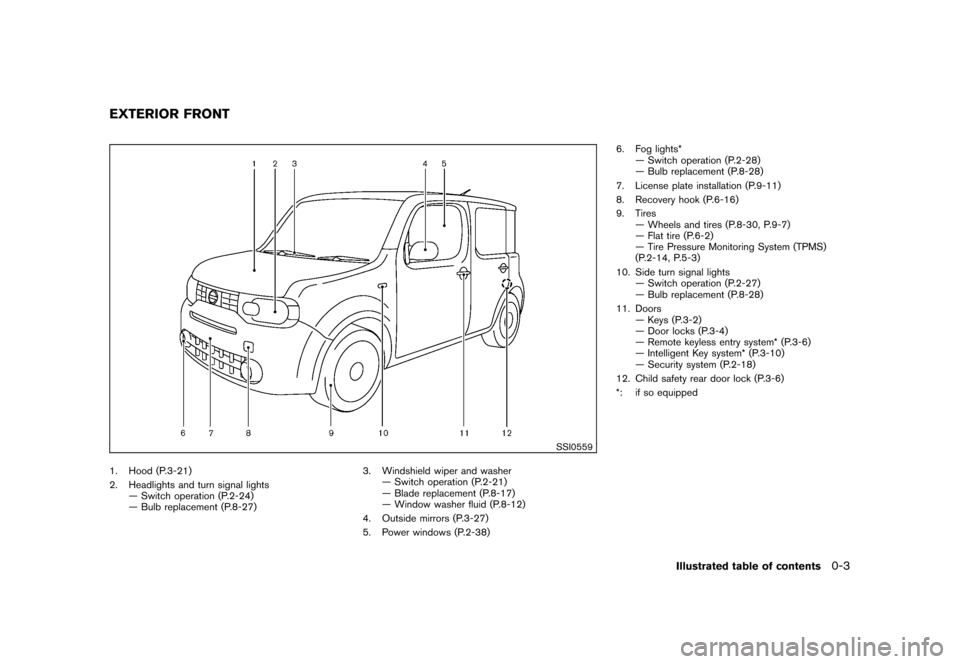
SSI0559
1. Hood (P.3-21)
2. Headlights and turn signal lights— Switch operation (P.2-24)
— Bulb replacement (P.8-27) 3. Windshield wiper and washer
— Switch operation (P.2-21)
— Blade replacement (P.8-17)
— Window washer fluid (P.8-12)
4. Outside mirrors (P.3-27)
5. Power windows (P.2-38) 6. Fog lights*
— Switch operation (P.2-28)
— Bulb replacement (P.8-28)
7. License plate installation (P.9-11)
8. Recovery hook (P.6-16)
9. Tires — Wheels and tires (P.8-30, P.9-7)
— Flat tire (P.6-2)
— Tire Pressure Monitoring System (TPMS)
(P.2-14, P.5-3)
10. Side turn signal lights — Switch operation (P.2-27)
— Bulb replacement (P.8-28)
11. Doors — Keys (P.3-2)
— Door locks (P.3-4)
— Remote keyless entry system* (P.3-6)
— Intelligent Key system* (P.3-10)
— Security system (P.2-18)
12. Child safety rear door lock (P.3-6)
*: if so equippedEXTERIOR FRONT
Illustrated table of contents
0-3
Page 20 of 345
Black plate (16,1)
Model "Z12-D" EDITED: 2010/ 9/ 27
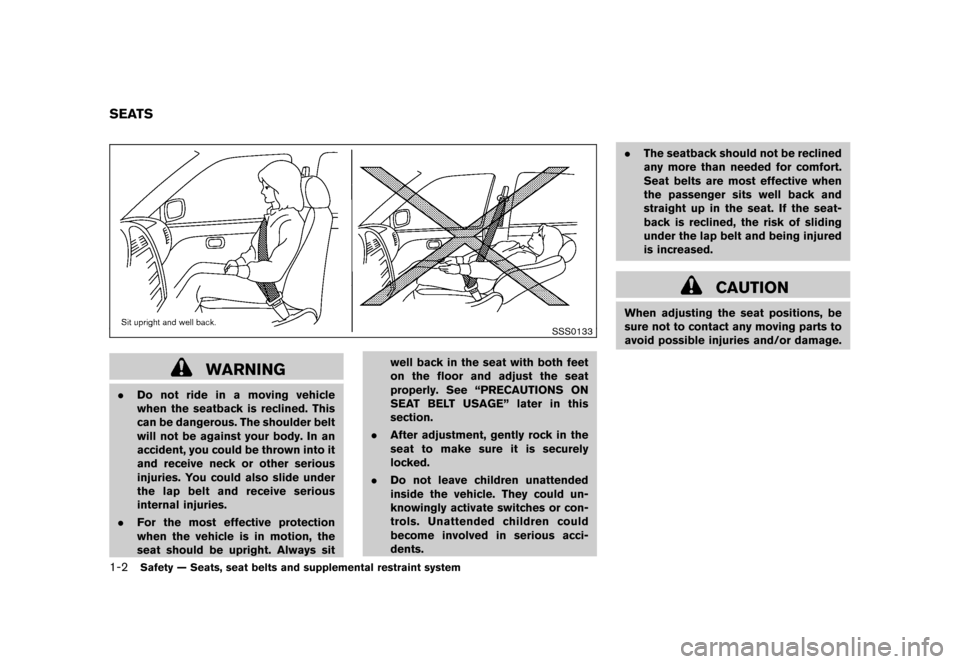
SSS0133
WARNING
.Do not ride in a moving vehicle
when the seatback is reclined. This
can be dangerous. The shoulder belt
will not be against your body. In an
accident, you could be thrown into it
and receive neck or other serious
injuries. You could also slide under
the lap belt and receive serious
internal injuries.
. For the most effective protection
when the vehicle is in motion, the
seat should be upright. Always sit well back in the seat with both feet
on the floor and adjust the seat
properly. See “PRECAUTIONS ON
SEAT BELT USAGE” later in this
section.
. After adjustment, gently rock in the
seat to make sure it is securely
locked.
. Do not leave children unattended
inside the vehicle. They could un-
knowingly activate switches or con-
trols. Unattended children could
become involved in serious acci-
dents. .
The seatback should not be reclined
any more than needed for comfort.
Seat belts are most effective when
the passenger sits well back and
straight up in the seat. If the seat-
back is reclined, the risk of sliding
under the lap belt and being injured
is increased.
CAUTION
When adjusting the seat positions, be
sure not to contact any moving parts to
avoid possible injuries and/or damage.
SEATS1-2
Safety — Seats, seat belts and supplemental restraint system
Page 34 of 345
Black plate (30,1)
Model "Z12-D" EDITED: 2010/ 9/ 27
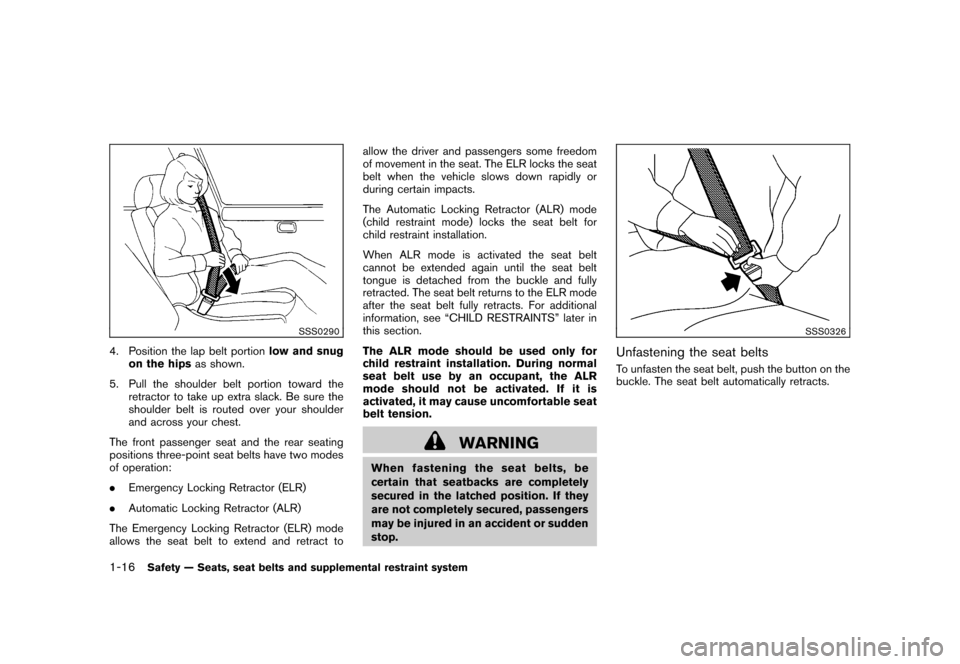
SSS0290
4. Position the lap belt portionlow and snug
on the hips as shown.
5. Pull the shoulder belt portion toward the retractor to take up extra slack. Be sure the
shoulder belt is routed over your shoulder
and across your chest.
The front passenger seat and the rear seating
positions three-point seat belts have two modes
of operation:
. Emergency Locking Retractor (ELR)
. Automatic Locking Retractor (ALR)
The Emergency Locking Retractor (ELR) mode
allows the seat belt to extend and retract to allow the driver and passengers some freedom
of movement in the seat. The ELR locks the seat
belt when the vehicle slows down rapidly or
during certain impacts.
The Automatic Locking Retractor (ALR) mode
(child restraint mode) locks the seat belt for
child restraint installation.
When ALR mode is activated the seat belt
cannot be extended again until the seat belt
tongue is detached from the buckle and fully
retracted. The seat belt returns to the ELR mode
after the seat belt fully retracts. For additional
information, see “CHILD RESTRAINTS” later in
this section.
The ALR mode should be used only for
child restraint installation. During normal
seat belt use by an occupant, the ALR
mode should not be activated. If it is
activated, it may cause uncomfortable seat
belt tension.
WARNING
When fastening the seat belts, be
certain that seatbacks are completely
secured in the latched position. If they
are not completely secured, passengers
may be injured in an accident or sudden
stop.
SSS0326
Unfastening the seat beltsTo unfasten the seat belt, push the button on the
buckle. The seat belt automatically retracts.
1-16
Safety — Seats, seat belts and supplemental restraint system
Page 48 of 345
Black plate (44,1)
Model "Z12-D" EDITED: 2010/ 9/ 27
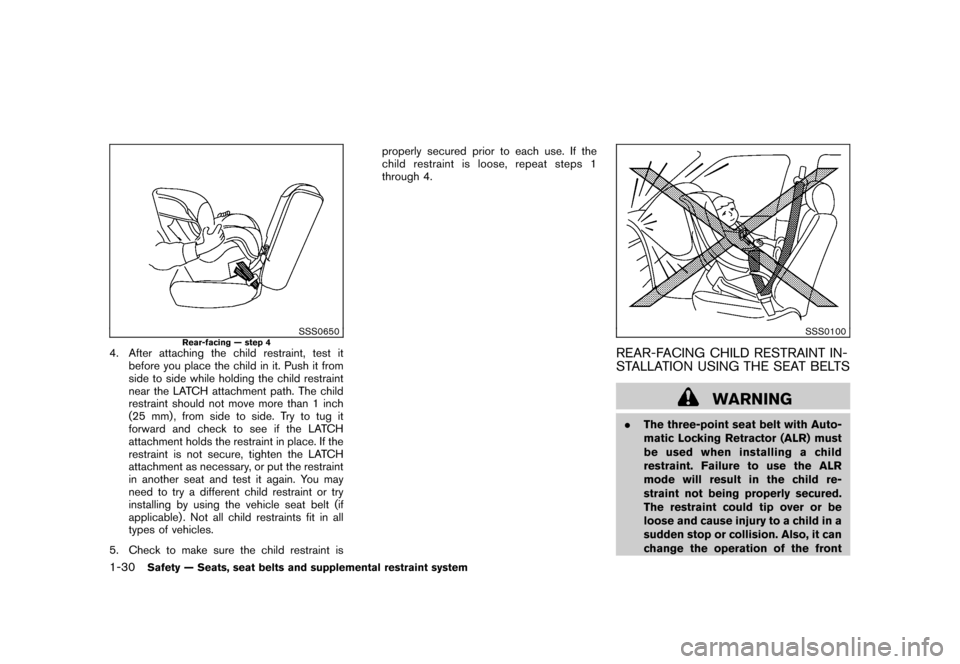
SSS0650
Rear-facing — step 4
4. After attaching the child restraint, test itbefore you place the child in it. Push it from
side to side while holding the child restraint
near the LATCH attachment path. The child
restraint should not move more than 1 inch
(25 mm) , from side to side. Try to tug it
forward and check to see if the LATCH
attachment holds the restraint in place. If the
restraint is not secure, tighten the LATCH
attachment as necessary, or put the restraint
in another seat and test it again. You may
need to try a different child restraint or try
installing by using the vehicle seat belt (if
applicable) . Not all child restraints fit in all
types of vehicles.
5. Check to make sure the child restraint is properly secured prior to each use. If the
child restraint is loose, repeat steps 1
through 4.
SSS0100
REAR-FACING CHILD RESTRAINT IN-
STALLATION USING THE SEAT BELTS
WARNING
.
The three-point seat belt with Auto-
matic Locking Retractor (ALR) must
be used when installing a child
restraint. Failure to use the ALR
mode will result in the child re-
straint not being properly secured.
The restraint could tip over or be
loose and cause injury to a child in a
sudden stop or collision. Also, it can
change the operation of the front
1-30
Safety — Seats, seat belts and supplemental restraint system
Page 50 of 345
Black plate (46,1)
Model "Z12-D" EDITED: 2010/ 9/ 27
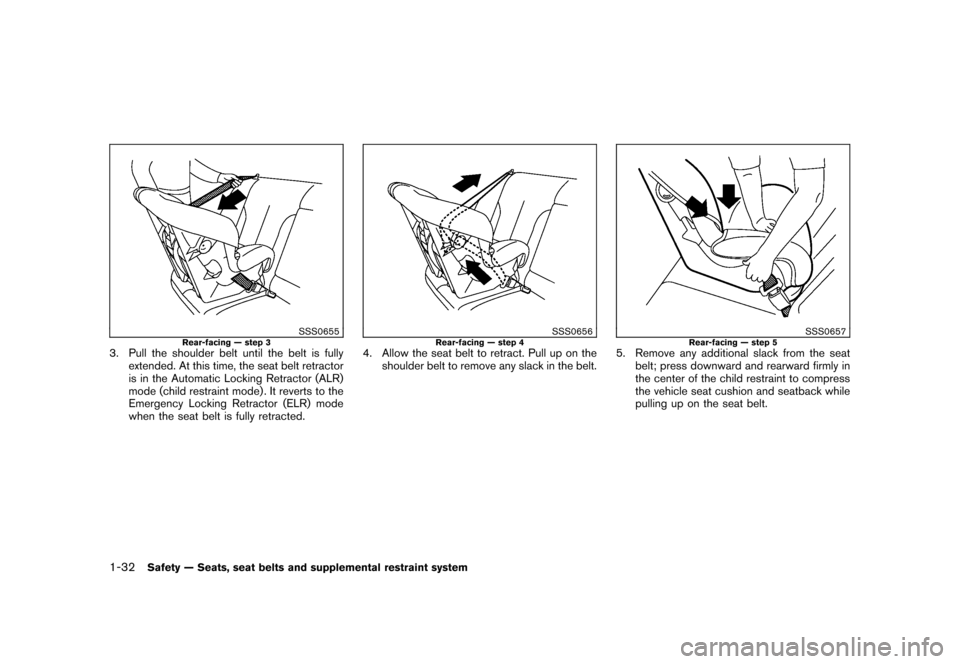
SSS0655
Rear-facing — step 3
3. Pull the shoulder belt until the belt is fullyextended. At this time, the seat belt retractor
is in the Automatic Locking Retractor (ALR)
mode (child restraint mode) . It reverts to the
Emergency Locking Retractor (ELR) mode
when the seat belt is fully retracted.
SSS0656
Rear-facing — step 4
4. Allow the seat belt to retract. Pull up on theshoulder belt to remove any slack in the belt.
SSS0657
Rear-facing — step 5
5. Remove any additional slack from the seatbelt; press downward and rearward firmly in
the center of the child restraint to compress
the vehicle seat cushion and seatback while
pulling up on the seat belt.
1-32
Safety — Seats, seat belts and supplemental restraint system
Page 51 of 345
Black plate (47,1)
Model "Z12-D" EDITED: 2010/ 9/ 27
SSS0658
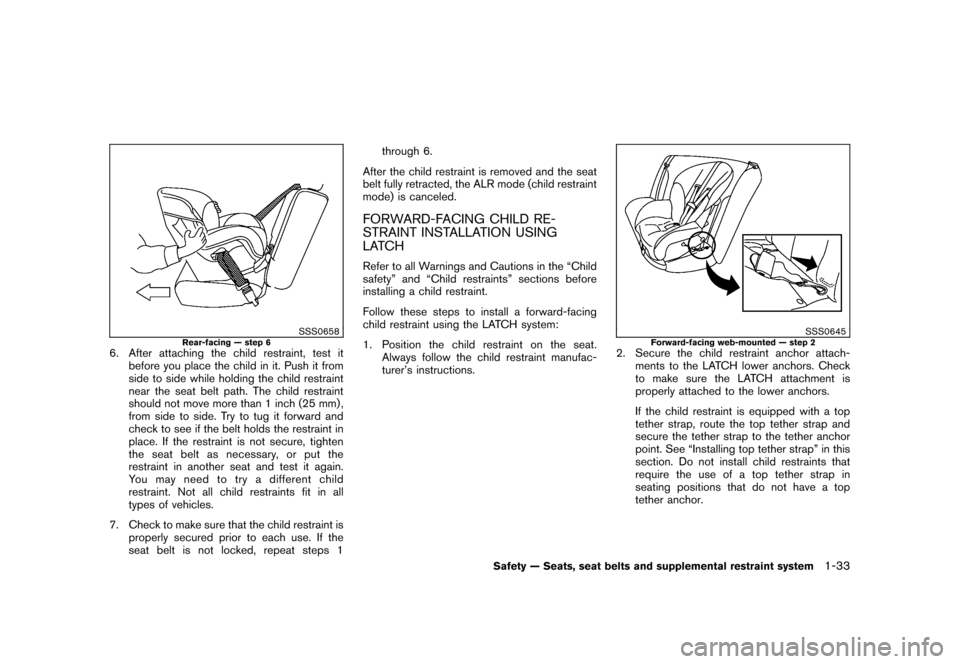
Rear-facing — step 6
6. After attaching the child restraint, test itbefore you place the child in it. Push it from
side to side while holding the child restraint
near the seat belt path. The child restraint
should not move more than 1 inch (25 mm) ,
from side to side. Try to tug it forward and
check to see if the belt holds the restraint in
place. If the restraint is not secure, tighten
the seat belt as necessary, or put the
restraint in another seat and test it again.
You may need to try a different child
restraint. Not all child restraints fit in all
types of vehicles.
7. Check to make sure that the child restraint is properly secured prior to each use. If the
seat belt is not locked, repeat steps 1 through 6.
After the child restraint is removed and the seat
belt fully retracted, the ALR mode (child restraint
mode) is canceled.
FORWARD-FACING CHILD RE-
STRAINT INSTALLATION USING
LATCHRefer to all Warnings and Cautions in the “Child
safety” and “Child restraints” sections before
installing a child restraint.
Follow these steps to install a forward-facing
child restraint using the LATCH system:
1. Position the child restraint on the seat. Always follow the child restraint manufac-
turer’s instructions.
SSS0645
Forward-facing web-mounted — step 2
2. Secure the child restraint anchor attach-ments to the LATCH lower anchors. Check
to make sure the LATCH attachment is
properly attached to the lower anchors.
If the child restraint is equipped with a top
tether strap, route the top tether strap and
secure the tether strap to the tether anchor
point. See “Installing top tether strap” in this
section. Do not install child restraints that
require the use of a top tether strap in
seating positions that do not have a top
tether anchor.
Safety — Seats, seat belts and supplemental restraint system
1-33
Page 53 of 345
Black plate (49,1)
Model "Z12-D" EDITED: 2010/ 9/ 27
through 6.
FORWARD-FACING CHILD RE-
STRAINT INSTALLATION USING THE
SEAT BELTS
WARNING
.The three-point seat belt with Auto-
matic Locking Retractor (ALR) must
be used when installing a child
restraint. Failure to use the ALR
mode will result in the child re-
straint not being properly secured.
The restraint could tip over or be
loose and cause injury to a child in a
sudden stop or collision. Also, it can
change the operation of the front
passenger air bag. See “Front pas-
senger air bag and status light”
later in this section.
. When installing a child restraint
system in the rear center position,
both the center seat belt connector
tongue and buckle tongue must be
secured. See “Rear center seat belt
(except for Cargo Van models)” ear-
lier in this section.
SSS0640
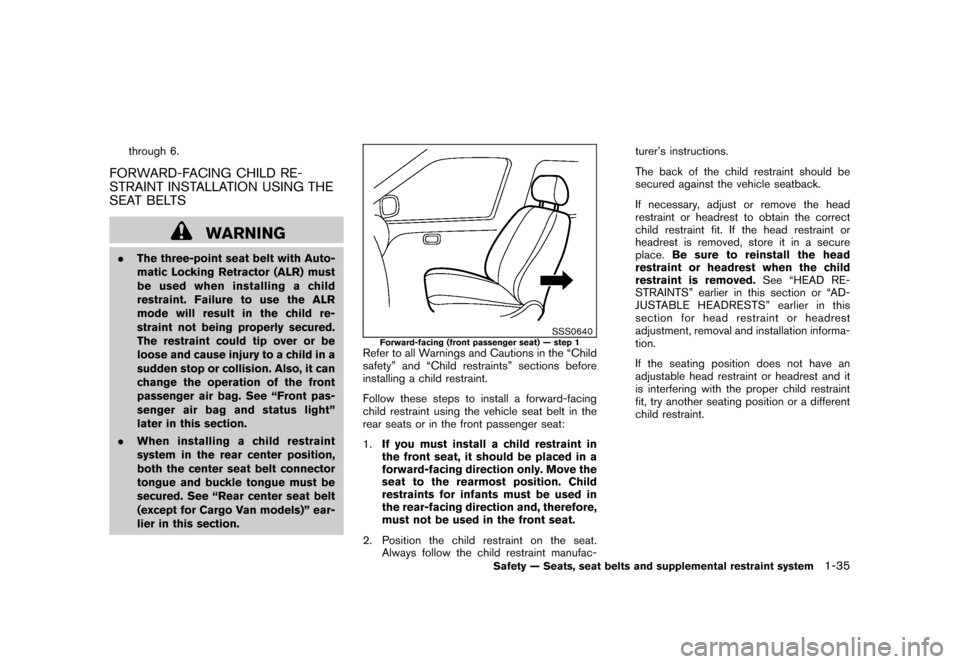
Forward-facing (front passenger seat) — step 1
Refer to all Warnings and Cautions in the “Child
safety” and “Child restraints” sections before
installing a child restraint.
Follow these steps to install a forward-facing
child restraint using the vehicle seat belt in the
rear seats or in the front passenger seat:
1.If you must install a child restraint in
the front seat, it should be placed in a
forward-facing direction only. Move the
seat to the rearmost position. Child
restraints for infants must be used in
the rear-facing direction and, therefore,
must not be used in the front seat.
2. Position the child restraint on the seat. Always follow the child restraint manufac- turer’s instructions.
The back of the child restraint should be
secured against the vehicle seatback.
If necessary, adjust or remove the head
restraint or headrest to obtain the correct
child restraint fit. If the head restraint or
headrest is removed, store it in a secure
place.
Be sure to reinstall the head
restraint or headrest when the child
restraint is removed. See “HEAD RE-
STRAINTS” earlier in this section or “AD-
JUSTABLE HEADRESTS” earlier in this
section for head restraint or headrest
adjustment, removal and installation informa-
tion.
If the seating position does not have an
adjustable head restraint or headrest and it
is interfering with the proper child restraint
fit, try another seating position or a different
child restraint.
Safety — Seats, seat belts and supplemental restraint system
1-35
Page 54 of 345
Black plate (50,1)
Model "Z12-D" EDITED: 2010/ 9/ 27
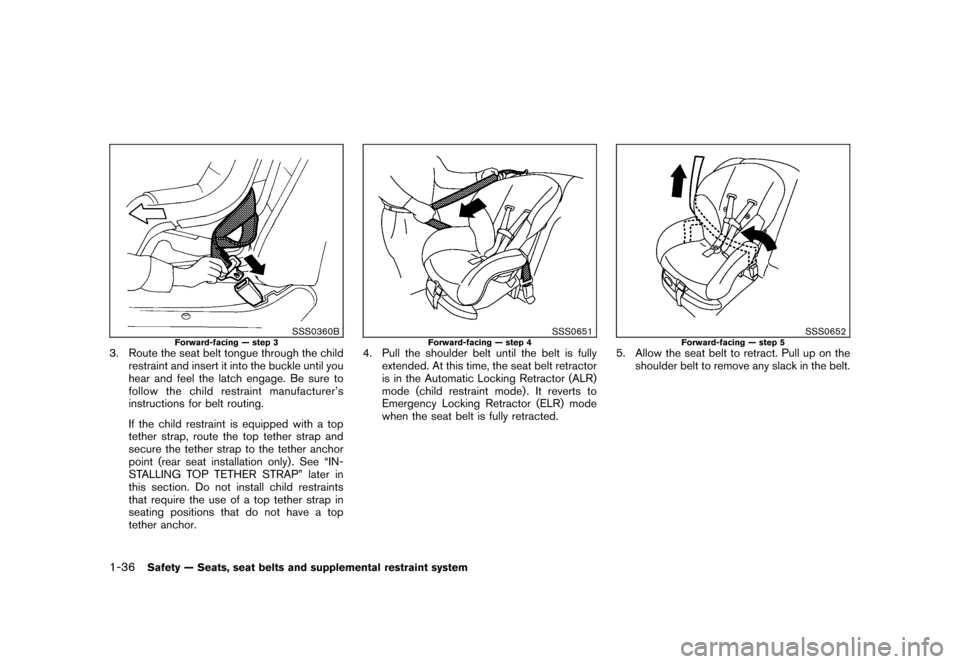
SSS0360B
Forward-facing — step 3
3. Route the seat belt tongue through the childrestraint and insert it into the buckle until you
hear and feel the latch engage. Be sure to
follow the child restraint manufacturer’s
instructions for belt routing.
If the child restraint is equipped with a top
tether strap, route the top tether strap and
secure the tether strap to the tether anchor
point (rear seat installation only) . See “IN-
STALLING TOP TETHER STRAP” later in
this section. Do not install child restraints
that require the use of a top tether strap in
seating positions that do not have a top
tether anchor.
SSS0651
Forward-facing — step 4
4. Pull the shoulder belt until the belt is fullyextended. At this time, the seat belt retractor
is in the Automatic Locking Retractor (ALR)
mode (child restraint mode) . It reverts to
Emergency Locking Retractor (ELR) mode
when the seat belt is fully retracted.
SSS0652
Forward-facing — step 5
5. Allow the seat belt to retract. Pull up on theshoulder belt to remove any slack in the belt.
1-36
Safety — Seats, seat belts and supplemental restraint system