Page 324 of 422
●Use the correct jack-up points. Never
use any other part of the vehicle for jack
support.
● Never jack up the vehicle more than
necessary.
● Never use blocks on or under the jack.
● Do not start or run the engine while
vehicle is on the jack. It may cause the
vehicle to move. This is especially true
for vehicles with limited slip
differentials.
● Do not allow passengers to stay in the
vehicle while it is on the jack.
● Never run the engine with a wheel(s) off
the ground. It may cause the vehicle to
move. Always refer to the proper illustrations for the
correct placement and jack-up points for your
specific vehicle model and jack type.
Carefully read the caution label attached to
the jack body and the following instruc-
tions.
1. Loosen each wheel nut one or two turns by turning counterclockwise with the wheel nut
wrench. Do not remove the wheel nuts
until the tire is off the ground.
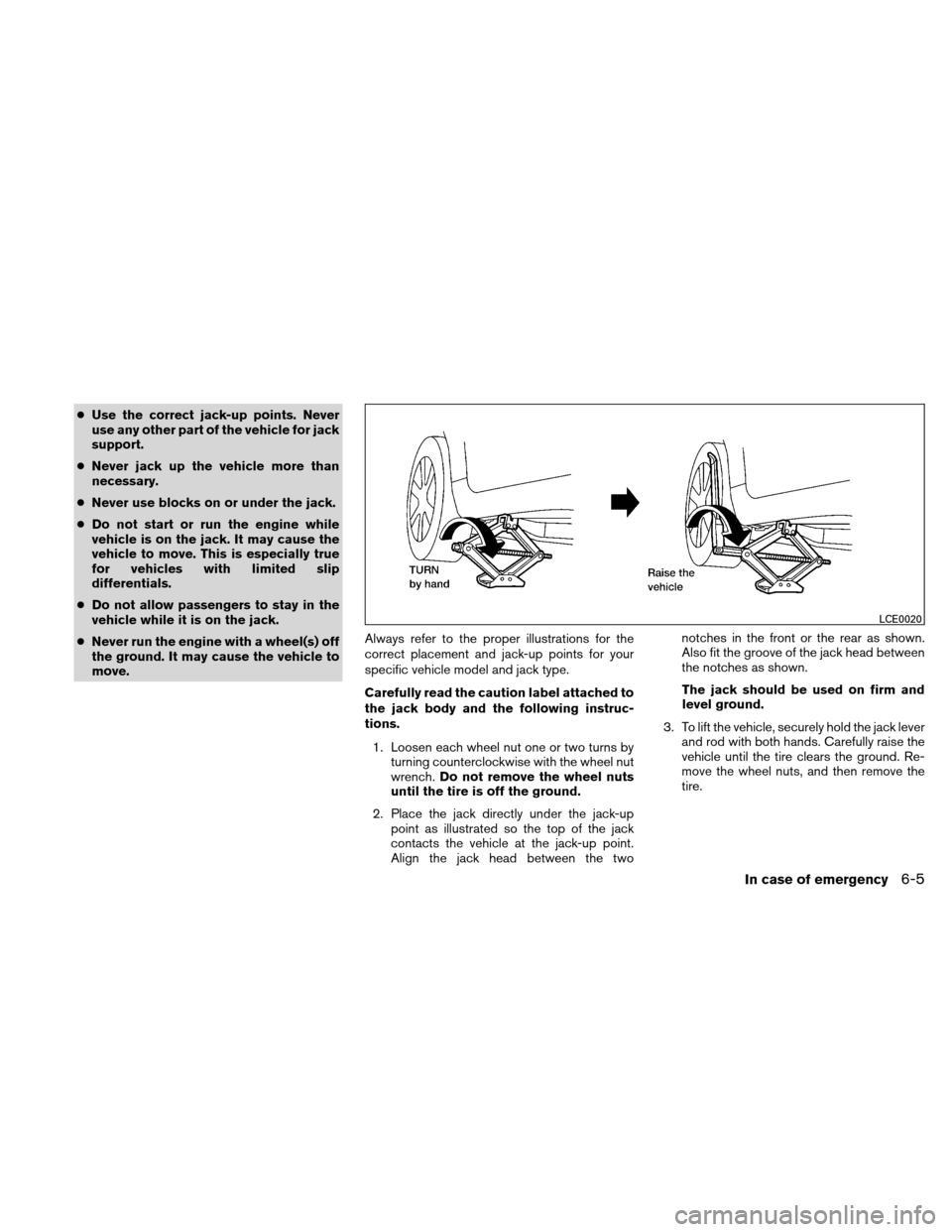
2. Place the jack directly under the jack-up point as illustrated so the top of the jack
contacts the vehicle at the jack-up point.
Align the jack head between the two notches in the front or the rear as shown.
Also fit the groove of the jack head between
the notches as shown.
The jack should be used on firm and
level ground.
3. To lift the vehicle, securely hold the jack lever and rod with both hands. Carefully raise the
vehicle until the tire clears the ground. Re-
move the wheel nuts, and then remove the
tire.
LCE0020
In case of emergency6-5
Page 353 of 422
CAUTION
Oil level should be checked regularly. Op-
erating the engine with an insufficient
amount of oil can damage the engine, and
such damage is not covered by warranty.
CHANGING ENGINE OIL
1. Park the vehicle on a level surface and applythe parking brake.
2. Start the vehicle and let it idle until it reaches operating temperature, then turn it off.
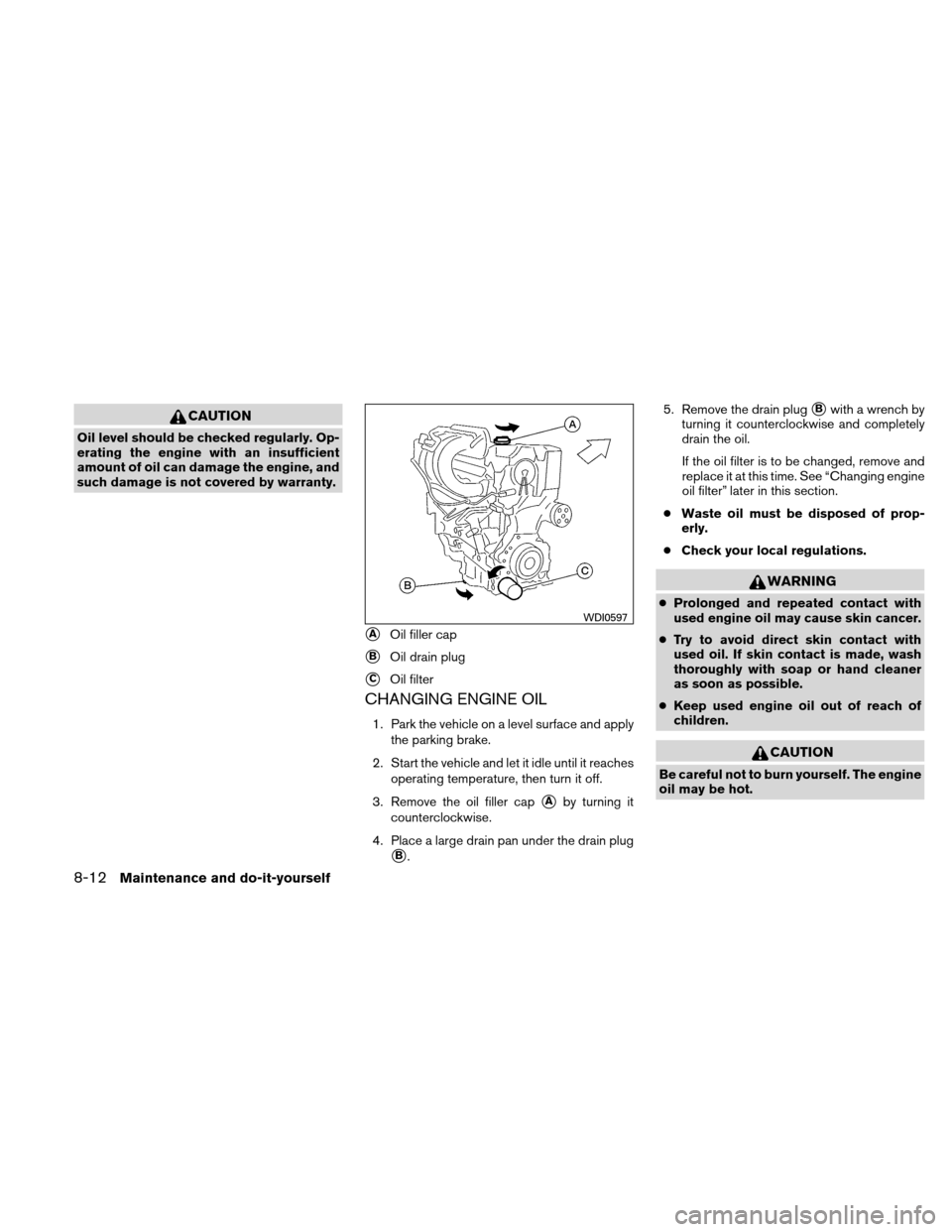
3. Remove the oil filler cap
�Aby turning it
counterclockwise.
4. Place a large drain pan under the drain plug
�B. 5. Remove the drain plug
�Bwith a wrench by
turning it counterclockwise and completely
drain the oil.
If the oil filter is to be changed, remove and
replace it at this time. See “Changing engine
oil filter” later in this section.
● Waste oil must be disposed of prop-
erly.
● Check your local regulations.
WARNING
●Prolonged and repeated contact with
used engine oil may cause skin cancer.
● Try to avoid direct skin contact with
used oil. If skin contact is made, wash
thoroughly with soap or hand cleaner
as soon as possible.
● Keep used engine oil out of reach of
children.
CAUTION
Be careful not to burn yourself. The engine
oil may be hot.
�AOil filler cap
�BOil drain plug
�COil filter
WDI0597
8-12Maintenance and do-it-yourself
Page 354 of 422
6. Clean and reinstall the drain plug and a newwasher. Securely tighten the drain plug with
a wrench. Do not use excessive force.
Drain plug tightening torque: 22 - 29 ft-lb (29 - 39 N·m)
7. Refill engine with recommended oil through the oil filler opening, then install the oil filler
cap securely.
See “Capacities and recommended
fuel/lubricants” in the “Technical and con-
sumer information” section of this manual for
drain and refill capacity.
The drain and refill capacity depends on the
oil temperature and drain time. Use these
specifications for reference only. Always use
the dipstick to determine when the proper
amount of oil is in the engine.
8. Start the vehicle. Check for leakage around the drain plug and oil filter. Correct as re-
quired.
9. Turn the vehicle off and wait more than 10 minutes. Check the oil level with the dipstick.
Add engine oil if necessary.
CHANGING ENGINE OIL FILTER
1. Park the vehicle on a level surface and apply
the parking brake.
2. Turn the vehicle off.
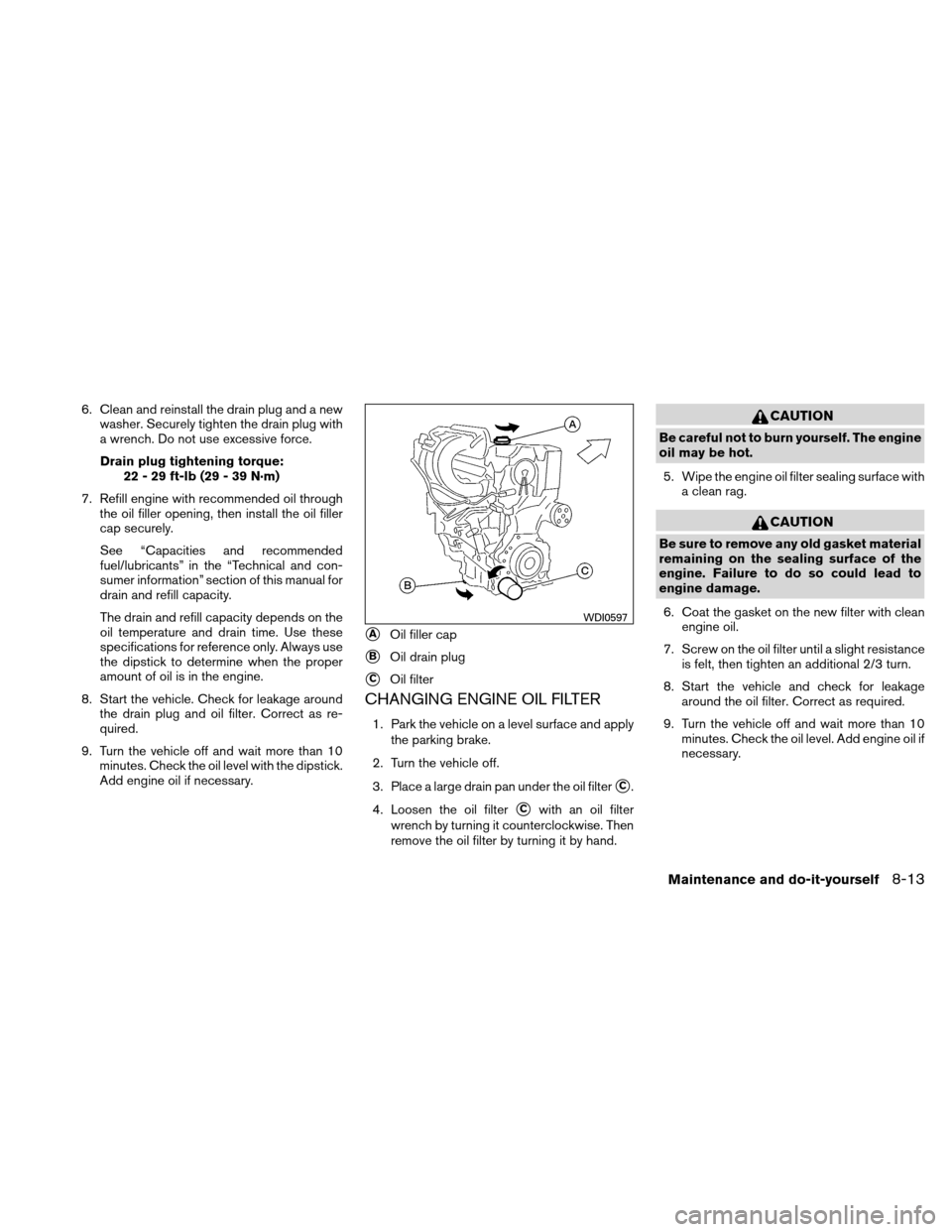
3. Place a large drain pan under the oil filter
�C.
4. Loosen the oil filter
�Cwith an oil filter
wrench by turning it counterclockwise. Then
remove the oil filter by turning it by hand.
CAUTION
Be careful not to burn yourself. The engine
oil may be hot.
5. Wipe the engine oil filter sealing surface with a clean rag.
CAUTION
Be sure to remove any old gasket material
remaining on the sealing surface of the
engine. Failure to do so could lead to
engine damage.
6. Coat the gasket on the new filter with clean engine oil.
7. Screw on the oil filter until a slight resistance is felt, then tighten an additional 2/3 turn.
8. Start the vehicle and check for leakage around the oil filter. Correct as required.
9. Turn the vehicle off and wait more than 10 minutes. Check the oil level. Add engine oil if
necessary.
�AOil filler cap
�BOil drain plug
�COil filter
WDI0597
Maintenance and do-it-yourself8-13
Page 415 of 422
Top tether strap anchor point locations . .1-22
Child safety rear door lock ............3-6
Chimes, audible reminders ...........2-17
Cleaning exterior and interior ...........7-2
Clock ...................4-38, 4-43
(models with navigation system) .......4-8
(models without navigation system) . . . .4-38
Clock set ..................4-8, 4-38
C.M.V.S.S. certification label ..........9-10
Cold weather driving ..............5-24
Compact disc
(CD) player .........4-39, 4-45, 4-51, 4-57
Compass display .................2-6
Console box ...................2-39
Console light ...................2-46
Control panel buttons ...............4-2
Brightness/contrast button .........4-12
Enter button ..................4-2
Setting button .................4-6
Controls Heater and air conditioner controls .....4-19
Coolant Capacities and recommended
fuel/lubricants .................9-2
Changing engine coolant ...........8-9
Checking engine coolant level ........8-9
Checking inverter coolant level .......8-10
Corrosion protection ...............7-7
Cruise control ..................5-15
Cup holders ...................2-38
D
Daytime running light system (Canada only) . .2-32 Defroster switch
Rear window and outside mirror defroster
switch .....................2-30
Digital Versatile Disc (DVD) player .......4-56
Dimensions and weights .............9-8
Dimmer switch for instrument panel ......2-33
Display controls (see control panel buttons) . .4-2
Door locks .....................3-4
Drive belt .....................8-16
Driving Cold weather driving ............5-24
Driving
with Electronically controlled
Continuously Variable Transmission
(eCVT) ....................5-11
Precautions when starting and driving . . . .5-2
E
Economy - fuel ..................5-17
Electronically Continuously Variable
Transmission (eCVT) Transmission shift selector lock release . .5-14
Electronically controlled Continuously Variable
Transmission (eCVT) Driving with Electronically controlled
Continuously Variable Transmission
(eCVT) ....................5-11
Electronically controlled Continuously
Variable Transmission (eCVT) fluid .....8-14
Emission control information label .......9-10
Emission control system warranty .......9-24
Energy flow ...................HEV-4
Energy/fuel history ...............HEV-5
Engine Block heater .................5-25 Capacities and recommended
fuel/lubricants
.................9-2
Changing engine coolant ...........8-9
Changing engine oil .............8-12
Changing engine oil filter ..........8-13
Checking engine coolant level ........8-9
Checking engine oil level ..........8-11
Engine compartment check locations . . . .8-7
Engine cooling system ............8-8
Engine oil ...................8-11
Engine oil and oil filter recommendation . . .9-5
Engine oil pressure warning light ......2-12
Engine oil viscosity ..............9-5
Engine serial number ............9-10
Engine specifications .............9-7
Enter button ....................4-2
Event data recorders ..............9-26
Exhaust gas (Carbon monoxide) .........5-2
Eyeglass case ..................2-37
F
Flashers
(See hazard warning flasher switch) ......2-34
Flat tire .......................6-2
Floor mat positioning aid .............7-6
Fluid Brake fluid ..................8-14
Capacities and recommended
fuel/lubricants .................9-2
Electronically
controlled Continuously
Variable Transmission (eCVT) fluid .....8-14
Engine coolant .................8-8
Engine oil ...................8-11
Inverter coolant ................8-10
10-2