2011 MITSUBISHI TRITON oil
[x] Cancel search: oilPage 310 of 369
Wheel condition
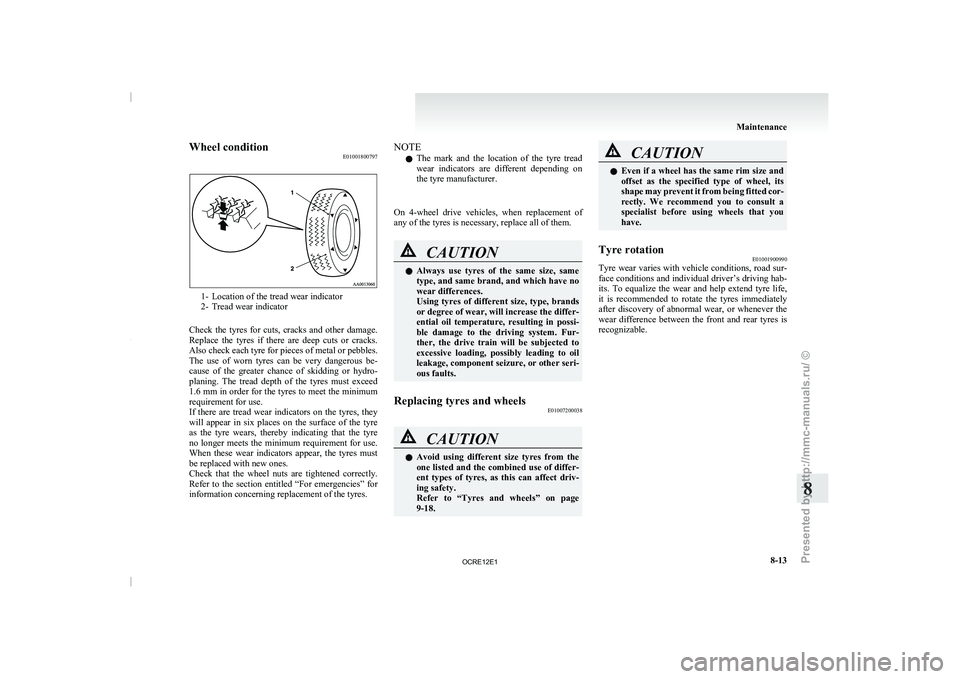
E010018007971- Location of the tread wear indicator
2- Tread wear indicator
Check the tyres for
cuts, cracks and other damage.
Replace the tyres if there are deep cuts or cracks.
Also check each tyre for pieces of metal or pebbles.
The use of worn tyres can be very dangerous be-
cause of the greater chance of skidding or hydro-
planing. The tread depth of the tyres must exceed
1.6 mm in order for the tyres to meet the minimum
requirement for use.
If there are tread wear indicators on the tyres, they
will appear in six places on the surface of the tyre
as the tyre wears, thereby indicating that the tyre
no longer meets the minimum requirement for use.
When these wear indicators appear, the tyres must
be replaced with new ones.
Check that the wheel nuts are tightened correctly.
Refer to the section entitled “For emergencies” for
information concerning replacement of the tyres. NOTE
l The
mark and the location
of the tyre tread
wear indicators are different depending on
the tyre manufacturer.
On 4-wheel drive vehicles, when replacement of
any of the tyres is necessary, replace all of them. CAUTION
l
Always use tyres of
the
same size, same
type, and same brand, and which have no
wear differences.
Using tyres of different size, type, brands
or degree of wear, will increase the differ-
ential oil temperature, resulting in possi-
ble damage to the driving system. Fur-
ther, the drive train will be subjected to
excessive loading, possibly leading to oil
leakage, component seizure, or other seri-
ous faults.
Replacing tyres and wheels E01007200038 CAUTION
l
Avoid using different size
tyres
from the
one listed and the combined use of differ-
ent types of tyres, as this can affect driv-
ing safety.
Refer to “Tyres and wheels” on page
9-18. CAUTION
l
Even if a wheel has
the same rim size and
offset as the specified type of wheel, its
shape may prevent it from being fitted cor-
rectly. We recommend you to consult a
specialist before using wheels that you
have.
Tyre rotation E01001900990
Tyre wear varies with vehicle conditions, road sur-
face conditions and
individual driver’s
driving hab-
its. To equalize the wear and help extend tyre life,
it is recommended to rotate the tyres immediately
after discovery of abnormal wear, or whenever the
wear difference between the front and rear tyres is
recognizable. Maintenance
8-13 8
OCRE12E1
Presented by http://mmc-manuals.ru/ \251
Page 315 of 369

NOTE
l Do
not allow the wiper
arm to fall onto the
windscreen; it could damage the glass.
3. Attach the retainers (C) to a new wiper blade. Refer to the illustration to ensure that the re-
tainers are correctly aligned as you attach
them. 4. Insert the wiper blade into the arm, starting
with the opposite end
of the blade from the
stopper. Make sure the hook (B) is fitted cor-
rectly in the grooves in the blade.
NOTE l If retainers are not supplied with the new wip-
er blade, use the retainers from the old blade. 5. Push the wiper blade until the hook (B) en-
gages securely with the stopper (A). General maintenance
E01002700113
Fuel, engine coolant, oil and exhaust
gas leakage
Look under the body of
your vehicle to check for
fuel, engine coolant, oil and exhaust gas leaks. WARNING
l If
you
see a
suspicious
fuel leak or if you
smell fuel, do not operate the vehicle; we
recommend you to call for assistance.
Exterior and interior lamp operation
Operate the combination lamp switch
to check that
all lamps are functioning properly.
If the lamps do not illuminate, the probable cause
is a blown fuse or defective lamp bulb. Check the
fuses first. If there is no blown fuses, check the
lamp bulbs.
For information regarding the inspection and re-
placement of the fuses and the lamp bulbs, refer to
“Fuses” on page 8-20 and “Replacement of lamp
bulbs” on page 8-23.
If the fuses and bulbs are all OK, we recommend
you to have your vehicle checked and repaired.
Meter, gauge and indicator/warning
lamps operation
Run the engine to check the operation of all meters,
gauges, and indicator/warning lamps.
If there is anything wrong, we recommend you to
have your vehicle inspected. Maintenance
8-18
8
OCRE12E1
Presented by http://mmc-manuals.ru/ \251
Page 318 of 369

Passenger compartment fuse location (RHD)No. Symbol Electrical system Ca-
pacity
1 Tail lamp (left) 7.5 A
2 Cigarette lighter 15 A
3 Ignition coil 10 A
4 Starter motor 7.5 A
5 Sunroof 20 A
6 Accessory socket 15 A No. Symbol Electrical system Ca-
pacity
7 Tail lamp (right) 7.5 A
8 Outside rear-view mirrors 7.5 A
9 Engine control unit 7.5 A
10 Control unit 7.5 A
11 Rear fog lamp 10 A
12 Central door lock 15 A
13 Room lamp
10 A
14 Rear window wiper 15 A
15 Gauge 7.5 A
16 Relay 7.5 A
17 Heated seat 20 A
18 Option
10 A
19 Heated door mirror 7.5 A
20 Windscreen wiper 20 A
21 Reversing lamps 7.5 A
22 Demister 30 A
23 Heater 30 A
24 Power seat 40 A
25 Radio 10 A No. Symbol Electrical system Ca-
pacity
26 Electronic controlled unit 15 A
27 — Spare fuse 7.5 A
28 — Spare fuse 20 A
29 — Spare fuse 30 A l
Some fuses may not
be
installed on your ve-
hicle, depending on the vehicle model or spec-
ifications.
l The table above shows the main equipment
corresponding to each fuse.
The fuse block does not contain spare 10 A
and 15 A fuses. If a fuse of one of these ca-
pacities blows, replace it temporarily by bor-
rowing the one that matches from:
10 A: Radio
15 A: Cigarette lighter
Replace the borrowed fuse as soon as possible. Maintenance
8-21 8
OCRE12E1
Presented by http://mmc-manuals.ru/ \251
Page 320 of 369

4. Referring to the fuse
load capacity table,
check the fuse pertaining to the problem. C- Fuse is OK
D- Blown fuse
NOTE l If
any system does not
function but the fuse
corresponding to that system is normal, there
may be a fault in the system elsewhere. We
recommend you to have your vehicle checked. 5. Insert
a new fuse of the same capacity by us-
ing the fuse puller
into the same place at the
fuse block. CAUTION
l
If the newly inserted
fuse
blows again af-
ter a short time, we recommend you to
have the electrical system checked to find
the cause and rectify it.
l Never use a fuse with a capacity larger
than that specified or any substitute, such
as wire, foil, etc.; doing so will cause the
circuit wiring to heat up and could cause
a fire. Replacement of lamp bulbs
E01003100710
Before replacing a bulb, ensure
the lamp is off. Do
not touch the glass part of the new bulb with your
bare fingers; the skin oil left on the glass will evap-
orate when the bulb gets hot and the vapour will
condense on the reflector and dim the surface. CAUTION
l
Bulbs are extremely hot
immediately
af-
ter being turned off.
When replacing a bulb, wait for it to cool
sufficiently before touching it. You could
otherwise be burnt.
NOTE l If
you are unsure of
how to carry out the
work as required, we recommend you to con-
sult a specialist.
l Be careful not to scratch the vehicle body
when removing a lamp or lens.
l When it rains or when the vehicle has been
washed, the inside of the lens sometimes be-
comes foggy. This is the same phenomenon
as when window glass mists up on a humid
day, and does not indicate a functional prob-
lem. When the lamp is switched on, the heat
will remove the fog. However, if water gath-
ers inside the lamp, we recommend you to
have the lamp checked.
Bulb capacity E01003200085
When replacing a bulb, use a new bulb with the
same wattage and colour. Maintenance
8-23 8RHD
OCRE12E1
Presented by http://mmc-manuals.ru/ \251
Page 322 of 369

Club cab
1- Door courtesy lamps*: 3.4 W
2- Front room lamp and
personal
lamps*:
7.5 W
3- Rear room lamp: 8 W
4- Glove box lamp: 1.4 W
5- Centre console downlight: 1.4 W
Double cab 1- Door courtesy lamps*: 3.4 W
2- Front room lamp and personal lamps: 7.5 W
3- Rear room lamp*: 8 W
4-
Glove box lamp: 1.4 W
5- Centre console downlight: 1.4 W Headlamps
E01003501375
Type 1 1. Remove the bulb and connector
assembly
(A) by turning it anticlockwise.
High beam
Low beam 2. Depress the tab (B) on the harness connector
and pull the harness
connector (C) to remove
it.
High beam Low beam 3. To install the bulb, perform the removal
steps in reverse. CAUTION
l
Handle halogen lamp bulbs
with
care.
The gas inside halogen lamp bulbs is high-
ly pressurized, so dropping, knocking, or
scratching a halogen lamp bulb can cause
it to shatter.
l Never hold the halogen lamp bulb with a
bare hand, dirty glove, etc.
The oil from your hand could cause the
bulb to break the next time the head-
lamps are operated.
If the glass surface is dirty, it must be
cleaned with alcohol, paint thinner, etc.,
and refit it after drying it thoroughly. Maintenance
8-25 8
OCRE12E1
Presented by http://mmc-manuals.ru/ \251
Page 323 of 369

Type 2
1. Disconnect the connector (A). 2. Remove the sealing cover (B).
3. Unhook the spring (C) which secures the
bulb, and then remove the headlamp bulb. 4. To install the bulb, perform the removal
steps in reverse. CAUTION
l
Handle halogen lamp bulbs with care.
The gas inside halogen lamp bulbs is high-
ly pressurized, so dropping, knocking, or
scratching a halogen lamp bulb can cause
it to shatter.
l Never hold the halogen lamp bulb with a
bare hand, dirty glove, etc.
The oil from your hand could cause the
bulb to break the next time the head-
lamps are operated.
If the glass surface is dirty, it must be
cleaned with alcohol, paint thinner, etc.,
and refit it after drying it thoroughly. Maintenance
8-26
8
OCRE12E1
Presented by http://mmc-manuals.ru/ \251
Page 326 of 369
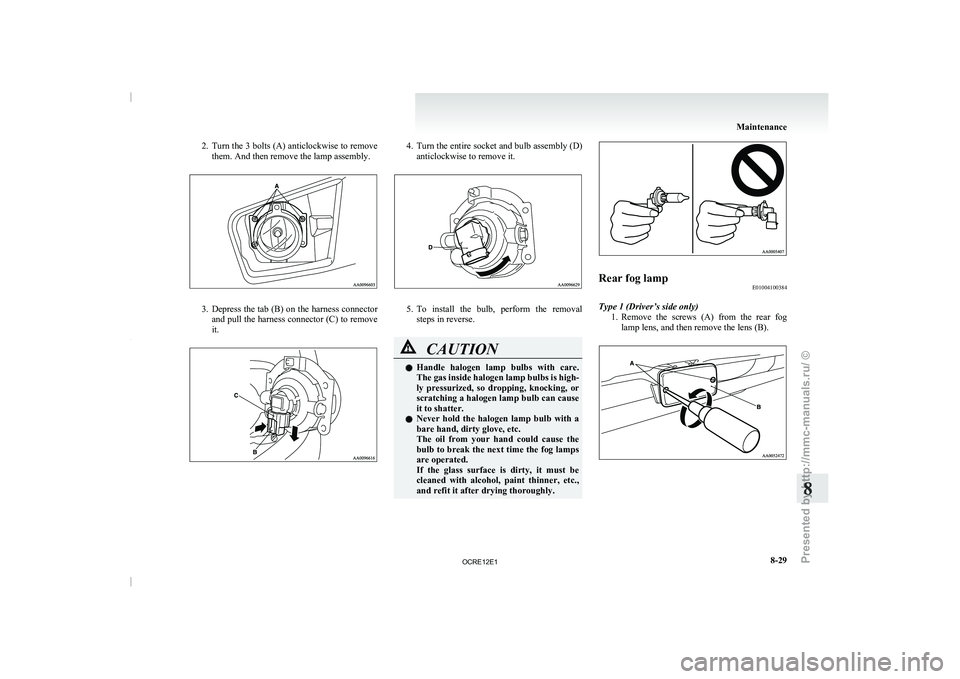
2. Turn the 3 bolts (A) anticlockwise to remove
them. And then remove the lamp assembly. 3. Depress the tab (B) on the harness connector
and pull the harness
connector (C) to remove
it. 4. Turn the entire socket and bulb assembly (D)
anticlockwise to remove it. 5. To install the bulb, perform the removal
steps in reverse. CAUTION
l
Handle halogen lamp bulbs
with
care.
The gas inside halogen lamp bulbs is high-
ly pressurized, so dropping, knocking, or
scratching a halogen lamp bulb can cause
it to shatter.
l Never hold the halogen lamp bulb with a
bare hand, dirty glove, etc.
The oil from your hand could cause the
bulb to break the next time the fog lamps
are operated.
If the glass surface is dirty, it must be
cleaned with alcohol, paint thinner, etc.,
and refit it after drying thoroughly. Rear fog lamp
E01004100384
Type 1 (Driver’s side only) 1. Remove the screws (A) from
the rear fog
lamp lens, and then remove the lens (B). Maintenance
8-29 8
OCRE12E1
Presented by http://mmc-manuals.ru/ \251
Page 350 of 369
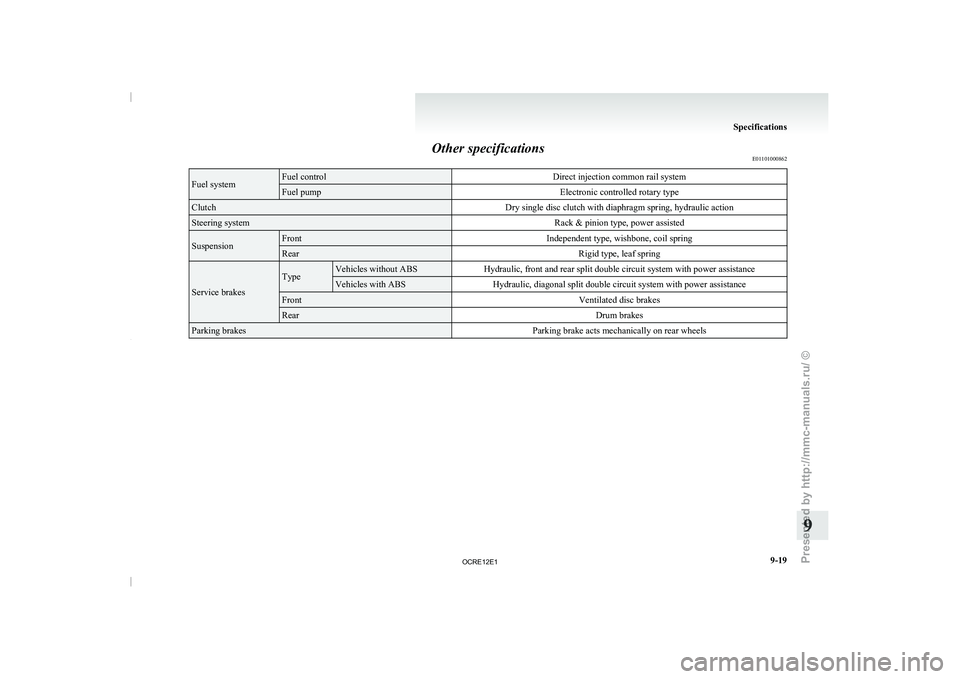
Other specifications
E01101000862Fuel system Fuel control
Direct injection common rail systemFuel pump
Electronic controlled rotary typeClutch
Dry single disc clutch with diaphragm spring, hydraulic actionSteering system
Rack & pinion type, power assistedSuspension Front
Independent type, wishbone, coil springRear
Rigid type, leaf springService brakes Type Vehicles without ABS
Hydraulic, front and rear split double circuit system with power assistance Vehicles with ABS
Hydraulic, diagonal split double circuit system with power assistanceFront
Ventilated disc brakesRear
Drum brakesParking brakes
Parking brake acts mechanically on rear wheels Specifications
9-19 9
OCRE12E1
Presented by http://mmc-manuals.ru/ \251