Page 514 of 602
Vehicle care and maintenance
7-13
7
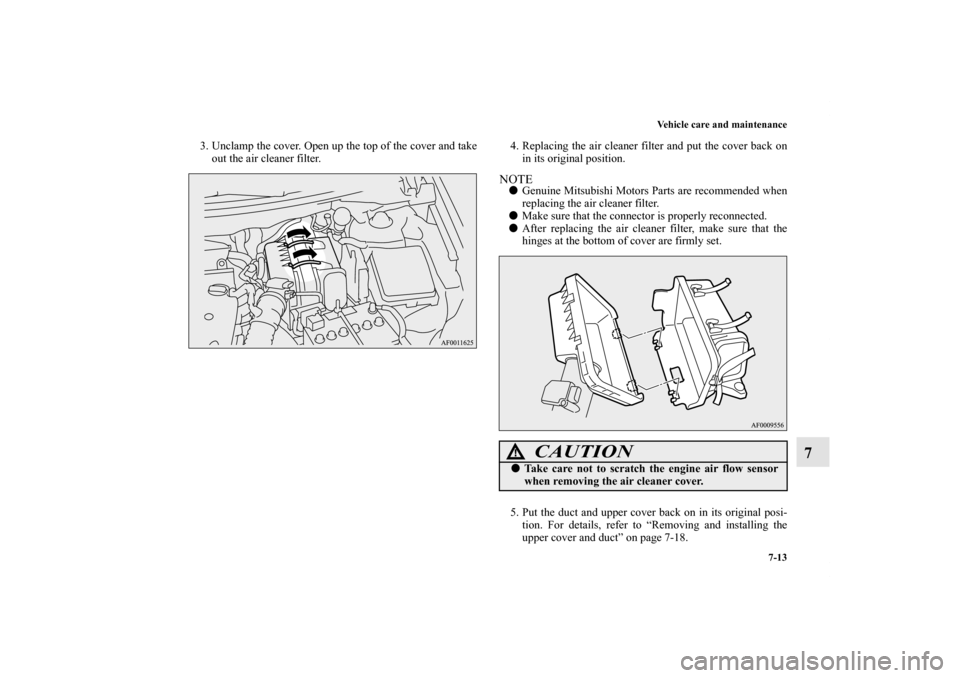
3. Unclamp the cover. Open up the top of the cover and take
out the air cleaner filter.4. Replacing the air cleaner filter and put the cover back on
in its original position.
NOTE�Genuine Mitsubishi Motors Parts are recommended when
replacing the air cleaner filter.
�Make sure that the connector is properly reconnected.
�After replacing the air cleaner filter, make sure that the
hinges at the bottom of cover are firmly set.
5. Put the duct and upper cover back on in its original posi-
tion. For details, refer to “Removing and installing the
upper cover and duct” on page 7-18.
CAUTION
!�Take care not to scratch the engine air flow sensor
when removing the air cleaner cover.
BK0120400US.book 13 ページ 2010年5月12日 水曜日 午前10時50分
Page 517 of 602
7-16 Vehicle care and maintenance
7Wa s h e r f l u i d
N00938600299
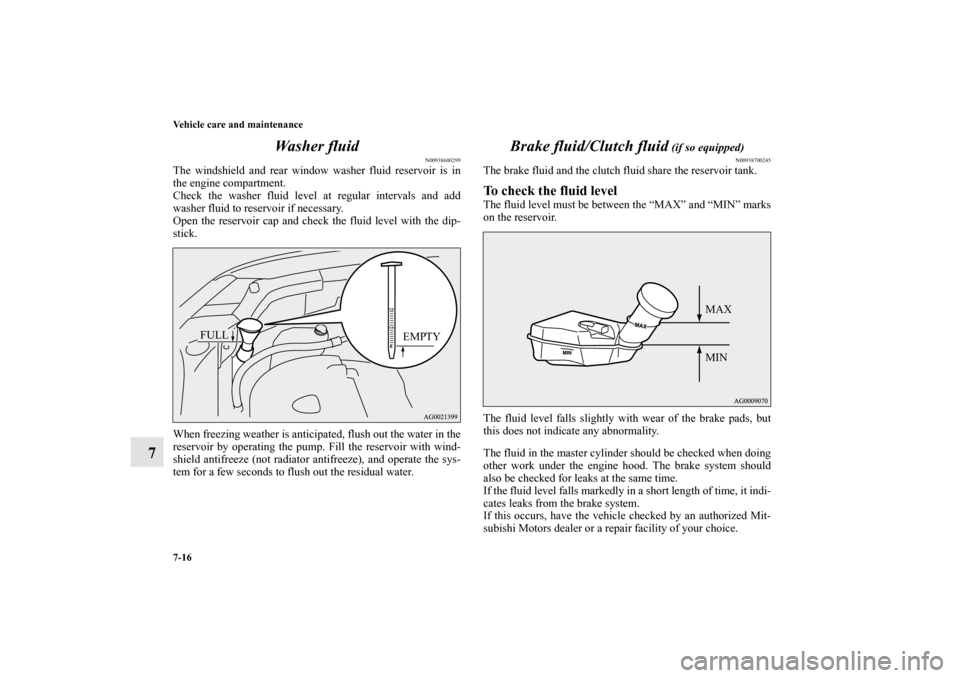
The windshield and rear window washer fluid reservoir is in
the engine compartment.
Check the washer fluid level at regular intervals and add
washer fluid to reservoir if necessary.
Open the reservoir cap and check the fluid level with the dip-
stick.
When freezing weather is anticipated, flush out the water in the
reservoir by operating the pump. Fill the reservoir with wind-
shield antifreeze (not radiator antifreeze), and operate the sys-
tem for a few seconds to flush out the residual water.
Brake fluid/Clutch fluid
(if so equipped)
N00938700245
The brake fluid and the clutch fluid share the reservoir tank.To check the fluid levelThe fluid level must be between the “MAX” and “MIN” marks
on the reservoir.
The fluid level falls slightly with wear of the brake pads, but
this does not indicate any abnormality.
The fluid in the master cylinder should be checked when doing
other work under the engine hood. The brake system should
also be checked for leaks at the same time.
If the fluid level falls markedly in a short length of time, it indi-
cates leaks from the brake system.
If this occurs, have the vehicle checked by an authorized Mit-
subishi Motors dealer or a repair facility of your choice.
FULL
EMPTY
MAX
MIN
BK0120400US.book 16 ページ 2010年5月12日 水曜日 午前10時50分
Page 523 of 602
7-22 Vehicle care and maintenance
7
Disconnection and connection
N00901700032
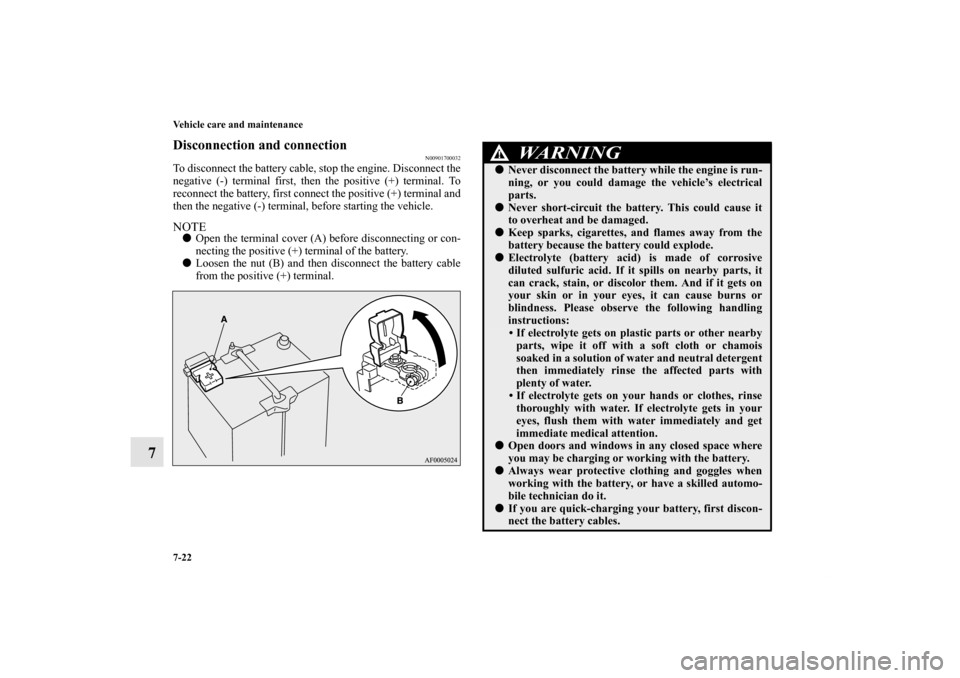
To disconnect the battery cable, stop the engine. Disconnect the
negative (-) terminal first, then the positive (+) terminal. To
reconnect the battery, first connect the positive (+) terminal and
then the negative (-) terminal, before starting the vehicle.NOTE�Open the terminal cover (A) before disconnecting or con-
necting the positive (+) terminal of the battery.
�Loosen the nut (B) and then disconnect the battery cable
from the positive (+) terminal.
WA R N I N G
!�Never disconnect the battery while the engine is run-
ning, or you could damage the vehicle’s electrical
parts.�Never short-circuit the battery. This could cause it
to overheat and be damaged.�Keep sparks, cigarettes, and flames away from the
battery because the battery could explode.�Electrolyte (battery acid) is made of corrosive
diluted sulfuric acid. If it spills on nearby parts, it
can crack, stain, or discolor them. And if it gets on
your skin or in your eyes, it can cause burns or
blindness. Please observe the following handling
instructions:
• If electrolyte gets on plastic parts or other nearby
parts, wipe it off with a soft cloth or chamois
soaked in a solution of water and neutral detergent
then immediately rinse the affected parts with
plenty of water.
• If electrolyte gets on your hands or clothes, rinse
thoroughly with water. If electrolyte gets in your
eyes, flush them with water immediately and get
immediate medical attention.
�Open doors and windows in any closed space where
you may be charging or working with the battery.�Always wear protective clothing and goggles when
working with the battery, or have a skilled automo-
bile technician do it.�If you are quick-charging your battery, first discon-
nect the battery cables.
BK0120400US.book 22 ページ 2010年5月12日 水曜日 午前10時50分
Page 534 of 602
Vehicle care and maintenance
7-33
7 Clutch pedal free play
(if so equipped)
N00940200074
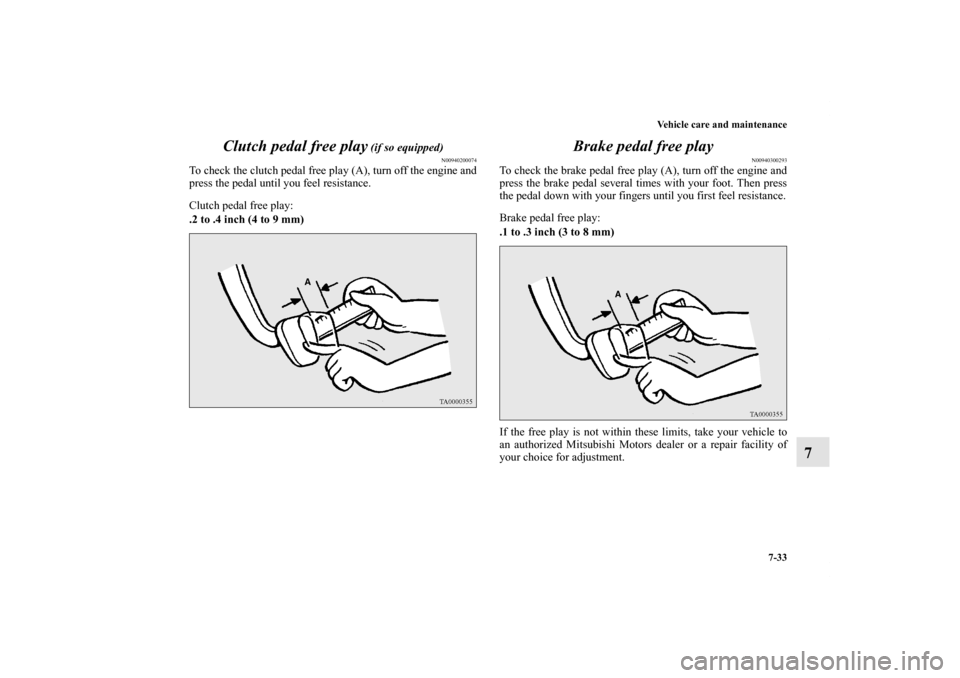
To check the clutch pedal free play (A), turn off the engine and
press the pedal until you feel resistance.
Clutch pedal free play:
.2 to .4 inch (4 to 9 mm)
Brake pedal free play
N00940300293
To check the brake pedal free play (A), turn off the engine and
press the brake pedal several times with your foot. Then press
the pedal down with your fingers until you first feel resistance.
Brake pedal free play:
.1 to .3 inch (3 to 8 mm)
If the free play is not within these limits, take your vehicle to
an authorized Mitsubishi Motors dealer or a repair facility of
your choice for adjustment.
BK0120400US.book 33 ページ 2010年5月12日 水曜日 午前10時50分
Page 536 of 602
Vehicle care and maintenance
7-35
7 Wiper blades
N00940700138
Check the wiper blades occasionally. Clean them regularly to
remove deposits of salt and road film. Use a sponge or cloth
and a mild detergent or non-abrasive cleaner to clean the blades
and glass areas.
Replace the blades if they continue to streak or smear.NOTE�Do not run the wipers on dry glass for a long time. This
wears out the rubber and can scratch the glass.During cold weatherIf the blades are frozen to the windshield or rear window, do
not operate the wipers until the ice has melted and the blades
are freed, otherwise the wiper motor may be damaged.
Emission-control system maintenance
N00940800328
Your vehicle is equipped with an emission-control system that
meets all the requirements of the U.S. Environmental Protec-
tion Agency and Environment Canada. The emission-control
system is made of:
�a positive crankcase ventilation system
�an evaporative emission-control system
�an exhaust emission-control system
To be sure the emission-control system works properly, have
your vehicle inspected and maintained by an authorized Mit-
subishi Motors dealer or a repair facility of your choice. This
should be done at the time or mileage specified in the “WAR-
RANTY AND MAINTENANCE MANUAL”.
These, and all the other “general” maintenance services listed
in this manual, need to be performed to keep your vehicle run-
ning properly and reliably.
You should also have an inspection and service any time you
suspect a malfunction.NOTE�To meet government regulations and promote cleaner air,
your vehicle is equipped with an onboard diagnostic sys-
tem (OBD). The engine electronic control module that
controls OBD functions stores various data (especially
about the exhaust emissions). This data will be erased if
the battery cable is disconnected, which could make a
rapid diagnosis difficult. Do not disconnect the battery
cable when the engine malfunction indicator (“SERVICE
ENGINE SOON” or “Check engine light”) is ON.
BK0120400US.book 35 ページ 2010年5月12日 水曜日 午前10時50分
Page 537 of 602
7-36 Vehicle care and maintenance
7
Spark plugs
N00940900228
Spark plugs must fire properly for good engine performance
and emission-control.
Do not reuse them by cleaning or regapping. Change them at
the mileage listed in the “WARRANTY AND MAINTE-
NANCE MANUAL”. NOTE�Use the spark plugs listed under “Engine specifications”
on page 9-7 or plugs that are exactly the same. Other
plugs could cause engine damage, performance problems
or radio noise.Fuel hoses
N00941000040
Check the hose surfaces for any heat and mechanical damage,
hard and brittle rubber, cracking, tears, cuts and abrasions. Pay
special attention to the hoses closest to high heat sources such
as the exhaust manifold. Check all the hose connections, such
as clamps and couplings, to make sure they are secure and that
there are no leaks. If you see any wear or damage, replace the
hoses immediately.Intake valve clearance
N00950100050
Have the valve clearance checked at an authorized Mitsubishi
Motors dealer at the mileage specified in the “WARRANTY
AND MAINTENANCE MANUAL”.
If the engine sounds abnormally loud, have adjustments made
by an authorized Mitsubishi Motors dealer.
Fuel system (tank, pipe line and connection, and
fuel tank filler cap)
N00941300173
Check these regularly for damage or leaks in the fuel lines and
connections. Check the fuel tank filler cap for damage or loose-
ness. Pay special attention to the fuel lines closest to high heat
sources such as the exhaust manifold.
WA R N I N G
!�If you see a fuel leak or if you smell fuel, do not run
the engine. Any spark (including from the ignition),
flame or smoking material could cause an explosion
or fire. Call an authorized Mitsubishi Motors dealer
or a repair facility of your choice for assistance.
BK0120400US.book 36 ページ 2010年5月12日 水曜日 午前10時50分
Page 539 of 602
7-38 Vehicle care and maintenance
7
Ball joint, steering linkage seals and drive shaft
boots
N00941800077
Check the following parts for damage and grease leaks:
�Ball joint boots of the front suspension and steering link-
age
�Bellows on both ends of the drive shaftDrive belt (for generator, air conditioning com-
pressor)
N00941900296
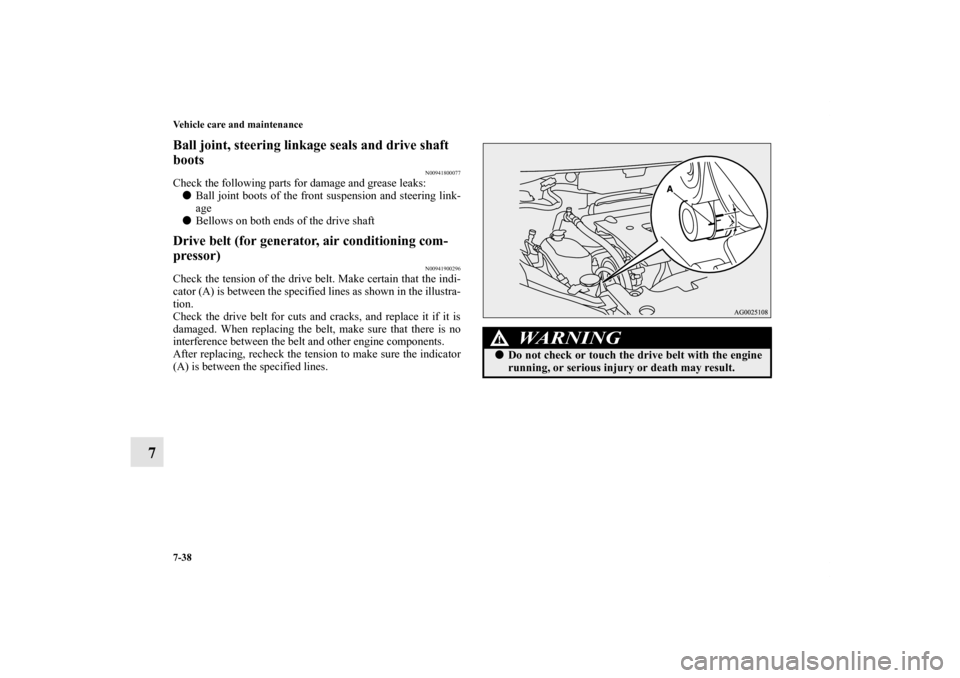
Check the tension of the drive belt. Make certain that the indi-
cator (A) is between the specified lines as shown in the illustra-
tion.
Check the drive belt for cuts and cracks, and replace it if it is
damaged. When replacing the belt, make sure that there is no
interference between the belt and other engine components.
After replacing, recheck the tension to make sure the indicator
(A) is between the specified lines.
WA R N I N G
!�Do not check or touch the drive belt with the engine
running, or serious injury or death may result.
BK0120400US.book 38 ページ 2010年5月12日 水曜日 午前10時50分
Page 540 of 602
Vehicle care and maintenance
7-39
7
Exhaust system
N00942200094
The best way to keep carbon monoxide gas from entering
inside your vehicle is to have the engine exhaust system prop-
erly serviced.
Have a competent mechanic inspect the complete exhaust sys-
tem and nearby body areas for broken, damaged, deteriorated,
or mispositioned parts if you notice any of the following:
�A change in the sound of the exhaust system
�The smell of exhaust fumes inside the vehicle
�The underside or rear of the vehicle is damaged
Also check the exhaust system each time the vehicle is raised
for lubrication, oil changes, or required service. Any open
seams or loose connections could let dangerous exhaust fumes
seep into the luggage compartment and passenger compart-
ments.Check for any of the following conditions:�Check for holes or exhaust gas leaks caused by corrosion
or damage.
�Check the joints and connections for looseness or exhaust
gas leaks.
�Check the rubber hangers and brackets for damage.
Hood lock release mechanism and safety catch
N00942500101
The hood lock release mechanism and hood safety catch should
be checked, cleaned, and oiled when needed for easy move-
ment and to stop rust and wear. Use Multipurpose Grease
NLGI Grade 2 sparingly for all sliding parts of the hood latch
and release lever. Work the grease into the hood lock mecha-
nism until all the movable surfaces are covered.
Also, put a light coat of the same grease on the safety catch
wherever moving parts touch.
WA R N I N G
!�Carbon monoxide gas from your vehicle’s exhaust is
poisonous. Breathing these fumes can cause uncon-
sciousness or death.
BK0120400US.book 39 ページ 2010年5月12日 水曜日 午前10時50分