Page 625 of 714
7-28 Vehicle care and maintenance
7
Tire inflation pressures
N00939300815
Proper tire inflation pressure is essential for the safe and satis-
factory operation of your vehicle. The wrong tire pressure will
cause problems in three major areas:
�Safety
Too little pressure increases flexing in the tire and can
cause tire failure. Too much pressure can cause a tire to
lose its ability to cushion shock. Objects on the road and
potholes could then cause tire damage that may result in
tire failure.
�Economy
The wrong tire pressure can cause uneven wear patterns in
the tire tread. These abnormal wear patterns will reduce
the tread life, and the tire will have to be replaced sooner.
Too little pressure also makes it harder for the tire to roll,
and this uses up more fuel.
�Ride comfort and vehicle stability
The superior riding experience built into your vehicle
partly depends on the correct tire pressure. Too much
pressure gives an uncomfortable and jarring ride. Too lit-
tle pressure feels as if your vehicle is slow to respond.
Unequal tire pressures can make steering your vehicle
uneven and unpredictable.
The tire pressure for your vehicle under normal driving condi-
tions is listed on the placard attached to the driver’s door sill.
(Refer to “Tire and loading information placard” on page 9-4.)The recommended inflation pressures under normal driving
conditions should be used for the tires listed below.
Tire pressures should be checked, and adjusted if necessary, at
least once a month.
Pressures should be checked more often whenever weather
temperatures change severely, because tire pressures change
with outdoor temperatures. The pressures listed are always
“cold inflation pressure”.
Cold inflation pressure is measured after the vehicle has been
parked for at least three hours or is driven less than 1 mile (1.6
km) after having been parked for three hours.
Cold inflation pressure must not go above the maximum values
molded into the tire sidewall. After driving several miles, your
tire inflation pressure may increase 2 to 6 psi (14 to 41 kPa)
from the cold inflation pressure. Do not let air out of the tires to
get back to the specified cold pressure, or your tires will be too
low.
Item
Tire size
Front
Rear
Normal tireP215/70R16
P225/55R18240 KPA,
35 PSI240 KPA,
35 PSI
Compact spare
wheelT155/90D16 420 KPA, 60 PSI
BK0122500US.book 28 ページ 2010年5月12日 水曜日 午前11時11分
Page 628 of 714
Vehicle care and maintenance
7-31
7
Tire rotation
N00939900488
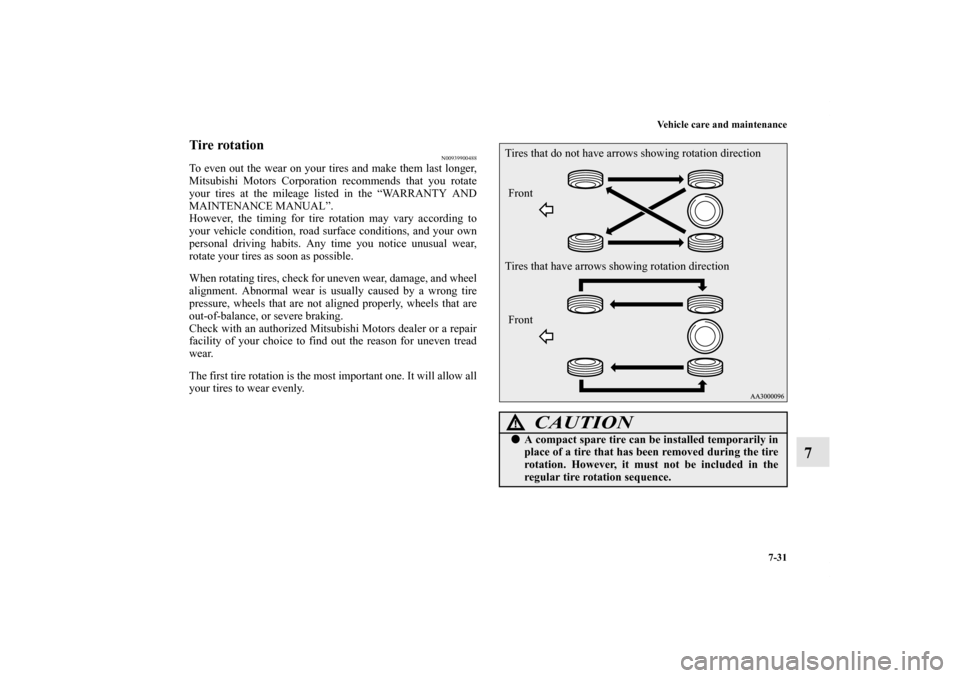
To even out the wear on your tires and make them last longer,
Mitsubishi Motors Corporation recommends that you rotate
your tires at the mileage listed in the “WARRANTY AND
MAINTENANCE MANUAL”.
However, the timing for tire rotation may vary according to
your vehicle condition, road surface conditions, and your own
personal driving habits. Any time you notice unusual wear,
rotate your tires as soon as possible.
When rotating tires, check for uneven wear, damage, and wheel
alignment. Abnormal wear is usually caused by a wrong tire
pressure, wheels that are not aligned properly, wheels that are
out-of-balance, or severe braking.
Check with an authorized Mitsubishi Motors dealer or a repair
facility of your choice to find out the reason for uneven tread
wear.
The first tire rotation is the most important one. It will allow all
your tires to wear evenly.
CAUTION
!�A compact spare tire can be installed temporarily in
place of a tire that has been removed during the tire
rotation. However, it must not be included in the
regular tire rotation sequence.Tires that do not have arrows showing rotation direction
Tires that have arrows showing rotation directionFront
Front
BK0122500US.book 31 ページ 2010年5月12日 水曜日 午前11時11分
Page 641 of 714
7-44 Vehicle care and maintenance
7
Sub fuse block
1. Remove the personal compartment in the same way that
you would with the main fuse block.
2. Use the fuse remover to pry loose the 2 clips (E) on the
bottom cover.
The remover is in the fuse block in the engine compart-
ment.
Refer to “Fuse replacement” on page 7-49.NOTE�When finished, be sure to return the remover to the fuse
block in the engine compartment.
Engine compartmentIn the engine compartment, the fuse block is located as shown
in the illustration.Fuse load capacities
N00954800169
This fuse list shows the names of the electrical systems and
their fuse capacities.
There are spare fuses in the fuse block cover in the engine
compartment. Always replace a blown fuse with one of the
same capacity as the original.1- Push the lock lever.
2- Remove the fuse block cover.
BK0122500US.book 44 ページ 2010年5月12日 水曜日 午前11時11分
Page 645 of 714
7-48 Vehicle care and maintenance
7
*: Fusible link
�Some fuses may not be installed on your vehicle, depend-
ing on the vehicle model or specifications.
�The table above shows the main equipment corresponding
to each fuse.
There are no 7.5 A, 25 A or 30 A spare fuses. If a fuse of one of
these capacities blows, replace it temporarily by borrowing one
of the fuses indicated below.
7.5 A: 10 A spare fuse
25 A: 20 A spare fuse
30 A: 30 A audio amplifier fuse
Replace the borrowed fuse with a fuse that has the correct
capacity as soon as possible.
Identification of fuse
32 Diesel 30 A
33 — Spare fuse 10 A
34 — Spare fuse 15 A
35 — Spare fuse 20 ANo.
Symbol
Electrical system
Capacity
Capacity
Color
7.5 A Brown
10 A Red
15 A Blue
20 A Yellow
25 A Natural (white)
30 A Green (fuse type) /Pink (fusible link type)
40 A Green (fusible link type)
BK0122500US.book 48 ページ 2010年5月12日 水曜日 午前11時11分