Page 584 of 714
For emergencies
6-15
6
3. Open the lower gate.
Refer to “Flap-fold tailgate: To open” on page 3-60.
4. With the wheel nut wrench, firmly tighten the tire hanger
mounting bolt by turning it clockwise.
5. Install the cover over the tire hanger mounting bolt.
To change a tire
N00849800418
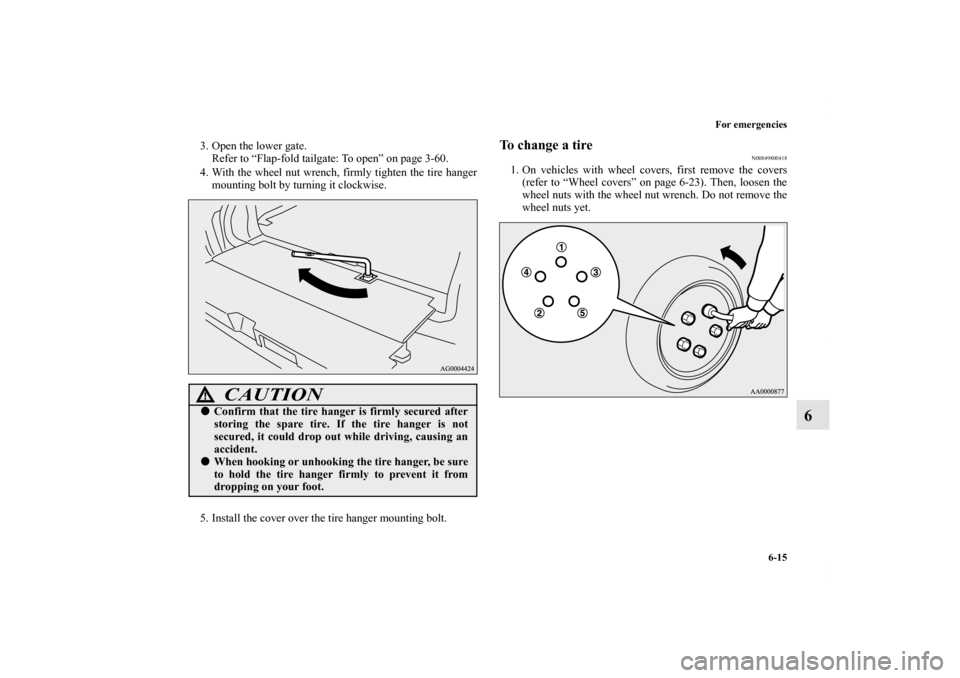
1. On vehicles with wheel covers, first remove the covers
(refer to “Wheel covers” on page 6-23). Then, loosen the
wheel nuts with the wheel nut wrench. Do not remove the
wheel nuts yet.
CAUTION
!�Confirm that the tire hanger is firmly secured after
storing the spare tire. If the tire hanger is not
secured, it could drop out while driving, causing an
accident.�When hooking or unhooking the tire hanger, be sure
to hold the tire hanger firmly to prevent it from
dropping on your foot.
BK0122500US.book 15 ページ 2010年5月12日 水曜日 午前11時11分
Page 585 of 714
6-16 For emergencies
6
2. Place the jack under one of the jacking points (A) shown
in the illustration. Use the jacking point closest to the tire
you wish to change.
NOTE�Put the spare wheel under the vehicle body near the jack.
This makes it safer if the jack slips out of position.
WA R N I N G
!�Set the jack only at the positions shown here. If the
jack is set at a wrong position, it could dent your
vehicle or the jack might fall over and cause per-
sonal injury.�Do not use the jack on a tilted or soft surface.
Otherwise, the jack might slip and cause personal
injury. Always use the jack on a flat, hard surface.
Before setting the jack, make sure there are no sand
or pebbles under the jack base.
BK0122500US.book 16 ページ 2010年5月12日 水曜日 午前11時11分
Page 587 of 714
6-18 For emergencies
6
5. Remove the wheel nuts with the wheel nut wrench, then
take the wheel off.6. Clean out any mud, etc. on the hub surface (F), hub bolts
(G) or in the installation holes (H) in the wheel, and then
mount the spare tire.�No one should be in your vehicle when using the
jack.�Do not start or run the engine while your vehicle is
on the jack.�Do not turn the raised wheel. The tires that are still
on the ground could turn and make your vehicle fall
off the jack.
CAUTION
!�Handle the wheel carefully when changing the tire,
to avoid scratching the wheel surface.
WA R N I N G
!
BK0122500US.book 18 ページ 2010年5月12日 水曜日 午前11時11分
Page 588 of 714
For emergencies
6-19
6
7. [Vehicle with steel wheels]
• Normal wheels and compact spare wheel
Install the wheel nuts (tapered nuts) with their tapered
ends facing inward, then tighten by hand until the wheel
is no longer loose.
WA R N I N G
!�Mount the spare wheel with the valve stem (I) facing
outward. If you cannot see the valve stem (I), you
have installed the wheel backwards.
Operating the vehicle with the spare wheel installed
backwards can cause vehicle damage and result in
an accident.
BK0122500US.book 19 ページ 2010年5月12日 水曜日 午前11時11分
Page 589 of 714
6-20 For emergencies
6
[Vehicle with aluminum wheels]
• Normal wheels
Temporarily tighten the wheel nuts (flange nuts) until
their flange section comes in contact with the wheel and
it is no longer loose.• Compact spare wheel
Install the wheel nuts with their tapered ends facing
inward, then tighten by hand until the wheel is no longer
loose.
NOTE�Flange nuts can be temporarily used on the compact spare
or steel wheel, but return them to the original wheel and
tire as soon as possible.
�If all 4 wheels are changed to steel wheels, use tapered
nuts.
CAUTION
!�Never apply oil to either the wheel bolts or the nuts
or they will tighten too much.
BK0122500US.book 20 ページ 2010年5月12日 水曜日 午前11時11分
Page 591 of 714
6-22 For emergencies
6
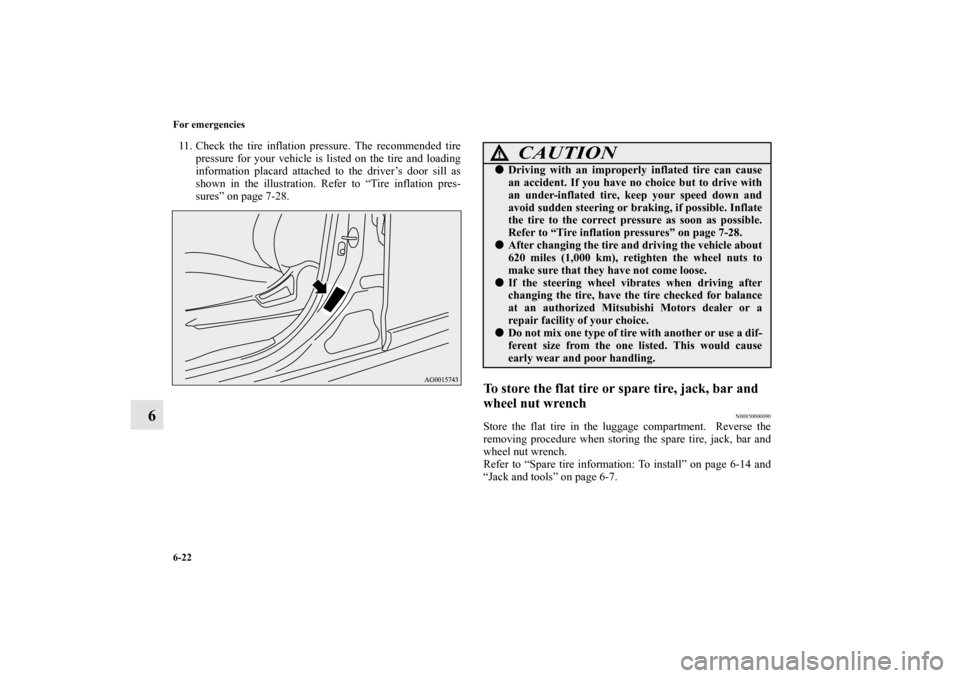
11. Check the tire inflation pressure. The recommended tire
pressure for your vehicle is listed on the tire and loading
information placard attached to the driver’s door sill as
shown in the illustration. Refer to “Tire inflation pres-
sures” on page 7-28.
To store the flat tire or spare tire, jack, bar and
wheel nut wrench
N00850000090
Store the flat tire in the luggage compartment. Reverse the
removing procedure when storing the spare tire, jack, bar and
wheel nut wrench.
Refer to “Spare tire information: To install” on page 6-14 and
“Jack and tools” on page 6-7.
CAUTION
!�Driving with an improperly inflated tire can cause
an accident. If you have no choice but to drive with
an under-inflated tire, keep your speed down and
avoid sudden steering or braking, if possible. Inflate
the tire to the correct pressure as soon as possible.
Refer to “Tire inflation pressures” on page 7-28.�After changing the tire and driving the vehicle about
620 miles (1,000 km), retighten the wheel nuts to
make sure that they have not come loose.�If the steering wheel vibrates when driving after
changing the tire, have the tire checked for balance
at an authorized Mitsubishi Motors dealer or a
repair facility of your choice.�Do not mix one type of tire with another or use a dif-
ferent size from the one listed. This would cause
early wear and poor handling.
BK0122500US.book 22 ページ 2010年5月12日 水曜日 午前11時11分
Page 621 of 714
7-24 Vehicle care and maintenance
7Tires
N00939200494
It is important to familiarize yourself with the following terms:
�Cold tire pressure:
• The measured pressure after the vehicle has been parked
for at least three hours,
or
• The measured pressure when the vehicle is driven less
than 1 mile (1.6 km) after having been parked for three
hours.
�Maximum pressure: the maximum permissible cold tire
inflation pressure for this tire.
�Recommended inflation pressure: the inflation pressure
for optimum tire performance.�Intended outboard sidewall:
• The sidewall that contains a whitewall, bears white let-
tering or bears manufacturer, brand, and/or model name
molding that is higher or deeper than the same molding
on the other sidewall of the tire, or
• The outward facing sidewall of an asymmetrical tire that
has a particular side that must always face outward
when mounted on a vehicle.
�Passenger car tire: a tire intended for use on passenger
cars, multipurpose passenger vehicles, and trucks, that
have a gross vehicle weight rating (GVWR) of 10,000
pounds or less.
�Light truck (LT) tire: a tire designated by its manufacturer
as primarily intended for use on lightweight trucks or mul-
tipurpose passenger vehicles.
�Tread: portion of a tire that comes into contact with the
road.
�Tread rib: a tread section running circumferentially
around a tire.
�Tread separation: pulling away of the tread from the tire
carcass.
�Carcass: the tire structure, except tread and sidewall rub-
ber which, when inflated, bears the load.
�Sidewall: portion of a tire between the tread and bead.
�Section width: the linear distance between the exteriors of
the sidewalls of an inflated tire, excluding elevations due
to labeling, decoration, or protective bands.
�Bead: the part of the tire that is made of steel wires,
wrapped or reinforced by ply cords and that is shaped to
fit the rim.
�Ply: a layer of rubber-coated parallel cords.
�Cord: the strands forming the plies in the tire.
WA R N I N G
!�Driving with tires that are worn, damaged or
improperly inflated is dangerous.
These type tire conditions will adversely affect vehi-
cle performance.
These type tire conditions can also cause a tread sep-
aration or blowout which may result in an accident
causing serious injury or death.�Tires, including spare tire, degrade over time with
age even when they are not being used.
It is recommended that tires over 6 years generally
be replaced even if damage is not obvious.
BK0122500US.book 24 ページ 2010年5月12日 水曜日 午前11時11分
Page 623 of 714
7-26 Vehicle care and maintenance
7
�Temporary spare tires are high pressure compact spares
designed for temporary emergency use only. Tires
designed to this standard have the letter “T” molded
into the sidewall preceding the size designation. Exam-
ple: T145/80D18 103M.Service DescriptionEXAMPLE: 95H
Maximum LoadMaximum load indicates the maximum load this tire is
designed to carry.Maximum PressureMaximum Pressure indicates the maximum permissible
cold tire inflation pressure for this tire.Tire Identification Number (TIN)The TIN may be found on one or both sides of the tire but
the date code may only be on one side. Look for the TIN on
the outboard side of tires as mounted on the vehicle. If the
TIN is not found on the outboard side then you will find it
on the inboard side of the tire. 95Load index
A numerical code associated with the maximum
load a tire can carry.
HSpeed symbol
A symbol indicating the range of speeds at
which a tire can carry a load corresponding to its
load index under certain operating conditions.
The maximum speed corresponding to the speed
symbol should only be achieved under specified
operating conditions. (i.e. tire pressure, vehicle
loading, road conditions and posted speed lim-
its)
WA R N I N G
!�Overloading of your tire is dangerous. Overload-
ing can cause tire failure, affect vehicle handling,
and increase your stopping distance. Use tires of
the recommended load capacity for your vehicle.
Never overload them.
BK0122500US.book 26 ページ 2010年5月12日 水曜日 午前11時11分


![MITSUBISHI OUTLANDER 2011 2.G Owners Manual For emergencies
6-19
6
7. [Vehicle with steel wheels]
• Normal wheels and compact spare wheel
Install the wheel nuts (tapered nuts) with their tapered
ends facing inward, then tighten by hand until](/manual-img/19/7521/w960_7521-587.png "MITSUBISHI OUTLANDER 2011 2.G Owners Manual For emergencies
6-19
6
7. [Vehicle with steel wheels]
• Normal wheels and compact spare wheel
Install the wheel nuts (tapered nuts) with their tapered
ends facing inward, then tighten by hand until")
![MITSUBISHI OUTLANDER 2011 2.G Owners Manual 6-20 For emergencies
6
[Vehicle with aluminum wheels]
• Normal wheels
Temporarily tighten the wheel nuts (flange nuts) until
their flange section comes in contact with the wheel and
it is no longer](/manual-img/19/7521/w960_7521-588.png "MITSUBISHI OUTLANDER 2011 2.G Owners Manual 6-20 For emergencies
6
[Vehicle with aluminum wheels]
• Normal wheels
Temporarily tighten the wheel nuts (flange nuts) until
their flange section comes in contact with the wheel and
it is no longer")