Page 562 of 714
Comfort controls
5-135
5
Roof antenna (for vehicles with SIRIUS satellite
radio)For securing the best satellite reception, the angle of the
antenna is fixed.
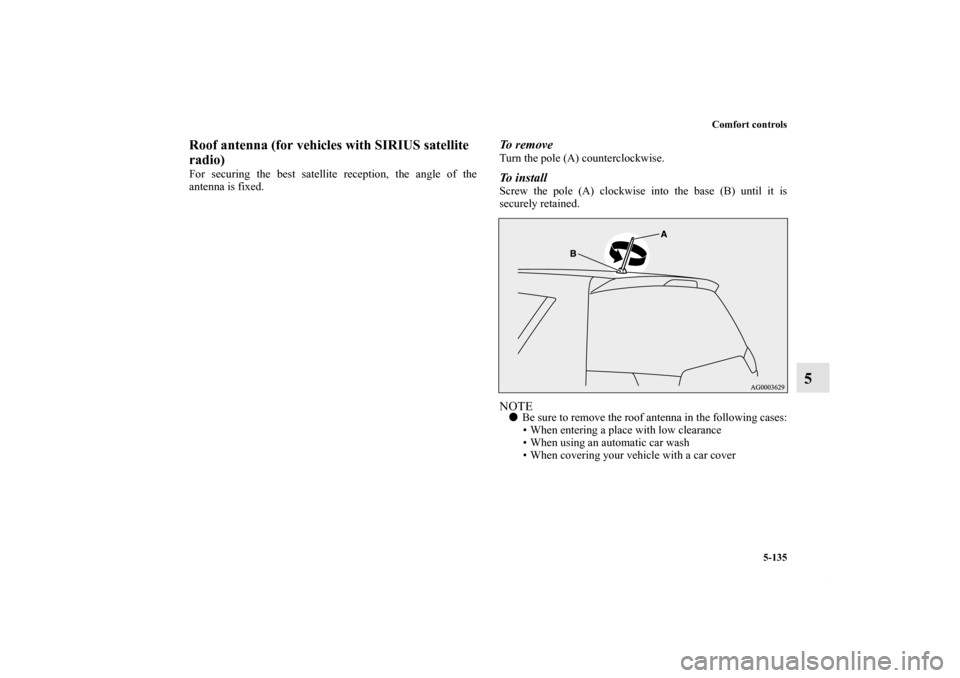
To r e m o v eTurn the pole (A) counterclockwise.To i n s t a l lScrew the pole (A) clockwise into the base (B) until it is
securely retained.NOTE�Be sure to remove the roof antenna in the following cases:
• When entering a place with low clearance
• When using an automatic car wash
• When covering your vehicle with a car cover
BK0122500US.book 135 ページ 2010年5月12日 水曜日 午前11時11分
Page 563 of 714
5-136 Comfort controls
5Clock
(if so equipped)
N00755000078
The time is displayed when the ignition switch is in the “ON”
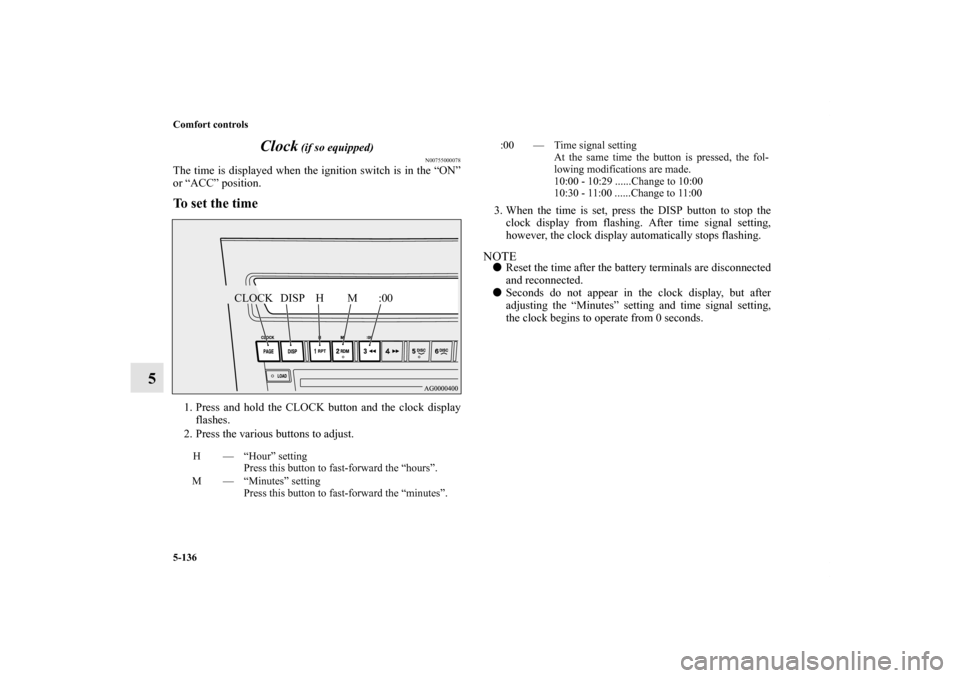
or “ACC” position.To set the time1. Press and hold the CLOCK button and the clock display
flashes.
2. Press the various buttons to adjust.3. When the time is set, press the DISP button to stop the
clock display from flashing. After time signal setting,
however, the clock display automatically stops flashing.
NOTE�Reset the time after the battery terminals are disconnected
and reconnected.
�Seconds do not appear in the clock display, but after
adjusting the “Minutes” setting and time signal setting,
the clock begins to operate from 0 seconds.
H — “Hour” setting
Press this button to fast-forward the “hours”.
M — “Minutes” setting
Press this button to fast-forward the “minutes”.
CLOCK DISP H M :00
:00 — Time signal setting
At the same time the button is pressed, the fol-
lowing modifications are made.
10:00 - 10:29 ......Change to 10:00
10:30 - 11:00 ......Change to 11:00
BK0122500US.book 136 ページ 2010年5月12日 水曜日 午前11時11分
Page 564 of 714
Comfort controls
5-137
5 General information about your radio
N00733900370
Your vehicle’s radio receives both AM and FM stations.
The quality of your reception is affected by distance, obstacles,
and signal interference.
This radio complies with Part 15 of Federal Communications
Commission (FCC) Rules (for vehicles sold in U.S.A.). Opera-
tion is subject to the following conditions:�
The device may not cause harmful interference.
�
This device must accept any interference recieved, includ-
ing interference that may cause undesirable operation.
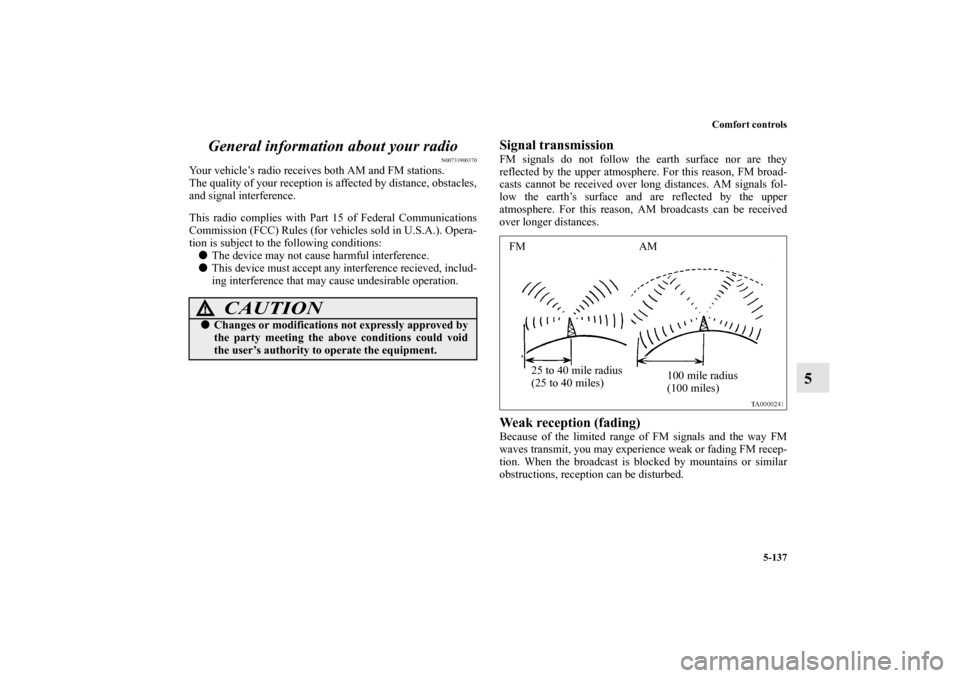
Signal transmissionFM signals do not follow the earth surface nor are they
reflected by the upper atmosphere. For this reason, FM broad-
casts cannot be received over long distances. AM signals fol-
low the earth’s surface and are reflected by the upper
atmosphere. For this reason, AM broadcasts can be received
over longer distances.Weak reception (fading)Because of the limited range of FM signals and the way FM
waves transmit, you may experience weak or fading FM recep-
tion. When the broadcast is blocked by mountains or similar
obstructions, reception can be disturbed.
CAUTION
!�
Changes or modifications not expressly approved by
the party meeting the above conditions could void
the user’s authority to operate the equipment.
FM AM
25 to 40 mile radius
(25 to 40 miles)100 mile radius
(100 miles)
BK0122500US.book 137 ページ 2010年5月25日 火曜日 午後3時48分
Page 572 of 714
For emergencies
6-3
6
3. You could be injured if the vehicles move. Set the parking
brake firmly on each vehicle. Put an automatic transaxle
or CVT in “P” (PARK) or a manual transaxle in “N”
(Neutral). Turn the ignition switch to the “LOCK” posi-
tion.NOTE�Turn off all lights, heater, and other electrical loads. This
will avoid sparks and help save both batteries.
4. Make sure your battery electrolyte is at the proper level.
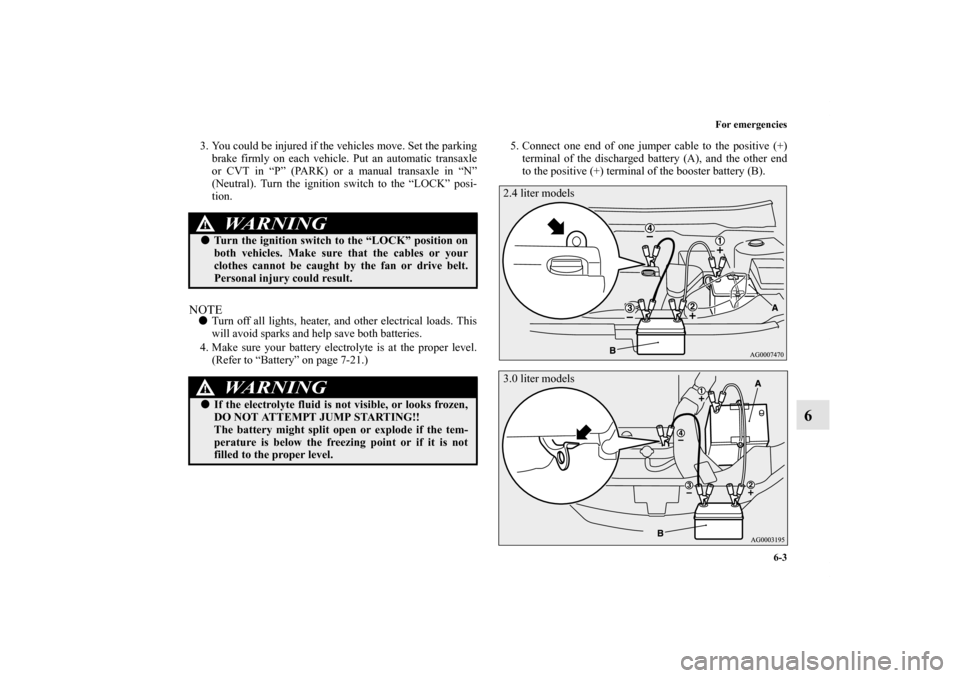
(Refer to “Battery” on page 7-21.)5. Connect one end of one jumper cable to the positive (+)
terminal of the discharged battery (A), and the other end
to the positive (+) terminal of the booster battery (B).
WA R N I N G
!�Turn the ignition switch to the “LOCK” position on
both vehicles. Make sure that the cables or your
clothes cannot be caught by the fan or drive belt.
Personal injury could result.
WA R N I N G
!�If the electrolyte fluid is not visible, or looks frozen,
DO NOT ATTEMPT JUMP STARTING!!
The battery might split open or explode if the tem-
perature is below the freezing point or if it is not
filled to the proper level.
2.4 liter models3.0 liter models
BK0122500US.book 3 ページ 2010年5月12日 水曜日 午前11時11分
Page 573 of 714
6-4 For emergencies
6
NOTE�Open the terminal cover before connecting the jumper
cable to the positive terminal of the battery.
(Refer to “Battery” on page 7-21.)
�Use the proper cables suitable for the battery size.
Otherwise heat damage to the cables could result.
�Check the jumper cables for damage and corrosion before
use.
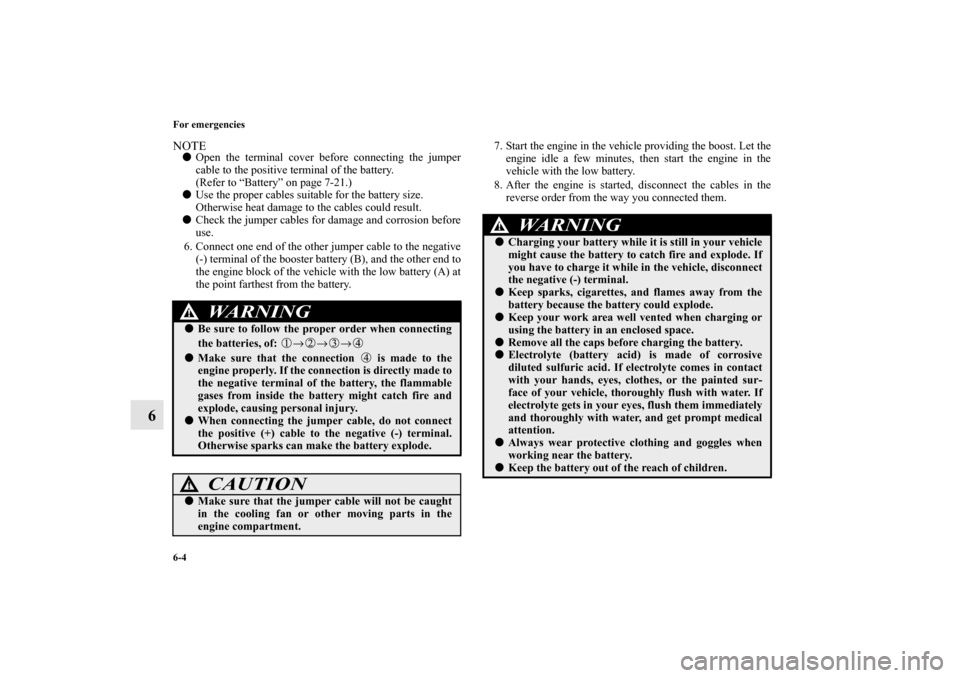
6. Connect one end of the other jumper cable to the negative
(-) terminal of the booster battery (B), and the other end to
the engine block of the vehicle with the low battery (A) at
the point farthest from the battery.7. Start the engine in the vehicle providing the boost. Let the
engine idle a few minutes, then start the engine in the
vehicle with the low battery.
8. After the engine is started, disconnect the cables in the
reverse order from the way you connected them.
WA R N I N G
!�Be sure to follow the proper order when connecting
the batteries, of: →→→�Make sure that the connection is made to the
engine properly. If the connection is directly made to
the negative terminal of the battery, the flammable
gases from inside the battery might catch fire and
explode, causing personal injury.�When connecting the jumper cable, do not connect
the positive (+) cable to the negative (-) terminal.
Otherwise sparks can make the battery explode.
CAUTION
!�Make sure that the jumper cable will not be caught
in the cooling fan or other moving parts in the
engine compartment.
WA R N I N G
!�Charging your battery while it is still in your vehicle
might cause the battery to catch fire and explode. If
you have to charge it while in the vehicle, disconnect
the negative (-) terminal.�Keep sparks, cigarettes, and flames away from the
battery because the battery could explode.�Keep your work area well vented when charging or
using the battery in an enclosed space.�Remove all the caps before charging the battery.�Electrolyte (battery acid) is made of corrosive
diluted sulfuric acid. If electrolyte comes in contact
with your hands, eyes, clothes, or the painted sur-
face of your vehicle, thoroughly flush with water. If
electrolyte gets in your eyes, flush them immediately
and thoroughly with water, and get prompt medical
attention.�Always wear protective clothing and goggles when
working near the battery.�Keep the battery out of the reach of children.
BK0122500US.book 4 ページ 2010年5月12日 水曜日 午前11時11分
Page 574 of 714
For emergencies
6-5
6
As your vehicle has anti-lock brakesIf you drive your vehicle with a low battery charge after the
engine has been started by using jumper cables, the engine may
misfire. This can cause the anti-lock braking system warning
light to blink on and off. This is only due to the low battery
voltage. It is not a problem with the brake system. If this hap-
pens, fully charge the battery and ensure the charging system is
operating properly.
Engine overheating
N00836500349
When the engine is overheating, the information screen in the
multi-information display will be interrupted and the engine
coolant temperature warning display will appear. Also “ ”
will blink. If so happens:
1. Stop the vehicle in a safe place. Turn on the hazard warn-
ing flashers.
2. With the engine still running, carefully raise the engine
hood to vent the engine compartment.
3. Check that the cooling fan is running. If the fan is not
turning, stop the engine immediately and contact an
authorized Mitsubishi Motors dealer or a repair facility of
your choice for assistance.
4. If you see steam or spray coming from under the hood,
turn off the engine.
WA R N I N G
!�To avoid personal injury, keep hands, hair, jewelry
and clothes away from the cooling fan. The cooling
fan can start at any time.
BK0122500US.book 5 ページ 2010年5月12日 水曜日 午前11時11分
Page 575 of 714
6-6 For emergencies
6
5. If you do not see steam or spray coming from under the
hood, leave the engine on until the bar graph for the
engine coolant temperature warning display on the multi-
information display goes down. When it is in the middle
of the normal zone, you can start driving again. If the bar
graph stays in the red zone, turn off the engine.
6. When you do not see any more steam or spray, open the
hood. Look for obvious leaks, such as a split radiator
hose. Be careful as components will be hot. Any leak
source must be repaired.
7. If there is no obvious leak source, check the coolant level
in the engine coolant reserve tank. If there is none, or if it
is too low, slowly add coolant.8. If the engine coolant reserve tank needs coolant, you will
probably also need to add coolant to the radiator. Do not
loosen or remove the radiator cap until the engine has
cooled down.
9. Start the engine, and slowly add coolant, up to the bottom
of the filler neck. Use plain water if you have to (and
replace it with the right coolant as soon as possible).
10. Replace the radiator cap and tighten it fully. Check the
engine coolant temperature display on the multi-informa-
tion display. You can start driving again when the bar
graph for the engine coolant temperature display returns
to the normal zone.
11. Have the system inspected by your authorized Mitsubishi
Motors dealer or a repair facility of your choice.
WA R N I N G
!�Before raising the engine hood, check to see if there
is steam or spray coming from under the hood.
Steam or spray coming from an overheated engine
could seriously scald you.
Do not open the hood until there is no steam or
spray.
WA R N I N G
!�Removing the radiator cap could scald you with
escaping hot water or steam. When checking the
radiator level, cover the cap with a cloth before try-
ing to remove it. Turn it slowly counterclockwise,
without pressing down, to the first notch. The pres-
sure in the system will then be let out. When the
pressure is COMPLETELY LET OUT, press down
and keep turning the cap counterclockwise until it
comes off.
BK0122500US.book 6 ページ 2010年5月12日 水曜日 午前11時11分
Page 577 of 714
6-8 For emergencies
6
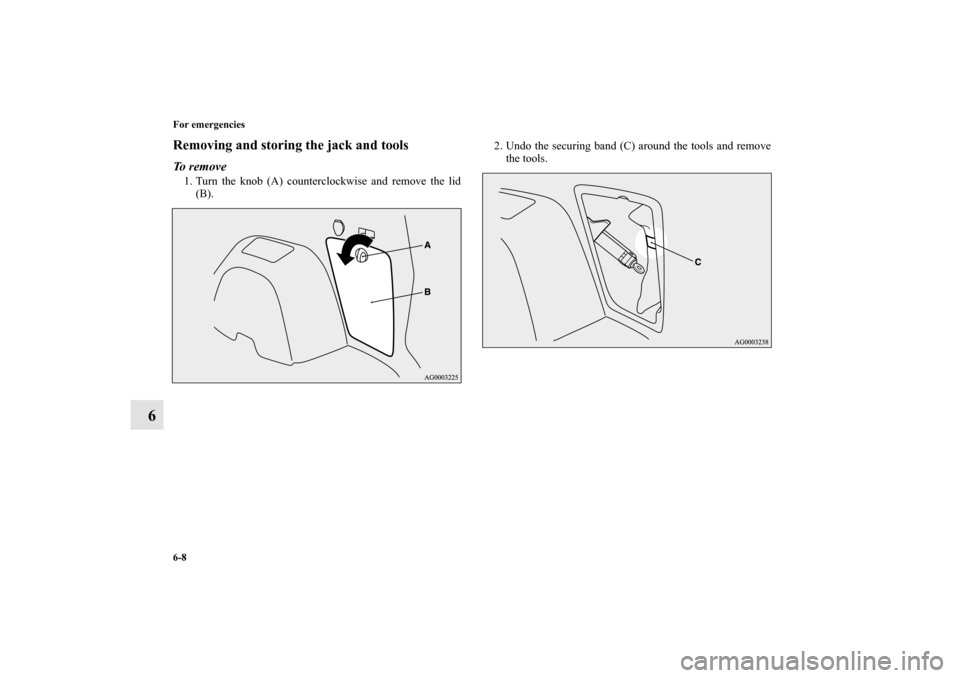
Removing and storing the jack and toolsTo r e m o v e1. Turn the knob (A) counterclockwise and remove the lid
(B).2. Undo the securing band (C) around the tools and remove
the tools.
BK0122500US.book 8 ページ 2010年5月12日 水曜日 午前11時11分