Page 602 of 714
Vehicle care and maintenance
7-5
7
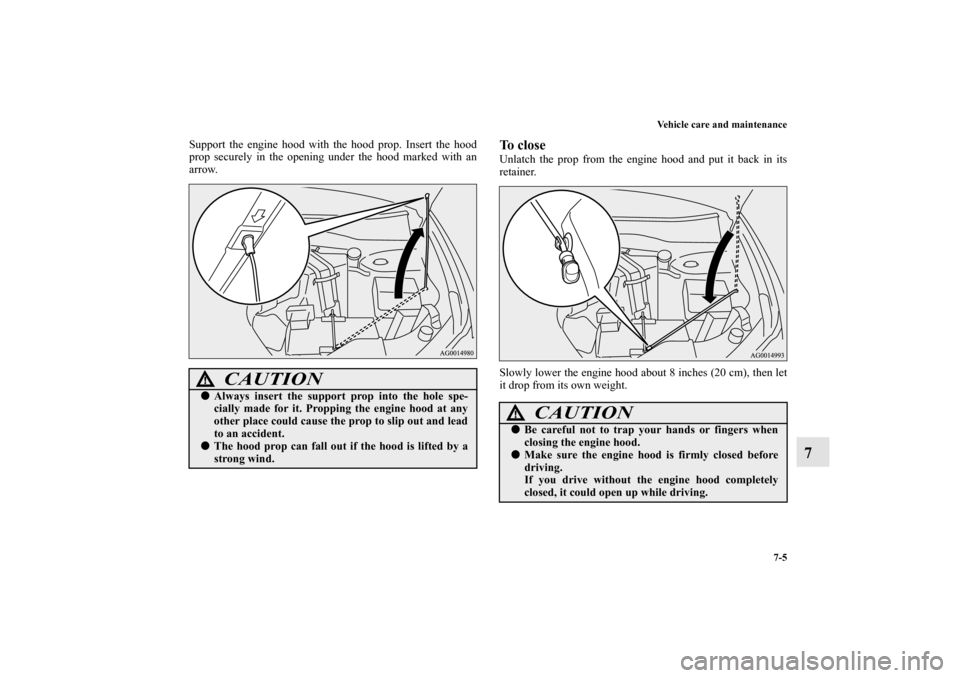
Support the engine hood with the hood prop. Insert the hood
prop securely in the opening under the hood marked with an
arrow.
To closeUnlatch the prop from the engine hood and put it back in its
retainer.
Slowly lower the engine hood about 8 inches (20 cm), then let
it drop from its own weight.
CAUTION
!�Always insert the support prop into the hole spe-
cially made for it. Propping the engine hood at any
other place could cause the prop to slip out and lead
to an accident.�The hood prop can fall out if the hood is lifted by a
strong wind.
CAUTION
!�Be careful not to trap your hands or fingers when
closing the engine hood.�Make sure the engine hood is firmly closed before
driving.
If you drive without the engine hood completely
closed, it could open up while driving.
BK0122500US.book 5 ページ 2010年5月12日 水曜日 午前11時11分
Page 620 of 714
Vehicle care and maintenance
7-23
7
NOTE�Check each battery terminal for corrosion. You can stop
more corrosion by washing with a solution of baking soda
and water. Grease the posts and clamps after cleaning or
tightening them.
�Check to see that the battery is securely installed and can-
not be moved. Also check each terminal for tightness.
�If you will not be driving your vehicle for a long period of
time, remove the battery and store it in a place where the
battery fluid will not freeze. The battery only should be
stored with a full charge.
�Before cleaning the battery, tighten all the filler port caps
to keep dirt and moisture out.
WA R N I N G
!�Never disconnect the battery while the engine is run-
ning, or you could damage the vehicle’s electrical
parts.�Never short-circuit the battery. This could cause it
to overheat and be damaged.�Keep sparks, cigarettes, and flames away from the
battery because the battery could explode.�Electrolyte (battery acid) is made of corrosive
diluted sulfuric acid. If it spills on nearby parts, it
can crack, stain, or discolor them. And if it gets on
your skin or in your eyes, it can cause burns or
blindness. Please observe the following handling
instructions:
• If electrolyte gets on plastic parts or other nearby
parts, wipe it off with a soft cloth or chamois
soaked in a solution of water and neutral detergent
then immediately rinse the affected parts with
plenty of water.
• If electrolyte gets on your hands or clothes, rinse
thoroughly with water. If electrolyte gets in your
eyes, flush them with water immediately and get
immediate medical attention.
�Open doors and windows in any closed space where
you may be charging or working with the battery.�Always wear protective clothing and goggles when
working with the battery, or have a skilled automo-
bile technician do it.�If you are quick-charging your battery, first discon-
nect the battery cables.
�In order to prevent a short-circuit, be sure to discon-
nect the negative (-) terminal first, and reconnect it
last.�If the electrolyte level is very low, have the battery
checked at an authorized Mitsubishi Motors dealer
or a repair facility of your choice.�Battery posts, terminals and related accessories con-
tain lead and lead compounds. Wash hands after
handling.
WA R N I N G
!
BK0122500US.book 23 ページ 2010年5月12日 水曜日 午前11時11分
Page 633 of 714

7-36 Vehicle care and maintenance
7
Spark plugs
N00940900231
Spark plugs must fire properly to ensure proper engine perfor-
mance and emission-control.
Do not reuse spark plugs by cleaning or regapping. Spark plugs
should be replaced at the mileage specified in the “WAR-
RANTY AND MAINTENANCE MANUAL”.NOTE�Use the recommended or equivalent spark plugs listed
under “Engine specifications” on page 9-9. Use of other
plugs could cause engine damage, loss of performance or
radio noise.Fuel hoses
N00941000040
Check the hose surfaces for any heat and mechanical damage,
hard and brittle rubber, cracking, tears, cuts and abrasions. Pay
special attention to the hoses closest to high heat sources such
as the exhaust manifold. Check all the hose connections, such
as clamps and couplings, to make sure they are secure and that
there are no leaks. If you see any wear or damage, replace the
hoses immediately.Intake valve clearance
N00950100050
Have the valve clearance checked at an authorized Mitsubishi
Motors dealer at the mileage specified in the “WARRANTY
AND MAINTENANCE MANUAL”.
If the engine sounds abnormally loud, have adjustments made
by an authorized Mitsubishi Motors dealer.
Fuel system (tank, pipe line and connection, and
fuel tank filler cap)
N00941300173
Check these regularly for damage or leaks in the fuel lines and
connections. Check the fuel tank filler cap for damage or loose-
ness. Pay special attention to the fuel lines closest to high heat
sources such as the exhaust manifold.
WA R N I N G
!�If you see a fuel leak or if you smell fuel, do not run
the engine. Any spark (including from the ignition),
flame or smoking material could cause an explosion
or fire. Call an authorized Mitsubishi Motors dealer
or a repair facility of your choice for assistance.
BK0122500US.book 36 ページ 2010年5月12日 水曜日 午前11時11分
Page 644 of 714
Vehicle care and maintenance
7-47
7
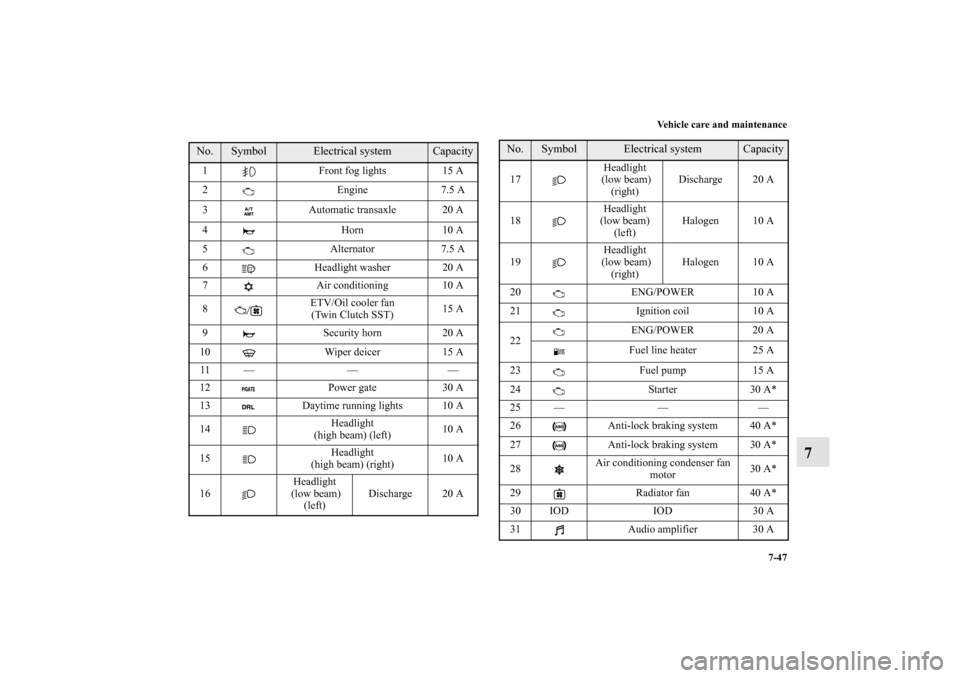
No.
Symbol
Electrical system
Capacity
1 Front fog lights 15 A
2Engine7.5 A
3 Automatic transaxle 20 A
4 Horn 10 A
5 Alternator 7.5 A
6 Headlight washer 20 A
7 Air conditioning 10 A
8ETV/Oil cooler fan
(Twin Clutch SST)15 A
9 Security horn 20 A
10 Wiper deicer 15 A
11 — — —
12 Power gate 30 A
13 Daytime running lights 10 A
14Headlight
(high beam) (left)10 A
15Headlight
(high beam) (right)10 A
16Headlight
(low beam)
(left)Discharge 20 A
17Headlight
(low beam)
(right)Discharge 20 A
18Headlight
(low beam)
(left)Halogen 10 A
19Headlight
(low beam)
(right)Halogen 10 A
20 ENG/POWER 10 A
21 Ignition coil 10 A
22ENG/POWER 20 A
Fuel line heater 25 A
23 Fuel pump 15 A
24 Starter 30 A*
25 — — —
26 Anti-lock braking system 40 A*
27 Anti-lock braking system 30 A*
28Air conditioning condenser fan
motor30 A*
29 Radiator fan 40 A*
30 IOD IOD 30 A
31 Audio amplifier 30 ANo.
Symbol
Electrical system
Capacity
BK0122500US.book 47 ページ 2010年5月12日 水曜日 午前11時11分
Page 647 of 714
7-50 Vehicle care and maintenance
7
4. Use the fuse location diagrams and the matching tables, to
check the fuse that is related to the problem. If the fuse is
not blown, something else must be causing the problem.
Have the system inspected by your authorized Mitsubishi
Motors dealer or a repair facility of your choice.5. Insert a new fuse of the same capacity securely into the
appropriate slot.B- Fuse is OK
C- Blown fuse
CAUTION
!�Never use a fuse with a capacity greater than the one
listed or any substitute, such as wire, foil etc. This
would cause the circuit wiring to heat up and could
cause a fire.�If the replacement fuse blows again after a short
time, have the electrical system checked by an
authorized Mitsubishi Motors dealer or a repair
facility of your choice to find and correct the cause.
BK0122500US.book 50 ページ 2010年5月12日 水曜日 午前11時11分
Page 706 of 714
Alphabetical index
3
E
Electric rear window defogger switch 3-232
Electronic immobilizer (Anti-theft starting system) 3-5
,3-42
Electronically controlled 4WD system 3-112
Emission-control system maintenance 7-35
Engine
Compartment 7-7
Coolant 7-12
,9-11
Hood 7-4
MIVEC 3-33,3-41
,3-91
Oil and oil filter 7-8,9-11
Overheating 6-5
Serial number 9-2
Specification 9-9
Engine coolant temperature display 3-169
Engine hood 7-4
Exhaust system 7-40
F
Floor console box 3-276
Fluid
Automatic transaxle fluid 7-16
,9-11
Brake fluid 9-11
Continuously variable transmission (CVT) fluid 7-18
,9-11
Engine coolant 7-12
,9-11
Engine oil 7-8
Power steering fluid 7-21
,9-11
Rear axle oil 7-19Transfer oil 7-18
Washer fluid 7-19
,9-11
Fluid capacities and lubricants 9-11
Free-hand advanced security transmitter (F.A.S.T.-key) 3-16
Front fog lights
Bulb capacity 7-51
Indicators 3-206
Replacement 7-65
Switch 3-222
Front seat adjustment 2-5
Front side-marker lights
Bulb capacity 7-51
Replacement 7-61
Front turn-signal light
Bulb capacity 7-51
Replacement 7-62
Fuel
Filling the fuel tank 1-4
Fuel economy 4-2
Fuel hoses 7-36
Fuel selection 1-2
Tank capacity 9-11
Fuses 7-42
Fusible links 7-42
G
General maintenance
Maintenance 7-37
General vehicle data 9-6
BK0122500US.book 3 ページ 2010年5月12日 水曜日 午前11時11分