Page 14 of 706
Overview
Outside (Rear)
N00100601017
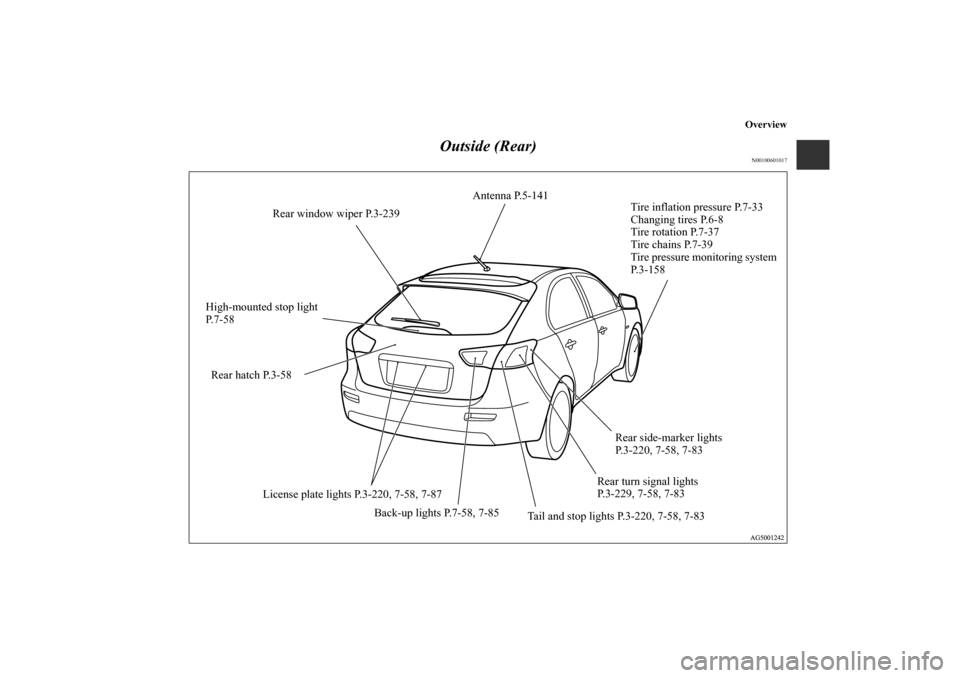
Antenna P.5-141
Tire inflation pressure P.7-33
Changing tires P.6-8
Tire rotation P.7-37
Tire chains P.7-39
Tire pressure monitoring system
P. 3 - 1 5 8
Rear side-marker lights
P.3-220, 7-58, 7-83
Tail and stop lights P.3-220, 7-58, 7-83 Back-up lights P.7-58, 7-85 License plate lights P.3-220, 7-58, 7-87 Rear hatch P.3-58 High-mounted stop light
P. 7 - 5 8Rear window wiper P.3-239
Rear turn signal lights
P.3-229, 7-58, 7-83
BK0125300US.book 12 ページ 2010年5月18日 火曜日 午後1時53分
Page 17 of 706

2 Quick index
Anti-lock braking system warning light�When this light comes on, the anti-lock braking system is not func-
tioning and only the ordinary braking system is functioning.
�Park your vehicle in a safe place and stop the engine.
Test the system as described on page 3-141.
�If the light does not go out after the test, or if it comes on again, we
recommend that you have the system checked at an authorized Mit-
subishi Motors dealer or a repair facility of your choice as soon as
possible.P.3-140,
3-141
SRS warning light�It is not necessary to stop the vehicle immediately, but we recommend
that you have the airbag and the pre-tensioner seat belt system
checked at an authorized Mitsubishi Motors dealer as soon as possi-
ble.P. 2 - 2 4 ,
2-46
Tire pressure monitoring system warning light�If the warning light comes on, you should stop and adjust the tires to
the proper inflation pressure as soon as possible.
(See “Tire inflation pressures” on page 7-33.)
Once adjustments have been made, the warning light will go off after
a few minutes of driving.
�If the warning light blinks for approximately 1 minute and then
remains continuously illuminated, the system is not operating prop-
erly. If the system returns to normal, the warning light will go off. If
the warning light does not go off, have the vehicle inspected at an
authorized Mitsubishi Motors dealer.P.3-159
Warning light
Do this
Ref. page
BK0125300US.book 2 ページ 2010年5月18日 火曜日 午後1時53分
Page 22 of 706
Quick index
7
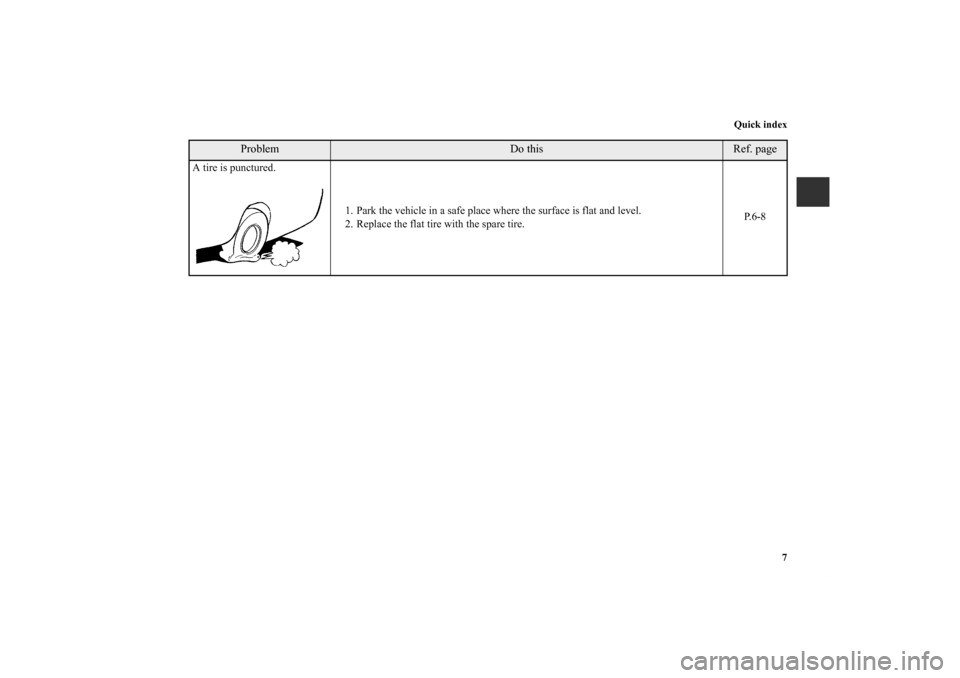
A tire is punctured.
1. Park the vehicle in a safe place where the surface is flat and level.
2. Replace the flat tire with the spare tire.P. 6 - 8
Problem
Do this
Ref. page
BK0125300US.book 7 ページ 2010年5月18日 火曜日 午後1時53分
Page 86 of 706
Seat and restraint systems
2-53
2
Side airbag system
N00408100359
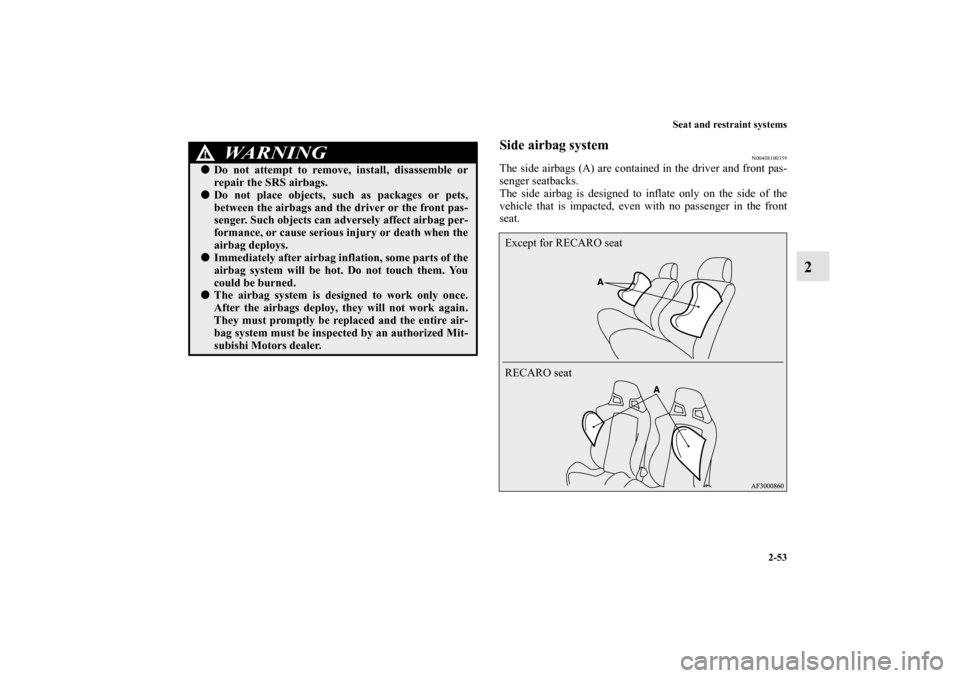
The side airbags (A) are contained in the driver and front pas-
senger seatbacks.
The side airbag is designed to inflate only on the side of the
vehicle that is impacted, even with no passenger in the front
seat.
WA R N I N G
!�Do not attempt to remove, install, disassemble or
repair the SRS airbags.�Do not place objects, such as packages or pets,
between the airbags and the driver or the front pas-
senger. Such objects can adversely affect airbag per-
formance, or cause serious injury or death when the
airbag deploys.�Immediately after airbag inflation, some parts of the
airbag system will be hot. Do not touch them. You
could be burned. �The airbag system is designed to work only once.
After the airbags deploy, they will not work again.
They must promptly be replaced and the entire air-
bag system must be inspected by an authorized Mit-
subishi Motors dealer.
Except for RECARO seat
RECARO seat
BK0125300US.book 53 ページ 2010年5月18日 火曜日 午後1時53分
Page 224 of 706
Features and controls
3-129
3 All-wheel drive system
(if so equipped)
N00516400046
All-wheel drive vehicles are propelled by engine power distrib-
uted constantly and appropriately to all four wheels.
Not only does this ensure enhanced handling on dry, paved
roads but also permits better traction when driving on slippery,
wet or snow-covered roads and when moving out of mud.
These vehicles, however, are not designed for off-road use,
and are unsuitable for driving on bumpy ground that may
cause excessive strain. All-wheel drive vehicles should be
driven only under the same conditions as are suitable for ordi-
nary front-wheel drive vehicles.
Cautions on handling of all-wheel drive
vehicles
N00530800158
Tires and wheelsSince driving torque can be applied to the four wheels, the
driving performance of the vehicle when operating in all-wheel
drive is greatly affected by the condition of the tires.
Pay close attention to the tires.
�Install only the specified tires on all wheels. Refer to
“Tires and wheels” on page 9-9.
�Be sure all four tires and wheels are the same size and
type.
When it is necessary to replace any of the tires or wheels,
replace all four.
�All tires should be rotated before the wear difference
between the front and rear tires is recognizable.
Good vehicle performance cannot be expected if there is a dif-
ference in wear between tires. Refer to “Tire rotation” on page
7-37.
�Check the tire inflation pressure regularly.
BK0125300US.book 129 ページ 2010年5月18日 火曜日 午後1時53分
Page 253 of 706
3-158 Features and controls
3Tire pressure monitoring system
N00530200370
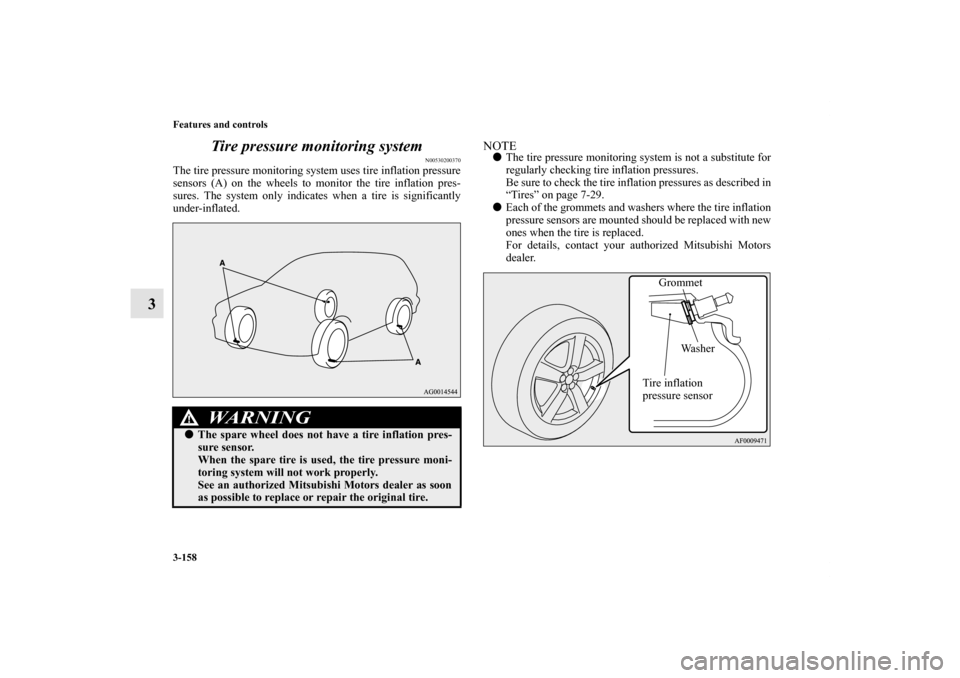
The tire pressure monitoring system uses tire inflation pressure
sensors (A) on the wheels to monitor the tire inflation pres-
sures. The system only indicates when a tire is significantly
under-inflated.
NOTE�The tire pressure monitoring system is not a substitute for
regularly checking tire inflation pressures.
Be sure to check the tire inflation pressures as described in
“Tires” on page 7-29.
�Each of the grommets and washers where the tire inflation
pressure sensors are mounted should be replaced with new
ones when the tire is replaced.
For details, contact your authorized Mitsubishi Motors
dealer.
WA R N I N G
!�The spare wheel does not have a tire inflation pres-
sure sensor.
When the spare tire is used, the tire pressure moni-
toring system will not work properly.
See an authorized Mitsubishi Motors dealer as soon
as possible to replace or repair the original tire.
Grommet
Wa s h e r
Tire inflation
pressure sensor
BK0125300US.book 158 ページ 2010年5月18日 火曜日 午後1時53分
Page 254 of 706
Features and controls
3-159
3
The tire pressure monitoring system warning
light/display
N00532700308
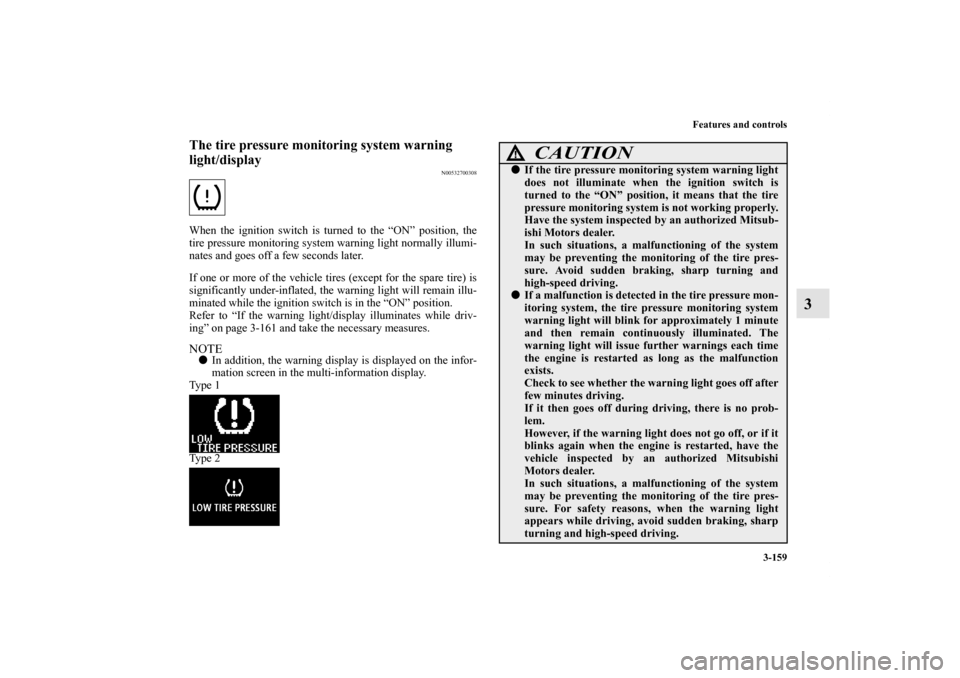
When the ignition switch is turned to the “ON” position, the
tire pressure monitoring system warning light normally illumi-
nates and goes off a few seconds later.
If one or more of the vehicle tires (except for the spare tire) is
significantly under-inflated, the warning light will remain illu-
minated while the ignition switch is in the “ON” position.
Refer to “If the warning light/display illuminates while driv-
ing” on page 3-161 and take the necessary measures.NOTE�In addition, the warning display is displayed on the infor-
mation screen in the multi-information display.
Ty p e 1
Ty p e 2
CAUTION
!�If the tire pressure monitoring system warning light
does not illuminate when the ignition switch is
turned to the “ON” position, it means that the tire
pressure monitoring system is not working properly.
Have the system inspected by an authorized Mitsub-
ishi Motors dealer.
In such situations, a malfunctioning of the system
may be preventing the monitoring of the tire pres-
sure. Avoid sudden braking, sharp turning and
high-speed driving.�If a malfunction is detected in the tire pressure mon-
itoring system, the tire pressure monitoring system
warning light will blink for approximately 1 minute
and then remain continuously illuminated. The
warning light will issue further warnings each time
the engine is restarted as long as the malfunction
exists.
Check to see whether the warning light goes off after
few minutes driving.
If it then goes off during driving, there is no prob-
lem.
However, if the warning light does not go off, or if it
blinks again when the engine is restarted, have the
vehicle inspected by an authorized Mitsubishi
Motors dealer.
In such situations, a malfunctioning of the system
may be preventing the monitoring of the tire pres-
sure. For safety reasons, when the warning light
appears while driving, avoid sudden braking, sharp
turning and high-speed driving.
BK0125300US.book 159 ページ 2010年5月18日 火曜日 午後1時53分
Page 255 of 706
3-160 Features and controls
3
NOTE�In addition, the warning display is displayed on the infor-
mation screen in the multi-information display.
Ty p e 1
Ty p e 2Each tire, including the spare (if provided), should be checked
monthly when cold and inflated to the inflation pressure rec-
ommended by the vehicle manufacturer on the vehicle placard
or tire inflation pressure label. (If your vehicle has tires of a
different size than the size indicated on the vehicle placard or
tire inflation pressure label, you should determine the proper
tire inflation pressure for those tires.)
As an added safety feature, your vehicle has been equipped
with a tire pressure monitoring system (TPMS) that illuminates
a low tire pressure telltale when one or more of your tires is
significantly under-inflated.
Accordingly, when the low tire pressure telltale illuminates,
you should stop and check your tires as soon as possible, and
inflate them to the proper pressure. Driving on a significantly
under-inflated tire causes the tire to overheat and can lead to
tire failure.
Under-inflation also reduces fuel efficiency and tire tread life,
and may affect the vehicle’s handling and stopping ability.
Please note that the TPMS is not a substitute for proper tire
maintenance, and it is the driver’s responsibility to maintain
correct tire pressure, even if under-inflation has not reached the
level to trigger illumination of the TPMS low tire pressure tell-
tale.
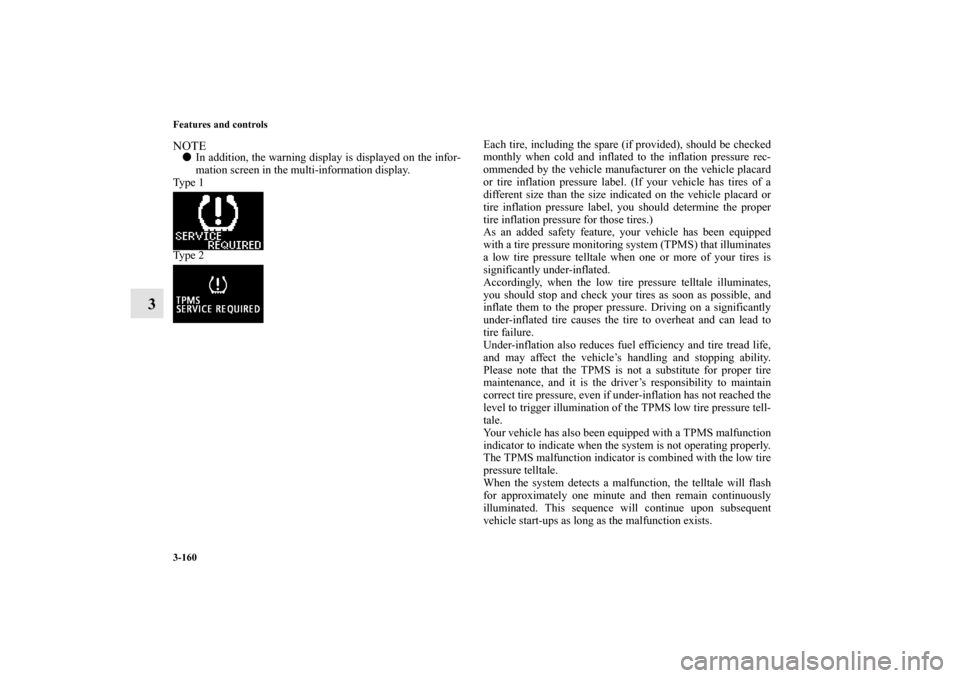
Your vehicle has also been equipped with a TPMS malfunction
indicator to indicate when the system is not operating properly.
The TPMS malfunction indicator is combined with the low tire
pressure telltale.
When the system detects a malfunction, the telltale will flash
for approximately one minute and then remain continuously
illuminated. This sequence will continue upon subsequent
vehicle start-ups as long as the malfunction exists.
BK0125300US.book 160 ページ 2010年5月18日 火曜日 午後1時53分