Page 632 of 706
Vehicle care and maintenance
7-53
7
*- Fusible link
�Some fuses may not be installed on your vehicle, depend-
ing on the vehicle model or specifications.
�The table above shows the main equipment corresponding
to each fuse.
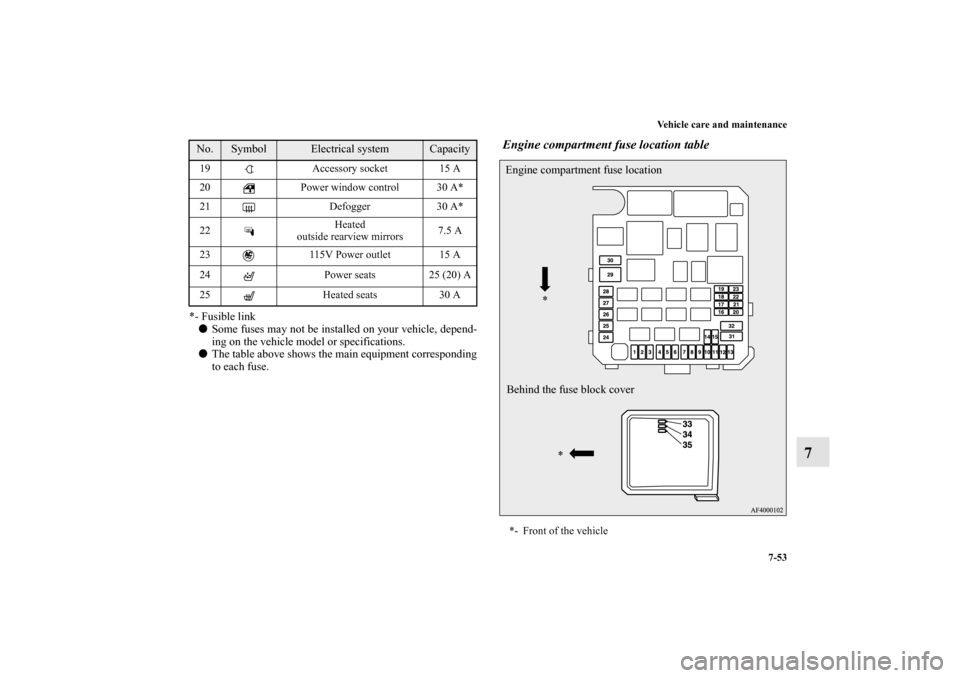
Engine compartment fuse location table
19 Accessory socket 15 A
20 Power window control 30 A*
21 Defogger 30 A*
22Heated
outside rearview mirrors7.5 A
23 115V Power outlet 15 A
24 Power seats 25 (20) A
25 Heated seats 30 ANo.
Symbol
Electrical system
Capacity
*- Front of the vehicleEngine compartment fuse location
Behind the fuse block cover*
*
BK0125300US.book 53 ページ 2010年5月18日 火曜日 午後1時53分
Page 633 of 706
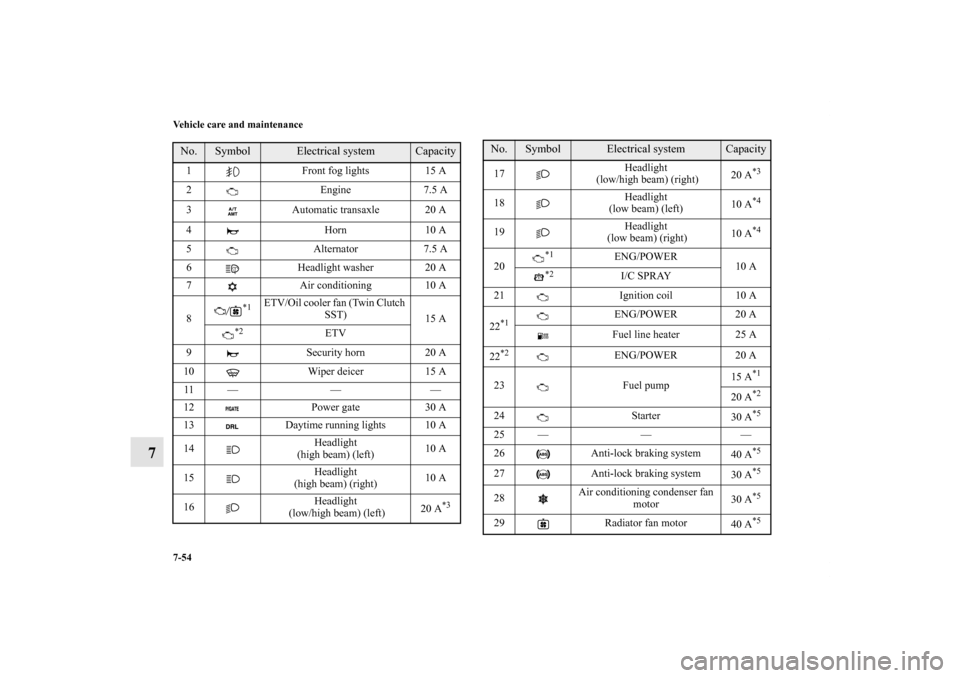
7-54 Vehicle care and maintenance
7
No.
Symbol
Electrical system
Capacity
1 Front fog lights 15 A
2 Engine 7.5 A
3 Automatic transaxle 20 A
4 Horn 10 A
5 Alternator 7.5 A
6 Headlight washer 20 A
7 Air conditioning 10 A
8
*1
ETV/Oil cooler fan (Twin Clutch
SST)
15 A
*2
ETV
9 Security horn 20 A
10 Wiper deicer 15 A
11 — — —
12 Power gate 30 A
13 Daytime running lights 10 A
14Headlight
(high beam) (left)10 A
15Headlight
(high beam) (right)10 A
16Headlight
(low/high beam) (left)20 A
*3
17Headlight
(low/high beam) (right)20 A
*3
18Headlight
(low beam) (left)10 A
*4
19Headlight
(low beam) (right)10 A
*4
20
*1
ENG/POWER
10 A
*2
I/C SPRAY
21 Ignition coil 10 A
22
*1
ENG/POWER 20 A
Fuel line heater 25 A
22
*2
ENG/POWER 20 A
23 Fuel pump15 A
*1
20 A
*2
24 Starter
30 A
*5
25 — — —
26 Anti-lock braking system
40 A
*5
27 Anti-lock braking system
30 A
*5
28Air conditioning condenser fan
motor30 A
*5
29 Radiator fan motor
40 A
*5
No.
Symbol
Electrical system
Capacity
BK0125300US.book 54 ページ 2010年5月18日 火曜日 午後1時53分
Page 635 of 706
7-56 Vehicle care and maintenance
7
Fuse replacement
N00954900085
1. Before replacing a fuse, always turn off the electrical item
connected to the fuse and turn the ignition switch to the
“LOCK” position.
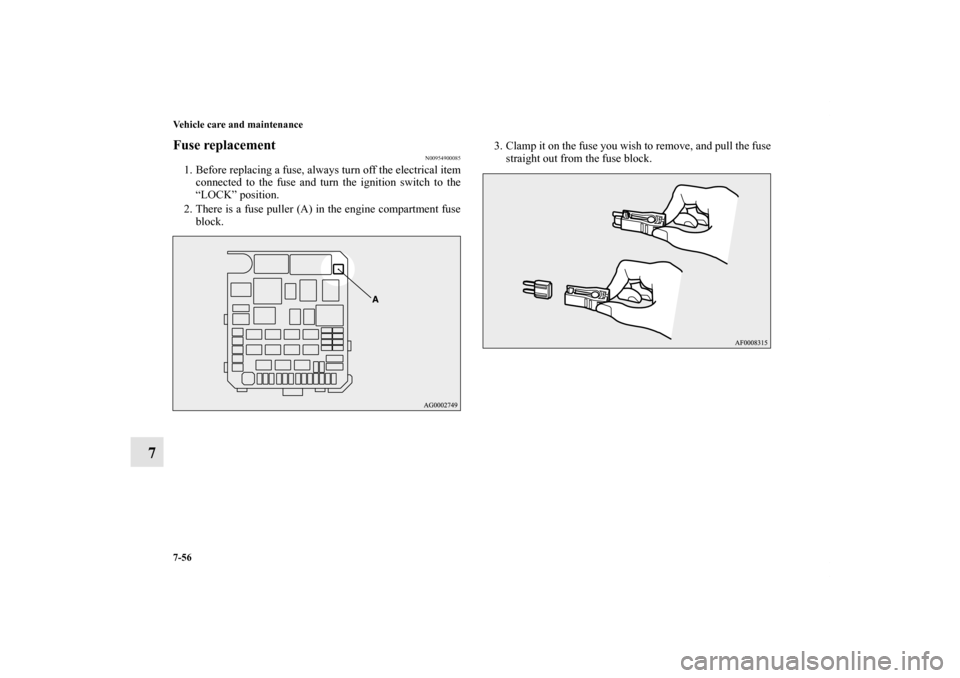
2. There is a fuse puller (A) in the engine compartment fuse
block.3. Clamp it on the fuse you wish to remove, and pull the fuse
straight out from the fuse block.
BK0125300US.book 56 ページ 2010年5月18日 火曜日 午後1時53分
Page 641 of 706
7-62 Vehicle care and maintenance
7
Headlights (low beam, except for vehicles
equipped with high intensity discharge head-
lights)
N00901800088
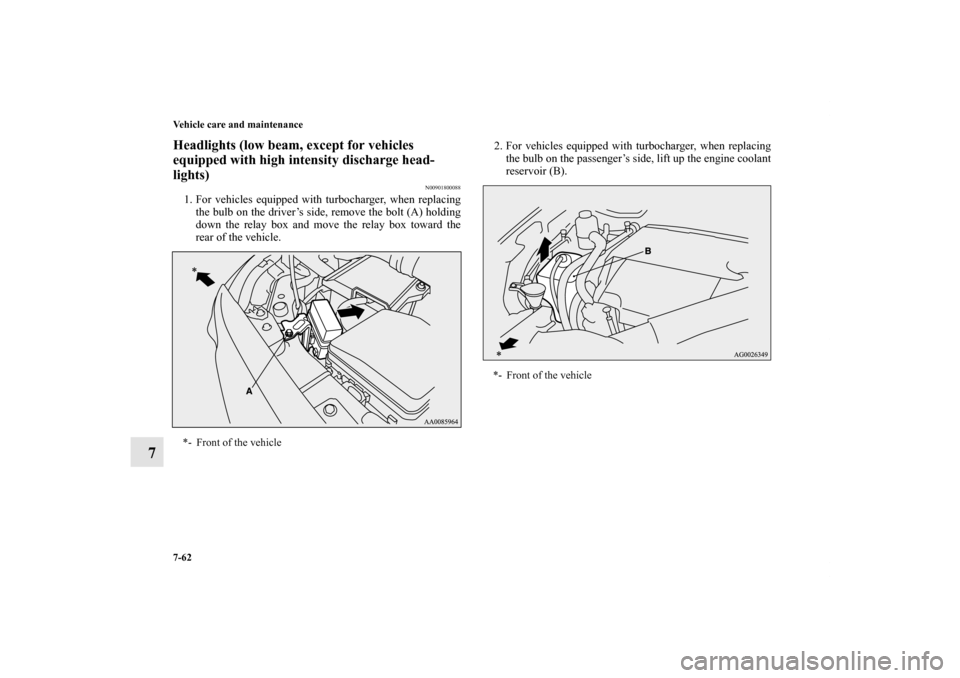
1. For vehicles equipped with turbocharger, when replacing
the bulb on the driver’s side, remove the bolt (A) holding
down the relay box and move the relay box toward the
rear of the vehicle.2. For vehicles equipped with turbocharger, when replacing
the bulb on the passenger’s side, lift up the engine coolant
reservoir (B).*- Front of the vehicle
*- Front of the vehicle
BK0125300US.book 62 ページ 2010年5月18日 火曜日 午後1時53分
Page 649 of 706
7-70 Vehicle care and maintenance
7
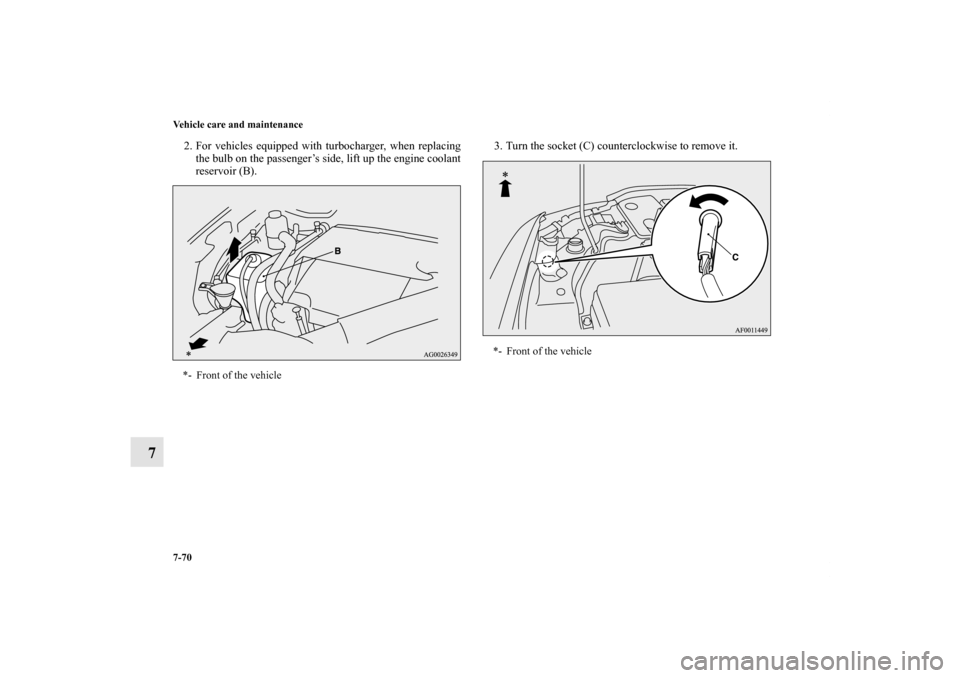
2. For vehicles equipped with turbocharger, when replacing
the bulb on the passenger’s side, lift up the engine coolant
reservoir (B).3. Turn the socket (C) counterclockwise to remove it.*- Front of the vehicle
*- Front of the vehicle
BK0125300US.book 70 ページ 2010年5月18日 火曜日 午後1時53分
Page 674 of 706
Vehicle care and maintenance
7-95
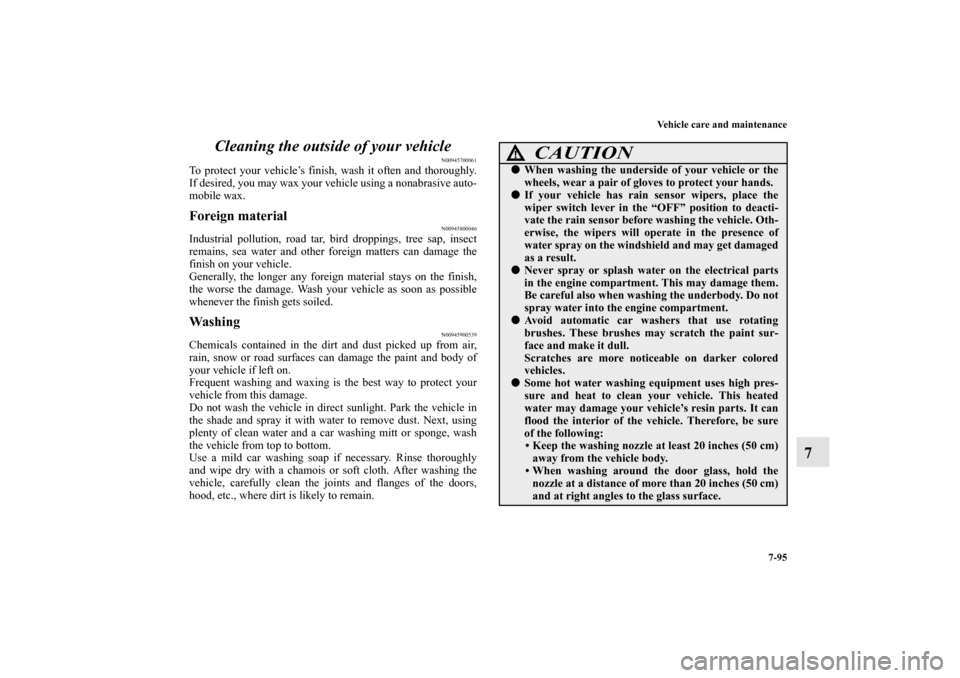
7 Cleaning the outside of your vehicle
N00945700061
To protect your vehicle’s finish, wash it often and thoroughly.
If desired, you may wax your vehicle using a nonabrasive auto-
mobile wax. Foreign material
N00945800046
Industrial pollution, road tar, bird droppings, tree sap, insect
remains, sea water and other foreign matters can damage the
finish on your vehicle.
Generally, the longer any foreign material stays on the finish,
the worse the damage. Wash your vehicle as soon as possible
whenever the finish gets soiled.Wash i ng
N00945900539
Chemicals contained in the dirt and dust picked up from air,
rain, snow or road surfaces can damage the paint and body of
your vehicle if left on.
Frequent washing and waxing is the best way to protect your
vehicle from this damage.
Do not wash the vehicle in direct sunlight. Park the vehicle in
the shade and spray it with water to remove dust. Next, using
plenty of clean water and a car washing mitt or sponge, wash
the vehicle from top to bottom.
Use a mild car washing soap if necessary. Rinse thoroughly
and wipe dry with a chamois or soft cloth. After washing the
vehicle, carefully clean the joints and flanges of the doors,
hood, etc., where dirt is likely to remain.
CAUTION
!�When washing the underside of your vehicle or the
wheels, wear a pair of gloves to protect your hands.�If your vehicle has rain sensor wipers, place the
wiper switch lever in the “OFF” position to deacti-
vate the rain sensor before washing the vehicle. Oth-
erwise, the wipers will operate in the presence of
water spray on the windshield and may get damaged
as a result.�Never spray or splash water on the electrical parts
in the engine compartment. This may damage them.
Be careful also when washing the underbody. Do not
spray water into the engine compartment.�Avoid automatic car washers that use rotating
brushes. These brushes may scratch the paint sur-
face and make it dull.
Scratches are more noticeable on darker colored
vehicles.�Some hot water washing equipment uses high pres-
sure and heat to clean your vehicle. This heated
water may damage your vehicle’s resin parts. It can
flood the interior of the vehicle. Therefore, be sure
of the following:
• Keep the washing nozzle at least 20 inches (50 cm)
away from the vehicle body.
• When washing around the door glass, hold the
nozzle at a distance of more than 20 inches (50 cm)
and at right angles to the glass surface.
BK0125300US.book 95 ページ 2010年5月18日 火曜日 午後1時53分
Page 676 of 706
Vehicle care and maintenance
7-97
7
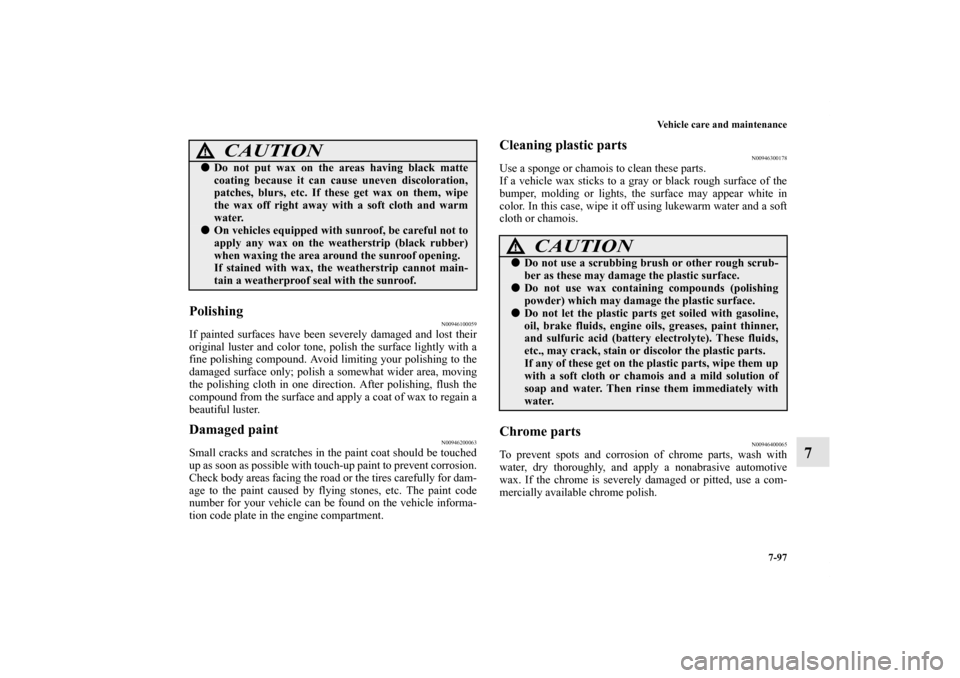
Polishing
N00946100059
If painted surfaces have been severely damaged and lost their
original luster and color tone, polish the surface lightly with a
fine polishing compound. Avoid limiting your polishing to the
damaged surface only; polish a somewhat wider area, moving
the polishing cloth in one direction. After polishing, flush the
compound from the surface and apply a coat of wax to regain a
beautiful luster.Damaged paint
N00946200063
Small cracks and scratches in the paint coat should be touched
up as soon as possible with touch-up paint to prevent corrosion.
Check body areas facing the road or the tires carefully for dam-
age to the paint caused by flying stones, etc. The paint code
number for your vehicle can be found on the vehicle informa-
tion code plate in the engine compartment.
Cleaning plastic parts
N00946300178
Use a sponge or chamois to clean these parts.
If a vehicle wax sticks to a gray or black rough surface of the
bumper, molding or lights, the surface may appear white in
color. In this case, wipe it off using lukewarm water and a soft
cloth or chamois. Chrome parts
N00946400065
To prevent spots and corrosion of chrome parts, wash with
water, dry thoroughly, and apply a nonabrasive automotive
wax. If the chrome is severely damaged or pitted, use a com-
mercially available chrome polish.
�Do not put wax on the areas having black matte
coating because it can cause uneven discoloration,
patches, blurs, etc. If these get wax on them, wipe
the wax off right away with a soft cloth and warm
water.�On vehicles equipped with sunroof, be careful not to
apply any wax on the weatherstrip (black rubber)
when waxing the area around the sunroof opening.
If stained with wax, the weatherstrip cannot main-
tain a weatherproof seal with the sunroof.
CAUTION
!
CAUTION
!�Do not use a scrubbing brush or other rough scrub-
ber as these may damage the plastic surface. �Do not use wax containing compounds (polishing
powder) which may damage the plastic surface. �Do not let the plastic parts get soiled with gasoline,
oil, brake fluids, engine oils, greases, paint thinner,
and sulfuric acid (battery electrolyte). These fluids,
etc., may crack, stain or discolor the plastic parts.
If any of these get on the plastic parts, wipe them up
with a soft cloth or chamois and a mild solution of
soap and water. Then rinse them immediately with
water.
BK0125300US.book 97 ページ 2010年5月18日 火曜日 午後1時53分
Page 678 of 706
Vehicle care and maintenance
7-99
7
Engine compartment
N00947000042
Never spray or splash water on the electrical components in the
engine compartment, as this may cause damage.
Do not allow any nearby parts (such as plastic parts) come into
contact with sulphuric acid (battery electrolyte), which may
crack, stain, or discolour them.
If this occurs, wipe the parts with a soft cloth saturated with a
mild detergent and water solution.
Then immediately rinse the affected parts with plenty of water.
BK0125300US.book 99 ページ 2010年5月18日 火曜日 午後1時53分