Page 115 of 706
3-20 Features and controls
3
To operate using the F.A.S.T.-key
N00503400185
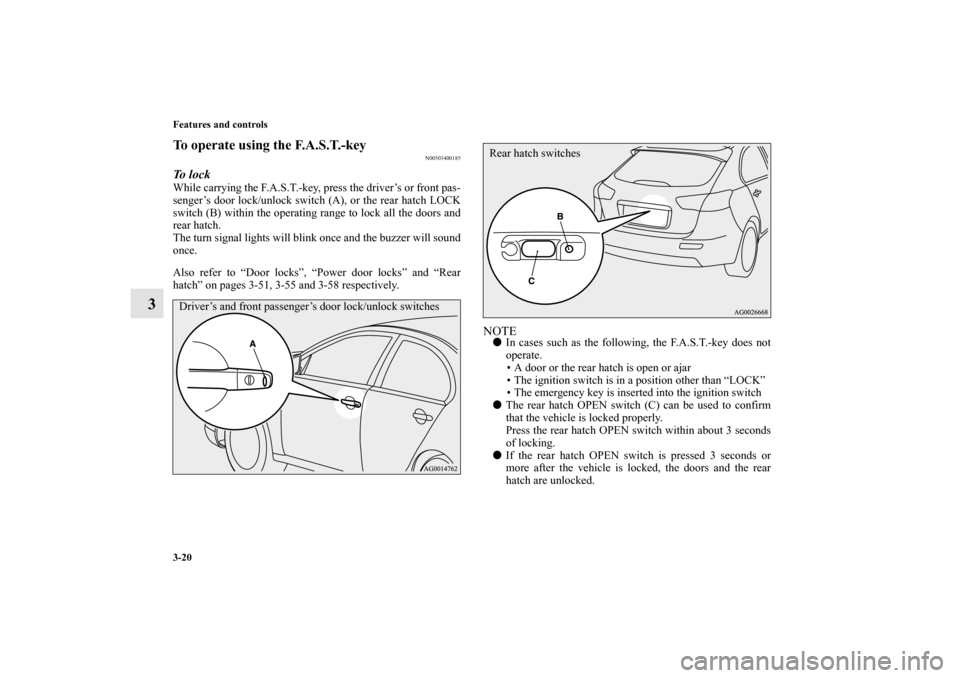
To l o c kWhile carrying the F.A.S.T.-key, press the driver’s or front pas-
senger’s door lock/unlock switch (A), or the rear hatch LOCK
switch (B) within the operating range to lock all the doors and
rear hatch.
The turn signal lights will blink once and the buzzer will sound
once.
Also refer to “Door locks”, “Power door locks” and “Rear
hatch” on pages 3-51, 3-55 and 3-58 respectively.
NOTE�In cases such as the following, the F.A.S.T.-key does not
operate.
• A door or the rear hatch is open or ajar
• The ignition switch is in a position other than “LOCK”
• The emergency key is inserted into the ignition switch
�The rear hatch OPEN switch (C) can be used to confirm
that the vehicle is locked properly.
Press the rear hatch OPEN switch within about 3 seconds
of locking.
�If the rear hatch OPEN switch is pressed 3 seconds or
more after the vehicle is locked, the doors and the rear
hatch are unlocked.
Driver’s and front passenger’s door lock/unlock switches
Rear hatch switches
BK0125300US.book 20 ページ 2010年5月18日 火曜日 午後1時53分
Page 116 of 706
Features and controls
3-21
3
�The time within which locking confirmation is possible
can be adjusted. See an authorized Mitsubishi Motors
dealer for details.
On a vehicle equipped with a Mitsubishi Multi-Communi-
cation System, the function can be adjusted on the screen.
For details, refer to the separate operation manual.To unlockWhile carrying the F.A.S.T.-key within the operating range,
you can unlock the doors and the rear hatch by F.A.S.T.-key
operation.
The dome light will turn on for 30 seconds. The turn signal
lights will blink twice and the buzzer will sound twice.
Also refer to “Door locks”, “Power door locks” and “Rear
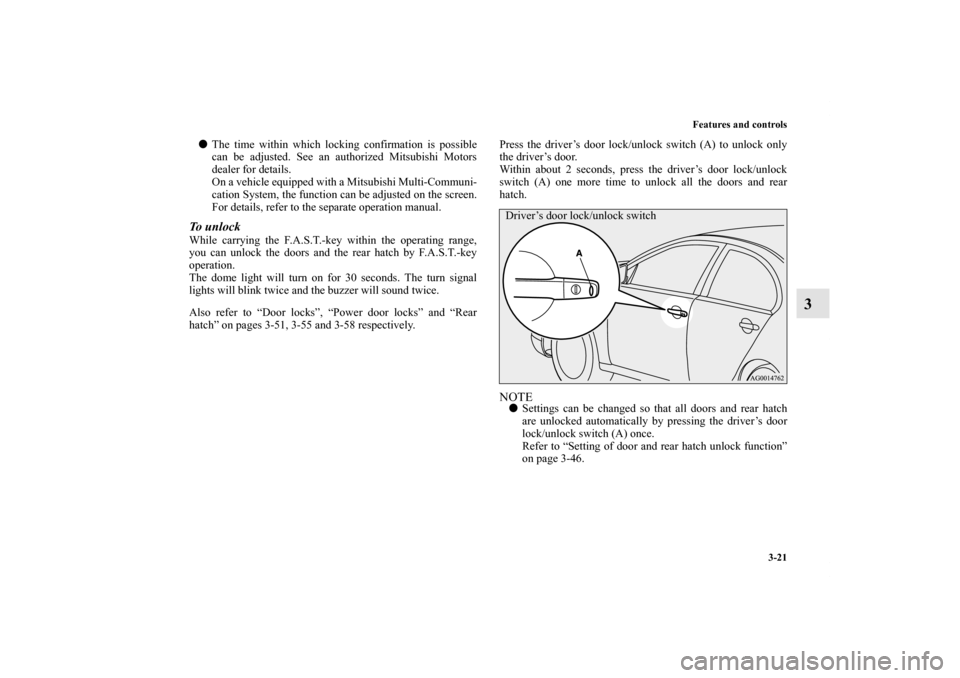
hatch” on pages 3-51, 3-55 and 3-58 respectively.Press the driver’s door lock/unlock switch (A) to unlock only
the driver’s door.
Within about 2 seconds, press the driver’s door lock/unlock
switch (A) one more time to unlock all the doors and rear
hatch.
NOTE�Settings can be changed so that all doors and rear hatch
are unlocked automatically by pressing the driver’s door
lock/unlock switch (A) once.
Refer to “Setting of door and rear hatch unlock function”
on page 3-46.Driver’s door lock/unlock switch
BK0125300US.book 21 ページ 2010年5月18日 火曜日 午後1時53分
Page 146 of 706
Features and controls
3-51
3
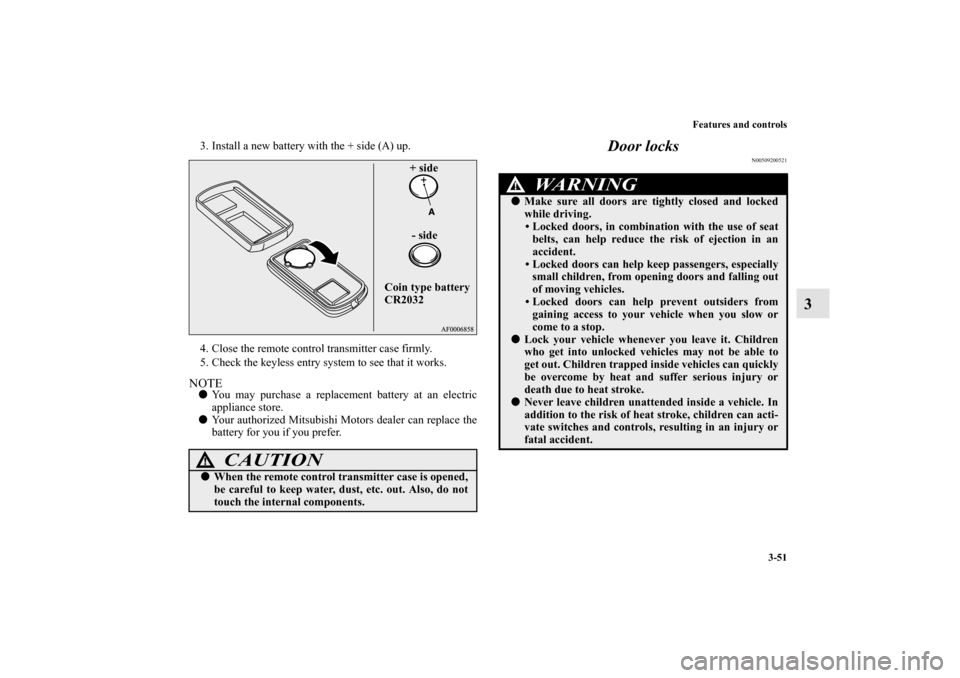
3. Install a new battery with the + side (A) up.
4. Close the remote control transmitter case firmly.
5. Check the keyless entry system to see that it works.NOTE�You may purchase a replacement battery at an electric
appliance store.
�Your authorized Mitsubishi Motors dealer can replace the
battery for you if you prefer.
Door locks
N00509200521
CAUTION
!�When the remote control transmitter case is opened,
be careful to keep water, dust, etc. out. Also, do not
touch the internal components.
Coin type battery
CR2032+ side
- side
WA R N I N G
!�Make sure all doors are tightly closed and locked
while driving.
• Locked doors, in combination with the use of seat
belts, can help reduce the risk of ejection in an
accident.
• Locked doors can help keep passengers, especially
small children, from opening doors and falling out
of moving vehicles.
• Locked doors can help prevent outsiders from
gaining access to your vehicle when you slow or
come to a stop.
�Lock your vehicle whenever you leave it. Children
who get into unlocked vehicles may not be able to
get out. Children trapped inside vehicles can quickly
be overcome by heat and suffer serious injury or
death due to heat stroke.�Never leave children unattended inside a vehicle. In
addition to the risk of heat stroke, children can acti-
vate switches and controls, resulting in an injury or
fatal accident.
BK0125300US.book 51 ページ 2010年5月18日 火曜日 午後1時53分
Page 152 of 706
Features and controls
3-57
3 “Child safety locks” for rear door
N00509400204
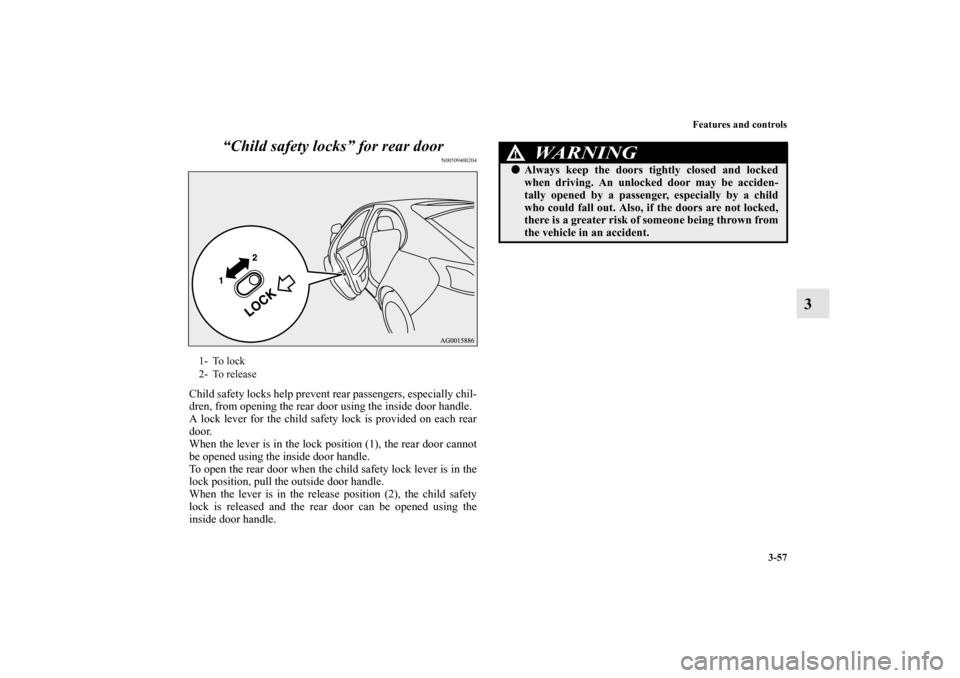
Child safety locks help prevent rear passengers, especially chil-
dren, from opening the rear door using the inside door handle.
A lock lever for the child safety lock is provided on each rear
door.
When the lever is in the lock position (1), the rear door cannot
be opened using the inside door handle.
To open the rear door when the child safety lock lever is in the
lock position, pull the outside door handle.
When the lever is in the release position (2), the child safety
lock is released and the rear door can be opened using the
inside door handle.1- To lock
2- To release
WA R N I N G
!�Always keep the doors tightly closed and locked
when driving. An unlocked door may be acciden-
tally opened by a passenger, especially by a child
who could fall out. Also, if the doors are not locked,
there is a greater risk of someone being thrown from
the vehicle in an accident.
BK0125300US.book 57 ページ 2010年5月18日 火曜日 午後1時53分
Page 165 of 706
3-70 Features and controls
3
Timer functionThe power windows can be run up or down when the ignition
switch is in the “ON” position.
The door windows can be opened or closed for a 30 second
period after the ignition switch is turned to the “ACC” or
“LOCK” position. However, once the driver’s door or the front
passenger’s door is opened, the power windows cannot be
operated.
Safety mechanism (Driver’s door window only)
N00528800089
If a hand or head is trapped, for safety the door window is auto-
matically lowered a little.
After the door window is lowered, pull up the switch again to
close the door window.
WA R N I N G
!�If the safety mechanism is activated three or more
times successively, the safety mechanism will be tem-
porarily cancelled.
If a hand or head subsequently gets trapped, a seri-
ous injury can result.�The safety mechanism is deactivated while the
switch is pulled up continuously. Therefore be espe-
cially careful that hands or head are not trapped in
the door window opening.�Do not deliberately trap your hands or head in
order to activate the safety mechanism.
Your hand or head could be trapped and personal
injury could result.
CAUTION
!�The safety mechanism is deactivated just before the
door window closes. This allows the door window to
close completely. Therefore be especially careful that
fingers are not trapped in the door window opening.
BK0125300US.book 70 ページ 2010年5月18日 火曜日 午後1時53分
Page 169 of 706
3-74 Features and controls
3
5. The sunroof should now operate in the normal manner.
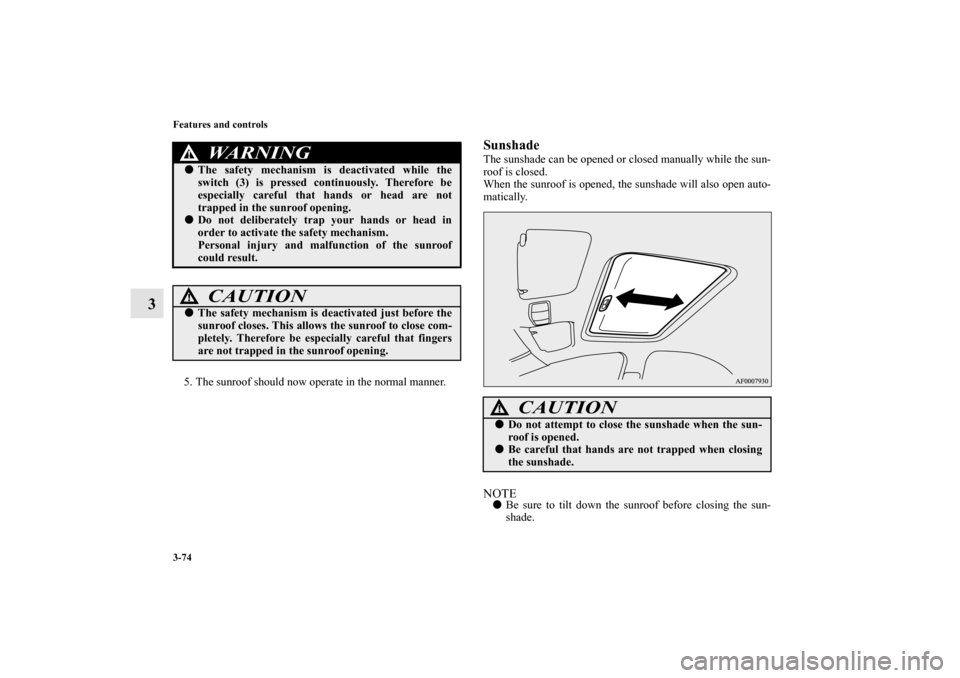
SunshadeThe sunshade can be opened or closed manually while the sun-
roof is closed.
When the sunroof is opened, the sunshade will also open auto-
matically.NOTE�Be sure to tilt down the sunroof before closing the sun-
shade.
WA R N I N G
!�The safety mechanism is deactivated while the
switch (3) is pressed continuously. Therefore be
especially careful that hands or head are not
trapped in the sunroof opening.�Do not deliberately trap your hands or head in
order to activate the safety mechanism.
Personal injury and malfunction of the sunroof
could result.
CAUTION
!�The safety mechanism is deactivated just before the
sunroof closes. This allows the sunroof to close com-
pletely. Therefore be especially careful that fingers
are not trapped in the sunroof opening.
CAUTION
!�Do not attempt to close the sunshade when the sun-
roof is opened.�Be careful that hands are not trapped when closing
the sunshade.
BK0125300US.book 74 ページ 2010年5月18日 火曜日 午後1時53分
Page 200 of 706
Features and controls
3-105
3
Operation of the CVT
N00514500333
CAUTION
!�Before selecting a position with the engine running
and the vehicle stationary, fully depress the brake
pedal to prevent the vehicle from creeping.
Do not release the brakes until you are ready to
drive away. The vehicle will begin to move as soon as
the CVT is engaged, especially when the engine
speed is high (fast idle or air conditioning on).�Depress the brake pedal with the right foot.
Using the left foot could cause driver movement
delay in case of an emergency.�To prevent sudden acceleration, never run the
engine at high rpms when shifting from the “P”
(PARK) or “N” (NEUTRAL) position.�Operating the accelerator pedal while the other foot
is resting on the brake pedal will affect braking effi-
ciency and may cause premature wear of brake
pads.�Use the selector lever in the correct shift position in
accordance with driving conditions.
Never coast downhill backward in the driving shift
position { “D” (DRIVE), “L” (LOW) or sports
mode} or coast forward in the “R” (REVERSE)
position.
Engine stopping and increased brake pedal and
steering effort could lead to an accident.
�Do not rev the engine with the brake pedal pressed
when the vehicle is stationary.
This can damage the CVT.
Also, when you depress the accelerator pedal while
holding down the brake pedal with the selector lever
in the “D” (DRIVE) position, the engine revolutions
may not rise as high as when performing the same
operation with the selector lever in the “N” (NEU-
TRAL) position.
CAUTION
!
BK0125300US.book 105 ページ 2010年5月18日 火曜日 午後1時53分
Page 202 of 706
Features and controls
3-107
3
When the CVT makes no speed change
N00515300208
If the CVT does not shift while driving, or your vehicle does
not pick up enough speed when starting on an uphill slope,
there may be something unusual happening in the transmission,
causing a safety device to activate. Have your vehicle checked
at an authorized Mitsubishi Motors dealer or a repair facility of
your choice as soon as possible.
1. If your vehicle has difficulty moving uphill, shift the
selector lever into “L” (LOW) position (except for vehi-
cles with sport mode) or 2nd shift range of the sports
mode.
This method might not work depending on the type of
transmission malfunction.
2. Once the vehicle is moving on a level road, move the
selector lever back to “D” (DRIVE) position.NOTE�When the warning display or the warning display
appears on the information screen in the multi-informa-
tion display, there could be a malfunction in the CVT.
Refer to “Continuously variable transmission (CVT):
Warning display” on page 3-100.
Twin Clutch SST (Sportronic Shift Trans-
mission)
(if so equipped)
N00539700046
The Twin Clutch SST is a transmission that, through integrated
control of the engine and transmission, is able to achieve both
the smooth shifting of an automatic transaxle and the accelera-
tion and fuel economy close to a manual transaxle. In addition,
the control mode can be selected from two types to suit the
driving conditions.
Together with manual shifting, the transmission is capable of
responding to a variety of driving circumstances.
Twin Clutch SST control mode → P. 3 - 1 1 6
Manual shift → P. 3 - 1 1 8
BK0125300US.book 107 ページ 2010年5月18日 火曜日 午後1時53分