Page 120 of 706
Features and controls
3-25
3
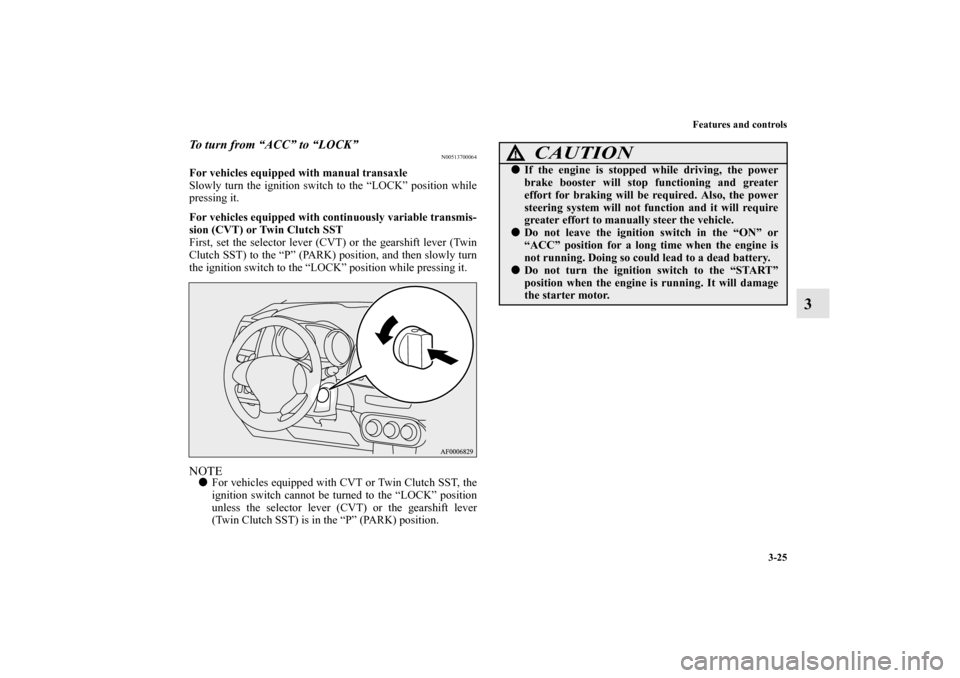
To turn from “ACC” to “LOCK”
N00513700064
For vehicles equipped with manual transaxle
Slowly turn the ignition switch to the “LOCK” position while
pressing it.
For vehicles equipped with continuously variable transmis-
sion (CVT) or Twin Clutch SST
First, set the selector lever (CVT) or the gearshift lever (Twin
Clutch SST) to the “P” (PARK) position, and then slowly turn
the ignition switch to the “LOCK” position while pressing it.NOTE�For vehicles equipped with CVT or Twin Clutch SST, the
ignition switch cannot be turned to the “LOCK” position
unless the selector lever (CVT) or the gearshift lever
(Twin Clutch SST) is in the “P” (PARK) position.
CAUTION
!�If the engine is stopped while driving, the power
brake booster will stop functioning and greater
effort for braking will be required. Also, the power
steering system will not function and it will require
greater effort to manually steer the vehicle.�Do not leave the ignition switch in the “ON” or
“ACC” position for a long time when the engine is
not running. Doing so could lead to a dead battery.�Do not turn the ignition switch to the “START”
position when the engine is running. It will damage
the starter motor.
BK0125300US.book 25 ページ 2010年5月18日 火曜日 午後1時53分
Page 155 of 706
3-60 Features and controls
3
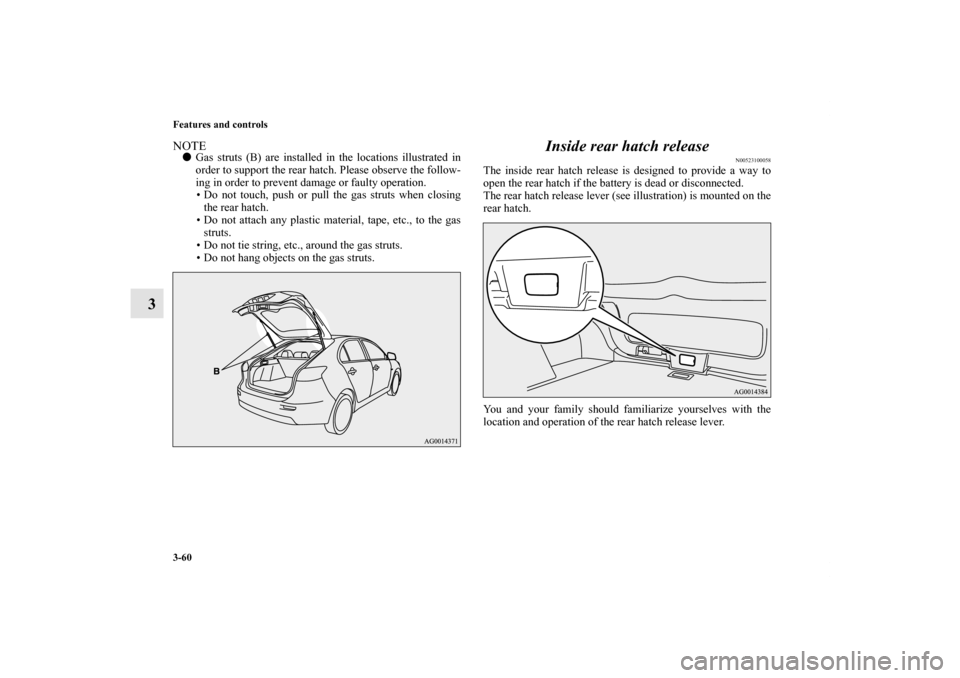
NOTE�Gas struts (B) are installed in the locations illustrated in
order to support the rear hatch. Please observe the follow-
ing in order to prevent damage or faulty operation.
• Do not touch, push or pull the gas struts when closing
the rear hatch.
• Do not attach any plastic material, tape, etc., to the gas
struts.
• Do not tie string, etc., around the gas struts.
• Do not hang objects on the gas struts.
Inside rear hatch release
N00523100058
The inside rear hatch release is designed to provide a way to
open the rear hatch if the battery is dead or disconnected.
The rear hatch release lever (see illustration) is mounted on the
rear hatch.
You and your family should familiarize yourselves with the
location and operation of the rear hatch release lever.
BK0125300US.book 60 ページ 2010年5月18日 火曜日 午後1時53分
Page 257 of 706
3-162 Features and controls
3
NOTE�To avoid the risk of damage to the tire inflation pressure
sensors, have any punctured tire repaired by an authorized
Mitsubishi Motors dealer. If the tire repair is not done by
an authorized Mitsubishi Motors dealer, it is not covered
by your warranty.
�Do not use an aerosol puncture-repair spray on any tire.
Such a spray could damage the tire inflation pressure sen-
sors. Have any puncture repaired by an authorized Mit-
subishi Motors dealer.The tire pressure monitoring system may not work normally in
the following circumstances:
�A wireless facility or device using the same frequency is
near the vehicle.
�Snow or ice is stuck inside the fenders and/or on the
wheels.
�The tire inflation pressure sensors’ battery is dead.
�Wheels other than Mitsubishi genuine wheels are being
used.
�Wheels that are not fitted with tire inflation pressure sen-
sors are being used.
�Wheels whose ID codes are not memorized by the vehicle
are used.
�Compact spare tire is fitted on a road wheel.
�A window tint that affects the radio wave signals is
installed.
NOTE�Tire inflation pressures vary with the ambient tempera-
ture. If the vehicle is subjected to large variations in ambi-
ent temperature, the tire inflation pressures may be under-
inflated (causing the warning light/display to come on)
when the ambient temperature is relatively low. If the
warning light/display comes on, adjust the tire inflation
pressure.
WA R N I N G
!�If the warning light/display illuminates while you
are driving, avoid hard braking, sharp steering
maneuvers and high speeds. Driving with an under-
inflated tire adversely affects vehicle performance
and can result in an accident.
CAUTION
!�If a tire has a puncture, replace that tire with the
spare tire. Driving on a punctured tire could lead to
an accident.�The warning light/display may not illuminate imme-
diately in the event of a tire blowout or rapid leak.
BK0125300US.book 162 ページ 2010年5月18日 火曜日 午後1時53分
Page 339 of 706
3-244 Features and controls
3
NOTE�If the ignition switch is left in the “ACC” position, the
accessory power will automatically turn off after a certain
period of time and you will no longer be able to use the
Bluetooth
® 2.0 interface. The accessory power comes on
again if the ignition switch is turned from the “ACC”
position. Refer to “ACC power auto-cutout function” on
page 3-83.
�The Bluetooth
® 2.0 interface cannot be used if the Blue-
tooth
® device has a dead battery or the device power is
turned off.
�Hands-free calls will not be possible if your phone does
not have service available.
�Some Bluetooth
® devices are not compatible with the
Bluetooth
® 2.0 interface.Steering control switch → P. 3 - 2 4 5
Voice recognition function → P. 3 - 2 4 7
Useful voice commands → P. 3 - 2 4 8
Speaker enrollment function → P.3-250
Connecting the Bluetooth
® 2.0 interface and the Bluetooth
®
device→ P.3-251
Operating a music player connected via Bluetooth
® → P. 3 - 2 5 6
How to make or receive hands-free calls → P. 3 - 2 5 6
Phonebook function → P. 3 - 2 6 0
WA R N I N G
!�Although the Bluetooth
® 2.0 interface allows you to
make hands-free calls, if you choose to use the cellu-
lar phone while driving, you must not allow yourself
to be distracted from the safe operation of your vehi-
cle. Anything, including cellular phone usage, that
distracts you from the safe operation of your vehicle
increases your risk of an accident.
�Refer to and comply with all state and local laws in
your area regarding cellular phone usage while driv-
ing.
BK0125300US.book 244 ページ 2010年5月18日 火曜日 午後1時53分
Page 557 of 706
6-2 For emergencies
6If the vehicle breaks down
N00836300204
If your vehicle breaks down on the road, move to the shoulder
and turn on the hazard warning flashers. If there is no shoulder,
or the shoulder is not safe, drive in the right lane slowly, with
the hazard lights flashing, until you come to a safe stopping
place. Keep the flashers flashing. If the engine stops/fails If the engine stops, there will be no power assist to the steering
and brakes, making these difficult to use.
�The brake booster will not work, so the brakes will not
grip well. The brake pedal will be harder to press than
usual.
�Since there is no power steering assist, the steering wheel
will be hard to turn. When the engine fails at the intersection Get help from your passengers, bystanders, etc. to push the
vehicle and move it to a safe zone.
Jump-starting the engine
N00836400654
If the engine cannot be started because the battery is weak or
dead, you can start it with the battery from another vehicle
using jumper cables.
1. Take off any metal jewelry such as watch bands or brace-
lets that might make an accidental electrical contact.
2. Position the vehicles close enough together so that the
jumper cables can reach, but be sure the vehicles aren’t
touching each other.
WA R N I N G
!�When using jumper cables to start a vehicle, follow
the procedures and be very cautious.
CAUTION
!�Do not try to start your vehicle by pushing or tow-
ing. Vehicles equipped with continuously variable
transmission (CVT) or Twin Clutch SST cannot be
started this way. Pushing or towing a vehicle that
has a manual transaxle may overheat and damage
the catalytic converter. Also, there is more risk of an
accident when a vehicle is being pushed or towed.
CAUTION
!�Check the other vehicle. It must have a 12-volt bat-
tery. If the other system isn’t 12-volt, both systems
can be damaged.
BK0125300US.book 2 ページ 2010年5月18日 火曜日 午後1時53分