Page 580 of 700

Vehicle care and maintenance
7-3
7 Catalytic converter
N00937400131
The catalytic converter requires you to use unleaded fuel only.
Leaded gasoline will destroy the emission-control effective-
ness of the converter.
Normally, the catalytic converter does not require maintenance.
However, it is important to keep the engine properly tuned for
the converter to continue to work properly. To reduce the possibility of catalytic converter damage:
�Use UNLEADED GASOLINE ONLY of the type of rec-
ommended in “Fuel selection”.
�Do not drive with an extremely low fuel level. Running
out of gas could damage the catalytic converter.
�Do not try to start the engine by pushing or towing the
vehicle. If the battery is weak or run down, use jumper
cables to properly start the engine.
�Do not idle the engine with any spark plug wires discon-
nected or removed, such as when performing diagnostic
tests.
�Do not idle the engine for a long time if it is idling
roughly or otherwise obviously malfunctioning.
�To prevent the catalytic converter from being damaged
from unburned gas, do not race the engine when turning
off the ignition switch.
�Stop driving the vehicle if you think the performance is
less than normal, the engine is running oddly or there is
any other engine trouble, such as with the ignition, etc. If
you are not able to stop driving immediately, slow down
and drive for only a short time. Have an inspection made
by an authorized Mitsubishi Motors dealer or a repair
facility of your choice as soon as possible.
�In unusual situations involving major engine problems, a
burning odor may indicate severe and abnormal catalytic
converter overheating. If this occurs, stop in a safe place,
shut the engine off and let the vehicle cool. Once the
engine is cool, immediately take your vehicle to a dealer
or a repair facility of your choice for service.
CAUTION
!�Damage to the catalytic converter can result if your
vehicle is not kept in proper operating condition. If
the engine malfunctions or misfires, or if your vehi-
cle performance suffers, have it serviced promptly.
Running your vehicle when it is overheated may
result in damage to the converter and vehicle.
WA R N I N G
!�Do not park or run your vehicle in areas where com-
bustible materials such as dry grass or leaves can
come in contact with a hot exhaust, since a fire could
occur.�Do not put undercoat paint on the catalytic con-
verter.
BK0119300US.book 3 ページ 2010年5月21日 金曜日 午前10時13分
Page 581 of 700
7-4 Vehicle care and maintenance
7Engine hood
N00937500464
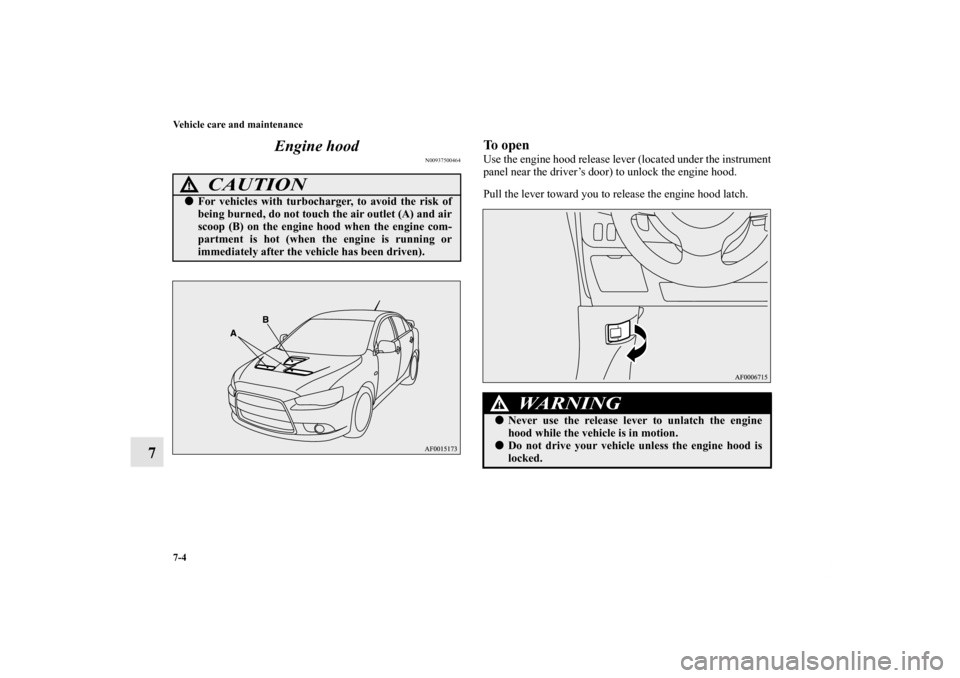
To openUse the engine hood release lever (located under the instrument
panel near the driver’s door) to unlock the engine hood.
Pull the lever toward you to release the engine hood latch.
CAUTION
!�For vehicles with turbocharger, to avoid the risk of
being burned, do not touch the air outlet (A) and air
scoop (B) on the engine hood when the engine com-
partment is hot (when the engine is running or
immediately after the vehicle has been driven).
WA R N I N G
!�Never use the release lever to unlatch the engine
hood while the vehicle is in motion. �Do not drive your vehicle unless the engine hood is
locked.
BK0119300US.book 4 ページ 2010年5月21日 金曜日 午前10時13分
Page 636 of 700
Vehicle care and maintenance
7-59
7
Inside
N00950400460
Headlights (low beam, except for vehicles with
high intensity discharge headlights)
N00943100869
1. For vehicles equipped with turbocharger, when replacing
the bulb on the driver’s side, remove the bolt (A) holding
down the relay box and move the relay box toward the
rear of the vehicle.
Description
Wattage
1- Trunk area light 5 W
2- Dome light (rear) (if so equipped) 8 W
3-Dome light (front)/
Reading light (if so equipped)8 W
*- Front of the vehicle
BK0119300US.book 59 ページ 2010年5月21日 金曜日 午前10時13分
Page 639 of 700
7-62 Vehicle care and maintenance
7
Headlights (high beam, except for vehicles with
high intensity discharge headlights)
N00943100843
1. When replacing the bulb on the front passenger’s side,
remove the bolt (A) holding down the washer tank spout
and move the spout toward the rear of the vehicle.2. Turn the cap (B) counterclockwise to remove it.*- Front of the vehicle
*- Front of the vehicle
BK0119300US.book 62 ページ 2010年5月21日 金曜日 午前10時13分
Page 641 of 700
7-64 Vehicle care and maintenance
7
Daytime running lights (for vehicles with high
intensity discharge headlights)
N00900300060
1. When replacing the bulb on the front passenger’s side,
remove the bolt (A) holding down the washer tank spout
and move the spout toward the rear of the vehicle.
CAUTION
!�Handle halogen light bulb with care. The gas inside
a halogen light bulb is highly pressurized, so drop-
ping, knocking, or scratching a halogen light bulb
can cause it to shatter.�Never hold the halogen light bulb with a bare hand,
dirty glove, etc.
The oil from your hand could cause the bulb to
break the next time the headlights are used.
If the glass surface is dirty, clean it with alcohol and
let it dry completely before installing the bulb.
*- Front of the vehicle
BK0119300US.book 64 ページ 2010年5月21日 金曜日 午前10時13分
Page 644 of 700
Vehicle care and maintenance
7-67
7
Parking and side-marker lights (except for vehi-
cles with high intensity discharge headlights)
N00917300512
1. For vehicles equipped with turbocharger, when replacing
the bulb on the driver’s side, remove the bolt (A) holding
down the relay box and move the relay box toward the
rear of the vehicle.2. For vehicles equipped with turbocharger, when replacing
the bulb on the passenger’s side, lift up the engine coolant
reservoir (B).*- Front of the vehicle
*- Front of the vehicle
BK0119300US.book 67 ページ 2010年5月21日 金曜日 午前10時13分
Page 676 of 700
Customer assistance/Reporting Safety Defects
8-3
8 Reporting Safety Defects
N01047200417
If you believe that your vehicle has a defect which could
cause a crash or could cause injury or death, you should
immediately inform the National Highway Traffic Safety
Administration (NHTSA) in addition to notifying Mitsub-
ishi Motors Corporation.
If NHTSA receives similar complaints, it may open an
investigation, and if it finds that a safety defect exists in a
group of vehicles, it may order a recall and remedy cam-
paign. However, NHTSA cannot become involved in indi-
vidual problems between you, your dealer, or Mitsubishi
Motors Corporation.
To contact NHTSA, you may call the Vehicle Safety Hotline
toll-free at 1-888-327-4236 (TTY: 1-800-424-9153); go to
http://www.safercar.gov; or write to:
You can also obtain other information about motor vehicle
safety from http://www.safercar.gov.
For vehicles sold in U.S.A.To contact Mitsubishi Motors North America, Inc. call 1-
888-648-7820 or write to:For vehicles sold in CanadaIf you live in Canada, and you believe that your vehicle has
a safety defect, you should immediately notify Transport
Canada, in addition to notifying Mitsubishi Motor Sales of
Canada, Inc. You may write to:
To contact Mitsubishi Motor Sales of Canada, Inc. call 1-
888-576-4878 or write to: NHTSA Headquarters
1200 New Jersey Avenue, SE
West Building
Washington, DC 20590Mitsubishi Motors North America, Inc.
Customer Relations Department
P.O. Box 6400
Cypress, CA 90630-0064
Transport Canada
330 Sparks Street
Tower C
Ottawa, Ontario K1A 0N5
Mitsubishi Motor Sales of Canada, Inc.
Customer Relations Department
P.O. Box 41009
4141 Dixie Road
Mississauga, ON L4W 5C9
BK0119300US.book 3 ページ 2010年5月21日 金曜日 午前10時13分
Page 697 of 700

Alphabetical index
6Seat 2-2
Arm rest 2-9
Front seats 2-3
Heated seats 2-7
Rear seats 2-8
Seats and restraint systems 2-3
Seat belt 2-14
Adjustable seat belt shoulder anchor 2-20
Child restraint 2-24
Driver’s seat belt reminder/warning 2-18
Force limiter 2-23
Front passenger seat belt warning light 2-19
Maintenance and inspection 2-34
Pre-tensioner 2-22
Seat belt extender 2-21
Seat belt instructions 2-15
Seat belt use during pregnancy 2-21
Service brake 3-136
Service precautions 7-2
Snow tires 7-37
Spark plugs 7-41
Steering
Power steering fluid 7-22
,9-11
Tilt lock lever 3-80
Wheel lock 3-31
,3-88
Storage spaces 3-284
Front console boxes 3-287
Sun visors 3-275
Supplemental Restraint System 2-35How the Supplement Restraint System works 2-39
Servicing 2-59
Warning light/display 2-44
T
Tank capacity 1-5
,9-11
Theft-alarm system
System 3-64
Tire pressure monitoring system 3-159
Warning light/display 3-160
Tires 7-29
How to change a tire 6-9
Inflation pressure 7-32
Maintenance 7-34
Quality grading 8-2
Replacing tires and wheels 7-34
Rotation 7-35
Size (tire and wheel) 9-10
Snow tires 7-37
Tire and loading information placard 4-9
,9-4
Tire chains 7-37
Tread wear indicators 7-35
Tissue holder 3-288
Tools 6-7
Storage 6-7
Towing 6-22
Trailer towing 4-13
Transfer oil 7-19
Trunk area light
BK0119300US.book 6 ページ 2010年5月21日 金曜日 午前10時13分