Page 545 of 700

5-146 Comfort controls
5
�In the following circumstances, moisture can form on
discs and inside the audio system, preventing normal
operation.
• When there is high humidity (for example, when it is
raining).
• When the temperature suddenly rises, such as right after
the heater is turned on in cold weather.
In this case, wait until the moisture has had time to dry
out.
�When the CD player is subjected to violent vibrations,
such as during off-road driving, the tracking may not
work.
�When storing compact discs, always store them in their
separate cases. Never place compact discs in direct sun-
light, or in any place where the temperature or humidity is
high.
�Never touch the flat surface of the disc where there isn’t a
label. This will damage the disc surface and could affect
the sound quality. When handling a compact disc, always
hold it by the outer edge and the center hole.�To clean a disc, use a soft, clean, dry cloth. Wipe directly
from the center hole toward the outer edge. Do not wipe in
a circle. Never use any chemicals such as benzine, paint
thinner, a disc spray cleaner, or an anti-static agent on the
disc.
�Do not use a ball point pen, felt pen, pencil, etc. to write
on the label surface of the disc.
BK0119300US.book 146 ページ 2010年5月21日 金曜日 午前10時13分
Page 552 of 700
6
For emergencies
If the vehicle breaks down . . . . . . . . . . . . . . . . . . .6- 2
Jump-starting the engine . . . . . . . . . . . . . . . . . . . .6- 2
Engine overheating . . . . . . . . . . . . . . . . . . . . . . . .6- 5
Tools and jack . . . . . . . . . . . . . . . . . . . . . . . . . . . .6- 7
How to change a tire . . . . . . . . . . . . . . . . . . . . . . .6- 9
Towing . . . . . . . . . . . . . . . . . . . . . . . . . . . . . . . . . .6- 22
Operation under adverse driving conditions . . . . .6- 24
BK0119300US.book 1 ページ 2010年5月21日 金曜日 午前10時13分
Page 553 of 700

6-2 For emergencies
6If the vehicle breaks down
N00836300161
If your vehicle breaks down on the road, move to the shoulder
and turn on the hazard warning flashers. If there is no shoulder,
or the shoulder is not safe, drive in the right lane slowly, with
the hazard lights flashing, until you come to a safe stopping
place. Keep the flashers flashing. If the engine stops/fails If the engine stops, there will be no power assist to the steering
and brakes, making these difficult to use.
�The brake booster will not work, so the brakes will not
grip well. The brake pedal will be harder to press than
usual.
�Since there is no power steering assist, the steering wheel
will be hard to turn. When the engine fails at the intersection Get help from your passengers, bystanders, etc. to push the
vehicle and move it to a safe zone.
Jump-starting the engine
N00836400713
If the engine cannot be started because the battery is weak or
dead, you can start it with the battery from another vehicle
using jumper cables.
1. Take off any metal jewelry such as watch bands or brace-
lets that might make an accidental electrical contact.
2. Position the vehicles close enough together so that the
jumper cables can reach, but be sure the vehicles aren’t
touching each other.
WA R N I N G
!�When using jumper cables to start a vehicle, follow
the procedures and be very cautious.
CAUTION
!�Do not try to start your vehicle by pushing or tow-
ing. Vehicles with continuously variable transmis-
sion (CVT) or Twin Clutch SST cannot be started
this way. Pushing or towing a vehicle that has a
manual transaxle may overheat and damage the cat-
alytic converter. Also, there is more risk of an acci-
dent when a vehicle is being pushed or towed.
CAUTION
!�Check the other vehicle. It must have a 12-volt bat-
tery. If the other system isn’t 12-volt, both systems
can be damaged.
BK0119300US.book 2 ページ 2010年5月21日 金曜日 午前10時13分
Page 558 of 700
For emergencies
6-7
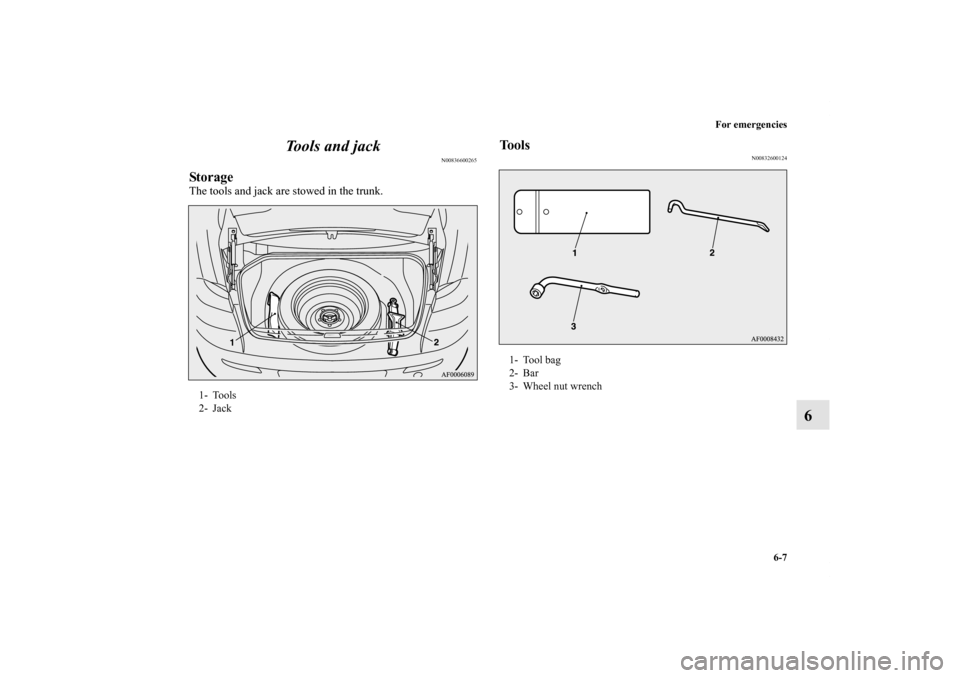
6 Tools and jack
N00836600265
StorageThe tools and jack are stowed in the trunk.
Tools
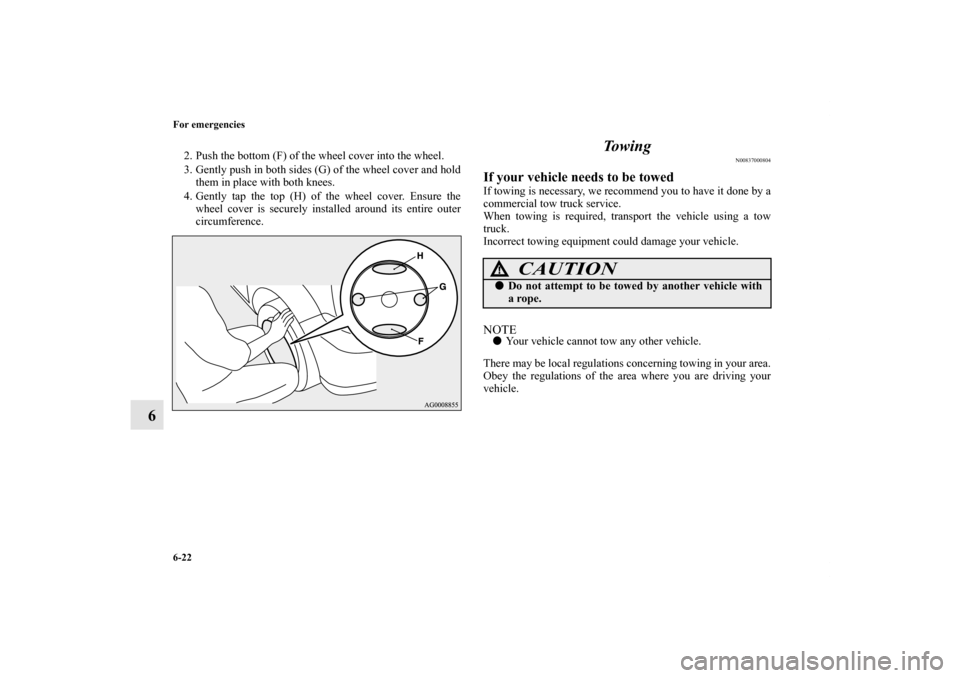
N00832600124
1- Tools
2- Jack
1- Tool bag
2- Bar
3- Wheel nut wrench
BK0119300US.book 7 ページ 2010年5月21日 金曜日 午前10時13分
Page 561 of 700

6-10 For emergencies
6
NOTE�The chocks shown in the illustration do not come with
your vehicle. It is recommended that you purchase chocks
or blocks and keep them in the vehicle for use if needed.
�If chocks or blocks are not available, use stones or any
other objects that are large enough to hold the wheel in
position.
6. Get the jack, bar and wheel nut wrench ready.
Refer to “Tools and jack” on page 6-7.Spare tire information
N00849600298
Compact spare tireThe compact spare tire is designed to save space in the trunk.
Its lighter weight makes it easier to use if a flat tire occurs.
WA R N I N G
!�Be sure to apply chocks or blocks to the correct tire
when jacking up the vehicle. If the vehicle moves
while jacked up, the jack could slip out of position,
leading to an accident.
WA R N I N G
!�Tires, including spare tire, degrade over time with
age even when they are not being used. It is recom-
mended that tires over 6 years generally be replaced
even if damage is not obvious.
CAUTION
!�While the compact spare tire is stowed, the inflation
pressure should be checked at least once a month to
assure that it remains at the recommended inflation
pressure. See the tire and loading information plac-
ard attached to the driver’s door sill.
Refer to “Tire and loading information placard” on
page 9-4.�Driving with an improperly inflated tire can cause
an accident. If you have no choice but to drive with
an under-inflated tire, keep your speed down and
avoid sudden steering or braking, if possible. Inflate
the tire to the correct pressure as soon as possible.
Refer to “Tire inflation pressures” on page 7-32.�The compact spare tire should be used only tempo-
rarily. While the compact spare tire is being used,
the tire pressure monitoring system will not function
properly. Have the tire replaced or repaired at an
authorized Mitsubishi Motors dealer or a repair
facility of your choice as soon as possible.�If your vehicle has aluminum type wheels, you can
use the same wheel nuts on the compact spare tire
wheel. �Do not go over 50 mph (80 km/h) when driving with
the compact spare tire.�Avoid fast starting and braking when driving with
the compact spare tire.
BK0119300US.book 10 ページ 2010年5月21日 金曜日 午前10時13分
Page 573 of 700
6-22 For emergencies
6
2. Push the bottom (F) of the wheel cover into the wheel.
3. Gently push in both sides (G) of the wheel cover and hold
them in place with both knees.
4. Gently tap the top (H) of the wheel cover. Ensure the
wheel cover is securely installed around its entire outer
circumference.
To w i n g
N00837000804
If your vehicle needs to be towedIf towing is necessary, we recommend you to have it done by a
commercial tow truck service.
When towing is required, transport the vehicle using a tow
truck.
Incorrect towing equipment could damage your vehicle.NOTE�Your vehicle cannot tow any other vehicle.
There may be local regulations concerning towing in your area.
Obey the regulations of the area where you are driving your
vehicle.
CAUTION
!�Do not attempt to be towed by another vehicle with
a rope.
BK0119300US.book 22 ページ 2010年5月21日 金曜日 午前10時13分
Page 574 of 700
For emergencies
6-23
6
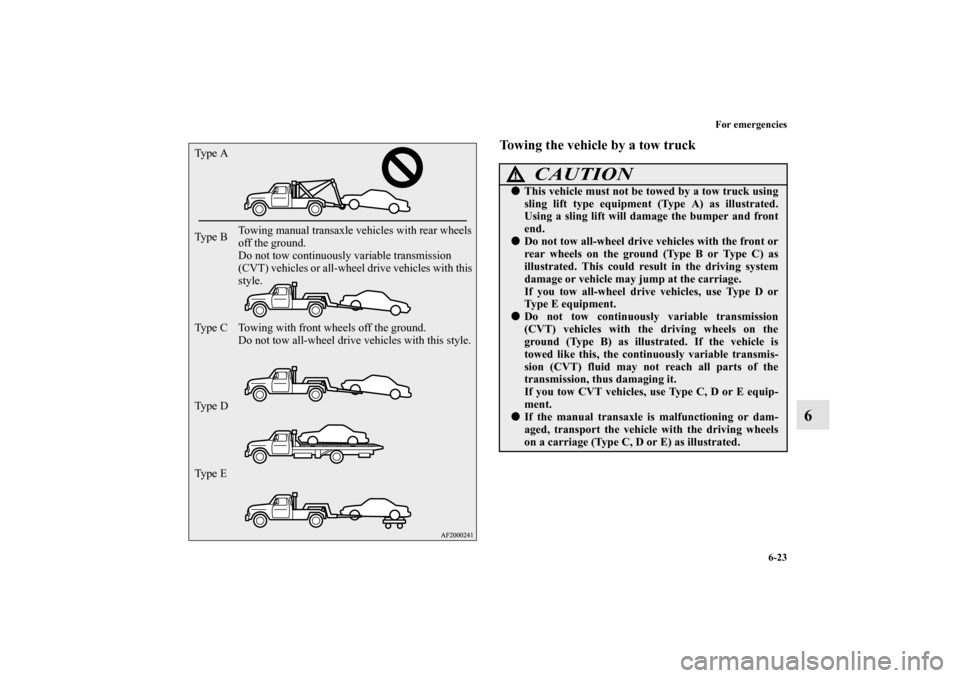
Towing the vehicle by a tow truck
Ty p e A
Ty p e B
Ty p e C
Ty p e D
Ty p e ETowing with front wheels off the ground.
Do not tow all-wheel drive vehicles with this style. Towing manual transaxle vehicles with rear wheels
off the ground.
Do not tow continuously variable transmission
(CVT) vehicles or all-wheel drive vehicles with this
style.
CAUTION
!�This vehicle must not be towed by a tow truck using
sling lift type equipment (Type A) as illustrated.
Using a sling lift will damage the bumper and front
end.�Do not tow all-wheel drive vehicles with the front or
rear wheels on the ground (Type B or Type C) as
illustrated. This could result in the driving system
damage or vehicle may jump at the carriage.
If you tow all-wheel drive vehicles, use Type D or
Type E equipment.�Do not tow continuously variable transmission
(CVT) vehicles with the driving wheels on the
ground (Type B) as illustrated. If the vehicle is
towed like this, the continuously variable transmis-
sion (CVT) fluid may not reach all parts of the
transmission, thus damaging it.
If you tow CVT vehicles, use Type C, D or E equip-
ment.�If the manual transaxle is malfunctioning or dam-
aged, transport the vehicle with the driving wheels
on a carriage (Type C, D or E) as illustrated.
BK0119300US.book 23 ページ 2010年5月21日 金曜日 午前10時13分
Page 575 of 700

6-24 For emergencies
6
Towing manual transaxle vehicles with rear wheels off
the ground (Type B)Place the gearshift lever in the “Neutral” position.
Turn the ignition switch to the “ACC” position and secure the
steering wheel in a straight-ahead position with a rope or tie-
down strap. Never place the ignition switch in the “LOCK”
position when towing.Towing with front wheels off the ground (Type C)Release the parking brake.
Place the gearshift lever in the “Neutral” position (manual tran-
saxle) or the selector lever in the “N” (NEUTRAL) position
(CVT).
Operation under adverse driving conditions
N00837200662
If your vehicle becomes stuck in sand, mud or
snow If your vehicle becomes stuck in snow, sand, or mud, it can
often be moved by a rocking motion. Rock your vehicle back
and forth to free it.
Do not rev the engine or spin the wheels. Constant efforts to
free a stuck vehicle can cause overheating and transaxle fail-
ure. Let the engine idle for a few minutes to cool the transaxle
before trying again.
If your vehicle is still stuck after several rocking attempts, call
for a commercial tow truck service.
�[For front-wheel drive vehicle equipped with the
active stability control (ASC)]
If the vehicle is towed with the ignition switch in the
“ON” position and only the front wheels or only the
rear wheels raised off the ground, the ASC may
operate, resulting in an accident. When towing the
vehicle with only the front wheels or only the rear
wheels raised, keep the ignition switch in the
“LOCK” or “ACC” position.
WA R N I N G
!�To prevent entry of exhaust gas from the towing
vehicle, set the selection switch to the recirculation
position.
CAUTION
!
WA R N I N G
!�When trying to rock your vehicle out of a stuck posi-
tion, make sure that there are no people nearby. The
rocking motion can make your vehicle suddenly
lurch forward or backward, and injure any
bystanders.
BK0119300US.book 24 ページ 2010年5月21日 金曜日 午前10時13分