2011 MITSUBISHI L200 wheel
[x] Cancel search: wheelPage 73 of 330
Seat belt inspectionE00406300475
l Check the belts for cuts, worn or frayed web-
bing and for cracked or deformed metallic
parts. Replace the belt assembly if defective.
l A dirty belt should be cleaned with neutral de-
tergent in warm water. After rinsing in water,
let it dry in the shade. Do not attempt to
bleach or re-dye the belts because this affects
their characteristics.WARNINGl We recommend you have all seat belt as-
semblies including retractors and attach-
ing hardware inspected after any colli-
sion. We recommend that seat belt assem-
blies in use during a collision be replaced
unless the collision was minor and the
belts show no damage and continue to op-
erate properly.
l Do not attempt to repair or replace any
part of the seat belt assemblies; we recom-
mend you to have this work done by a
MITSUBISHI MOTORS Authorized
Service Point. Incorrect repair or replace-
ment could reduce the effectiveness of the
belts and could result in serious injury in
the event of a collision.
l Once the pretensioner has activated, it
cannot be re-used.
It must be replaced together with the re-
tractor.Supplemental restraint system
(SRS) - airbag* E00407201797
The information written in this Supplemental Re-
straint System (SRS) section contains important
points concerning the driver, front passenger, side
and curtain airbags.
The SRS driver and front passenger airbags are de-
signed to supplement the primary protection of the
driver and front passenger side seat belt systems by
providing those occupants with protection against
head and chest injuries in certain moderate-to-se-
vere frontal collisions.
The SRS side airbag is designed to supplement the
properly worn seat belts and provide the driver and
front passenger with protection against chest injury
in certain moderate-to-severe side impact collisions.
The SRS curtain airbags are designed to supple-
ment the properly worn seat belts and provide the
driver and passengers with protection against head
injuries in certain moderate-to-severe side impact
collisions.
The SRS is NOT a substitute for the seat belts; for
maximum protection in all types of crashes and ac-
cidents, seat belts should ALWAYS be worn by ev-
eryone who drives or rides in this vehicle.WARNINGl IT IS VERY IMPORTANT TO AL-
WAYS PROPERLY WEAR YOUR
SEAT BELT, EVEN WITH AN AIRBAG:WARNING• Seat belts help keep the driver and pas-
sengers properly positioned, which re-
duces injury risk in all collisions, and
reduces the risk of serious or fatal in-
juries when the airbags inflate.
During sudden braking just before a
collision, an unrestrained or improper-
ly restrained driver or passengers can
move forward into direct contact with
or within close proximity to the airbag
which may then deploy during the col-
lision.
The initial stage of airbag inflation is
the most forceful which could cause se-
rious or fatal injuries if the occupant
contacts it at this stage.
• Seat belts reduce the risk of injury in
roll-overs, rear impact collisions, and
in lower-speed frontal collisions, be-
cause driver’s and passenger’s air-
bags are not designed to inflate in
those situations.
• Seat belts reduce the risk of being
thrown from your vehicle in a colli-
sion or roll-over.
l IT IS VERY IMPORTANT TO BE PROP-
ERLY SEATED.
A driver or front passenger too close to
the steering wheel or instrument panel
during airbag deployment can be killed
or seriously injured.
Airbags inflate very fast, and with great
force.
If the driver and front passenger are not
properly seated and restrained, the air-
Seat and seat belts
2-27
2
Page 74 of 330
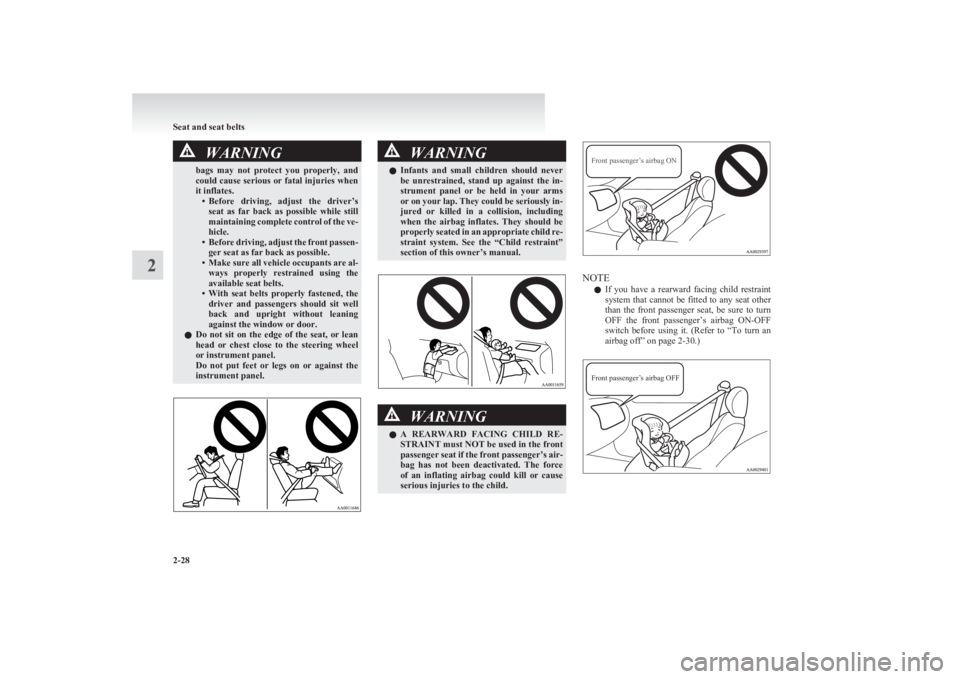
WARNINGbags may not protect you properly, and
could cause serious or fatal injuries when
it inflates. •Before driving, adjust the driver’s
seat as far back as possible while still
maintaining complete control of the ve-
hicle.
• Before driving, adjust the front passen-
ger seat as far back as possible.
• Make sure all vehicle occupants are al-
ways properly restrained using the
available seat belts.
• With seat belts properly fastened, the
driver and passengers should sit well
back and upright without leaning
against the window or door.
l Do not sit on the edge of the seat, or lean
head or chest close to the steering wheel
or instrument panel.
Do not put feet or legs on or against the
instrument panel.WARNINGl Infants and small children should never
be unrestrained, stand up against the in-
strument panel or be held in your arms
or on your lap. They could be seriously in-
jured or killed in a collision, including
when the airbag inflates. They should be
properly seated in an appropriate child re-
straint system. See the “Child restraint”
section of this owner’s manual.WARNINGl A REARWARD FACING CHILD RE-
STRAINT must NOT be used in the front
passenger seat if the front passenger’s air-
bag has not been deactivated. The force
of an inflating airbag could kill or cause
serious injuries to the child.Front passenger’s airbag ON
NOTE
l If you have a rearward facing child restraint
system that cannot be fitted to any seat other
than the front passenger seat, be sure to turn
OFF the front passenger’s airbag ON-OFF
switch before using it. (Refer to “To turn an
airbag off” on page 2-30.)
Front passenger’s airbag OFF
Seat and seat belts
2-28
2
Page 78 of 330
WARNING•The indication lamp does not come on
when the front passenger’s airbag ON-
OFF switch is turned OFF.
• The indication lamp stays on when the front passenger’s airbag ON-OFF
switch is turned ON.WARNINGl Do not fit any accessory that makes the in-
dication lamp impossible to see, and do
not cover the indication lamp with a stick-
er. You would not be able to verify the sta-
tus of the passenger airbag system.Driver’s and passenger’s front airbag
system E00407400330
The driver’s airbag is located under the padded cov-
er in the middle of the steering wheel. The front pas-
senger’s airbag is contained in the instrument panel
above the glove box.
The driver’s airbag and the front passenger’s air-
bag are designed to inflate at the same time even if
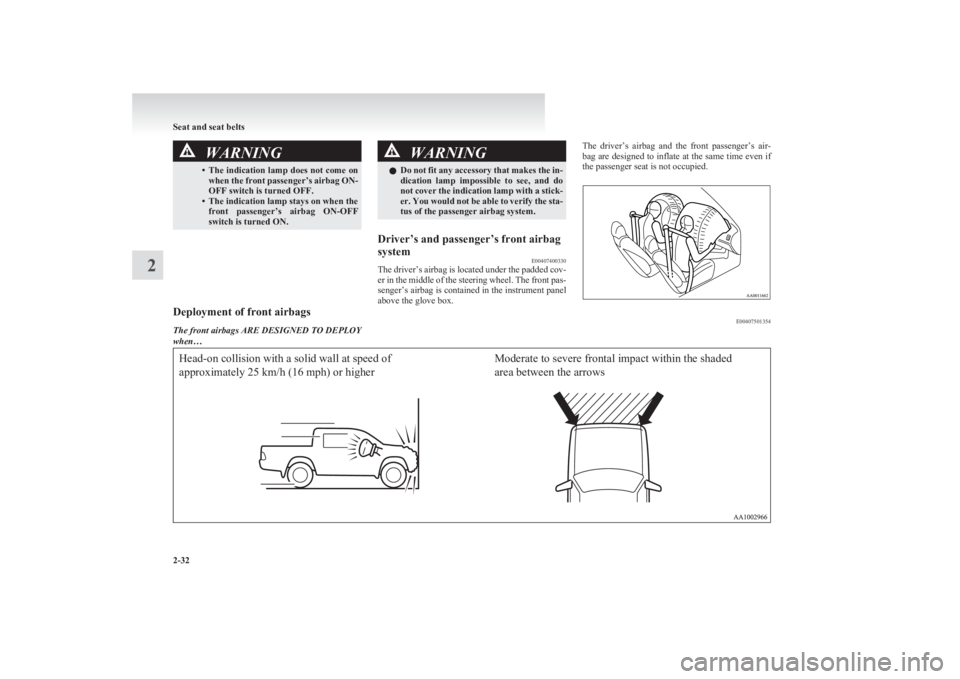
the passenger seat is not occupied.Deployment of front airbags E00407501354The front airbags ARE DESIGNED TO DEPLOY
when…Head-on collision with a solid wall at speed of
approximately 25 km/h (16 mph) or higher Moderate to severe frontal impact within the shaded
area between the arrows
Seat and seat belts
2-32
2
Page 79 of 330
The front airbags are designed to deploy when the
vehicle suffers a moderate to severe frontal impact.
A typical condition is shown in the illustration.
The front airbags will deploy if the severity of im-
pact is above the designed threshold level, compa-
rable to an approximately 25 km/h (16 mph) colli-
sion when impacting straight into a solid wall that
does not move or deform. If the severity of the im-
pact is below the above threshold level, the front air-
bags may not deploy. However, this threshold
speed will be considerably higher if the vehicle
strikes an object that absorbs the impact by either
deforming or moving (for example, another station-
ary vehicle, pole or a guard rail).
Because frontal collisions can easily move you out
of position, it is important to always properly wear
your seat belts. Your seat belts will help keep you
in a safe distance from the steering wheel and in-
strument panel during the initial stages of airbag de-
ployment. The initial stage of airbag inflation is the
most forceful, and can possibly cause serious or fa-
tal injuries. Moreover, the seat belts in your vehicle
are your primary means of protection in a collision.
The SRS airbags are designed to provide additional
protection. Therefore, for your safety and the safe-
ty of all occupants, be sure to always properly wear
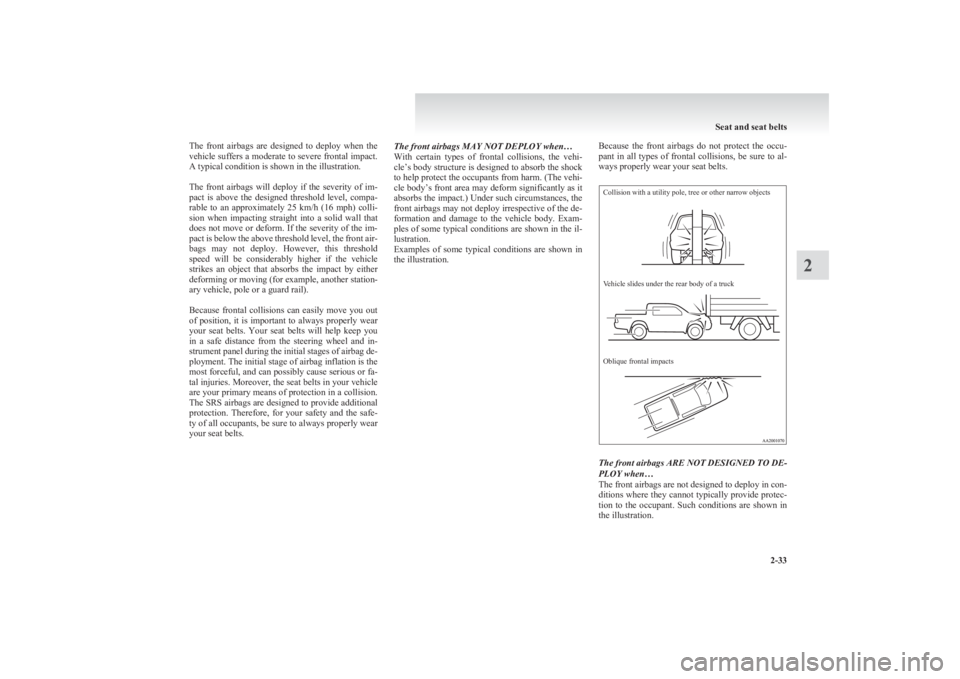
your seat belts.The front airbags MAY NOT DEPLOY when…
With certain types of frontal collisions, the vehi-
cle’s body structure is designed to absorb the shock
to help protect the occupants from harm. (The vehi-
cle body’s front area may deform significantly as it
absorbs the impact.) Under such circumstances, the
front airbags may not deploy irrespective of the de-
formation and damage to the vehicle body. Exam-
ples of some typical conditions are shown in the il-
lustration.
Examples of some typical conditions are shown in
the illustration.
Because the front airbags do not protect the occu-
pant in all types of frontal collisions, be sure to al-
ways properly wear your seat belts.Collision with a utility pole, tree or other narrow objectsVehicle slides under the rear body of a truckOblique frontal impacts
The front airbags ARE NOT DESIGNED TO DE-
PLOY when…
The front airbags are not designed to deploy in con-
ditions where they cannot typically provide protec-
tion to the occupant. Such conditions are shown in
the illustration.
Seat and seat belts
2-33
2
Page 80 of 330
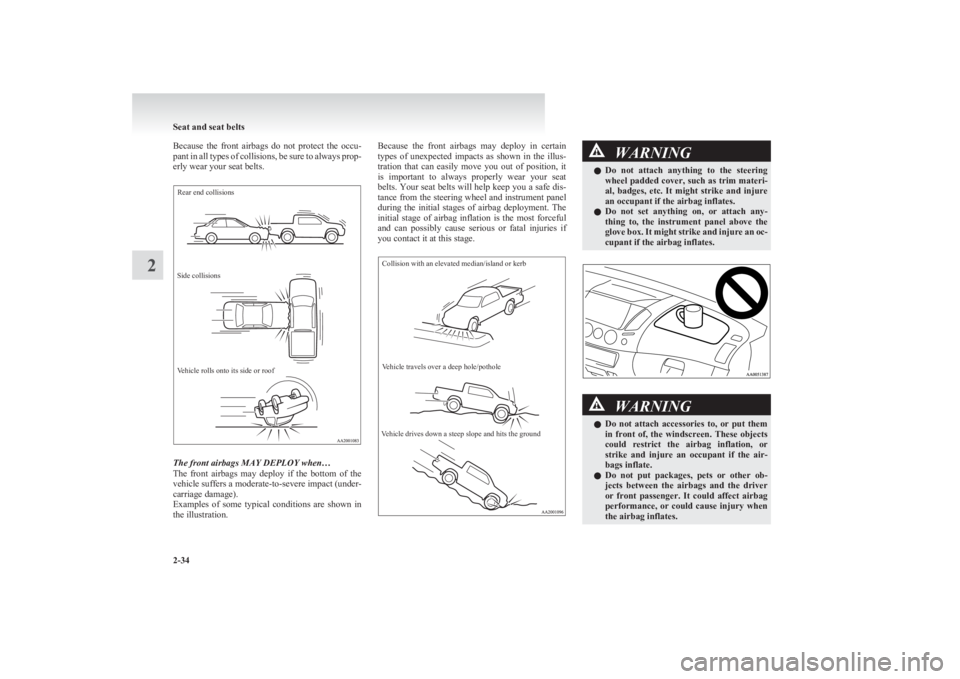
Because the front airbags do not protect the occu-
pant in all types of collisions, be sure to always prop-
erly wear your seat belts.Rear end collisionsSide collisionsVehicle rolls onto its side or roof
The front airbags MAY DEPLOY when…
The front airbags may deploy if the bottom of the
vehicle suffers a moderate-to-severe impact (under-
carriage damage).
Examples of some typical conditions are shown in
the illustration.
Because the front airbags may deploy in certain
types of unexpected impacts as shown in the illus-
tration that can easily move you out of position, it
is important to always properly wear your seat
belts. Your seat belts will help keep you a safe dis-
tance from the steering wheel and instrument panel
during the initial stages of airbag deployment. The
initial stage of airbag inflation is the most forceful
and can possibly cause serious or fatal injuries if
you contact it at this stage.Collision with an elevated median/island or kerbVehicle travels over a deep hole/potholeVehicle drives down a steep slope and hits the ground
WARNINGl Do not attach anything to the steering
wheel padded cover, such as trim materi-
al, badges, etc. It might strike and injure
an occupant if the airbag inflates.
l Do not set anything on, or attach any-
thing to, the instrument panel above the
glove box. It might strike and injure an oc-
cupant if the airbag inflates.WARNINGl Do not attach accessories to, or put them
in front of, the windscreen. These objects
could restrict the airbag inflation, or
strike and injure an occupant if the air-
bags inflate.
l Do not put packages, pets or other ob-
jects between the airbags and the driver
or front passenger. It could affect airbag
performance, or could cause injury when
the airbag inflates.
Seat and seat belts
2-34
2
Page 85 of 330

WARNING•The SRS warning lamp does not illu-
minate when you start the vehicle.
• The SRS warning lamp does not go
out after several seconds.
• The SRS warning lamp illuminates
while driving.SRS servicing E00407901244WARNINGlWe recommend any maintenance per-
formed on or near the components of the
SRS to be performed by a MITSUBISHI
MOTORS Authorized Service Point.
Improper work on the SRS components
or wiring could result in inadvertent de-
ployment of the airbags, or could render
the SRS inoperative; either situation
could result in serious injury.
l Do not modify your steering wheel, seat
belt retractor or any other SRS compo-
nents. For example, replacement of the
steering wheel, or modifications to the
front bumper or body structure can ad-
versely affect SRS performance and lead
to possible injury.
l If your vehicle has sustained any damage,
we recommend you to have the SRS in-
spected to ensure it is in proper working
order.WARNINGl On vehicles equipped with side airbags,
do not modify your front seats, centre pil-
lar and centre console.
It can adversely affect SRS performance
and lead to possible injury.
Also, if you have found any tear or open
seam in the seat fabric at the portion near
the side airbag, we recommend you to
have the seat inspected.
l On vehicles with the curtain airbags, if
you have found any scratch, crack or dam-
age to the portion of the front and rear pil-
lars and roof side rail, we recommend
you to have the SRS inspected by a
MITSUBISHI MOTORS Authorized
Service Point.
NOTE
l When you transfer ownership of the vehicle
to some other person, we urge you to alert
the new owner that it is equipped with the
SRS and refer the new owner to the applica-
ble section in this owner’s manual.
l If you junk or scrap the vehicle, we urge you
to first take the vehicle to a MITSUBISHI
MOTORS Authorized Service Point so that
the SRS can be rendered safe.
Seat and seat belts
2-39
2
Page 119 of 330
Switch position 0-Driver onlySwitch position 2-Driver + Full luggage load-
ing
{ Vehicles for Russia, Ka-
zakhstan and Ukraine with
heavy duty suspension}Switch position 3-Driver + Full luggage load-
ing
{ Vehicles for Russia, Ka-
zakhstan and Ukraine with-
out heavy duty suspension}
{ Except for vehicles for
Russia, Kazakhstan and Uk-
raine with heavy duty sus-
pension}Switch position 4-Driver + Full luggage load-
ing
{ Except for vehicles for
Russia, Kazakhstan and Uk-
raine without heavy duty
suspension}
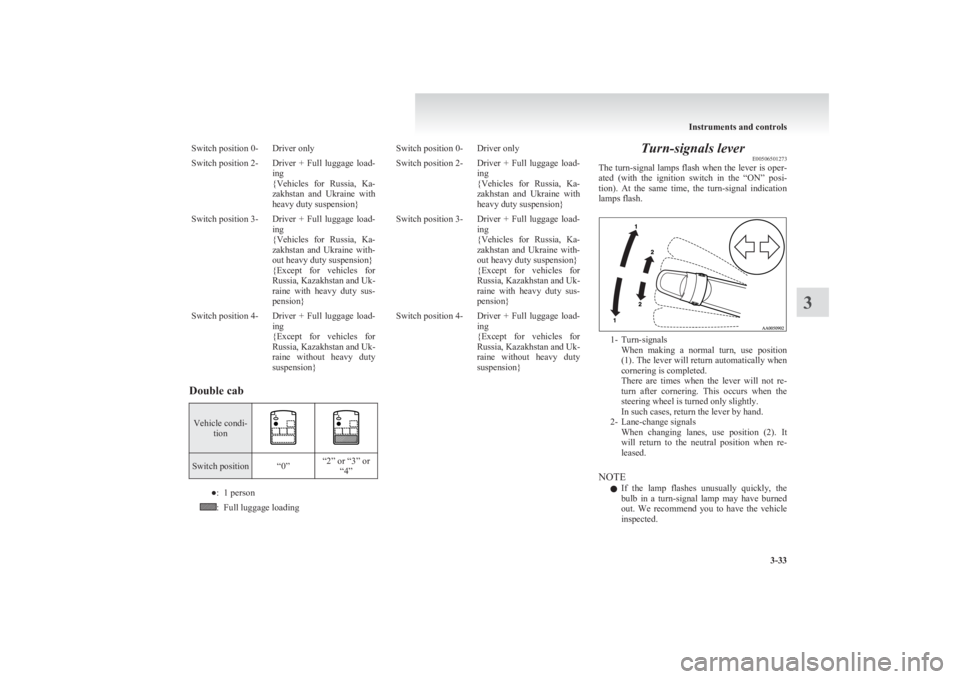
Double cab
Vehicle condi- tionSwitch position“0”“2” or “3” or“4”●:1 person:Full luggage loadingSwitch position 0-Driver onlySwitch position 2-Driver + Full luggage load-
ing
{ Vehicles for Russia, Ka-
zakhstan and Ukraine with
heavy duty suspension}Switch position 3-Driver + Full luggage load-
ing
{ Vehicles for Russia, Ka-
zakhstan and Ukraine with-
out heavy duty suspension}
{ Except for vehicles for
Russia, Kazakhstan and Uk-
raine with heavy duty sus-
pension}Switch position 4-Driver + Full luggage load-
ing
{ Except for vehicles for
Russia, Kazakhstan and Uk-
raine without heavy duty
suspension}Turn-signals lever E00506501273
The turn-signal lamps flash when the lever is oper-
ated (with the ignition switch in the “ON” posi-
tion). At the same time, the turn-signal indication
lamps flash.
1- Turn-signals When making a normal turn, use position
(1). The lever will return automatically when
cornering is completed.
There are times when the lever will not re-
turn after cornering. This occurs when the
steering wheel is turned only slightly.
In such cases, return the lever by hand.
2- Lane-change signals When changing lanes, use position (2). It
will return to the neutral position when re-
leased.
NOTE l If the lamp flashes unusually quickly, the
bulb in a turn-signal lamp may have burned
out. We recommend you to have the vehicle
inspected.
Instruments and controls
3-33
3
Page 126 of 330
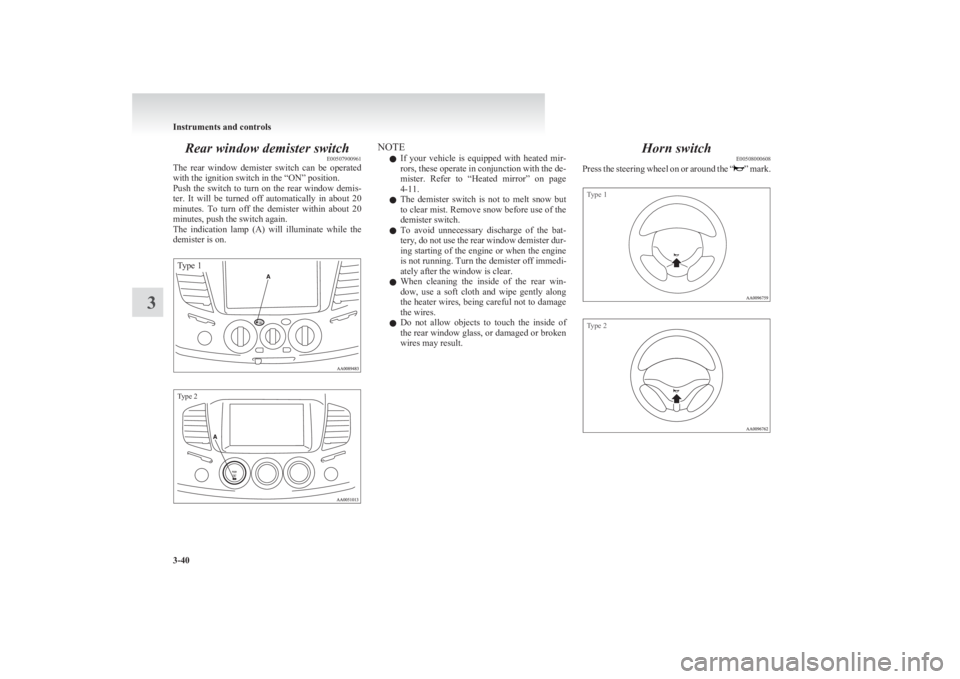
Rear window demister switchE00507900961
The rear window demister switch can be operated
with the ignition switch in the “ON” position.
Push the switch to turn on the rear window demis-
ter. It will be turned off automatically in about 20
minutes. To turn off the demister within about 20
minutes, push the switch again.
The indication lamp (A) will illuminate while the
demister is on.
Type 1Type 2NOTE
l If your vehicle is equipped with heated mir-
rors, these operate in conjunction with the de-
mister. Refer to “Heated mirror” on page
4-11.
l The demister switch is not to melt snow but
to clear mist. Remove snow before use of the
demister switch.
l To avoid unnecessary discharge of the bat-
tery, do not use the rear window demister dur-
ing starting of the engine or when the engine
is not running. Turn the demister off immedi-
ately after the window is clear.
l When cleaning the inside of the rear win-
dow, use a soft cloth and wipe gently along
the heater wires, being careful not to damage
the wires.
l Do not allow objects to touch the inside of
the rear window glass, or damaged or broken
wires may result.Horn switch E00508000608
Press the steering wheel on or around the “
” mark.
Type 1Type 2
Instruments and controls
3-40
3