2011 MERCEDES-BENZ G-CLASS light
[x] Cancel search: lightPage 265 of 288
DLoad index (Y page 265)ETire name
i
Tire data is vehicle-specific and may
deviate from the data in the example.
Indication of tire size, load-bearing
capacity and speed index
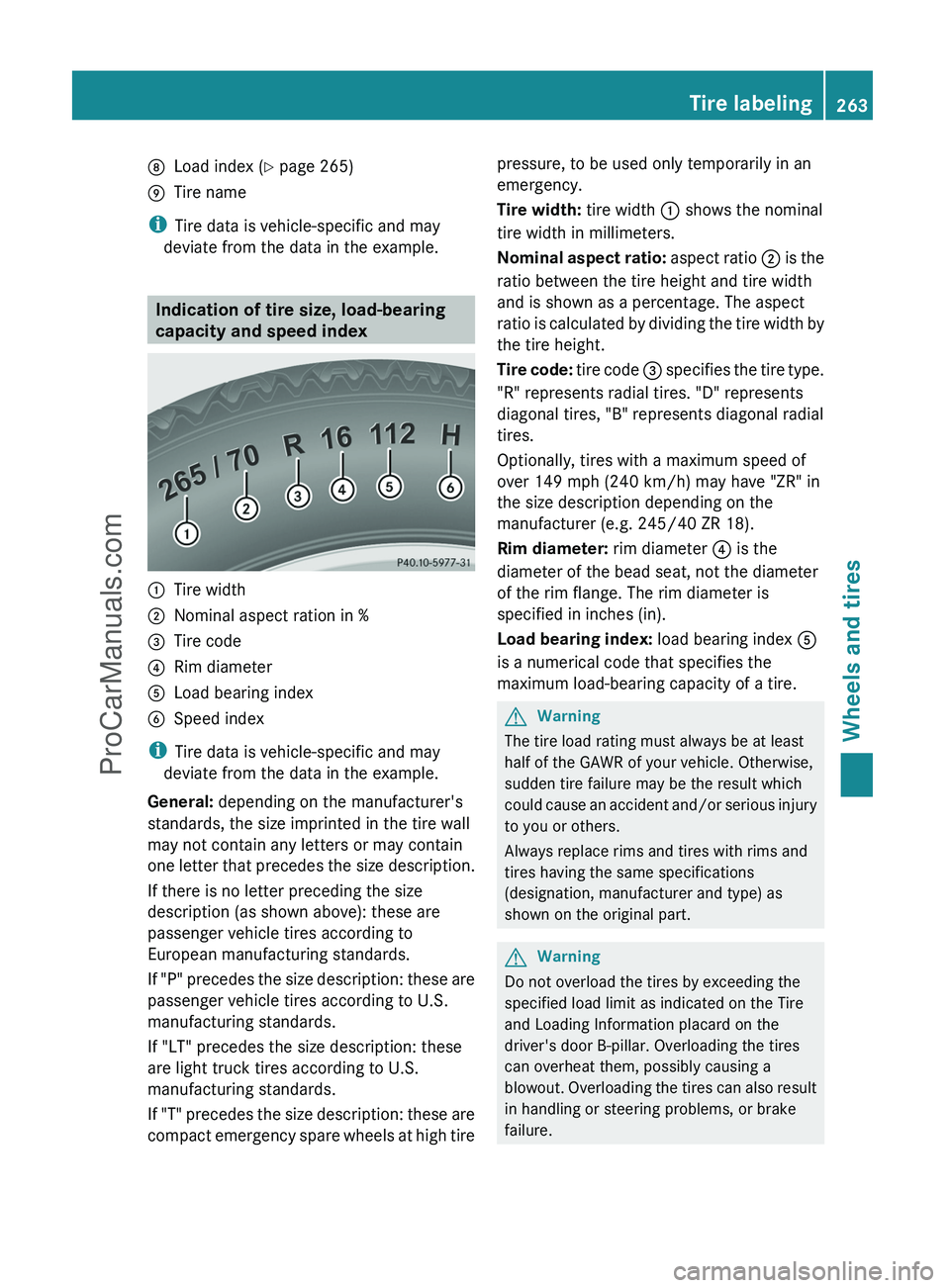
:Tire width;Nominal aspect ration in %=Tire code?Rim diameterALoad bearing indexBSpeed index
i Tire data is vehicle-specific and may
deviate from the data in the example.
General: depending on the manufacturer's
standards, the size imprinted in the tire wall
may not contain any letters or may contain
one letter that precedes the size description.
If there is no letter preceding the size
description (as shown above): these are
passenger vehicle tires according to
European manufacturing standards.
If "P" precedes the size description: these are
passenger vehicle tires according to U.S.
manufacturing standards.
If "LT" precedes the size description: these
are light truck tires according to U.S.
manufacturing standards.
If "T" precedes the size description: these are
compact emergency spare wheels at high tire
pressure, to be used only temporarily in an
emergency.
Tire width: tire width : shows the nominal
tire width in millimeters.
Nominal aspect ratio: aspect ratio ; is the
ratio between the tire height and tire width
and is shown as a percentage. The aspect
ratio is calculated by dividing the tire width by
the tire height.
Tire code: tire code = specifies the tire type.
"R" represents radial tires. "D" represents
diagonal tires, "B" represents diagonal radial
tires.
Optionally, tires with a maximum speed of
over 149 mph (240 km/h) may have "ZR" in
the size description depending on the
manufacturer (e.g. 245/40 ZR 18).
Rim diameter: rim diameter ? is the
diameter of the bead seat, not the diameter
of the rim flange. The rim diameter is
specified in inches (in).
Load bearing index: load bearing index A
is a numerical code that specifies the
maximum load-bearing capacity of a tire.GWarning
The tire load rating must always be at least
half of the GAWR of your vehicle. Otherwise,
sudden tire failure may be the result which
could cause an accident and/or serious injury
to you or others.
Always replace rims and tires with rims and
tires having the same specifications
(designation, manufacturer and type) as
shown on the original part.
GWarning
Do not overload the tires by exceeding the
specified load limit as indicated on the Tire
and Loading Information placard on the
driver's door B-pillar. Overloading the tires
can overheat them, possibly causing a
blowout. Overloading the tires can also result
in handling or steering problems, or brake
failure.
Tire labeling263Wheels and tiresZProCarManuals.com
Page 267 of 288
All-weather tires and winter tiresIndexSpeed ratingH M+S21up to 130 mph (210 km/h)V M+S21up to 149 mph (240 km/h)
i
Not all tires that have the M+S
identification offer the driving
characteristics of winter tires. In addition
to the M+S marking, winter tires also have
the i snowflake symbol on the tire wall.
Tires with this marking fulfill the
requirements of the Rubber Manufacturers
Association (RMA) and the Rubber
Association of Canada (RAC) regarding the
tire traction on snow and have been
especially developed for driving on snow.
An electronic speed limiter prevents your
vehicle from exceeding a speed of
130 mph (210 km/h).
The speed index of tires mounted at the
factory may be higher than the maximum
speed that the electronic speed limiter
permits.
Make sure that your tires have the required
speed index as specified in the "tires" section
( Y page 272), e.g. if you buy new tires.
Further information about reading tire data
can be obtained from any qualified specialist
workshop, e.g. an authorized Mercedes-Benz
Center.
Load identification
i Tire data is vehicle-specific and may
deviate from the data in the example.
In addition to the load bearing index, load
index : may be imprinted after the letters
that identify speed index B(Y page 263) on
the sidewall of the tire.
R If no specification is given: no text (as in the
example above), represents a standard
load (SL) tire
R XL or Extra Load: represents a reinforced
tire
R Light Load: represents a light load tire
R C, D, E: represents a load range that
depends on the maximum load that the tire
can carry at a certain pressure
DOT, Tire Identification Number (TIN)
U.S. tire regulations prescribe that every
manufacturer of new tires or retreader has to
imprint a TIN in or on the sidewall of each tire
produced.
21 or M+S i for winter tires.Tire labeling265Wheels and tiresZProCarManuals.com
Page 273 of 288
authorized Mercedes-Benz Center or tire
dealer for repairs.GWarning
Do not drive with a flat tire. A flat tire affects
the ability to steer or brake the vehicle. You
might lose control of the vehicle. Continued
driving with a flat tire or driving at high speed
with a flat tire will cause excessive heat build-
up and possibly a fire.
! For safety reasons, Mercedes-Benz
recommends that you only use tires,
wheels and accessories which have been
approved by Mercedes-Benz specifically
for your vehicle.
These tires have been specially adapted for
use with the control systems, such as ABS
or ESP ®
, and are marked as follows:
R MO = Mercedes-Benz Original
Mercedes-Benz Original Extended tires
may only be used on wheels that have been
specifically approved by Mercedes-Benz.
Only use tires, wheels or accessories
tested and approved by Mercedes-Benz.
Certain characteristics, e.g. handling,
vehicle noise emissions or fuel
consumption, may otherwise be adversely
affected. In addition, when driving with a
load, tire dimension variations could cause
the tires to come into contact with the
bodywork and axle components. This could
result in damage to the tires or the vehicle.
Mercedes-Benz accepts no liability for
damage resulting from the use of tires,
wheels or accessories other than those
tested and approved.
Further information about tires, wheels and
approved combinations can be obtained
from any authorized Mercedes-Benz
Center.
i The Tire and Load Information placard
with the recommended tire pressures is
attached to the B-pillar on the driver's side.
Further information about driving at high
speeds or driving with vehicle loads that are
lighter than the maximum vehicle load can
be found in the tire pressure table on the
inside of the fuel filler flap. Check tire
pressures regularly, and only when the tires
are cold. Comply with the maintenance
recommendations of the tire manufacturer
in the vehicle document wallet.
For further information on the recommended
tire inflation pressure and on tire pressures
for specific driving conditions, see
( Y page 249).
i Notes on vehicle tires:
Always:
R mount tires of the same size on a given
axle (left/right)
R mount tires of the same type on your
vehicle at a given time (summer tires,
winter tires, all-weather tires, all-terrain
tires)
i The following pages contain information
on approved wheels and tire sizes for
equipping your vehicle with winter tires.
Winter tires are not available at the factory
as standard equipment or optional extras.
If you wish to fit approved winter tires to
your vehicle, wheels of appropriate size
may also be required as the sizes of the
approved winter tires may differ from those
of the original tires. This is dependent on
the model and the equipment installed at
the factory.
Wheels and tires as well as additional
information are available from a qualified
specialist workshop, e.g. an authorized
Mercedes-Benz Center.
The tire and wheel combinations listed in the
tables below apply to the following models:V1G 550 V2G 55 AMGWheel and tire combinations271Wheels and tiresZProCarManuals.com
Page 280 of 288
Direct skin contact with fuels and the
inhalation of fuel vapors are damaging to your
health.
Premium-grade unleaded gasoline
! To ensure the longevity and full
performance of the engine, only premium-
grade unleaded gasoline must be used.
If premium-grade unleaded gasoline is
unavailable and regular gasoline is used,
observe the following precautions:
R only fill the fuel tank to half full with
regular unleaded gasoline and add the
rest as soon as possible with premium-
grade unleaded gasoline.
R do not drive at the maximum speed.
R avoid sudden acceleration.
R when the vehicle is carrying a light cargo,
e.g. two passengers without luggage, do
not allow the engine to rev above
3000 rpm.
R when the vehicle is fully loaded or being
operated in mountainous terrain, do not
depress the accelerator pedal further
than 2
/ 3 of the pedal travel.
Fuel requirements
Use only premium-grade unleaded gasoline.
The octane number should be at least 91.
Details can be found on the gas pump. The
octane number is the average value of the
Research Octane Number (RON) and the
Motor Octane Number (MON): (RON +
MON) / 2, also known as knock resistance.
Reformulated Gasoline (RFG) and/or
unleaded gasoline with additives can be used
if the concentration of the additives in the fuel
does not exceed 10%, e.g.:
R Ethanol
R TAME
R ETBE
R IPA
R TBA
For MTBE, the concentration should not
exceed 15%.
The concentration of methanol in gasoline
including other additives must not exceed
3 %.
Using mixtures of methanol and ethanol is not
permitted. Gasohol, a mixture of 10% ethanol
and 90% unleaded gasoline, can be used.
All of these mix fuels must fulfill the fuel
requirements, e.g.:
R knock resistance
R boiling point
R vapor pressure
Additives in gasoline
One of the major problems in engine design
is the creation of carbon deposits during the
process of burning fuel. Mercedes-Benz
recommends that you use fuel brands that
have the additives which prevent the build up
of carbon deposits.
If you use fuels without these additives for a
longer period of time, there may be a build up
of carbon deposits, especially on the inlet
valves and in the combustion chamber.
This could lead to engine running problems,
e.g.:
R longer engine warm-up phase
R uneven idle
R engine noise
R misfiring
R loss of power
In areas where carbon deposits can build up
due to the lack of availability of gasoline with
the corresponding additives, Mercedes-Benz
recommends the use of additives that have
been approved for Mercedes-Benz vehicles.
Consult an authorized Mercedes-Benz Center
or visit http://www.mbusa.com (USA only)
to view a list of approved products. Observe
the instructions for use in the product
description.
278Service products and capacitiesTechnical data
ProCarManuals.com