2011 MERCEDES-BENZ CL-Class lock
[x] Cancel search: lockPage 22 of 480

Maximum permissible tire
pressure (definition) ....................... 459
Maximum tire load .........................452
Maximum tire load (definition) .......459
Optional equipment weight
(definition) ..................................... 460
PSI (pounds per square inch)
(definition) ..................................... 459
Replacing ....................................... 460
Service life ..................................... 440
Sidewall (definition) .......................460
Speed index (definition) .................458
Storing ........................................... 461
Structure and characteristics
(definition) ..................................... 457
Temperature .................................. 453
TIN (Tire Identification Number)
(definition) ..................................... 460
Tire bead (definition) ......................459
Tire pressure (definition) ................459
Tire pressures (recommended) ......458
Tire size (data) ............................... 461
Tire size designation, load-bearing
capacity, speed index ....................454
Tire tread ....................................... 439
Tire tread (definition) .....................459
Total load limit (definition) .............460
Traction ......................................... 453
Traction (definition) .......................460
Tread wear ..................................... 453
Uniform Tire Quality Grading
Standards ...................................... 452
Uniform Tire Quality Grading
Standards (definition) ....................458
Unladen weight (definition) ............459
Wear indicator (definition) .............460
Wheel rim (definition) ....................458
Tires and wheels (important safety
information) ....................................... 438
Toggling .............................................. 185
Tone settings Balance and fader ..........................125
Treble and bass ............................. 125
Top Tether ............................................ 59
Towing Important safety guidelines ...........430
Installing the towing eye ................431
Removing the towing eye ...............432Traffic jam function ........................... 155
Traffic Program Switching off .................................. 124
Traffic report
Real-time traffic report ..................161
Traffic report read-aloud function ... 159
Traffic reports .................................... 159
Transfer case ..................................... 281
Transmission position display ......... 276
Transmission positions .................... 276
Treble and bass Adjusting ....................................... 125
Trip computer (on-board
computer) .......................................... 332
Trip odometer Calling up ....................................... 332
Resetting (on-board computer) ......333
True Image™ ...................................... 127
Trunk Automatic opening ..................... 82, 83
Emergency release ..........................84
Important safety guidelines .............81
Limiting the opening angle ............. 234
Locking separately ...........................83
Trunk lid
Display message ............................ 372
Trunk lid opening height
restriction .......................................... 234
trunk load (maximum) ...................... 474
Turn signal (display message) ......... 356
Turn signals ....................................... 246
Type plate see Vehicle identification plate
U
Unlocking Emergency unlocking .......................80
From inside the vehicle (central
unlocking button) ............................. 79
Using the telephone .......................... 184
20Index
Page 23 of 480

V
Vanity mirror Sun visor ........................................ 388
Vehicle
Data acquisition ............................... 27
Emergency unlocking .......................80
Equipment ....................................... 23
Exterior view .................................... 30
Individual settings (on-board
computer) ...................................... 341
Loading .......................................... 448
Lowering ........................................ 425
Maintenance .................................... 24
Parking up ..................................... 286
Raising ........................................... 422
Reporting problems .........................26
Towing away .................................. 430
Tow-starting ................................... 430
Transporting .................................. 433
Vehicle data
see Technical data
Vehicle dimensions ........................... 474
Vehicle identification number see VIN
Vehicle identification plate .............. 467
Vehicle level ...................................... 304
Active Body Control .......................305
Vehicle level (display message) ....... 364
Vehicle tool kit .................................. 420
Vehicle weights ................................. 474
Video (DVD) ........................................ 335
Video DVD Fast forward/rewind ...................... 225
Operation ....................................... 223
Pause function ............................... 226
Selecting ........................................ 225
Selecting a film/title ...................... 226
Selecting a scene/chapter ............226
Stop function ................................. 226
Video DVD (on-board computer) ...... 335
Video DVD mode Switching to ................................... 224
VIN ...................................................... 467
Voice Control System Settings ................................. 130, 131Volume
Adjusting ....................................... 124
Navigation announcements ...........124
Phone calls .................................... 124
W
Warning and indicator lamps ABS ................................................ 377
Brakes ........................................... 375
Check Engine ................................. 380
ESP ®
.............................................. 378
ESP ®
OFF ....................................... 379
Fuel tank ........................................ 380
Overview .......................................... 33
Reserve fuel ................................... 380
Seat belt ........................................ 376
SRS ................................................ 379
Tire pressure monitor ....................381
Warranty ............................................ 466
Waveband Switching (radio) ............................ 196
Wheel bolt tightening torque ........... 425
Wheel chock ...................................... 422
Wheels Changing/replacing .......................460
Changing a wheel .......................... 421
Checking ........................................ 438
Cleaning ......................................... 412
Mounting a wheel .......................... 424
Removing a wheel ..........................424
Storing ........................................... 461
Tightening torque ........................... 425
Wheel size/tire size .......................461
Window curtain air bag
Display message ............................ 347
Operation ......................................... 46
Windows
see Side windows
Windows (cleaning instructions) ..... 413
Windshield Defrosting ...................................... 260
Infrared reflective .......................... 400
Windshield washer fluid (display
message) ............................................ 373
Windshield washer system Adding washer fluid .......................408
Notes ............................................. 473
Index21
Page 33 of 480
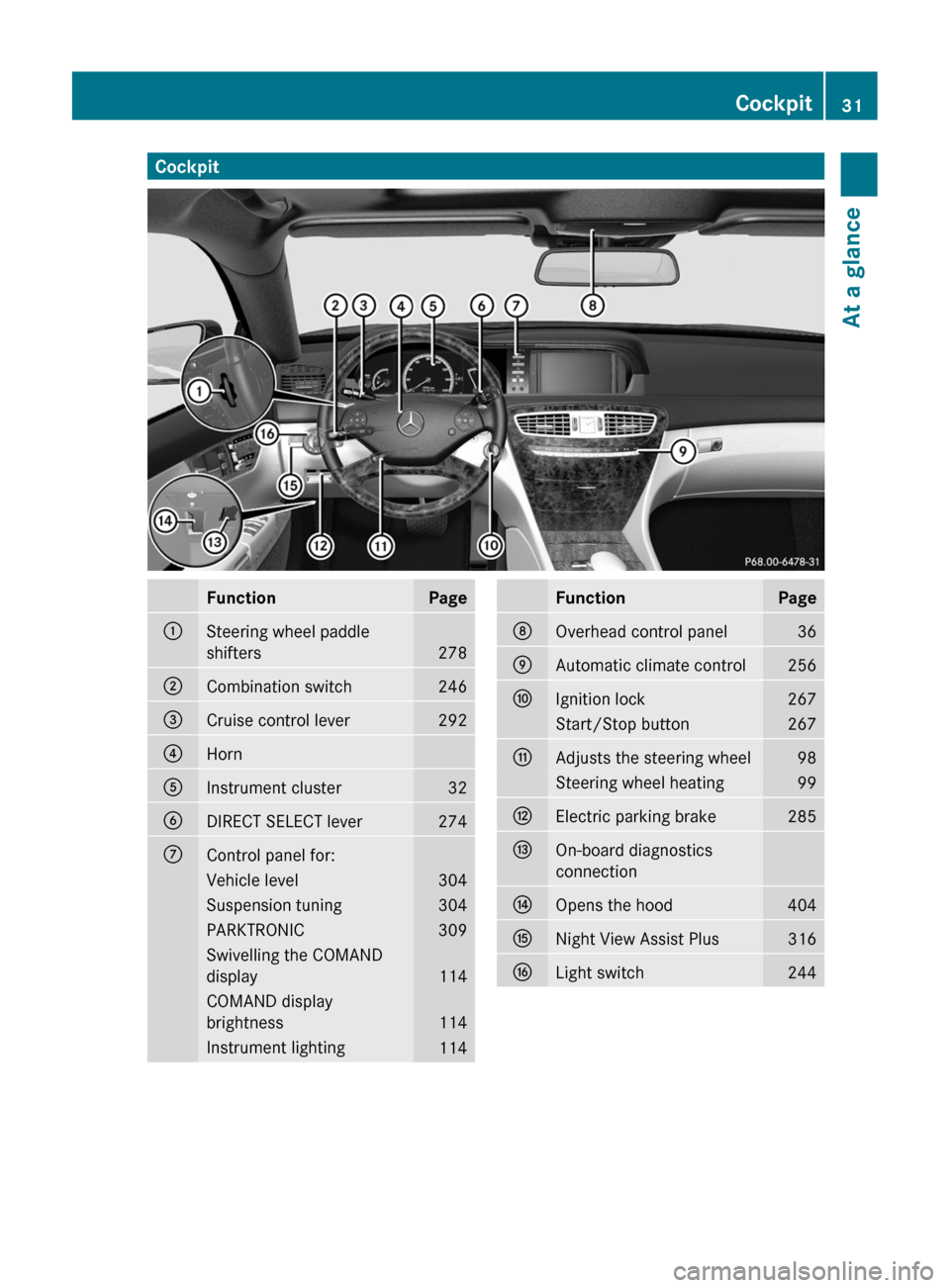
CockpitFunctionPage:Steering wheel paddle
shifters278
;Combination switch246=Cruise control lever292?HornAInstrument cluster32BDIRECT SELECT lever274CControl panel for:Vehicle level304Suspension tuning304PARKTRONIC309Swivelling the COMAND
display114
COMAND display
brightness114
Instrument lighting114FunctionPageDOverhead control panel36EAutomatic climate control256FIgnition lock267Start/Stop button267GAdjusts the steering wheel98Steering wheel heating99HElectric parking brake285IOn-board diagnostics
connection
JOpens the hood404KNight View Assist Plus316LLight switch244Cockpit31At a glance
Page 39 of 480

Door control panelFunctionPage:Opens the door79;&% Locks/unlocks
the vehicle from the inside
79
=Adjusts the seat electrically94?r 45=
Memory function
102
w Adjusts the front-
passenger seat from the
driver’s seat
94
Ac Seat heating97s Seat ventilation98B7Zª\
Adjusts and folds the
exterior mirrors in/out
electrically
100
CW Opens/closes the
side windows
85
FunctionPageDn Activates/
deactivates the override
feature for the side
windows in the rear
compartment
60
Ep Opens/closes the
trunk lid
82
Door control panel37At a glance
Page 51 of 480

If the SmartKey has been removed from the
ignition lock or is in position 0, indicator lamp
42: does not light up.
GWarning
If the red SRS 6 indicator lamp in the
instrument cluster and the 42
indicator lamp are lit at the same time, there
is a malfunction in the OCS. The front
passenger front air bag will be deactivated in
this case. Have the system checked by
qualified technicians as soon as possible.
Contact an authorized Mercedes-Benz
Center.
Only have the seat repaired or replaced at an
authorized Mercedes-Benz Center.
In order to ensure proper operation of the air
bag system and OCS:
RSit with the seat belt properly fastened in a
position that is as upright as possible with
your back against the seat backrest.
RWhen seated, a passenger should not
position him/herself in such a way as to
cause the passenger's weight to be lifted
from the seat cushion as this may result in
the OCS being unable to correctly
approximate the passenger's weight
category.
RRead and observe all warnings in this
chapter.
System self-test
The 42 indicator lamp
illuminates when you:
Rturn the SmartKey to position 1 or 2 in the
ignition lock
Rpress the KEYLESS-GO Start/Stop button
once or twice
If an adult occupant is properly sitting on the
passenger seat and the OCS classifies the
occupant as an adult, the 42
indicator lamp illuminates and goes out again
after approximately 6 seconds.
If the seat is not occupied and the OCS
classifies the front passenger seat as being
unoccupied, the 4 indicator
lamp2 will illuminate and not go out.
GWarning!
If the 4 2 indicator lamp does
not illuminate, the system is not functioning.
You must contact an authorized Mercedes-
Benz Center before seating any child on the
front passenger seat.
For more information, see "Problems with the
Occupant Classification System"
(Y page 50).
GWarning
Never place anything between seat cushion
and child seat (e.g. a pillow), since it reduces
the effectiveness of the OCS. The underside
and rear side child restraint system must be
placed entirely on the seat cushion and the
backrest of the front-passenger seat
backrest.
If necessary, adjust the tilt of the passenger
seat backrest.
An incorrectly mounted child seat could cause
injuries to the child in case of an accident,
instead of increasing protection for the child.
Follow the manufacturer's instructions for
installation of child restraint systems.
Occupant safety49SafetyZ
Page 53 of 480

PRE-SAFE®
systemGWarning
The PRE-SAFE ®
system reduces the impact of
an accident on vehicle occupants, as long as
their seat belts have been fastened correctly.
Although your vehicle is equipped with a PRE-
SAFE ®
system, the possibility of injury in the
event of an accident cannot be ruled out. You
should therefore always drive carefully and
adapt your driving style to the prevailing road,
weather and traffic conditions.
PRE-SAFE ®
takes pre-emptive measures to
protect occupants in certain hazardous
situations.
PRE-SAFE ®
intervenes:
R in emergency braking situations, e.g. if BAS
is activated or, in vehicles with DISTRONIC
PLUS, where BAS PLUS intervenes
powerfully
R in critical driving situations, e.g. when
physical limits are exceeded and the
vehicle understeers or oversteers severely
or when having to swerve to avoid an
obstacle at a speed
PRE-SAFE ®
takes the following measures
depending on the hazardous situation
detected:
R the front-passenger seat is adjusted if it is
in an unfavorable position.
R it increases the air pressure in the side
bolsters of the seat cushion and seat
backrest of the active multicontour seats in
the front.
R if the vehicle skids, the side windows and
sliding sunroof are closed so that only a
small gap remains.
If the sliding sunroof or a side window is
obstructed when closing, the closing
procedure is stopped. The obstructed sliding
sunroof or side window then opens again
slightly.
If the hazardous situation passes without
resulting in an accident, all settings made by
PRE-SAFE ®
can be reversed. The air pressure
in the side bolsters on the active multicontour
seat is reduced again.
If the seat belts are not released:XMove the backrest back slightly, but only
when the vehicle is stationary.
The belt pretensioning is reduced and the
locking mechanism is released.GWarning
Make sure that nobody can become trapped
as you adjust the seat.
! Make sure that there are no objects in the
footwell or behind the seats when resetting
the seats. There is a risk that the seats
and/or the objects could be damaged.
Seat belts
Important safety notes
The use of infant or child restraint systems is
required by law in all 50 states, the District of
Columbia, the U.S. territories and all
Canadian provinces.
Even where this is not the case, all vehicle
occupants should have their seat belts
fastened when the vehicle is in motion.
i See "Children in the vehicle"
( Y page 56) for more information on
infants and children traveling with you in
the vehicle and restraints for infants and
children.
GWarning!
Always fasten your seat belt before driving off.
Always make sure all of your passengers are
properly restrained. You and your passengers
should always wear seat belts.
Failure to wear and properly fasten and
position your seat belt greatly increases your
risk of injuries and their likely severity in an
accident.
If you are ever in an accident, your injuries can
be considerably more severe without your
Occupant safety51SafetyZ
Page 57 of 480

Emergency Tensioning Devices and
seat belt force limiters
The seat belts are equipped with belt
tensioners and belt force limiters.
! If the front-passenger seat is not
occupied, do not engage the seat belt
tongue in the buckle on the front-
passenger seat. Otherwise, the Emergency
Tensioning Device could be triggered in the
event of an accident.
The belt tensioners tighten the seat belts in
an accident, pulling them close against the
body.
Belt tensioners do not correct incorrect seat
positions or incorrectly fastened seat belts.
Belt tensioners do not pull vehicle occupants
back towards the backrest.
Seat belt force limiters, when triggered, help
to reduce the peak force exerted by the seat
belt on the vehicle occupant.
The front belt force limiters are synchronized
with the front air bags, which take on a part
of the deceleration force. Thus, the force
exerted on the occupant is distributed over a
greater area.
The belt tensioners can only be activated
when:
R the ignition is switched on.
R the restraint systems are operational; see
"SRS warning lamp" ( Y page 40).
R the belt tongue is engaged in the buckle on
each of the three-point seat belts in the
front.
R the front-passenger seat is occupied and
the belt tongue is engaged in the buckle on
the front-passenger side.
The belt tensioners on the seats in the rear
compartment are triggered independently of
the lock status of the seat belts.
The belt tensioners are triggered depending
on the type and severity of an accident:
R in the event of a head-on or rear-end
collision, if the vehicle decelerates or
accelerates rapidly in a longitudinal
direction during the initial stages of the
impact
R in the event of a side impact, on the side
opposite the impact if the vehicle
decelerates or accelerates rapidly in a
lateral direction
R in certain situations, if the vehicle
overturns and the system determines that
it can provide additional protection
If the air bags are deployed, you will hear a
bang and a small amount of powder may also
be released. Only in rare cases will the bang
affect your hearing. The powder that is
released generally does not constitute a
health hazard. The 6 SRS warning lamp
lights up.GWarning
Pyrotechnic ETDs that were activated must be
replaced.
For your safety, when disposing of the
pyrotechnic ETDs always follow our safety
instructions. These are available at any
authorized Mercedes-Benz Center.
Automatic comfort-fit feature
The front seat belts have an automatic
comfort-install feature. The automatic
comfort-install feature reduces the retraction
force of the seat belts. This results in
increased seat belt comfort.
Occupant safety55SafetyZ
Page 58 of 480

Children in the vehicle
Important safety notes
GWarning
When leaving the vehicle, always remove the
SmartKey from the ignition lock. Always take
the SmartKey with you and lock the vehicle.
Do not leave children unattended in the
vehicle, even if they are secured in a child
restraint system, or with access to an
unlocked vehicle. A child's unsupervised
access to a vehicle could result in an accident
and/or serious personal injury. The children
could:
R injure themselves on parts of the vehicle
R be seriously or fatally injured through
excessive exposure to extreme heat or cold
R injure themselves or cause an accident with
vehicle equipment that can be operated
even if the SmartKey is removed from the
ignition lock or removed from the vehicle,
such as seat adjustment, steering wheel
adjustment, or the memory function
If children open a door, they could injure other
persons or get out of the vehicle and injure
themselves or be injured by following traffic.
Do not expose the child restraint system to
direct sunlight. The child restraint system's
metal parts, for example, could become very
hot, and the child could be burned on these
parts.
GWarning!
Do not carry heavy or hard objects in the
passenger compartment or trunk unless they
are firmly secured in place.
Unsecured or improperly positioned cargo
increases a child's risk of injury in the event
of
R strong braking maneuvers
R sudden changes of direction
R an accident
If an infant or child is traveling in the vehicle:XSecure the child using an infant or child
restraint system appropriate to the age and
weight of the child.XMake sure that the infant or child is
properly secured at all times while the
vehicle is in motion.
Child restraint systems
Important safety notes
GWarning
Observe "Important safety notes"
( Y page 56).
We recommend all infants and children be
properly restrained using the child restraint
systems at all times while the vehicle is in
motion.
The use of infant or child restraints is required
by law in all 50 states, the District of
Columbia, the U.S. territories and all
Canadian provinces.
Infants and small children should always be
seated in an infant or child seat restraint
system appropriate for the size and weight of
the child. They must be properly secured in
accordance with the manufacturer's
installation instructions for the infant or child
seat restraint system. All infant and child seat
restraint systems must comply with the US
Federal Motor Vehicle Safety Standards 213
and 225 and Canadian Motor Vehicle Safety
Standards 213 and 210.2.
A statement by the child restraint
manufacturer of compliance with these
standards can be found on the instruction
label on the restraint system. You will also
find the statement in the instruction manual
provided with the child restraint system.
When using an infant restraint system, child
restraint system or booster seat, make sure
to carefully read and follow all manufacturer's
instructions for installation and use.
56Children in the vehicleSafety