2011 MERCEDES-BENZ C-CLASS COUPE fuel filter
[x] Cancel search: fuel filterPage 15 of 373
F
Fatigue Assist see ATTENTION ASSIST
Fault message
see Display messages
Filler cap
see Fuel fille rflap
Fire extinguisher ............................... 315
First-aid kit ......................................... 314
Flat tyre Changing a wheel/fitting the
spare wheel ................................... 321
MOExtended run-fla tsystem ......... 324
Preparing the vehicle .....................316
Raising the vehicle .........................322
TIREFIT kit ...................................... 317
Floormat ............................................ .297
Foglamps Extended range .............................. 112
Switching on/off ........................... 109
Frequencies
Garage door opene r....................... 297
Mobile phone ................................. 351
Two-way radio ................................ 351
Fron tfoglamp
Display message (12-butto nmul-
tifunction steering wheel) ..............249
Front foglamps
Display message (4-button multi-
function steering wheel) ................246
Switching on/off ........................... 109
Fron twindscreen
see Windscreen
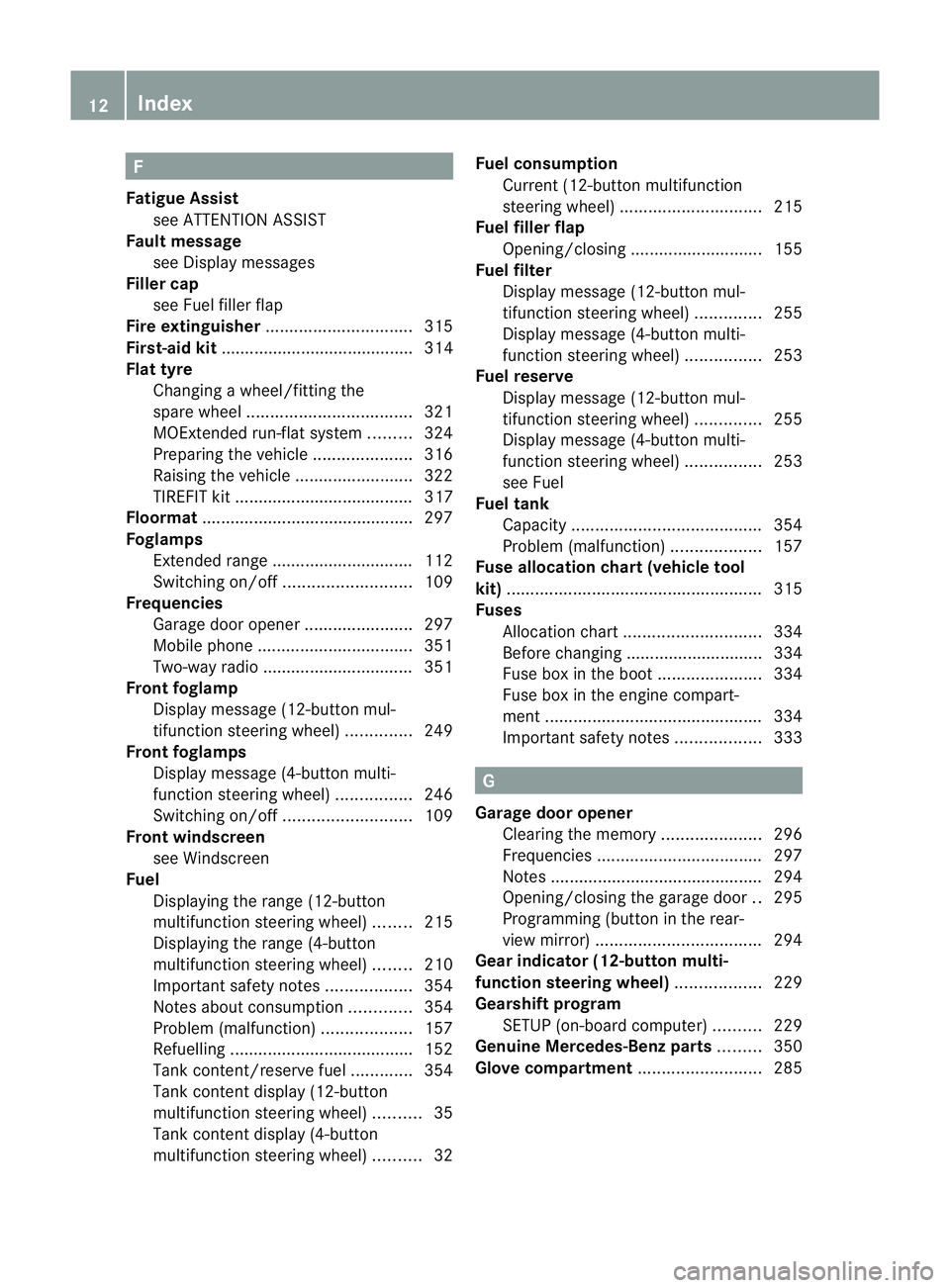
Fuel
Displaying the range (12-button
multifunction steering wheel) ........215
Displaying the range (4-button
multifunctio nsteering wheel) ........210
Important safety notes ..................354
Notes about consumption .............354
Problem (malfunction) ...................157
Refuelling ...................................... .152
Tank content/reserve fuel .............354
Tank content display (12-button
multifunctio nsteering wheel) ..........35
Tank content display (4-button
multifunctio nsteering wheel) ..........32Fuel consumption
Current (12-button multifunction
steering wheel) .............................. 215
Fuel filler flap
Opening/closing ............................ 155
Fuel filter
Display message (12-button mul-
tifunctio nsteering wheel) ..............255
Display message (4-button multi-
function steering wheel) ................253
Fuel reserve
Display message (12-button mul-
tifunctio nsteering wheel) ..............255
Display message (4-button multi-
function steering wheel) ................253
see Fuel
Fuel tank
Capacity ........................................ 354
Problem (malfunction) ...................157
Fuse allocation chart (vehicle tool
kit) ...................................................... 315
Fuses Allocation chart ............................. 334
Before changing ............................. 334
Fuse box in the boot ......................334
Fuse box in the engine compart-
ment .............................................. 334
Important safety notes ..................333 G
Garage door opener Clearing the memory .....................296
Frequencies ................................... 297
Notes ............................................. 294
Opening/closing the garage door ..295
Programming (button in the rear-
view mirror) ................................... 294
Gear indicator (12-button multi-
function steering wheel) ..................229
Gearshift program SETUP (on-board computer) ..........229
Genuine Mercedes-Benz parts .........350
Glove compartment ..........................28512
Index
Page 156 of 373
G
WARNING
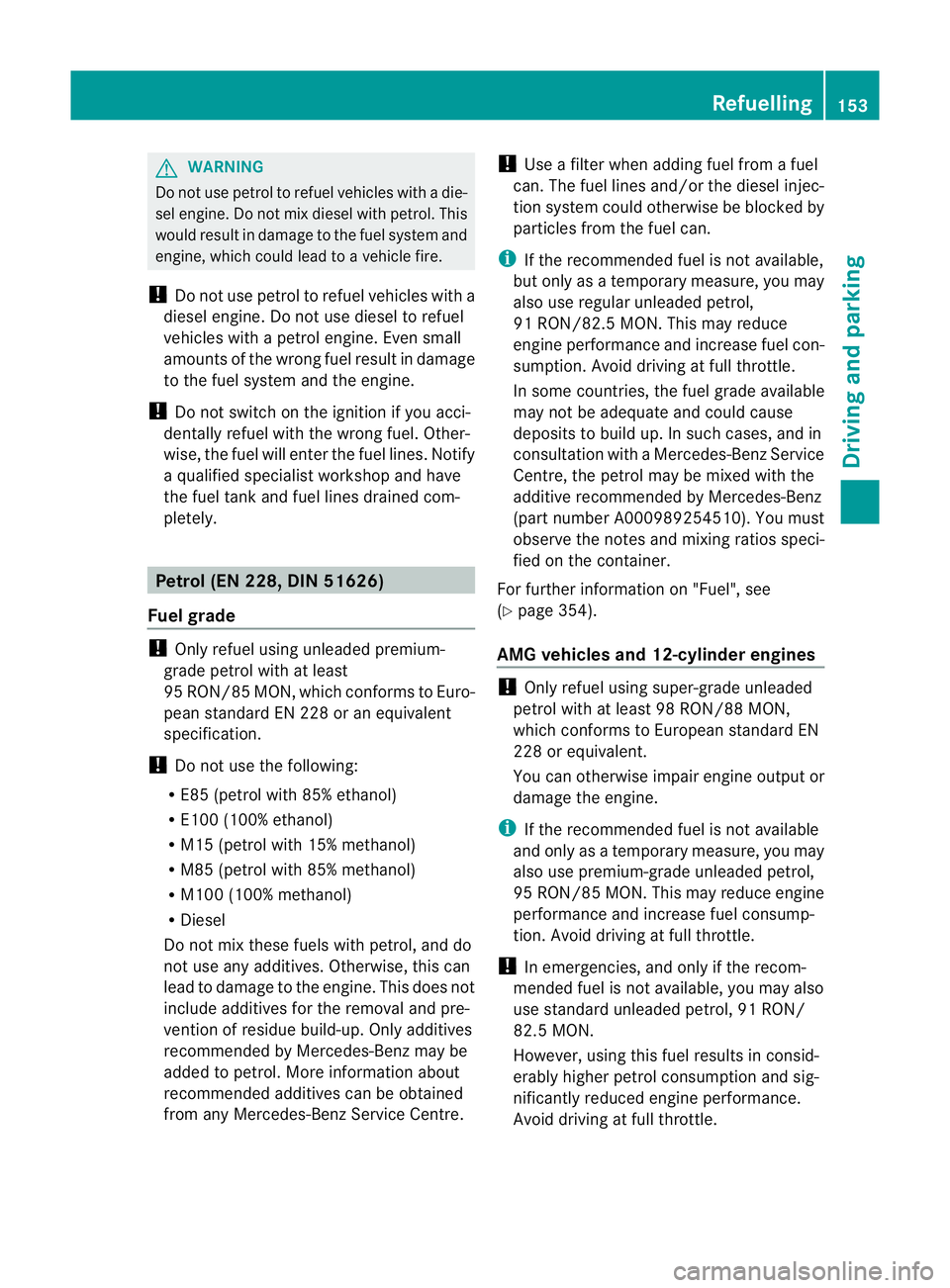
Do not use petrol to refuel vehicles with a die-
sel engine. Do not mix diesel with petrol. This
would result in damage to the fuel system and
engine, which could lead to a vehicle fire.
! Do not use petrol to refuel vehicles with a
diesel engine. Do not use diesel to refuel
vehicles with a petrol engine. Even small
amounts of the wrong fuel result in damage
to the fuel system and the engine.
! Do not switch on the ignition if you acci-
dentally refuel with the wrong fuel .Other-
wise, the fuel will ente rthe fuel lines. Notify
a qualified specialist workshop and have
the fuel tank and fuel lines drained com-
pletely. Petrol (EN 228, DIN 51626)
Fuel grade !
Only refuel using unleaded premium-
grade petrol with at least
95 RON/85 MON, which conforms to Euro-
pean standard EN 228 or an equivalent
specification.
! Do not use the following:
R E85 (petrol with 85% ethanol)
R E100 (100% ethanol)
R M15 (petrol with 15% methanol)
R M85 (petrol with 85% methanol)
R M100 (100% methanol)
R Diesel
Do not mix these fuels with petrol, and do
not use any additives. Otherwise, this can
lead to damage to the engine. This does not
include additives for the removal and pre-
vention of residue build-up. Only additives
recommended by Mercedes-Ben zmay be
added to petrol. More informatio nabout
recommended additives can be obtained
from any Mercedes-Benz Service Centre. !
Use a filter when adding fuel from a fuel
can. The fuel lines and/or the diesel injec-
tion system could otherwise be blocked by
particles from the fuel can.
i If the recommended fuel is not available,
but only as a temporary measure, you may
also use regular unleaded petrol,
91 RON/82.5 MON. This may reduce
engine performance and increase fuel con-
sumption .Avoid driving at full throttle.
In some countries, the fuel grade available
may not be adequate and could cause
deposits to build up. In such cases, and in
consultation with a Mercedes-Benz Service
Centre, the petrol may be mixed with the
additive recommended by Mercedes-Benz
(part number A000989254510). You must
observe the notes and mixing ratios speci-
fied on the container.
For further information on "Fuel", see
(Y page 354).
AMG vehicles and 12-cylinder engines !
Only refuel using super-grad eunleaded
petrol with at least 98 RON/88 MON,
which conforms to European standard EN
228 or equivalent.
You can otherwise impai rengine outpu tor
damage the engine.
i If the recommended fuel is not available
and only as a temporary measure, you may
also use premium-grade unleaded petrol,
95 RON/85 MON. This may reduce engine
performance and increase fuel consump-
tion. Avoid driving at full throttle.
! In emergencies, and only if the recom-
mended fuel is not available, you may also
use standard unleaded petrol, 91 RON/
82.5 MON.
However, using this fuel results in consid-
erably higher petrol consumption and sig-
nificantly reduced engine performance.
Avoid driving at full throttle. Refuelling
153Driving and parking Z
Page 157 of 373
If no fuel other than regular petrol with
91 RON/82.5 MON or a lowerg
rade is per-
manently available, you should have the
vehicle adapted to run on this fuel in a
qualified specialist workshop. Mercedes-
Benz recommends that you use a
Mercedes-Benz Service Centre for this pur-
pose.
C 350 BlueEFFICIENCY !
Only refuel using unleaded, sulphur-free
premium-grade petrol with at least
95 RON/85 MON, which conforms to Euro-
pean standard EN 228 or an equivalent
specification.
You can otherwise impair engine outpu tor
damage the emission control system.
i In some countries, the available petrol
may not be sufficiently low in sulphur. This
fuel can temporarily produce unpleasant
odours, especially on short journeys. As
soon as sulphur-free fuel (sulphur content
<10p pm) is used for refuelling, the odours
are reduced. Diesel (EN 590)
Fuel grade !
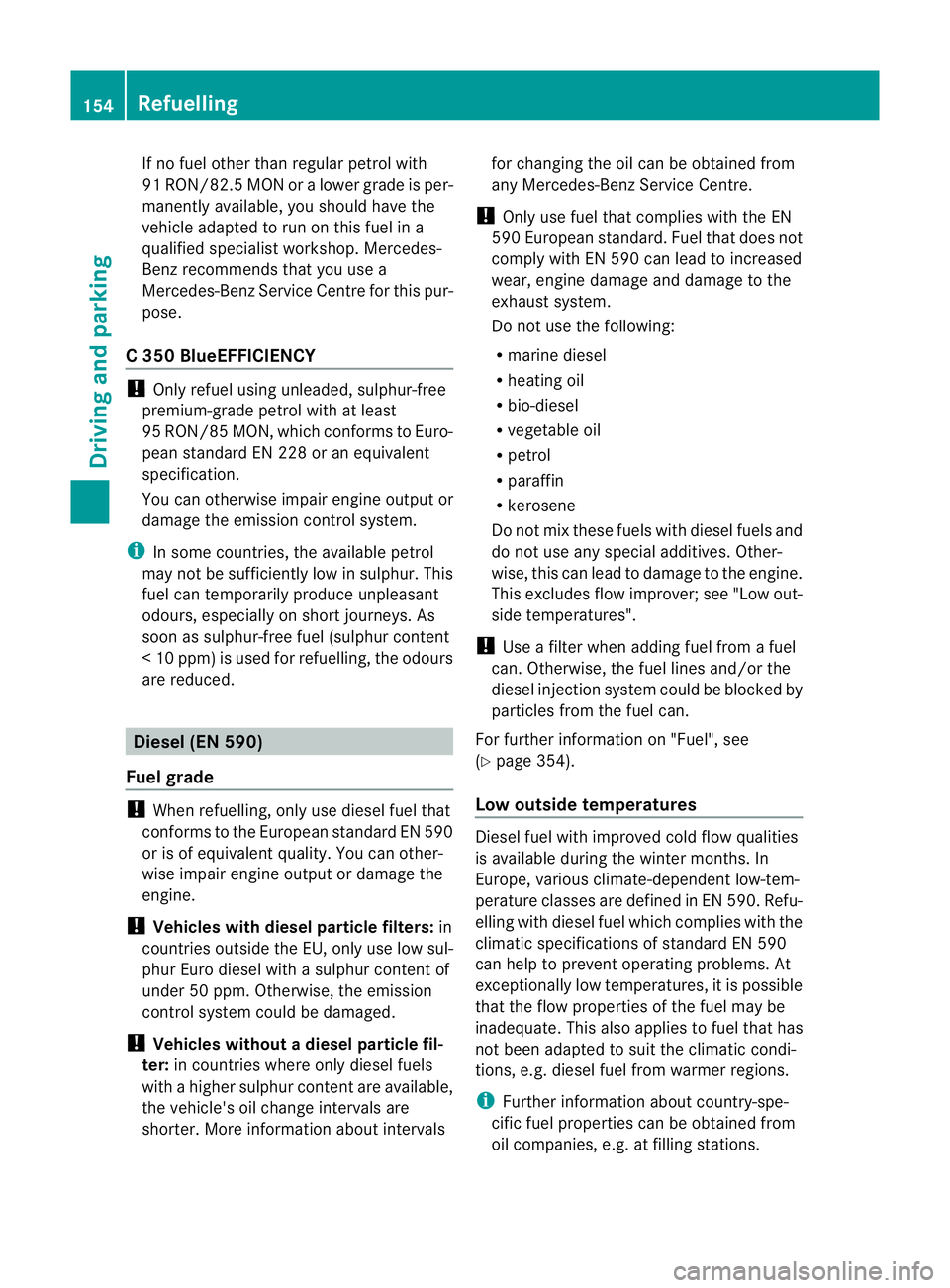
When refuelling, only use diesel fuel that
conform stothe European standard EN 590
or is of equivalent quality. You can other-
wise impair engine output or damage the
engine.
! Vehicles with diesel particle filters: in
countries outside the EU, only use low sul-
phur Euro diesel with a sulphurc ontent of
under 50 ppm. Otherwise, the emission
control system could be damaged.
! Vehicles without adiesel particle fil-
ter: in countries where only diesel fuels
with a higher sulphur conten tare available,
the vehicle's oil change intervals are
shorter. More information about intervals for changing the oil can be obtained from
any Mercedes-Benz Service Centre.
! Only use fuel that complies with the EN
590 European standard .Fuel that does not
comply with EN 590 can lead to increased
wear, engine damage and damag eto the
exhaust system.
Do not use the following:
R marine diesel
R heating oil
R bio-diesel
R vegetable oil
R petrol
R paraffin
R kerosene
Do not mix these fuels with diesel fuels and
do not use any special additives. Other-
wise, this can lead to damage to the engine.
This excludes flow improver; see "Low out-
side temperatures".
! Use a filter when adding fuel from a fuel
can. Otherwise, the fuel lines and/or the
diesel injection system could be blocked by
particles from the fuel can.
For further information on "Fuel", see
(Y page 354).
Low outside temperatures Diesel fuel with improved cold flow qualities
is available during the winter months. In
Europe, various climate-dependent low-tem-
perature classes are defined in EN 590. Refu-
elling with diesel fuel which complies with the
climatic specifications of standard EN 590
can help to prevent operating problems. At
exceptionally low temperatures, it is possible
that the flow properties of the fuel may be
inadequate. This also applies to fuel that has
not been adapted to suit the climatic condi-
tions, e.g. diesel fuel from warmer regions.
i Further information about country-spe-
cific fuel properties can be obtained from
oil companies, e.g. at filling stations. 154
RefuellingDriving and parking
Page 256 of 373

Display messages Possible causes/consequences and
M Solutions
4
Check eng. oil
level The engine oil level has dropped to a critical level.
Aw
arning tone also sounds.
X Chec kthe oil level (Y page 302).
X If necessary, top up the engine oil (Y page 303).
X Have the engine checked for leaks if the engine oil needs top-
ping up more often than usual. 8
Reserve fuel level The fuel level has dropped into the reserve range.
Operation of the auxiliary heating is deactivated when the fuel level
drops into the reserve range.
X
Refuel at the nearest filling station. C There is only a very small amount of fuel in the fuel tank.
The auxiliary heating cannot be operated.
X
Refuel at the nearest filling station without fail. ¸
Replace
air cleaner Vehicles with a diesel engine: the engine air filter is dirty and must
be replaced.
X
Visit a qualified specialist workshop. !
Clean
the fuel fil‐
ter Vehicles with a diesel engine: there is water in the fuel filter. The
water must be drained off.
X
Visit a qualified specialist workshop. Display messages
253On-board computer and displays Z
Page 258 of 373

Display messages Possible causes/consequences and
M Solutions
# The battery is no
tbeing charged.
Aw arning tone also sounds.
Possible causes are:
R a faulty alternator
R a torn poly-V-belt
R a malfunction in the electronics
X Stop the vehicle immediately, paying attentio ntoroad and traf-
fic conditions, and switch off the engine.
X Open the bonnet.
X Check whether the poly-V-belt is torn.
If the poly-V-belt is torn:
! Do not continue driving. The engine could otherwise overheat.
X Consult a qualified specialist workshop.
If the poly-V-belt is OK:
X Visit a qualified specialist workshop. 4
Check eng. oil
lev. when next
refuelling The engine oil level has dropped to a critical level.
Aw
arning tone also sounds.
X Chec kthe oil level (Y page 302).
X If necessary, top up the engine oil (Y page 303).
X Have the engine checked for leaks if the engine oil needs top-
ping up more often than usual. 8
Reserve fuel level The fuel level has dropped into the reserve range.
Operation of the auxiliary heating is deactivated when the fuel level
drops into the reserve range.
X
Refuel at the nearest filling station. C There is only a very small amount of fuel in the fuel tank.
The auxiliary heating cannot be operated.
X
Refuel at the nearest filling station without fail. ¸
Replace
air cleaner Vehicles with a diesel engine: the engine air filter is dirty and must
be replaced.
X
Visit a qualified specialist workshop. !
Clean
the fuel fil‐
ter Vehicles with a diesel engine: there is water in the fuel filter. The
water must be drained off.
X
Visit a qualified specialist workshop. Display messages
255On-board computer and displays Z
Page 358 of 373

H
Environmental note
CO 2(carbon dioxide) is the gas which scien-
tists believe to be principally responsible for
global warming (the greenhouse effect). Your
vehicle's CO 2emissions are directly related
to fuel consumption and therefore depend on:
R efficien tuse of the fuel by the engine
R driving style
R other non-technical factors, such as envi-
ronmental influences or road conditions
You can minimise your vehicle's CO 2emis-
sions by driving carefully and having it serv-
iced regularly. Engine oil
Please bear the following in mind The quality of engine oils is decisive for the
function and service life of an engine. After
extensive tests, Mercedes-Benz approves
engine oils which correspond to the current
technical standard.
Therefore, only Mercedes-Benz approved
engine oils may be used in Mercedes-Benz
engines.
Further information on tested and approved
engine oils can be obtained from any
Mercedes-Benz Service Centre. Mercedes-
Benz recommends that you have the oil
change carried out at a Mercedes-Benz
Service Centre. Mercedes-Benz approval is
indicated on the oil container by the inscrip-
tion "MB Approval" and the corresponding
designation, e.g. MB Approval 229.51.
The table shows which engine oils have been
approved for your vehicle. Petrol engines MB Approval
C 180
26
C 250 26 229.3, 229.5,
229.51
C 350
26 229.3, 229.5
C 63 AMG
27 229.5
Diesel engines MB Approval
Vehicles with
adiesel particle filter C 220 CDI
26
C 250 CDI 26 228.51,
229.31, 229.51
You can call up an overview of approved
engine oils on the Internet at
http://bevo.mercedes-benz.com by enter-
ing the designation, e.g. 229.5.
i
If the engine oils listed in the table are not
available, you may add a maximum of 1. 0l
of the following engine oils, once only, until
the next oil change:
R vehicles with a petrol engine 28
: MB
Approval 229.1 or ACEA A3
R vehicles with a diesel engine: MB
Approval 229.1 or ACEA C3
Capacities The following values refer to an oil change
including the oil filter.
26 BlueEFFICIENCY.
27 Restriction: only SAE 0W-40/SAE 5W-40 engine oils may be used.
28 Restriction: only SAE 0W-40/SAE 5W-40 engine oils may be used for AMG vehicles. Service products and capacities
355Technical data Z
Page 359 of 373

Vehicle model Capacity including
oil filter C 180
29
C 250 29 5.5 l
C 220 CDI
29
C 250 CDI 29
C 350 29 6.5 l
C 63 AMG
30 8.5 l
Additives
!
Do not use additives in engine oil. This
could damage the engine.
Engine oil viscosity Viscosity describes the flow characteristics
of a fluid
.Ifanengine oil has a high viscosity,
this means tha titis thick; a low viscosity
means that it is thin.
Engine oil selection is based on the respective
outside temperatures and in accordance with
the SAE classification (viscosity). The table
below shows you which SAE classifications
are to be used. The low-temperature proper-
ties of engine oils can be significantly
impaired during operation due to, for exam-
ple, ageing or soot and fuel accretion. It is
therefore strongly recommended to observe
regularo il changes using an approved engine
oil with the appropriate SA Eclassification. Brake fluid
G
WARNING
The brake fluid constantly absorbs moisture
fro mt he air; this lowers its boiling point.
If the boiling point of the brake fluid is too low,
vapour pockets may form in the brake system
when the brakes are applied hard (e.g. when
driving downhill). This would impair braking
efficiency.
You should have the brake fluid renewed at
regular intervals. The brake fluid change inter-
vals can be found in the Service Booklet.
Only use brake fluid approved by Mercedes-
Benz. Information about approved brake flu-
ids can be obtained from any Mercedes-Benz
Service Centre.
i There is usually a notice in the engine
compartmentt o remind you when the next
brake fluid change is due. Coolant
Important safety notes The coolant is a mixture of water and anti-
freeze/corrosion inhibitor. It performs the
following tasks:
R
anti-corrosion protection
R antifreeze protection
R raising the boiling point
i When the vehicle is first delivered, it is fil-
led with a coolant mixture that ensures
adequate antifreeze and corrosion protec-
tion.
! Only add coolant that has been premixed
with the desired antifreeze protection. The
engine could otherwise be damaged.
Further information on coolants and on fill-
ing can be found in the Mercedes-Benz
Specifications for Servic eProducts, MB
Approval 310.1, e.g. on the Internet at
29 BlueEFFICIENCY.
30 Including external oil cooler. 356
Service products and capacitiesTechnical data