Page 134 of 821
61
1
Before driving
1-3. Adjustable components (seats, mirrors, steering wheel)
Front seats
Flattening the front seatbacks
nBefore flattening the front seatbacks
Slide the rear seats as far back as possible. (→P. 6 6 )
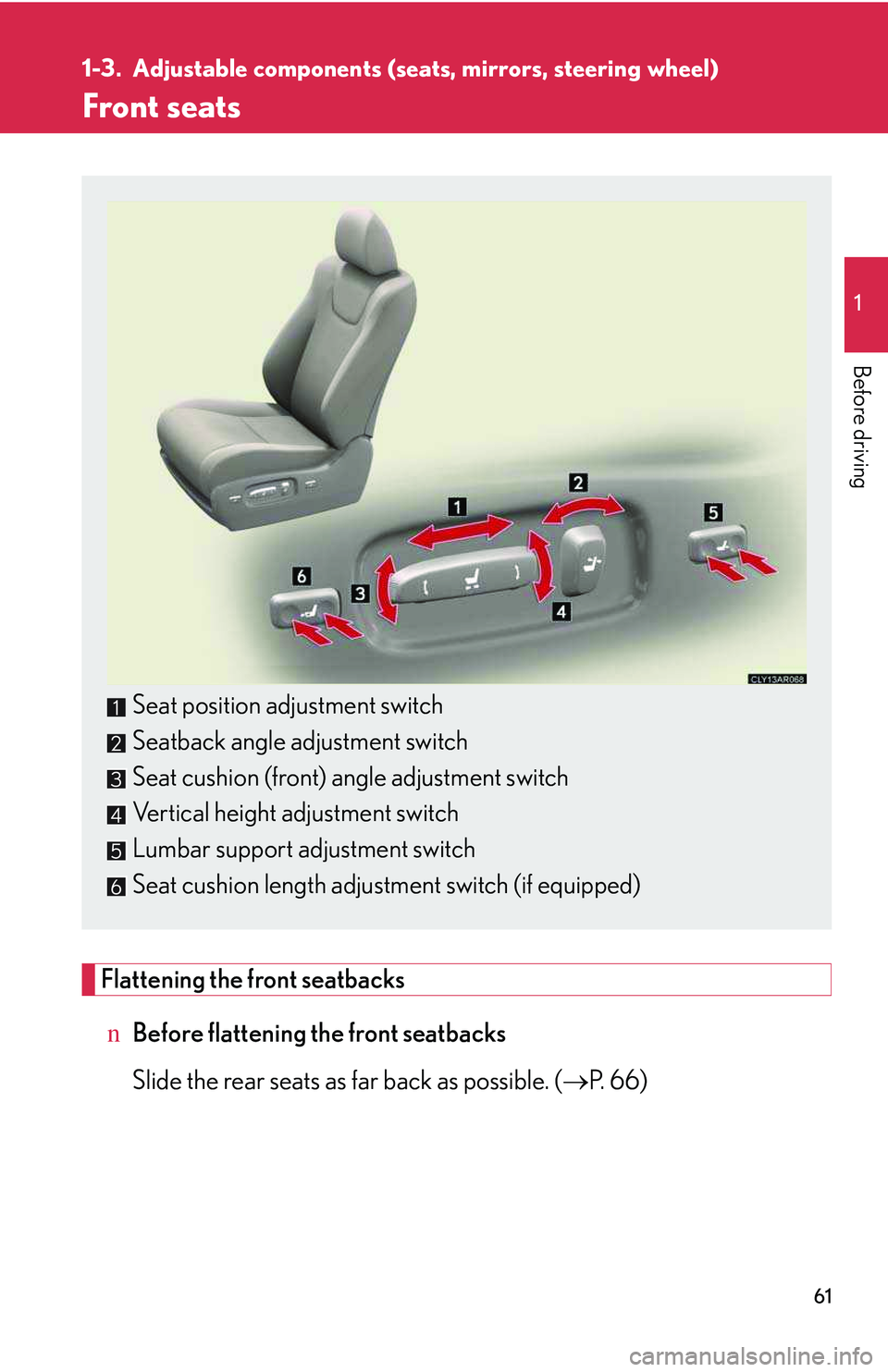
Seat position adjustment switch
Seatback angle adjustment switch
Seat cushion (front) angle adjustment switch
Vertical height adjustment switch
Lumbar support adjustment switch
Seat cushion length adjustment switch (if equipped)
Page 147 of 821
74
1-3. Adjustable components (seats, mirrors, steering wheel)
nAdjusting the height of the head restraints (front seats)
nAdjusting the rear seat head restraints
Always raise the head restraints to the uppermost lock position during use.
CAUTION
nHead restraint precautions
Observe the following precautions regarding the head restraints. Failure to do so
may result in death or serious injury.
lUse the head restraints designed for each respective seat.
lAdjust the head restraints to the correct position at all times.
lAfter adjusting the head restraints, push down on them and make sure they are
locked in position.
lDo not drive with the head restraints removed.
Make sure that the head restraints are
adjusted so that the center of the head
restraint is closest to the top of your ears.
Page 149 of 821
76
1-3. Adjustable components (seats, mirrors, steering wheel)
Seat belt comfort guide (outside rear seats)
If the shoulder belt sits close to a person's neck, use the seat belt comfort
guide.
Pull the comfort guide from the
pocket.
Slide the belt past the slot of the
guide.
The elastic cord must be behind
the seat belt.
nAdjusting the seat belt shoulder anchor height (front seats)
Push the seat belt shoulder
anchor down while pressing
the release button.
Push the seat belt shoulder
anchor up.
Move the height adjuster up and
down as needed until you hear a
click.
STEP1
STEP2
Page 158 of 821
85
1
1-3. Adjustable components (seats, mirrors, steering wheel)
Before driving
Anti-glare inside rear view mirror
Adjusting the height of rear view mirror
Adjust the height of the rear view
mirror by moving it up and down.
In automatic mode, sensors are used to detect the headlights of vehicles
behind and the reflected light is automatically reduced.
Turns automatic mode on/ off
The indicator comes on when
automatic mode is turned on.
The mirror will revert to auto-
matic mode each time the
“ENGINE START STOP” switch
is turned to IGNITION ON
mode.Indicator
nTo prevent sensor error
To ensure that the sensors operate properly,
do not touch or cover them.
Page 316 of 821
244
2-5. Driving information
Utility vehicle precautions
Off-road vehicle feature
lSpecific design characteristics give it a higher center of gravity than
ordinary passenger cars. This vehicle design feature causes this type of
vehicle to be more likely to rollover. And, utility vehicles have a signifi-
cantly higher rollover rate than other types of vehicles.
lAn advantage of the higher ground clearance is a better view of the
road allowing you to anticipate problems.
lIt is not designed for cornering at the same speeds as ordinary passen-
ger cars any more than low-slung sports cars designed to perform sat-
isfactorily under off-road conditions. Therefore, sharp turns at
excessive speeds may cause rollover.
This vehicle belongs to the utility vehicle class, which has higher
ground clearance and narrower tread in relation to the height of its
center of gravity to make it capable of performing in a wide variety of
off-road applications.
Page 338 of 821

266
2-5. Driving information
lWhen restarting after parking on a slope:
With the transmission in the P position, start the engine. Be sure
to keep the brake pedal depressed.
Shift into 3, 2, 1, or the R position (if reversing).
Release the parking brake and brake pedal, and slowly pull or
back away from the wheel blocks. Stop and apply the brakes.
Have someone retrieve the blocks.
nBefore towing
Check that the following conditions are met:
lThe vehicle's tires are properly inflated. (→P. 4 8 7 )
lTrailer tires are inflated according to the trailer manufacturer's recommendation.
lAll trailer lights work.
lAll lights work each time you connect them.
lThe trailer ball is set up at the proper height for the coupler on the trailer.
lThe vehicle remains level when a loaded or unloaded trailer is hitched. Do not
drive if the vehicle is not level, and check for improper tongue load, overloading,
worn suspension, or other possible causes.
lThe trailer cargo is securely loaded.
lThe rear view mirrors conform to all applicable federal, state/provincial or local
regulations. If they do not, install rear view mirrors appropriate for towing pur-
poses.
nBreak-in schedule
If your vehicle is new or equipped with any new power train components (such as
an engine, transmission, differential and wheel bearing), Lexus recommends that
you do not tow a trailer until it has been driven for over 500 miles (800 km).
However, avoid full throttle acceleration.
nMaintenance
lIf you tow a trailer, your vehicle will require more frequent maintenance due to
the additional load. (See “Warranty and Services Guide”, “Owner's Manual Sup-
plement” or “Scheduled Maintenance”.)
lRetighten the fixing bolts of the towing ball and bracket after approximately 600
miles (1000 km) of trailer towing.
STEP1
STEP2
STEP3
STEP4
Page 475 of 821
405
3-6. Using the storage features
3
Interior features
CAUTION
nCaution while driving
Keep the console box closed.
Injuries may result in the event of an accident or sudden braking.
NOTICE
nTr a y
Do not insert items exceeding the height of the tray. Doing so may prevent opening
and closing of the lid.
Console box
Page 643 of 821

574
5-2. Steps to take in an emergency
CAUTION
nUsing the tire jack
Improper use of the tire jack may cause the vehicle to suddenly fall off the jack,
leading to death or serious injury.
lDo not use the tire jack for any purpose other than replacing tires or installing and
removing tire chains.
lOnly use the tire jack that comes with this vehicle for replacing a flat tire.
Do not use it on other vehicles, and do not use other tire jacks for replacing tires
on this vehicle.
lAlways check that the tire jack is securely set to the jack point.
lDo not put any part of your body under the vehicle is supported by the jack.
lDo not start or run the engine while your vehicle while it is supported by the jack.
lDo not raise the vehicle while someone is in it.
lWhen raising the vehicle, do not put an object on or under the jack.
lDo not raise the vehicle to a height greater than that required to replace the tire.
lUse a jack stand if it is necessary to get under the vehicle.
Take particular care when lowering the vehicle to ensure that no one working on or
near the vehicle may be injured.
nReplacing a flat tire
Observe the following precautions to reduce the risk of death or serious injury:
lDo not touch the disc wheels or the area around the brakes immediately after the
vehicle has been driven.
After the vehicle has been driven the disc wheels and the area around the brakes
will be extremely hot. Touching these areas with hands, feet or other body parts
while changing a tire, etc. may result in burns.
lNever use oil or grease on the wheel bolts or wheel nuts.
Oil and grease may cause the wheel nuts to be excessively tightened, leading to
bolt or disc wheel damage. In addition, the oil or grease can cause the wheel nuts
to loosen and the wheel may fall off, causing a serious accident. Remove any oil or
grease from the wheel bolts or wheel nuts.