Page 342 of 821
270
2-5. Driving information
Dinghy towing
NOTICE
nTo avoid serious damage to your vehicle
nTo prevent causing serious damage to the transmission and Active Torque Con-
trol 4WD system (AWD models)
Your vehicle is not designed to be dinghy towed (with 4 wheels on the
ground) behind a motor home.
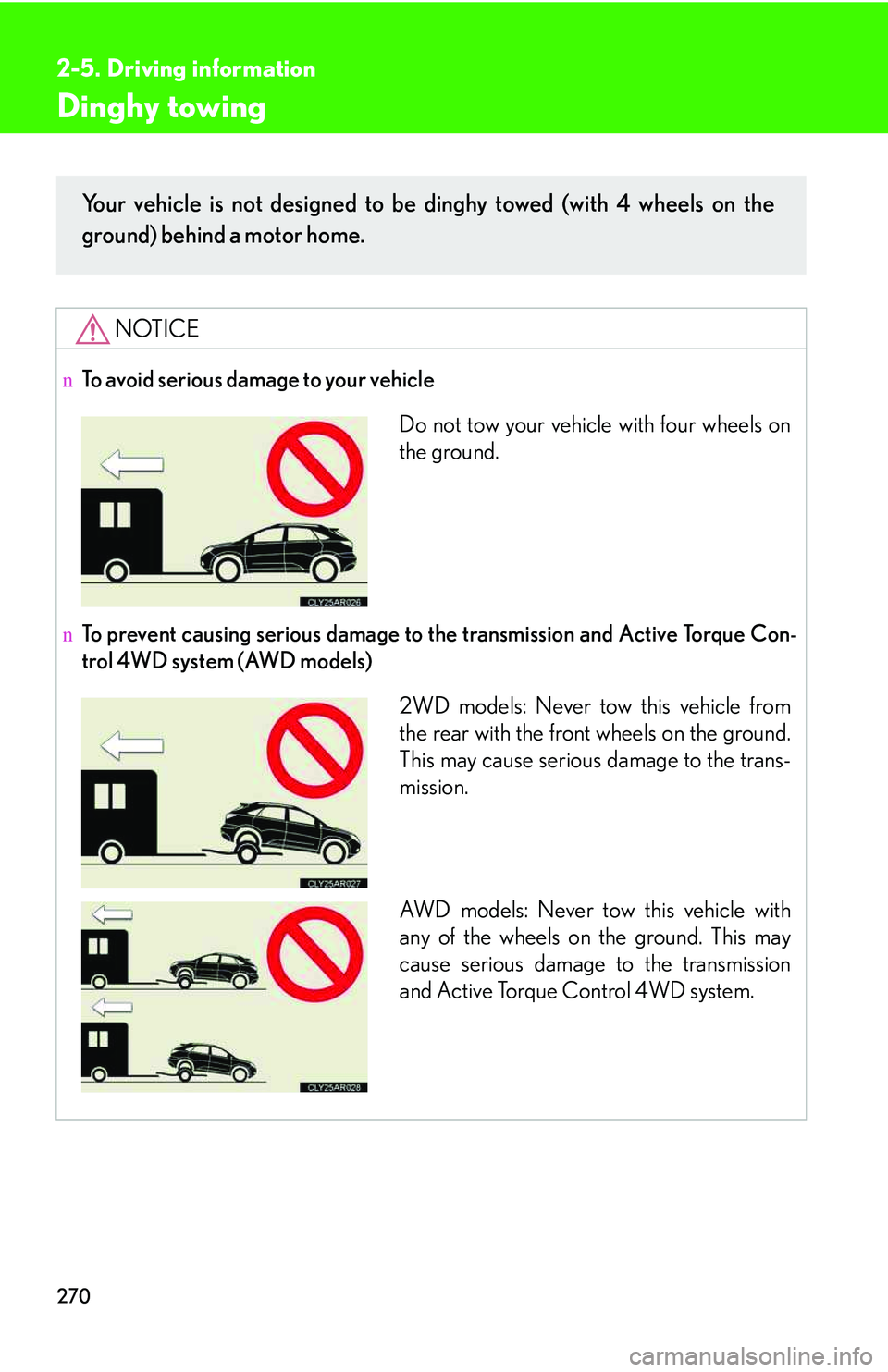
Do not tow your vehicle with four wheels on
the ground.
2WD models: Never tow this vehicle from
the rear with the front wheels on the ground.
This may cause serious damage to the trans-
mission.
AW D m o d e l s : N e v e r t ow this vehicle with
any of the wheels on the ground. This may
cause serious damage to the transmission
and Active Torque Control 4WD system.
Page 576 of 821

506
4-3. Do-it-yourself maintenance
6ECU-IG1 NO. 310 A
Outside rear view mirror, windshield
wipers and washer, seat heaters,
starter system, power outlet, moon
roof, Automatic High Beam
7ECU-IG1 NO. 110 A
Multiplex communication system,
electric power steering system, shift
lock control system, tilt and telescopic
steering, starter system, automatic
transmission system, power back
door, tire pressure warning system
8S/ROOF30 AMoon roof
9FUEL OPN7. 5 AFuel filler door opener
10PSB30 APre-collision seat belt
11TI & TE30 ATilt and telescopic steering system
12DR LOCK10 APower door lock system
13FR FOG15 AFront fog lights
14P-S E AT L H30 APo w e r s e a t ( l e f t - s i d e )
154WD7. 5 AAW D s y s t e m
16INVERTER20 A
17RR FOG7. 5 A
18D/L ALT B25 AMultiplex communication system
19HEATER10 AAir conditioning system
20ECU-IG1 NO. 210 A
Air conditioning system, multiport fuel
injection system/sequential multiport
fuel injection system, SRS airbag sys-
tem, multi-information display
FuseAmpereCircuit
Page 594 of 821
5
When trouble arises
525
5-1. Essential information
If your vehicle needs to be towed
Before towing
The following may indicate a problem with your transmission. Contact
your Lexus dealer before towing.
lThe engine is running, but the vehicle will not move.
lThe vehicle makes an abnormal sound.
If towing is necessary, we recommend having your vehicle towed by your
Lexus dealer or a commercial towing service, using a lift-type truck or a
flatbed truck.
Use a safety chain system for all towing, and abide by all state/provincial
and local laws.
2WD models: If towing your vehicle with a wheel-lift type truck from the
front, the vehicle's rear wheels and axles must be in good conditions.
(→P. 527, 530)
If they are damaged, use a towing dolly or flatbed truck.
AWD models: If towing your vehicle with a wheel-lift type truck, use a tow-
ing dolly. (→P. 5 2 7 , 5 3 0 )
Page 599 of 821

530
5-1. Essential information
NOTICE
nTo prevent body damage when towing with a sling-type truck
Do not tow with a sling-type truck, either from the front or rear.
nTo prevent causing serious damage to the transmission and Active Torque Con-
trol 4WD system (AWD models) when towing using a wheel-lift type truck
nTo prevent damaging the vehicle when towing using a wheel-lift type truck
When raising the vehicle, ensure adequate ground clearance for towing at the
opposite end of the raised vehicle. Without adequate clearance, the vehicle could
be damaged while being towed.
nRecreational towing (behind motor home, etc.)
Never dinghy tow your vehicle to prevent causing serious damage to the Active
Torque Control 4WD system (AWD models) and transmission. (→P. 2 7 0 )
2WD models: Never tow this vehicle from
the rear with the front wheels on the ground.
This may cause serious damage to the trans-
mission. If towing from the rear, use a towing
dolly.
AW D m o d e l s : N e v e r t ow this vehicle with
any of the wheels on the ground. This may
cause serious damage to the transmission
and Active Torque Control 4WD system.
Use a towing dolly.
Page 602 of 821

5
When trouble arises
533
5-1. Essential information
Event data recorder
In a crash or a near crash event
The SRS airbag sensor assembly contains the EDR. In a crash or near
crash event, this device may record some or all of the following informa-
tion:
lEngine speed
lWhether the brake pedal was applied or not
lVehicle speed
lTo what extent the accelerator pedal was depressed
lPosition of the transmission shift lever
lWhether the driver and front passenger wore seat belts or not
lDriver's seat position
lSRS airbag deployment data
lSRS airbag system diagnostic data
lFront passenger’s occupant classification
The information above is intended to be used for the purpose of improv-
ing vehicle safety performance. Unlike general data recorders, the EDR
does not record sound data such as conversation between passengers.
Your vehicle has computers that monitor and control certain aspects of
your vehicle. These computers assist in driving and maintaining optimal
vehicle performance.
Besides storing data useful for troubleshooting, there is an event data
recorder (EDR) that records data in a crash or near crash event.
Page 616 of 821
5
When trouble arises
547
5-2. Steps to take in an emergency
Have the vehicle inspected by your Lexus dealer immediately.
A buzzer sounds and a warning message is shown on the multi-informa-
tion display. Failure to investigate the cause of the following warnings may
lead to the system operating abnormally and possibly cause an accident.
Have the vehicle inspected by your Lexus dealer immediately.
Wa r n i n g m e s s a g eDetails
(If equipped)
Indicates a malfunction in the AWD system
Indicates that the automatic transmission fluid tem-
perature is too high
Indicates a malfunction in the brake lights system
Indicates a malfunction in the steering lock system
Page 659 of 821

590
5-2. Steps to take in an emergency
If the vehicle becomes stuck
CAUTION
nWhen attempting to free a stuck vehicle
If you choose to push the vehicle back and forth to free it, make sure the surround-
ing area is clear to avoid striking other vehicles, objects or people. The vehicle may
also lunge forward or lunge back suddenly as it becomes free. Use extreme cau-
tion.
nWhen shifting the shift lever
Be careful not to shift the shift lever with the accelerator pedal depressed.
This may lead to unexpected rapid acceleration of the vehicle that may cause an
accident and resulting in death or serious injury.
NOTICE
nTo avoid damage to the transmission and other components
lAvoid spinning the wheels.
lIf the vehicle remains stuck even after these procedures are performed, the vehi-
cle may require towing to be freed.
Carry out the following procedures if the tires spin or the vehicle becomes
stuck in mud, dirt, or snow:
Stop the engine. Set the parking brake and shift the shift lever
to P.
Remove the mud, snow, or sand from around the stuck tire.
Place wood, stones or some other material under the tires to
help provide traction.
Restart the engine.
AWD models: Active all-wheel drive lock mode (→P. 237)
Shift the shift lever to the D or R position and carefully apply
the accelerator to free the vehicle.
Turn off the TRAC and VSC systems if these functions are hamper-
ing your attempts to free the vehicle. (→ P. 2 3 3 )
STEP1
STEP2
STEP3
STEP4
STEP5
STEP6
Page 670 of 821
600
6-1. Specifications
Electrical system
Automatic transaxle
*:The fluid capacity is a reference quantity. If replacement is necessary, contact
your Lexus dealer.
Battery
Open voltage* at
68°F (20°C):
12.6 ⎯ 12.8 V Fully charged
12.2 ⎯ 12.4 V Half charged
11.8 ⎯ 12.0 V Discharged
(*: Voltage checked 20 minutes after the engine and
all the lights are turned off)
Charging rates5 A max.
Fluid capacity*2WD6.8 qt. (6.5 L, 5.7 Imp. qt.)
AW D7.0 qt. (6.7 L, 5.9 Imp. qt.)
Fluid typeToyota Genuine ATF WS
NOTICE
nAutomatic transmission fluid type
Using automatic transmission fluid other than “Toyota Genuine ATF WS” may
cause deterioration in shift quality, locking up of your transmission accompanied by
vibration, and ultimately damage the automatic transmission of your vehicle.