Page 17 of 609
IS250/220d/200d_EE
17
: If equipped
*1: For vehicles with a navigation system, refer to the “Navigation System Owner’s
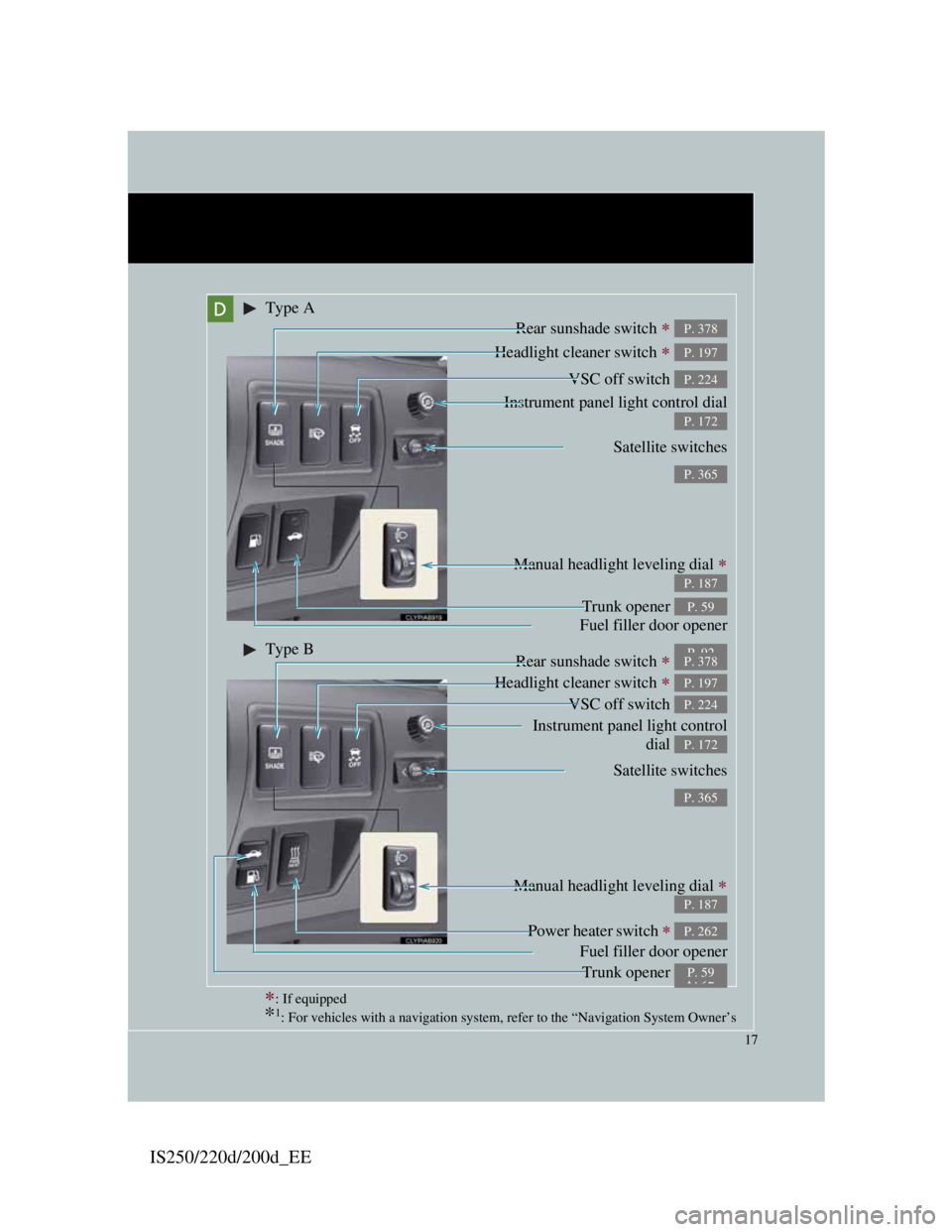
Rear sunshade switch P. 378
Fuel filler door opener
P. 92
Headlight cleaner switch P. 197
Satellite switches
P. 365
Instrument panel light control dial
P. 172
VSC off switch P. 224
Trunk opener P. 59
Manual headlight leveling dial
P. 187
D Type A
Type BRear sunshade switch P. 378
Fuel filler door opener
P. 92Trunk opener P. 59
Headlight cleaner switch P. 197
Satellite switches
P. 365
Instrument panel light control
dial
P. 172
VSC off switch P. 224
Power heater switch P. 262
Manual headlight leveling dial
P. 187
Page 25 of 609
IS250/220d/200d_EE
25
: If equipped
*1: For vehicles with a navigation system, refer to the “Navigation System Owner’s
Trunk opener P. 59
Headlight cleaner switch P. 197
Satellite switches P. 365
Rear sunshade switch P. 378
Fuel filler door opener P. 92
Manual headlight leveling dial
P. 187
D
Instrument panel light control dial P. 172
VSC off switch
P. 224
Page 190 of 609
178
2-2. Instrument cluster
IS250/220d/200d_EE
Indicators
The indicators inform the driver of the operating state of the
vehicle’s various systems.
Turn signal indicator
(P. 170)(vehicles
with an
automatic
transmis-
sion)
“ECT SNOW” indica-
tor
(P. 162)
Headlight high beam
indicator (P. 186)(vehicles
with an
automatic
transmis-
sion)“ECT PWR” indicator
(P. 162)
Tail light indicator
(P. 186)
(if
equipped)
Cruise control indicator
(P. 198, 202)
Front fog light indicator
(P. 190)
(if
equipped)
Lexus parking assist-
sensor indicator (P.
217)
Rear fog light indicator
(P. 190)Slip indicator
(P. 224)
(vehicles with an automatic
VSC off indicator
(P. 224)
*1, 2
*1
Page 212 of 609

200
2-4. Using other driving systems
IS250/220d/200d_EE
Cruise control can be set when
The shift lever is in the D or range 4 or higher of S has been selected.
Range 4 or higher has been selected by using the paddle shift.
(vehicles with paddle shift switch)
Vehicle speed is above approximately 40 km/h (25 mph).
Accelerating after setting the vehicle speed
The vehicle can be accelerated normally. After acceleration, the set
speed resumes.
Even without canceling the cruise control, the set speed can be increased
by first accelerating the vehicle to the desired speed and then pushing the
lever down to set the new speed.
Automatic cruise control cancelation
Cruise control will stop maintaining the vehicle speed in any of the follow-
ing situations.
Actual vehicle speed falls more than approximately 16 km/h (10 mph)
below the preset vehicle speed.
At this time, the memorized set speed is not retained.
Actual vehicle speed is below approximately 40 km/h (25 mph).
VSC is activated.
If the cruise control indicator light flashes
Press the “ON-OFF” button once to deactivate the system, and then press
the button again to reactivate the system.
If the cruise control speed cannot be set or if the cruise control cancels
immediately after being activated, there may be a malfunction in the cruise
control system. Have the vehicle inspected by any authorized Lexus dealer
or repairer, or another duly qualified and equipped professional.
Page 222 of 609

210
2-4. Using other driving systems
IS250/220d/200d_EE
Adjusting the speed setting:
P. 2 0 4
Canceling and resuming the
speed setting: P. 206
Dynamic radar cruise control can be set when
The shift lever is in the D or range 4 or higher of S has been selected.
Range 4 or higher has been selected by using the paddle shift.
(vehicles with paddle shift switch)
Vehicle speed is above approximately 50 km/h (30 mph).
Accelerating after setting the vehicle speed
The vehicle can accelerate normally. After acceleration, the set speed
resumes. However, during vehicle-to-vehicle distance control mode, the
vehicle speed may decrease below the set speed in order to maintain the dis-
tance to the vehicle ahead.
Automatic cancelation of vehicle-to-vehicle distance control
Vehicle-to-vehicle distance control driving is automatically canceled in the
following situations:
Actual vehicle speed falls below approximately 40 km/h (25 mph).
VSC is activated.
The sensor cannot operate correctly because it is covered in some way.
The windshield wipers are operating at high speed (when the wiper
switch is set to the “AUTO” mode or the high speed wiper operation
position).
When snow mode is set. (IS250 only)
If vehicle-to-vehicle distance control driving is automatically canceled for
any other reason, there may be a malfunction in the system. Contact any
authorized Lexus dealer or repairer, or another duly qualified and equipped
professional.
Page 223 of 609

211
2-4. Using other driving systems
2
When driving
IS250/220d/200d_EE
Automatic cancelation of constant speed control
The cruise control will stop maintaining the vehicle speed in the following
situations:
Actual vehicle speed is more than approximately 16 km/h (10 mph)
below the set vehicle speed.
At this time, the memorized set speed is not retained.
Actual vehicle speed falls below approximately 40 km/h (25 mph).
VSC is activated.
Radar sensor and grille cover
Always keep the sensor and grille cover clean to ensure that the vehicle-to-
vehicle distance control operates properly. (Some obstructions, such as
snow, ice and plastic objects, cannot be detected by the obstruction sensor.)
Dynamic radar cruise control is canceled if an obstruction is detected.
Warning lights, messages and buzzers for dynamic radar cruise control
Warning lights, messages and buzzers are used to indicate a system mal-
function or to inform the driver of the need for caution while driving. (P.
467, 473)
Grille cover
Radar sensor
Page 236 of 609

224
2-4. Using other driving systems
IS250/220d/200d_EE
Driving assist systems
To help enhance driving safety and performance, the following sys-
tems operate automatically in response to various driving situations.
Be aware, however, that these systems are supplementary and should
not be relied upon too heavily when operating the vehicle.
ABS (Anti-lock Brake System)
Helps to prevent wheel lock when the brakes are applied suddenly,
or if the brakes are applied while driving on a slippery road surface.
Brake assist
Generates an increased level of braking force after the brake pedal
is depressed, when the system detects a panic stop situation.
VSC (Vehicle Stability Control)
Helps the driver to control skidding when swerving suddenly or
turning on slippery road surfaces.
TRC (Traction Control)
Maintains drive power and prevents the rear wheels from spinning
when starting the vehicle or accelerating on slippery roads.
Hill-start assist control (vehicles with an automatic transmis-
sion)
Helps to prevent the vehicle from rolling backward when starting
on an incline or slippery slope.
EPS (Electric Power Steering)
Employs an electric motor to reduce the amount of effort needed to
turn the steering wheel.
PCS (Pre-Crash Safety System) (if equipped)
P. 230
VDIM (Vehicle Dynamics Integrated Management)
Provides integrated control of the ABS, brake assist, TRC, VSC,
hill-start assist control, and EPS systems.
Helps to maintain vehicle stability when swerving on slippery road
Page 237 of 609
225
2-4. Using other driving systems
2
When driving
IS250/220d/200d_EE
When the VSC/TRC/hill-start assist control systems are operating
The slip indicator flashes to
indicate that the VSC/TRC/hill-
start assist control systems have
been engaged.
The stop lights and high
mounted stoplight turn on when
the hill-start assist control sys-
tem is operating.
To disable TRC/VSC
If the vehicle gets stuck in fresh snow or mud, TRC and VSC may
reduce power from the engine to the wheels. You may need to turn
the system off to enable you to rock the vehicle in order to free it.
Turning off TRC
Quickly push and release the
switch to turn off TRC
A message will be shown on the
multi-information display.
Push the switch again to turn
the system back on.