Page 539 of 609

5
513
5-2. Steps to take in an emergency
When trouble arises
IS250/220d/200d_EE
CAUTION
When fixing the flat tire
Stop your vehicle in a safe and flat area.
Connect the valve and hose securely with the tire installed on the vehicle.
If the hose is not properly connected to the valve, air leakage may occur or
sealant may be sprayed out.
If the hose comes off the valve while inflating the tire, there is a risk that
the hose will move abruptly due to air pressure.
After inflation of the tire has been completed, the sealant may splatter
when the hose is disconnected or some air is let out of the tire.
Keep back from the tire while it is being repaired, as there is a chance of it
bursting while the repair operation is being performed. If you notice any
cracks or deformation of the tire, turn off the compressor switch and stop
the repair operation immediately.
The kit may overheat if operated for a long period of time. Do not operate
the compressor continuously for more than 10 minutes.
Parts of the kit become hot during operation. Be careful handling the kit
during and after operation.
Do not attach the vehicle speed warning sticker to an area other than the
one indicated. If the sticker is attached to an area where an SRS airbag is
located, such as the pad of the steering wheel, it may prevent the SRS air-
bag from operating properly.
Driving to spread the liquid sealant evenly
Drive the vehicle carefully at a low speed. Be especially careful when
turning and cornering.
If the vehicle does not drive straight or you feel a pull through the steering
wheel, stop the vehicle and check the following:
• Tire condition. The tire may have separated from the wheel.
• Tire inflation pressure. If tire inflation pressure is 130 kPa (1.3 kgf/
cm
2 or bar, 19 psi) or below, this may indicate severe tire damage.
Page 540 of 609

514
5-2. Steps to take in an emergency
IS250/220d/200d_EE
NOTICE
Do not drive the vehicle with a flat tire
Do not continue driving with a flat tire.
Driving even a short distance with a flat tire can damage the tire and the
wheel beyond repair.
When performing an emergency repair
Perform the emergency repair without removing the nail or screw that has
punctured the tread of the tire. If the object that has punctured the tire is
removed, repair by the emergency tire puncture repair kit may not be pos-
sible.
The kit is not waterproof. Make sure that the kit is not exposed to water,
such as when it is being used in the rain.
Do not put the kit directly onto dusty ground such as sand at the side of
the road. If the kit vacuums up dust etc., a malfunction may occur.
Use the kit with the top facing upward. The kit cannot work properly if it
is laid on its side.
Handling the emergency tire puncture repair kit
The compressor power source should be 12 V DC suitable for vehicle use.
Do not connect the compressor to any other source.
If gasoline splatters on the kit, the kit may deteriorate. Take care not to
allow gasoline to touch it.
Store the kit in its assigned place out of reach of children.
Do not disassemble or modify the kit. Do not subject parts such as the air
pressure indicator to impacts. This may cause a malfunction.
Page 541 of 609

5
515
5-2. Steps to take in an emergency
When trouble arises
IS250/220d/200d_EE
If the engine will not start
If the engine will not start even though correct starting procedures are
being followed (P. 156), consider each of the following points.
The engine will not start even when the starter motor operates
normally.
One of the following may be the cause of the problem.
There may not be sufficient fuel in the vehicle’s tank.
IS250: Refuel the vehicle.
IS220d and IS200d: P. 531
The engine may be flooded. (IS250)
Try to restart the engine once more following correct start-
ing procedures. (P. 156)
There may be a malfunction in the engine immobilizer sys-
tem.
(P. 96)
The starter motor turns over slowly, the interior lights and
headlights are dim, or the horn does not sound or sounds at a
low volume.
One of the following may be the cause of the problem.
The battery may be discharged. (P. 524)
The battery terminal connections may be loose or corroded.
The starter motor does not turn over, the interior lights and
headlights do not turn on, or the horn does not sound.
One of the following may be the cause of the problem.
One or both of the battery terminals may be disconnected.
The battery may be discharged. (P. 524)
There may be a malfunction in the steering lock system.
Contact any authorized Lexus dealer or repairer, or another
duly qualified and equipped professional, if the problem can-
Page 542 of 609

516
5-2. Steps to take in an emergency
IS250/220d/200d_EE
Emergency start function
When the engine does not start, the following steps can be used as
an interim measure to start the engine if the “ENGINE START
STOP” switch is functioning normally:
Vehicles with an automatic transmission
Set the parking brake.
Put the shift lever in P.
Set the “ENGINE START STOP” switch to ACCESSORY
mode.
Press and hold the “ENGINE START STOP” switch for
about 15 seconds while depressing the brake pedal firmly.
Vehicles with a manual transmission
Set the parking brake.
Put the shift lever in N.
Set the “ENGINE START STOP” switch to the ACCES-
SORY mode.
Push and hold the “ENGINE START STOP” switch for
about 15 seconds while depressing the brake pedal and
clutch pedal firmly.
Even if the engine can be started using the above steps, the system
may be malfunctioning. Have the vehicle checked by any autho-
rized Lexus dealer or repairer, or another duly qualified and
equipped professional.
STEP1
STEP2
STEP3
STEP4
STEP1
STEP2
STEP3
STEP4
Page 543 of 609
5
517
5-2. Steps to take in an emergency
When trouble arises
IS250/220d/200d_EE
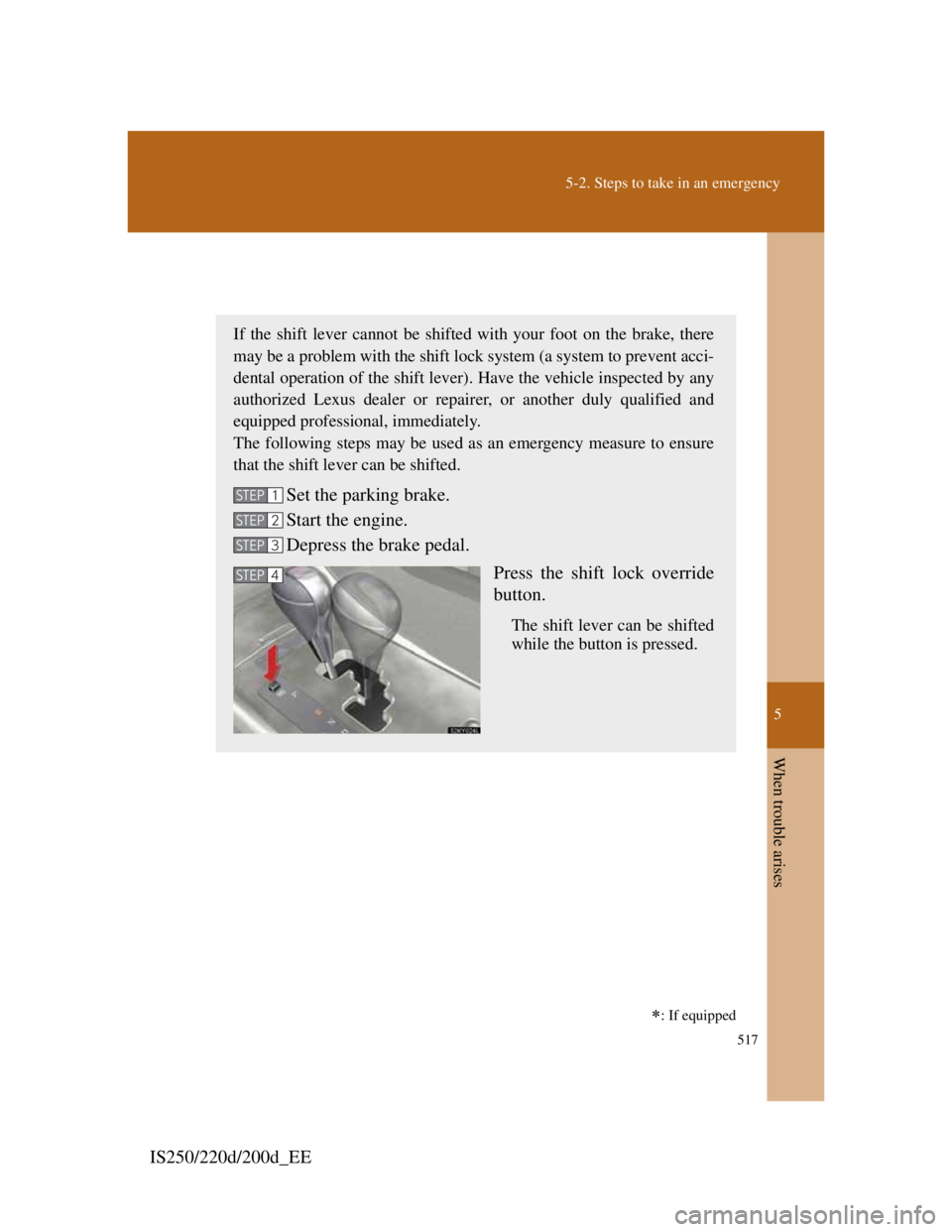
If the shift lever cannot be shifted from P
: If equipped
If the shift lever cannot be shifted with your foot on the brake, there
may be a problem with the shift lock system (a system to prevent acci-
dental operation of the shift lever). Have the vehicle inspected by any
authorized Lexus dealer or repairer, or another duly qualified and
equipped professional, immediately.
The following steps may be used as an emergency measure to ensure
that the shift lever can be shifted.
Set the parking brake.
Start the engine.
Depress the brake pedal.
Press the shift lock override
button.
The shift lever can be shifted
while the button is pressed.
STEP1
STEP2
STEP3
STEP4
Page 544 of 609
518
5-2. Steps to take in an emergency
IS250/220d/200d_EE
If you lose your keys
New genuine Lexus keys can be made by any authorized Lexus dealer
or repairer, and another duly qualified and equipped professional,
using the other key or the key number stamped on your key number
Page 548 of 609
522
5-2. Steps to take in an emergency
IS250/220d/200d_EEManual transmission
Shift the shift lever to N and depress the clutch pedal.
Touch the Lexus emblem side
of the electronic key to the
“ENGINE START STOP”
switch.
An alarm will sound to indicate
that the start function cannot
detect the electronic key that is
touched to the “ENGINE
START STOP” switch if any of
the doors is opened and closed
while the key is touched to the
switch.
To change “ENGINE START STOP” switch modes: Within
10 seconds of the buzzer sounding, release the clutch pedal
and press the “ENGINE START STOP” switch. Modes can
be changed each time the switch is pressed. (P. 158)
To start the engine: Press the “ENGINE START STOP”
switch within 10 seconds after the buzzer sounds, keeping
the clutch pedal depressed.
In the event that the engine still cannot be started, contact any
authorized Lexus dealer or repairer, or another duly qualified and
equipped professional.
STEP1
STEP2
STEP3
Page 550 of 609
524
5-2. Steps to take in an emergency
IS250/220d/200d_EE
If the vehicle battery is discharged
The following procedures may be used to start the engine if the vehi-
cle's battery is discharged.
You can call any authorized Lexus dealer or repairer, or another duly
qualified and equipped professional.
If you have a set of jumper (or booster) cables and a second
vehicle with a 12-volt battery, you can jump start your Lexus
following the steps below.
Remove the engine compartment covers. (P. 407)
Connecting the jumper cables
Left-hand vehicles
STEP1
STEP2