Page 200 of 563
198
2-5. Driving information
ES350_U
Towing a trailerConsult your Lexus dealer for further information on additional require-
ments such as a towing kit, etc.
■ Trailer tongue load
The trailer cargo load should be distributed so that the tongue load
is 9 to 11% of the total trailer weight, not exceeding the maximum
100 lb. (45 kg). (Tongue load / Tota l trailer weight x 100 = 9 to 11%)
The total trailer weight and tongue load can be measured with plat-
form scales found at a highway weighing stations, building supply
company, trucking company, junk yards, etc.
Total trailer weight
Tongue load
Page 201 of 563

199
2-5. Driving information
2
When driving
ES350_U
■Before towing
●Ensure that your vehicle’s tires are properly inflated. (→P. 4 0 3 )
●Trailer tires should be inflated according to the trailer manufacturer's recom-
mendation.
●All trailer lights work to be legal.
●Confirm all lights work each time you connect them.
●Check that your vehicle remains level when a loaded or unloaded trailer is
hitched. Do not drive if the vehicle is not level, and check for improper tongue
load, overloading, worn suspension, or other possible causes.
●Make sure the trailer cargo is securely loaded.
●Check that your rear view mirrors conform to any federal, state/provincial or
local regulations. If they do not, install rear view mirrors appropriate for towing
purposes.
■Break-in schedule
Lexus recommends that you do not use a new vehicle or a vehicle with any new
power train components (engine, transmission, differential, wheel bearings, etc.) to
tow a trailer for the first 500 miles (800 km) of driving.
■Maintenance
●If you tow a trailer, your vehicle will require more frequent maintenance due to
the additional load. (See “Warranty and Services Guide/Owner's Manual Sup-
plement/ Scheduled Maintenance”.)
●Retighten the fixing bolts of the towing ball and bracket after approximately
600 miles (1000 km) of trailer towing.
CAUTION
■To avoid accident or injury
●The total trailer weight (trailer weight plus the weight of cargo) must not exceed
1000 lb. (450 kg).
●Do not exceed the trailer hitch assembly weight, gross vehicle weight, gross axle
weight and trailer tongue load capacities.
●Never load more weight in the back than in the front of the trailer. About 60% of
the load should be in the front half of the trailer, and the remaining 40% in the
rear.
Page 202 of 563
200
2-5. Driving information
ES350_U
CAUTION
■Hitches
Trailer hitch assemblies have different weight capacities established by the hitch
manufacturer. Even though the vehicle may be physically capable of towing a
higher weight, the operator must never exceed the maximum weight rating speci-
fied for the trailer hitch.
●If you wish to install a trailer hitch, your Lexus dealer should be consulted.
●Use only a hitch that conforms to the total trailer weight requirement.
●Follow the directions supplied by the hitch manufacturer.
●Lubricate the hitch ball with a light coat of grease.
●Remove the trailer hitch whenever you are not towing a trailer. After removing
the hitch, seal any mounting holes in the vehicle body to prevent entry of any sub-
stances into the vehicle.
■When towing a trailer
●Never tap into your vehicle's hydraulic system, as this will lower the vehicle's
braking effectiveness.
●Never tow a trailer without using a safety chain securely attached to both the
trailer and the vehicle. If damage occurs to the coupling unit or hitch ball, there is
danger of the trailer wandering into another lane.
●Do not use cruise control/dynamic radar cruise control.
Doing so may result in inappropriate control of speed and could cause serious or
fatal accident.
NOTICE
■When installing a trailer hitch
●Use only the position recommended by your Lexus dealer. Do not install the
trailer hitch on the bumper; this may cause body damage.
●Do not use axle-mounted hitches, as they can cause damage to the axle housing,
wheel bearings, wheels or tires.
■Brakes
Lexus recommends trailers with brakes that conform to any applicable federal and
state/provincial regulations.
Page 333 of 563
331
3-7. Other interior features
3
Interior features
ES350_U
NOTICE
■To prevent seat heater damage
Do not put unevenly weighted objects on the seat and do not stick sharp objects
(needles, nails, etc.) into the seat.
■To prevent battery discharge
Set the dial to 0 when the engine is not running.
Page 335 of 563
333
3-7. Other interior features
3
Interior features
ES350_U
CAUTION
■Burns
●Use caution when seating the following persons in a seat with the seat heater on
to avoid the possibility of burns:
• Babies, small children, the elderly, the sick and the disabled
• Persons with sensitive skin
• Persons who are fatigued
• Persons who have taken alcohol or drugs that induce sleep (sleeping drugs,cold remedies, etc.)
●Do not cover the seat with anything when using the seat heater.
Using the seat heater with a blanket or cushion increases the temperature of the
seat and may lead to overheating.
NOTICE
■To prevent seat heater damage
Do not put unevenly weighted objects on the seat and do not stick sharp objects
(needles, nails, etc.) into the seat.
■To prevent battery discharge
Set the dial to 0 when the engine is not running.
Page 398 of 563

396
4-3. Do-it-yourself maintenance
ES350_U
Initializing the tire pressure warning system■ The tire pressure warning system must be initialized in the following
circumstances:
● When changing the tire inflation pressure by changing traveling
speed or load weight, etc.
When the tire pressure warning system is initialized, the current tire
inflation pressure is set as the pressure benchmark.
■ How to initialize the tire pressure warning system
Park the vehicle in safe place and turn the “ENGINE START
STOP” switch OFF.
While the vehicle is moving, initialization is not performed.
Adjust the tire inflation pressure to the specified cold tire inflation
pressure level. ( →P. 4 9 9 )
Make sure to adjust the tire pressure to the specified cold tire inflation
pressure level. The tire pressure warning system will operate based on
this pressure level.
Turn the “ENGINE START STOP” switch to IGNITION ON
mode.
Push and hold the tire pressure
warning reset switch until the tire
pressure warning light blinks
slowly 3 times.
Wait for a few minutes with the IGNITION ON mode, and then
turn the “ENGINE START STOP” switch OFF.
STEP1
STEP2
STEP3
STEP4
STEP5
Page 400 of 563
398
4-3. Do-it-yourself maintenance
ES350_U
■When to replace your vehicle’s tires
Tires should be replaced if:
●You have tire damage such as cuts, splits, cracks deep enough to expose the
fabric or bulges indicating internal damage
●A tire goes flat repeatedly or cannot be properly repaired due to the size or
location of a cut or other damage
If you are not sure, consult with your Lexus dealer.
■Replacing tires and wheels
If the ID code of the tire pressure warning valve and transmitter is not registered,
the tire pressure warning system will not work properly. After driving for about 20
minutes, the tire pressure warning light come s on after blinking for 1 minute to indi-
cate a system malfunction.
■Tire life
Any tire over 6 years old must be checked by a qualified technician even if they
have seldom or never been used or damage is not obvious.
■If the tread wears down below 0.16 in. (4 mm) on snow tires
The effectiveness of snow tires is lost.
■Maximum load of tire
Check that the maximum load of the replacement tire is greater than 1 /2 of the
Gross Axle Weight Ratings (GAWR) of either the front axle or the rear axle, which-
ever is greater.
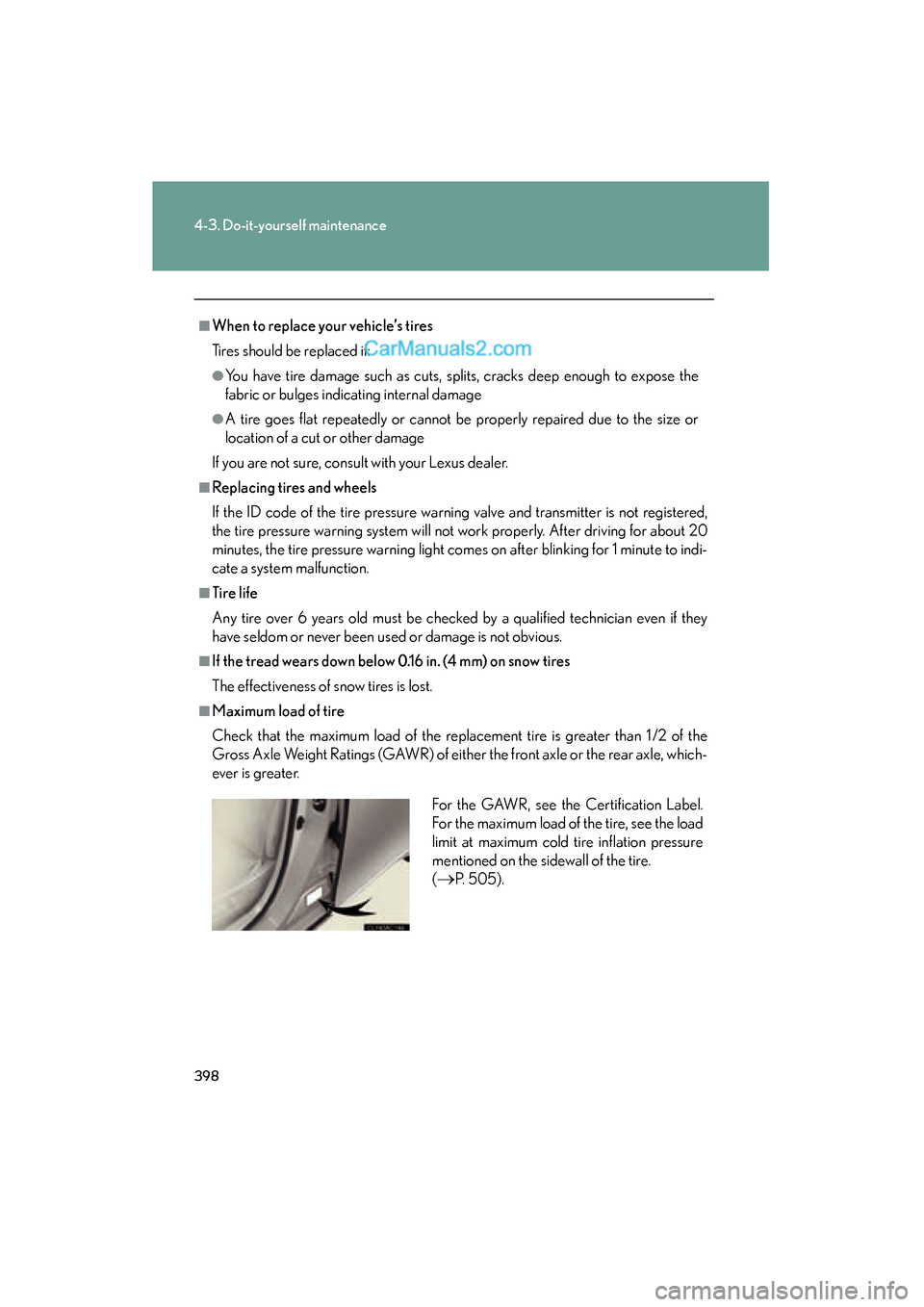
For the GAWR, see the Certification Label.
For the maximum load of the tire, see the load
limit at maximum cold tire inflation pressure
mentioned on the sidewall of the tire.
(
→P. 505).
Page 407 of 563
405
4-3. Do-it-yourself maintenance
4
Maintenance and care
ES350_U
■Effects of incorrect tire inflation pressure
Driving with incorrect tire inflation pressure may result in the following:
●Reduced fuel efficiency
●Reduced driving comfort and tire life
●Reduced safety
●Damage to the drive train
If a tire needs frequent refilling, have it checked by your Lexus dealer.
■Instructions for checking tire inflation pressure
When checking tire inflation pressure, observe the following:
●Check only when the tires are cold.
If your vehicle has been parked for at least 3 hours and has not been driven for
more than 1 mile or 1.5 km, you will get an accurate cold tire inflation pressure
reading.
●Always use a tire pressure gauge.
The appearance of the tire can be misleading. In addition, tire inflation pressures
that are even just a few pounds off can degrade ride and handling.
●Do not bleed or reduce tire inflation press ure after driving. It is normal for the
tire inflation pressure to be higher after driving.
●Never exceed the vehicle capacity weight.
Passengers and luggage weight should be placed so that the vehicle is bal-
anced.