2011 KIA Sportage lock
[x] Cancel search: lockPage 28 of 385
315
Safety features of your vehicle
C010303AHM
Headrest
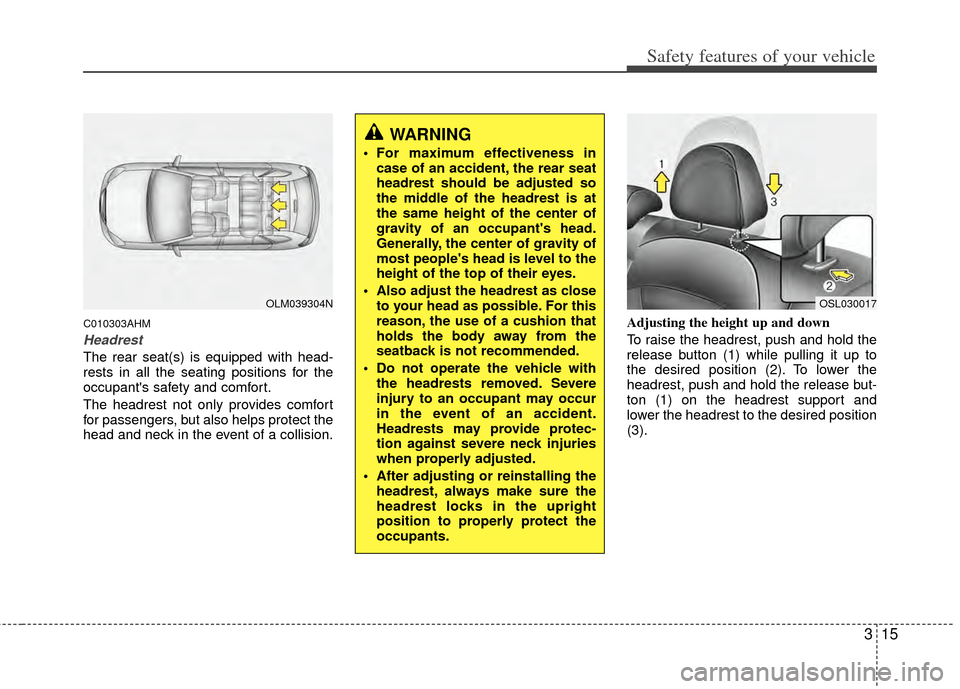
The rear seat(s) is equipped with head-
rests in all the seating positions for the
occupant's safety and comfort.
The headrest not only provides comfort
for passengers, but also helps protect the
head and neck in the event of a collision.Adjusting the height up and down
To raise the headrest, push and hold the
release button (1) while pulling it up to
the desired position (2). To lower the
headrest, push and hold the release but-
ton (1) on the headrest support and
lower the headrest to the desired position
(3).
OLM039304N
WARNING
For maximum effectiveness in
case of an accident, the rear seat
headrest should be adjusted so
the middle of the headrest is at
the same height of the center of
gravity of an occupant's head.
Generally, the center of gravity of
most people's head is level to the
height of the top of their eyes.
Also adjust the headrest as close to your head as possible. For this
reason, the use of a cushion that
holds the body away from the
seatback is not recommended.
Do not operate the vehicle with the headrests removed. Severe
injury to an occupant may occur
in the event of an accident.
Headrests may provide protec-
tion against severe neck injuries
when properly adjusted.
After adjusting or reinstalling the headrest, always make sure the
headrest locks in the upright
position to properly protect the
occupants.
OSL030017
Page 33 of 385
Safety features of your vehicle
20
3
Seat belt warning
(for front passenger’s seat)
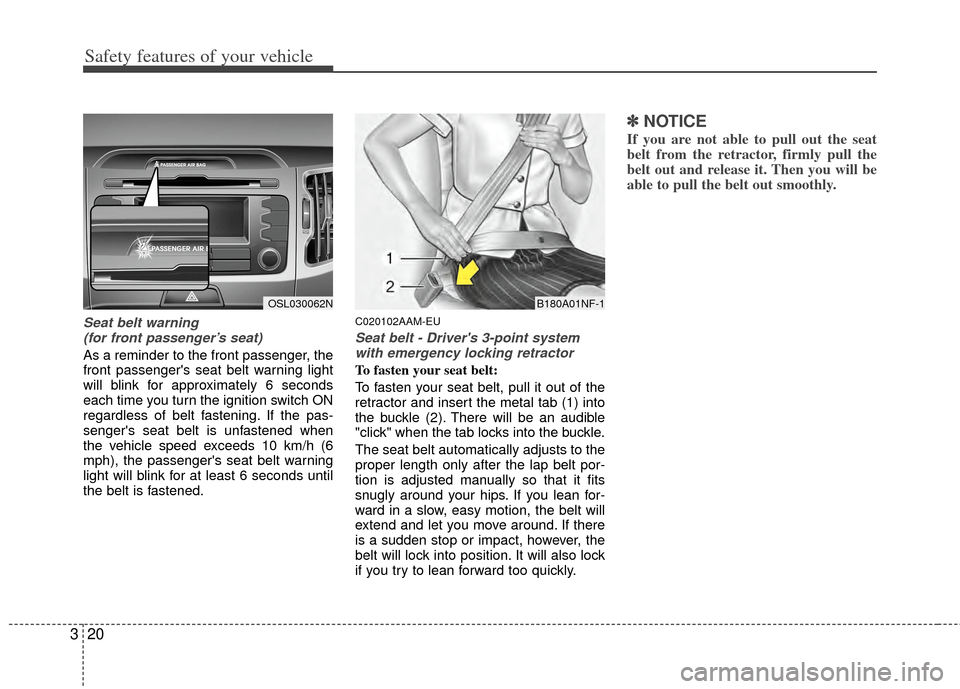
As a reminder to the front passenger, the
front passenger's seat belt warning light
will blink for approximately 6 seconds
each time you turn the ignition switch ON
regardless of belt fastening. If the pas-
senger's seat belt is unfastened when
the vehicle speed exceeds 10 km/h (6
mph), the passenger's seat belt warning
light will blink for at least 6 seconds until
the belt is fastened.
C020102AAM-EU
Seat belt - Driver's 3-point systemwith emergency locking retractor
To fasten your seat belt:
To fasten your seat belt, pull it out of the
retractor and insert the metal tab (1) into
the buckle (2). There will be an audible
"click" when the tab locks into the buckle.
The seat belt automatically adjusts to the
proper length only after the lap belt por-
tion is adjusted manually so that it fits
snugly around your hips. If you lean for-
ward in a slow, easy motion, the belt will
extend and let you move around. If there
is a sudden stop or impact, however, the
belt will lock into position. It will also lock
if you try to lean forward too quickly.
✽ ✽ NOTICE
If you are not able to pull out the seat
belt from the retractor, firmly pull the
belt out and release it. Then you will be
able to pull the belt out smoothly.
B180A01NF-1OSL030062N
Page 34 of 385
321
Safety features of your vehicle
Height adjustment
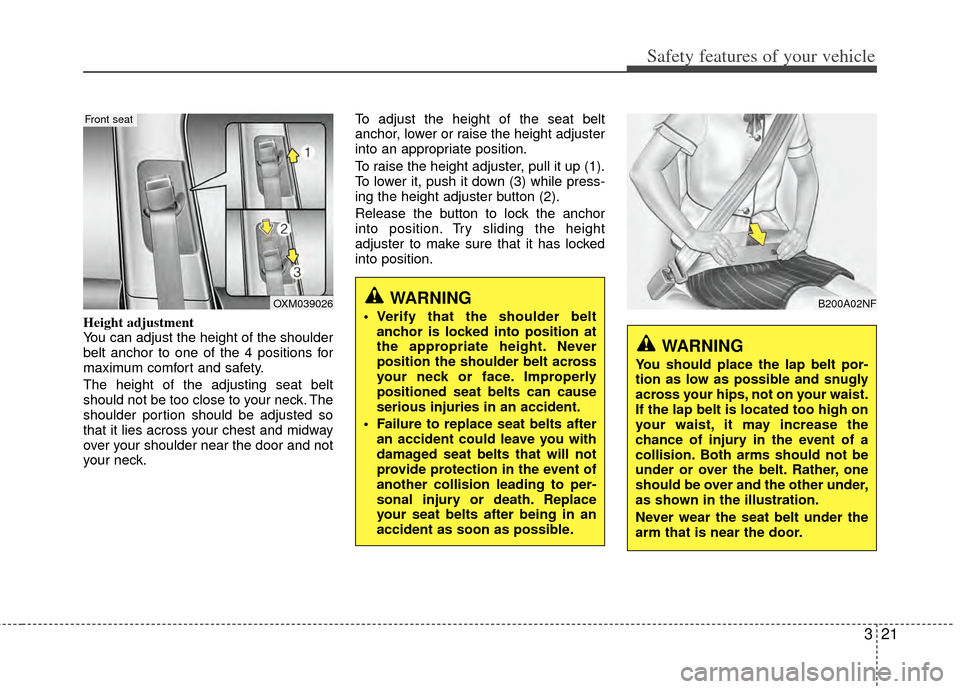
You can adjust the height of the shoulder
belt anchor to one of the 4 positions for
maximum comfort and safety.
The height of the adjusting seat belt
should not be too close to your neck. The
shoulder portion should be adjusted so
that it lies across your chest and midway
over your shoulder near the door and not
your neck.To adjust the height of the seat belt
anchor, lower or raise the height adjuster
into an appropriate position.
To raise the height adjuster, pull it up (1).
To lower it, push it down (3) while press-
ing the height adjuster button (2).
Release the button to lock the anchor
into position. Try sliding the height
adjuster to make sure that it has locked
into position.
B200A02NF
WARNING
You should place the lap belt por-
tion as low as possible and snugly
across your hips, not on your waist.
If the lap belt is located too high on
your waist, it may increase the
chance of injury in the event of a
collision. Both arms should not be
under or over the belt. Rather, one
should be over and the other under,
as shown in the illustration.
Never wear the seat belt under the
arm that is near the door.
WARNING
Verify that the shoulder belt
anchor is locked into position at
the appropriate height. Never
position the shoulder belt across
your neck or face. Improperly
positioned seat belts can cause
serious injuries in an accident.
Failure to replace seat belts after an accident could leave you with
damaged seat belts that will not
provide protection in the event of
another collision leading to per-
sonal injury or death. Replace
your seat belts after being in an
accident as soon as possible.OXM039026
Front seat
Page 35 of 385
Safety features of your vehicle
22
3
C020106AUN
Seat belts - Front passenger and rear
seat 3-point system with combinationlocking retractor
To fasten your seat belt:
Combination retractor type seat belts are
installed in the rear seat positions to help
accommodate the installation of child
restraint systems. Although a combina-
tion retractor is also installed in the front
passenger seat position, it is strongly
recommended that children always be
seated in the rear seat. NEVER place
any infant restraint system in the front
seat of the vehicle.
This type of seat belt combines the fea-
tures of both an emergency locking
retractor seat belt and an automatic lock-
ing retractor seat belt. To fasten your seat
belt, pull it out of the retractor and insert
the metal tab into the buckle. There will
be an audible "click" when the tab locks
into the buckle. When not securing a
child restraint, the seat belt operates in
the same way as the driver's seat belt
(Emergency Locking Retractor Type). It
automatically adjusts to the proper length
only after the lap belt portion of the seat
belt is adjusted manually so that it fits
snugly around your hips. When the seat belt is fully extended from
the retractor to allow the installation of a
child restraint system, the seat belt oper-
ation changes to allow the belt to retract,
but not to extend (Automatic Locking
Retractor Type). Refer to “Using a child
restraint system” in this section.
✽ ✽
NOTICE
Although the combination retractor
provides the same level of protection for
seated passengers in either emergency
or automatic locking modes, have the
seated passengers use the emergency
locking feature for improved conven-
ience. The automatic locking function is
intended to facilitate child restraint
installation. To convert from the auto-
matic locking feature to the emergency
locking operation mode, allow the
unbuckled seat belt to fully retract.
CAUTION
Do NOT fold down the left portion of
the rear seat back when the rearcenter seat belt is buckled. ALWAYS UNBUCKLE the rear center seatbelt before folding down the leftportion of the rear seat back. If the rear center seat belt is buckledwhen the left portion of the rear seat back is folded down, distortionand damage to the top portion of the seat back and seat belt garnishmay result, causing the seat back tolock into the folded down position.
Page 36 of 385
323
Safety features of your vehicle
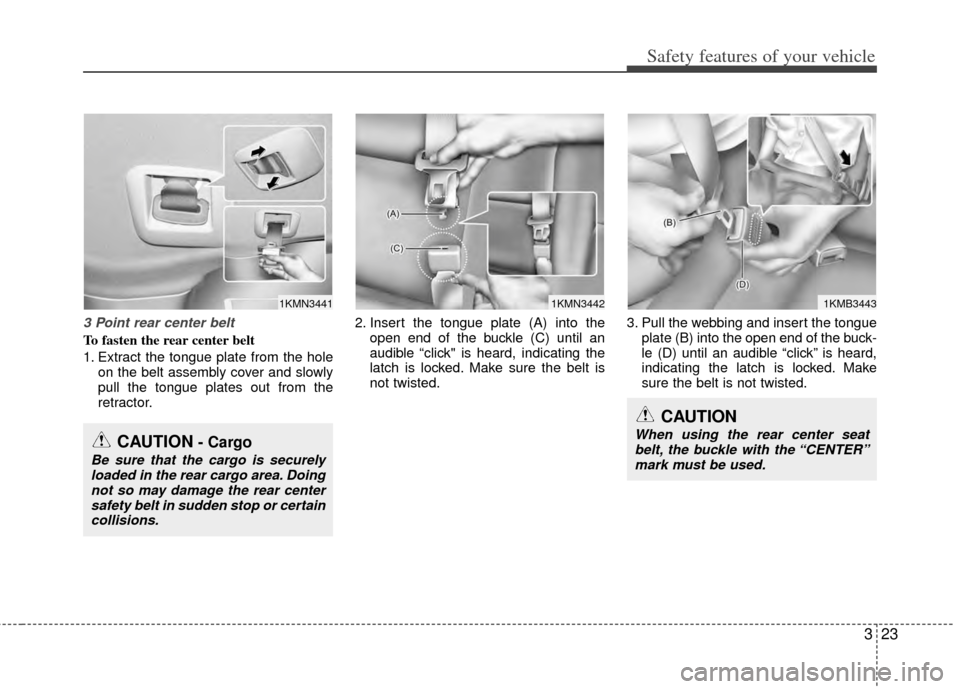
3 Point rear center belt
To fasten the rear center belt
1. Extract the tongue plate from the holeon the belt assembly cover and slowly
pull the tongue plates out from the
retractor. 2. Insert the tongue plate (A) into the
open end of the buckle (C) until an
audible “click" is heard, indicating the
latch is locked. Make sure the belt is
not twisted. 3. Pull the webbing and insert the tongue
plate (B) into the open end of the buck-
le (D) until an audible “click” is heard,
indicating the latch is locked. Make
sure the belt is not twisted.
1KMN3441
CAUTION- Cargo
Be sure that the cargo is securelyloaded in the rear cargo area. Doingnot so may damage the rear centersafety belt in sudden stop or certaincollisions.
1KMN34421KMB3443
CAUTION
When using the rear center seatbelt, the buckle with the “CENTER”mark must be used.
Page 37 of 385
Safety features of your vehicle
24
3
There will be an audible “click” when the
tab locks in the buckle. The seat belt
automatically adjusts to the proper length
only after the lap belt is adjusted manu-
ally so that it fits snugly around your hips,
if you lean forward in a slow, easy
motion, the belt will extend and let you
move around. If there is a sudden stop or
impact, the belt will lock into position. It
will also lock if you try to lean forward too
quickly.
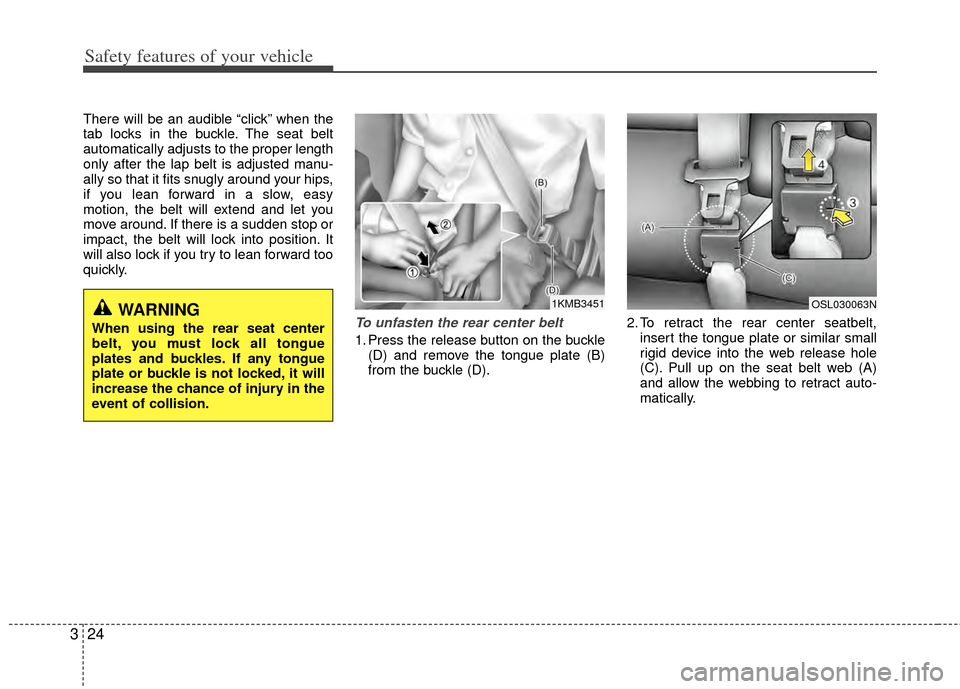
To unfasten the rear center belt
1. Press the release button on the buckle
(D) and remove the tongue plate (B)
from the buckle (D). 2. To retract the rear center seatbelt,
insert the tongue plate or similar small
rigid device into the web release hole
(C). Pull up on the seat belt web (A)
and allow the webbing to retract auto-
matically.
WARNING
When using the rear seat center
belt, you must lock all tongue
plates and buckles. If any tongue
plate or buckle is not locked, it will
increase the chance of injury in the
event of collision.
1KMB3451OSL030063N
Page 39 of 385
Safety features of your vehicle
26
3
C020200BHM-EU
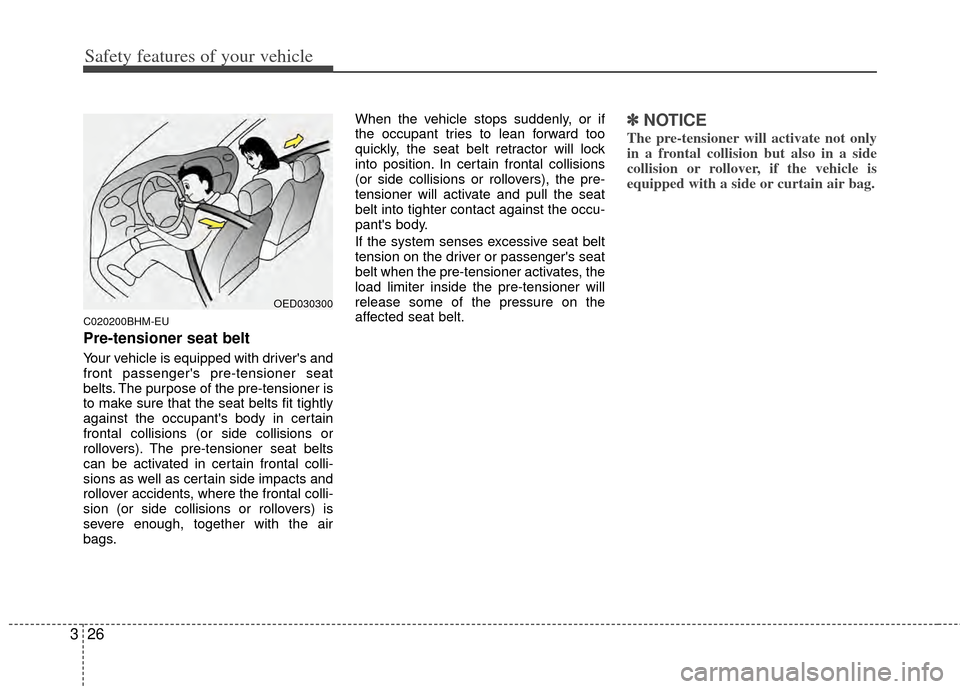
Pre-tensioner seat belt
Your vehicle is equipped with driver's and
front passenger's pre-tensioner seat
belts. The purpose of the pre-tensioner is
to make sure that the seat belts fit tightly
against the occupant's body in certain
frontal collisions (or side collisions or
rollovers). The pre-tensioner seat belts
can be activated in certain frontal colli-
sions as well as certain side impacts and
rollover accidents, where the frontal colli-
sion (or side collisions or rollovers) is
severe enough, together with the air
bags. When the vehicle stops suddenly, or if
the occupant tries to lean forward too
quickly, the seat belt retractor will lock
into position. In certain frontal collisions
(or side collisions or rollovers), the pre-
tensioner will activate and pull the seat
belt into tighter contact against the occu-
pant's body.
If the system senses excessive seat belt
tension on the driver or passenger's seat
belt when the pre-tensioner activates, the
load limiter inside the pre-tensioner will
release some of the pressure on the
affected seat belt.
✽ ✽
NOTICE
The pre-tensioner will activate not only
in a frontal collision but also in a side
collision or rollover, if the vehicle is
equipped with a side or curtain air bag.
OED030300
Page 47 of 385
Safety features of your vehicle
34
3
WARNING
To reduce the chance of serious or
fatal injuries:
Children of all ages are safer
when restrained in the rear seat.
A child riding in the front passen-
ger seat can be forcefully struck
by an inflating air bag resulting in
serious or fatal injuries.
Always follow the child restraint system manufacturer’s instruc-
tions for installation and use of
the child restraint.
Always make sure the child seat is secured properly in the car and
your child is securely restrained
in the child seat.
Never hold a child in your arms or lap when riding in a vehicle. The
violent forces created during a
crash will tear the child from your
arms and throw the child against
the car’s interior.
Never put a seat belt over your- self and a child. During a crash,
the belt could press deep into the
child causing serious internal
injuries.
(Continued)
(Continued)
Never leave children unattendedin a vehicle – not even for a short
time. The car can heat up very
quickly, resulting in serious
injuries to children inside. Even
very young children may inadver-
tently cause the vehicle to move,
entangle themselves in the win-
dows, or lock themselves or oth-
ers inside the vehicle.
Never allow two children, or any two persons, to use the same
seat belt.
Children often squirm and repo- sition themselves improperly.
Never let a child ride with the
shoulder belt under their arm or
behind their back. Always proper-
ly position and secure children in
the rear seat.
Never allow a child to stand-up or kneel on the seat or floor of a
moving vehicle. During a colli-
sion or sudden stop, the child
can be violently thrown against
the vehicle’s interior, resulting in
serious injury.
(Continued)(Continued)
Never use an infant carrier or achild safety seat that "hooks"
over a seatback, it may not pro-
vide adequate security in an acci-
dent.
Seat belts can become very hot, especially when the car is parked
in direct sunlight. Always check
the seat belt buckles before fas-
tening them over a child.