2011 KIA Soul load capacity
[x] Cancel search: load capacityPage 322 of 356
Maintenance
42
7
All season tires
KIA specifies all season tires on
some models to provide good per-
formance for use all year round,
including snowy and icy road condi-
tions. All season tires are identified
by ALL SEASON and/or M+S (Mud
and Snow) on the tire sidewall. Snow
tires have better snow traction than
all season tires and may be more
appropriate in some areas.
Summer tires
KIA specifies summer tires on some
models to provide superior perform-
ance on dry roads. Summer tire per-
formance is substantially reduced in
snow and ice. Summer tires do not
have the tire traction rating M+S
(Mud and Snow) on the tire side wall.
if you plan to operate your vehicle in
snowy or icy conditions. KIA recom-
mends the use of snow tires or all
season tires on all four wheels. Snow tires
If you equip your car with snow tires,
they should be the same size and
have the same load capacity as the
original tires. Snow tires should be
installed on all four wheels; other-
wise, poor handling may result.
Snow tires should carry 28 kPa (4
psi) more air pressure than the pres-
sure recommended for the standard
tires on the tire label on the driver's
side of the center pillar, or up to the
maximum pressure shown on the tire
sidewall, whichever is less.
Do not drive faster than 120 km/h (75
mph) when your vehicle is equipped
with snow tires.Radial-ply tires
Radial-ply tires provide improved
tread life, road hazard resistance and
smoother high speed ride. The radi-
al-ply tires used on this vehicle are of
belted construction, and are selected
to complement the ride and handling
characteristics of your vehicle.
Radial-ply tires have the same load
carrying capacity, as bias-ply or bias
belted tires of the same size, and use
the same recommended inflation
pressure. Mixing of radial-ply tires
with bias-ply or bias belted tires is
not recommended. Any combina-
tions of radial-ply and bias-ply or bias
belted tires when used on the same
vehicle will seriously deteriorate
vehicle handling. The best rule to fol-
low is: Identical radial-ply tires should
always be used as a set of four.
Longer wearing tires can be more
susceptible to irregular tread wear. It
is very important to follow the tire
rotation interval shown in this section
to achieve the tread life potential of
these tires. Cuts and punctures in
radial-ply tires are repairable only in
the tread area, because of sidewall
flexing. Consult your tire dealer for
radial-ply tire repairs.
Page 323 of 356
743
Maintenance
FUSES
G210000AAM
A vehicle’s electrical system is protected
from electrical overload damage by
fuses.This vehicle has 2 fuse panels, one locat-
ed in the driver’s side panel bolster, the
other in the engine compartment near
the battery.
If any of your vehicle’s lights, acces-
sories, or controls do not work, check the
appropriate circuit fuse. If a fuse has
blown, the element inside the fuse will
melt.
If the electrical system does not work,
first check the driver’s side fuse panel.
Always replace a blown fuse with one of
the same rating.
If the replacement fuse blows, this indi-
cates an electrical problem. Avoid using
the system involved and immediately
consult an authorized KIA dealer.
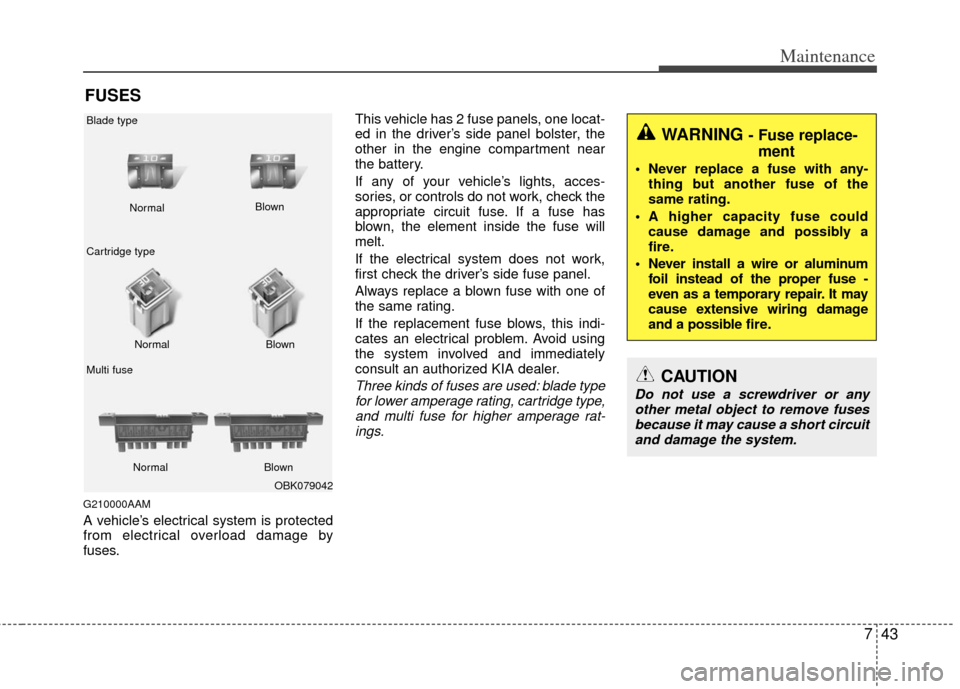
Three kinds of fuses are used: blade type
for lower amperage rating, cartridge type, and multi fuse for higher amperage rat-ings.
WARNING - Fuse replace- ment
Never replace a fuse with any-
thing but another fuse of the
same rating.
A higher capacity fuse could cause damage and possibly a
fire.
Never install a wire or aluminum foil instead of the proper fuse -
even as a temporary repair. It may
cause extensive wiring damage
and a possible fire.
CAUTION
Do not use a screwdriver or anyother metal object to remove fusesbecause it may cause a short circuitand damage the system.
OBK079042
Normal
Normal
Blade type
Cartridge type
Multi fuse Blown
Blown
Normal Blown
Page 355 of 356

Index
8I
Summer tires ··················\
··················\
··················\
············7-42
Sunroof··················\
··················\
··················\
··················\
···4-27
Sunvisor ··················\
··················\
··················\
··················\
·4-90
Tachometer··················\
··················\
··················\
···············4-38
Tailgate··················\
··················\
··················\
··················\
···4-17Emergency tailgate safety release ··················\
···········4-18
Tether anchor system ··················\
··················\
·················3-30\
Tilt steering ··················\
··················\
··················\
··············4-31
Tire and loading information label ··················\
··············5-46
Tire specification and pressure label ··················\
·············8-7
Tires and wheels ··················\
··················\
·················7-30\
, 8-3 All season tires ··················\
··················\
··················\
····7-42
Checking tire inflation pressure ··················\
··············7-31
Compact spare tire replacement ··················\
··············7-35
Radial-ply tires ··················\
··················\
··················\
····7-42
Recommended cold tire inflation pressures ··············7-30
Snow tires ··················\
··················\
··················\
············7-42
Summer tires ··················\
··················\
··················\
·······7-42
Tire care··················\
··················\
··················\
···············7-30
Tire maintenance ··················\
··················\
··················\
·7-35
Tire replacement ··················\
··················\
··················\
··7-34
Tire rotation ··················\
··················\
··················\
·········7-32
Tire sidewall labeling ··················\
··················\
············7-36
Tire terminology and definitions··················\
·············7-40
Tire traction ··················\
··················\
··················\
·········7-35 Wheel alignment and tire balance ··················\
···········7-33
Wheel replacement ··················\
··················\
················7-35
Tires pressure monitoring system (TPMS)··················\
····6-7 Changing a tire with TPMS ··················\
··················\
··6-10
Low tire pressure telltale ··················\
·················6-8,\
6-13
TPMS (Tire pressure monitoring system) malfunction indicator ··················\
··················\
6-9, 6-14
Towing ··················\
··················\
··················\
··················\
···6-25 Emergency towing··················\
··················\
·················6-27\
Towing capacity ··················\
··················\
··················\
·······5-46
Transaxle Automatic transaxle ··················\
··················\
··············5-15
Manual transaxle ··················\
··················\
··················\
·5-12
Trip computer ··················\
··················\
··················\
··········4-41
Tripmeter··················\
··················\
··················\
··················\
4-41
Vehicle break-in process ··················\
··················\
··············1-5
Vehicle certification label ··················\
··················\
············8-6
Vehicle handling instructions··················\
··················\
·······1-5
Vehicle identification number (VIN) ··················\
·············8-6
Vehicle load limit ··················\
··················\
··················\
·····5-46 Cargo capacity ··················\
··················\
··················\
·····5-46
Certification label ··················\
··················\
··················\
5-48
Seating capacity ··················\
··················\
··················\
··5-46
Tire and loading information label··················\
··········5-46
Towing capacity ··················\
··················\
··················\
··5-46
Vehicle capacity weight ··················\
··················\
········5-46
T
V