2011 KIA Sedona engine
[x] Cancel search: enginePage 47 of 370

Features of your vehicle
30
3
1. Stop the engine.
2. To open the fuel filler lid, push the
release button located on the driver’s
lower door. 3. Pull the fuel filler lid out to open.
4. To remove the cap, turn the fuel tank
cap counterclockwise.
5. Refuel as needed.
6. To install the cap, turn it clockwise until it “clicks”. This indicates that the cap is
securely tightened.
7. Close the fuel filler lid and push it light- ly and make sure that it is securely
closed.
FUEL FILLER LID
OVQA022026
WARNING
To avoid injury from sharp edges, it
is recommended that protective
gloves be worn if there is a need to
open the fuel filler door manually.
WARNING - Refueling
If pressurized fuel sprays out, it can
cover your clothes or skin and thus
subject you to the risk of fire and
burns. Always remove the fuel cap
carefully and slowly. If the cap is
venting fuel or if you hear a hissing
sound, wait until the condition
stops before completely removing
the cap.
1VQA2025
Page 48 of 370

331
Features of your vehicle
WARNING - Refueling dan-
gers
Automotive fuels are flammable
materials. When refueling, please
note the following guidelines care-
fully. Failure to follow these guide-
lines may result in severe personal
injury, severe burns or death by fire
or explosion.
Before refueling note the locationof the Emergency Gasoline Shut-
Off, if available, at the gas station
facility.
Before touching the fuel nozzle, you should eliminate potentially
dangerous static electricity dis-
charge by touching another metal
part of the vehicle, a safe distance
away from the fuel filler neck, noz-
zle, or other gas source.
(Continued)
(Continued)
Do not get back into a vehicleonce you have begun refueling
since you can generate static
electricity by touching, rubbing or
sliding against any item or fabric
(polyester, satin, nylon, etc.)
capable of producing static elec-
tricity. Static electricity discharge
can ignite fuel vapors resulting in
rapid burning. If you must re-
enter the vehicle, you should
once again eliminate potentially
dangerous static electricity dis-
charge by touching a metal part
of the vehicle, away from the fuel
filler neck, nozzle or other gaso-
line source.
When using a portable fuel con- tainer be sure to place the con-
tainer on the ground prior to refu-
eling. Static electricity discharge
from the container can ignite fuel
vapors causing a fire. Once refu-
eling has begun, contact with the
vehicle should be maintained
until the filling is complete.
(Continued)(Continued)Use only portable plastic fuel
containers designed to carry and
store gasoline.
Do not use cellular phones while refueling. Electric current and/or
electronic interference from cellu-
lar phones can potentially ignite
fuel vapors causing a fire.
When refueling, always shut the engine off. Sparks produced by
electrical components related to
the engine can ignite fuel vapors
causing a fire. Once refueling is
complete, check to make sure the
filler cap and filler door are
securely closed, before starting
the engine.
DO NOT use matches or a lighter and DO NOT SMOKE or leave a lit
cigarette in your vehicle while at a
gas station especially during
refueling. Automotive fuel is high-
ly flammable and can, when ignit-
ed, result in fire.
(Continued)
Page 49 of 370

Features of your vehicle
32
3
When fuel filler lid does not open
with the release button
If the fuel filler lid does not open using
the remote fuel filler lid release, you can
open it manually. Unsnap and remove the
panel in the cargo area. Pull the handle
outward.
(Continued)
If a fire breaks out during refuel-
ing, leave the vicinity of the vehi-
cle, and immediately contact the
manager of the gas station and
then contact the local fire depart-
ment or 911. Follow any safety
instructions they provide.CAUTION
Make sure to refuel your vehicle according to the “Fuel require-ments” suggested in section 1.
Check to make sure the fuel filler cap is securely closed after refu-eling. A loose fuel filler cap maycause the "Check Engine"(Malfunction Indicator) light in theinstrument panel to illuminateunnecessarily.
If the fuel filler cap requires replacement, use only a genuineKia cap or the equivalent speci-fied for your vehicle. An incorrect fuel filler cap can result in a seri-ous malfunction of the fuel sys-tem or emission control system.
Do not spill fuel on the exterior surfaces of the vehicle. Any typeof fuel spilled on painted surfacesmay damage the paint.
If the fuel filler lid will not open in cold weather because the areaaround it is frozen, push or lightlytap the lid.
OVQ036007N
Page 57 of 370

Features of your vehicle
40
3
Seat cushion height (for driver’s seat)
To change the height of the seat cushion,
push the lever up or down located on the
outside of the seat cushion.
To lower the seat cushion, push down
the lever several times.
To raise the seat cushion, pull up the lever several times.
Front seat adjustment - power
The front seat can be adjusted by using
the control knob on the front door. Before
driving, adjust the seat to the proper
position so as to easily control the steer-
ing wheel, pedals and switches on the
instrument panel.
1VQA2328
WARNING
The power seats are operable with
the ignition OFF.
Therefore, children should never be
left unattended in the car.
CAUTION
Power seats are driven by an electric motor. Stop operatingonce the adjustment is complet- ed. Excessive operation maydamage the electrical equipment.
When in operation, the power seats consume large amounts ofelectrical power. To prevent unnec- essary charging system drain,don’t adjust the power seatslonger than necessary while the engine is not running.
Do not operate two or more power seat control buttons at the sametime. Doing so may result inpower seat motor or electrical component malfunction.
1VQA2044
Page 75 of 370

Features of your vehicle
58
3
WARNING- Cargo
Cargo should always be secured to
prevent it from being thrown about
the vehicle in a collision and caus-
ing injury to the vehicle occupants.
Special care should be taken of
objects placed in the rear seats,
since those may hit the front seat
occupants in a frontal collision.
CAUTION- Rear safety
belts
When returning the rear seatbacks
to the upright position, rememberto return the rear shoulder belts totheir proper position. Routing thesafety belt webbing through therear safety belt guides will helpkeep the belts from being trappedbehind or under the seats.
WARNING - Cargo loading
Make sure the engine is off, the
transaxle is in P and the parking
brake is applied whenever loading
or unloading cargo. Failure to take
these steps may allow the vehicle to
move if shift lever is inadvertently
moved to another position.CAUTION - Avoid damag-
ing rear safety buckles
When you fold the rear seatback or
put luggage on the rear seat cush- ion, insert the buckle in the pocketbetween the rear seatback andcushion. Doing so can prevent thebuckle from being damaged by the rear seatback or luggage.
CAUTION
Before changing seat position, slipthe seat belt into the trim panel andclose the power outlet cap.
1VQA2190A
1VQA2074B/1VQA2074C
2nd row3rd row
Page 78 of 370

361
Features of your vehicle
L/R: When the remote control outside
rearview mirror switch is selected to
the L (left) or R (right) position, both
outside rearview mirrors will move
downward.
Neutral : When the remote control out-
side rearview mirror switch is
placed in the middle position,
the outside rearview mirrors
will not operate while the vehi-
cle is moving backward.
✽ ✽ NOTICE
The outside rearview mirrors will auto-
matically revert to their original posi-
tions under the following conditions:
1. Ignition switch is in the LOCK posi-
tion.
2. Shift lever is moved to any position except R.
3. Remote control outside rearview mir- ror switch is placed in the middle
position.To adjust the position of the accelerator
and brake pedals, push the switch with
the shift lever in the P position.
If you push the ▲ portion of the switch,
the pedals move toward the driver.
If you push the ▼ portion of the switch,
the pedals move away from the driver.
Setting the adjustable pedal posi-
tion
1. Be sure the parking brake is engaged.
2. Move the accelerator and brake ped- als to the front most position by push-
ing the ▼ portion of the switch.
3. Adjust the seat position and the steer- ing wheel angle properly.
4. Move the pedals toward you until you can fully depress the brake pedal by
pushing the ▲ portion of the switch.
5. Depress the pedals a few times to get used to the feel after adjusting.
POWER ADJUSTABLE PEDALS (IF EQUIPPED)
1VQA2066
WARNING
Adjust the pedals after parkingthe vehicle on level ground. Never
attempt to adjust the pedals while
the vehicle is moving.
Never adjust the pedals with your foot on the accelerator pedal as
this may result in increasing the
engine speed and acceleration.
Make sure that you can fully depress the brake pedal before
driving. Otherwise, you may not
be able to hold down the brake
pedal firmly in an emergency
stop.
Page 102 of 370
385
Features of your vehicle
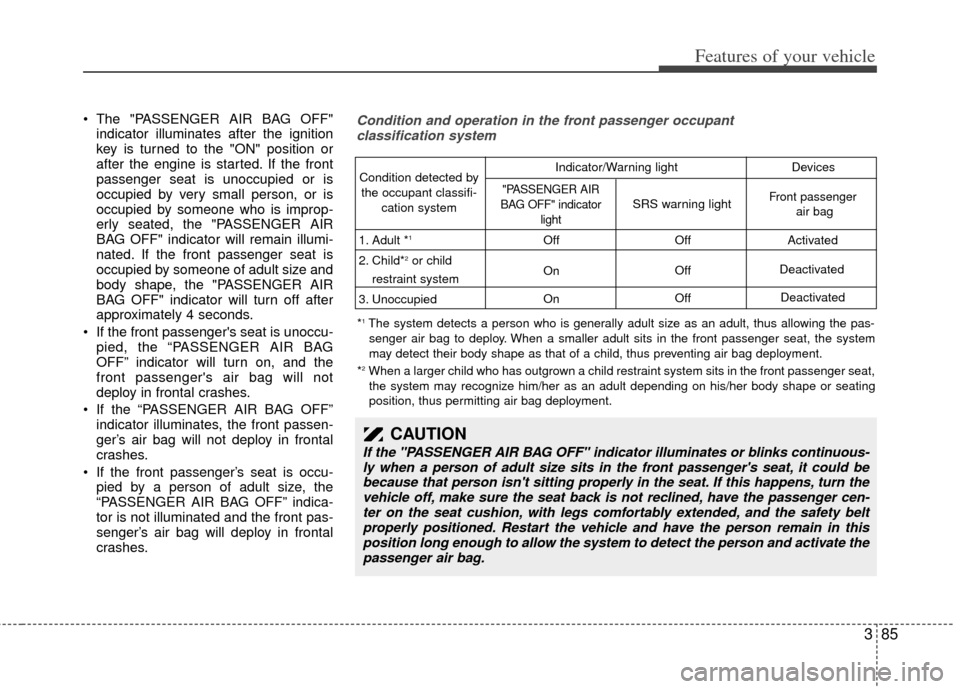
The "PASSENGER AIR BAG OFF"indicator illuminates after the ignition
key is turned to the "ON" position or
after the engine is started. If the front
passenger seat is unoccupied or is
occupied by very small person, or is
occupied by someone who is improp-
erly seated, the "PASSENGER AIR
BAG OFF" indicator will remain illumi-
nated. If the front passenger seat is
occupied by someone of adult size and
body shape, the "PASSENGER AIR
BAG OFF" indicator will turn off after
approximately 4 seconds.
If the front passenger's seat is unoccu- pied, the “PASSENGER AIR BAG
OFF” indicator will turn on, and the
front passenger's air bag will not
deploy in frontal crashes.
If the “PASSENGER AIR BAG OFF” indicator illuminates, the front passen-
ger’s air bag will not deploy in frontal
crashes.
If the front passenger’s seat is occu- pied by a person of adult size, the
“PASSENGER AIR BAG OFF” indica-
tor is not illuminated and the front pas-
senger’s air bag will deploy in frontal
crashes.Condition and operation in the front passenger occupant classification system
Condition detected by
the occupant classifi- cation system
1. Adult *
1
2. Child*2or child
restraint system
3. Unoccupied Off
On
On Off
Off
Off
Activated
Deactivated
"PASSENGER AIR
BAG OFF" indicator lightSRS warning lightFront passengerair bag
Deactivated
Indicator/Warning light Devices
*1The system detects a person who is generally adult size as an adult, thus allowing the pas-
senger air bag to deploy. When a smaller adult sits in the front passenger seat, the system
may detect their body shape as that of a child, thus preventing air bag deployment.
*
2When a larger child who has outgrown a child restraint system sits in the front passenger seat, the system may recognize him/her as an adult depending on his/her body shape or seating
position, thus permitting air bag deployment.
CAUTION
If the "PASSENGER AIR BAG OFF" indicator illuminates or blinks continuous- ly when a person of adult size sits in the front passenger's seat, it could bebecause that person isn't sitting properly in the seat. If this happens, turn thevehicle off, make sure the seat back is not reclined, have the passenger cen-ter on the seat cushion, with legs comfortably extended, and the safety beltproperly positioned. Restart the vehicle and have the person remain in thisposition long enough to allow the system to detect the person and activate thepassenger air bag.
Page 118 of 370

3101
Features of your vehicle
Installing a child restraint on a
front passenger’s seat is forbid-
den.
Never place a rear-facing child restraint
in the front passenger’s seat. If the air
bag deploys, it would impact the rear-fac-
ing child restraint, causing serious or
fatal injury.
In addition, do not place front-facing child
restraint in the front passenger’s seat
either. If the front passenger air bag
inflates, it would cause serious or fatal
injuries to the child.
Air bag warning light
The purpose of the air bag warning light
in your instrument panel is to alert you of
a potential problem with your air bag -
Supplemental Restraint System (SRS).
When the ignition switch is turned ON,
the indicator light should blink or illumi-
nate for approximately 6 seconds, then
go off.
Have the system checked if:
The light does not turn on briefly whenyou turn the ignition ON.
The light stays on after the engine starts.
The light comes on while the vehicle is in motion.
1JBH3051
WARNING
Never put child restraint in thefront passenger’s seat. If the front
passenger air bag inflates, it
would cause serious or fatal
injuries.
When children are seated in the rear outboard seats in which side
air bags are equipped, be sure to
put the child restraint system as
far away from the door side as
possible, and secure the child
restraint system to be locked in
position.
Inflation of side or curtain air bag
could cause serious injury or
death due to the expansion
impact.
W7-147