2011 KIA Cerato Trans
[x] Cancel search: TransPage 283 of 342

Maintenance
87
Chassis and body (Continued)
Kilometers or time in months, whichever comes first
× 1,000 km 8 16 24 32 40 48 56 64 72 80 88 96 104 112 120 128
# Months 4 8 12 16 20 24 28 32 36 40 44 48 52 56 60 64
Automatic transaxle fluid* (1) I I I I I I IIIIIRI III
Chassis & underbody bolts & nuts I I I I I I IIIIIII III
Tire condition & inflation pressure I I I I I I IIIIIII III
Wheel alignment (4)
Tire rotation
Steering operation & linkage I I I I I I IIIIIII III
Power steering fluid & lines* I I I IIIII
Driveshaft dust boots I I I I I
Seat belts, buckles & anchors I I I I I I IIIIIII III
Lock, hinges & hood latch L L L L L L LLLLLLL LLL
MAINTENANCE
INTERVALS
MAINTENANCE
ITEM
Inspect when abnormal condition noted
Rotate the tires every 12,000 km
* : if equipped
Page 286 of 342

711
Maintenance
G050800AUN
Air cleaner filter
A Genuine KIA air cleaner filter is recom-
mended when the filter is replaced.
G050900AUN
Spark plugs
Make sure to install new spark plugs of
the correct heat range.
G051000AHM
Valve clearance (if equipped)
Inspect for excessive valve noise and/or
engine vibration and adjust if necessary.
An authorized KIA dealer should perform
the operation.
G051100AHM
Cooling system
Check the cooling system components,
such as the radiator, coolant reservoir,
hoses and connections for leakage and
damage. Replace any damaged parts.
G051200AUN
Coolant
The coolant should be changed at the
intervals specified in the maintenance
schedule.
G051300AUN
Manual transaxle fluid
(if equipped)
Inspect the manual transaxle fluid
according to the maintenance schedule.
G051400AUN
Automatic transaxle fluid
(if equipped)
The fluid level should be in the "HOT"
range of the dipstick, after the engine
and transaxle are at normal operating
temperature. Check the automatic
transaxle fluid level with the engine run-
ning and the transaxle in neutral, with the
parking brake properly applied.
G051500AUN
Brake hoses and lines
Visually check for proper installation,
chafing, cracks, deterioration and any
leakage. Replace any deteriorated or
damaged parts immediately.
G051600AAM
Brake/Clutch (if equipped) fluid
Check the brake fluid level in the brake
fluid reservoir. The level should be
between “MIN” and “MAX” marks on the
side of the reservoir. Use only hydraulic
brake fluid conforming to DOT 3 or DOT
4 specification.
G051700ATD
Parking brake
Inspect the parking brake system includ-
ing the parking brake lever and cables.
Page 294 of 342

719
Maintenance
It is recommended that the automatic
transaxle fluid should be checked by an
authorized KIA dealer.
In severe conditions, the fluid should be
changed at an authorized KIA dealer in
accordance to the scheduled mainte-
nance at the beginning of this chapter.
G120100AUN-U1
Checking the washer fluid level
Check the fluid level in the washer fluid
reservoir and add fluid if necessary. Plain
water may be used if washer fluid is not
available. However, use washer solvent
with antifreeze characteristics in cold cli-
mates to prevent freezing.
WARNING - Coolant
Do not use radiator coolant orantifreeze in the washer fluid
reservoir.
Radiator coolant can severely obscure visibility when sprayed
on the windshield and may cause
loss of vehicle control or damage
to paint and body trim.
Windshield washer fluid agents contain some amounts of alcohol
and can be flammable under cer-
tain circumstances. Do not allow
sparks or flame to contact the
washer fluid or the washer fluid
reservoir. Damage to the vehicle
or occupants could occur.
Windshield washer fluid is poi- sonous to humans and animals.
Do not drink and avoid contact-
ing windshield washer fluid.
Serious injury or death could
occur.
OTD079011
WASHER FLUID
AUTOMATIC TRANSAXLE
FLUID
CAUTION
The use of a non-specified fluid
could result in transaxle malfunc-tion and failure.
Use only specified automatictransaxle fluid. (Refer to “Recommended lubricants andcapacities” in section 8.)
Page 311 of 342

Maintenance
36
7
G201100AAM-EC
Tire terminology and definitions
Air Pressure: The amount of air
inside the tire pressing outward on the
tire. Air pressure is expressed in kilo-
pascal (kPa) or pounds per square
inch (psi).
Accessory Weight : This means the
combined weight of optional acces-
sories. Some examples of optional
accessories are, automatic
transaxle, power seats, and air con-
ditioning.
Aspect Ratio : The relationship of a
tire's height to its width.
Belt: A rubber coated layer of cords
that is located between the plies and
the tread. Cords may be made from
steel or other reinforcing materials.
Bead: The tire bead contains steel
wires wrapped by steel cords that
hold the tire onto the rim.
Bias Ply Tire : A pneumatic tire in
which the plies are laid at alternate
angles less than 90 degrees to the
centerline of the tread. Cold Tire Pressure: The amount of
air pressure in a tire, measured in
kilopascals (kPa) or pounds per
square inch (psi) before a tire has
built up heat from driving.
Curb Weight: This means the weight
of a motor vehicle with standard and
optional equipment including the
maximum capacity of fuel, oil and
coolant, but without passengers and
cargo.
DOT Markings: The DOT code
includes the Tire Identification
Number (TIN), an alphanumeric des-
ignator which can also identify the
tire manufacturer, production plant,
brand and date of production.
GVWR: Gross Vehicle Weight Rating
GAWR FRT: Gross Axle Weight
Rating for the Front Axle.
GAWR RR: Gross Axle Weight
Rating for the Rear axle.
Intended Outboard Sidewall
: The
side of an asymmetrical tire, that
must always face outward when
mounted on a vehicle. Kilopascal (kPa): The metric unit for
air pressure.
Load Index: An assigned number
ranging from 1 to 279 that corre-
sponds to the load carrying capacity
of a tire.
Maximum Inflation Pressure
: The
maximum air pressure to which a
cold tire may be inflated. The maxi-
mum air pressure is molded onto the
sidewall.
Maximum Load Rating : The load
rating for a tire at the maximum per-
missible inflation pressure for that
tire.
Maximum Loaded Vehicle Weight:
The sum of curb weight; accessory
weight; vehicle capacity weight; and
production options weight.
Normal Occupant Weight: The
number of occupants a vehicle is
designed to seat multiplied by 68 kg
(150 pounds).
Occupant Distribution : Designated
seating positions.
Page 319 of 342
Maintenance
44
7
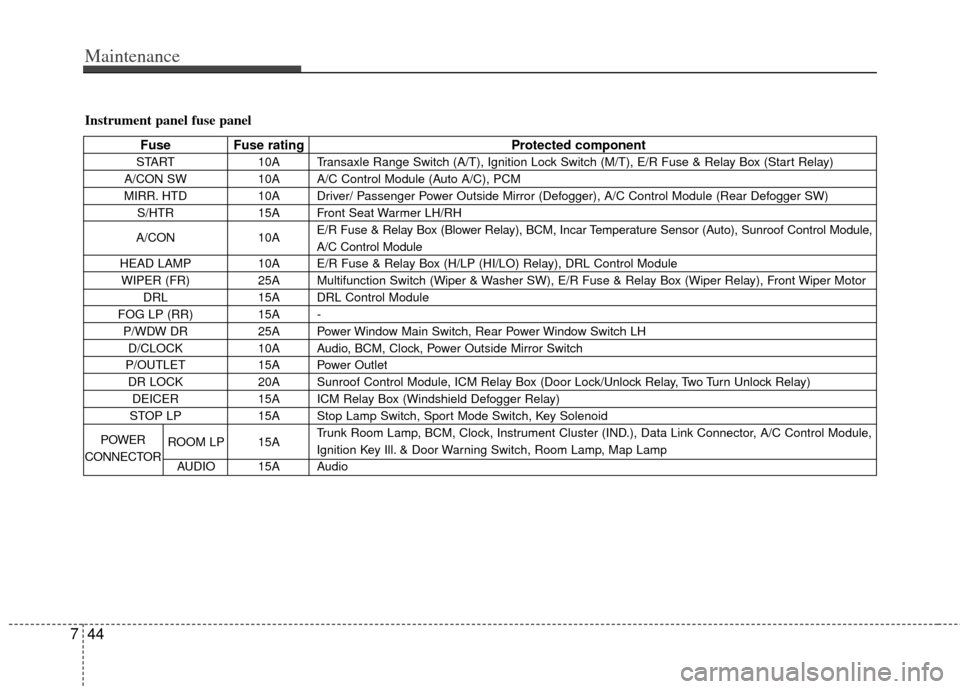
Instrument panel fuse panel
Fuse Fuse rating Protected component
START10A Transaxle Range Switch (A/T), Ignition Lock Switch (M/T), E/R Fuse & Relay Box (Start Relay)
A/CON SW 10A A/C Control Module (Auto A/C), PCM
MIRR. HTD 10A Driver/ Passenger Power Outside Mirror (Defogger), A/C Control Module (Rear Defogger SW)
S/HTR 15A Front Seat Warmer LH/RH
A/CON 10AE/R Fuse & Relay Box (Blower Relay), BCM, Incar Temperature Sensor (Auto), Sunroof Control Module,
A/C Control Module
HEAD LAMP 10A E/R Fuse & Relay Box (H/LP (HI/LO) Relay), DRL Control Module
WIPER (FR) 25A Multifunction Switch (Wiper & Washer SW), E/R Fuse & Relay Box (Wiper Relay), Front Wiper Motor
DRL 15A DRL Control Module
FOG LP (RR) 15A -
P/WDW DR 25A Power Window Main Switch, Rear Power Window Switch LH
D/CLOCK 10A Audio, BCM, Clock, Power Outside Mirror Switch
P/OUTLET 15A Power Outlet
DR LOCK 20A Sunroof Control Module, ICM Relay Box (Door Lock/Unlock Relay, Two Turn Unlock Relay)
DEICER 15A ICM Relay Box (Windshield Defogger Relay)
STOP LP 15A Stop Lamp Switch, Sport Mode Switch, Key Solenoid
ROOM LP 15A Trunk Room Lamp, BCM, Clock, Instrument Cluster (IND.), Data Link Connector, A/C Control Module,
Ignition Key Ill. & Door Warning Switch, Room Lamp, Map Lamp
AUDIO 15A Audio
POWER
CONNECTOR
Page 335 of 342

Specifications & Consumer information
48
RECOMMENDED LUBRICANTS AND CAPACITIES
I040000ATD-EC
To help achieve proper engine and powertrain performance and durability, use only lubricants of the proper quality. The correct
lubricants also help promote engine efficiency that results in improved fuel economy.
These lubricants and fluids are recommended for use in your vehicle.
LubricantVolumeClassification
Engine oil *1 *22.0 Engine 3.9l(4.1US qt.)API Service SM*3,
(drain and refill, with oil filter) 2.4 Engine 4.3 l(4.5 US qt.) ILSAC GF-4 or above
Manual transaxle fluid 2.0 Engine 1.9l
(2.0 US qt.)
API GL-4 (SAE 75W-85, fill for life)
2.4 Engine 1.8l (1.9 US qt.)
2.0 Engine 6.6l (6.9 US qt.) MICHANG ATF SP-IV
Automatic transaxle fluid SK ATF SP-IV
2.4 Engine 7.6l (8.0 US qt.) NOCA ATF SP-IV
KIA genuine ATF SP-IV
Power steering 0.9 l(0.9 US qt.) PSF-4
Coolant 6.0l (6.3 US qt.)
Brake/Clutch fluid 0.7~0.8l (0.7~0.8 US qt.)FMVSS116 DOT-3 or DOT-4
Fuel 52l(13.7 US gal.) -
*1Refer to the recommended SAE viscosity numbers on the next page.
*2Engine oils labeled Energy Conserving Oil are now available. Along with other additional benefits, they contribute to fuel economy by reducing the
amount of fuel necessary to overcome engine friction. Often, these improvements are difficult to measure in everyday driving, but in a year’s time,
they can offer significant cost and energy savings.
*3If the API service SM engine oil is not available in your country, you are able to use API service SL.
Mixture of antifreeze and water (Ethylene glycol
base coolant for aluminum radiator)
Page 340 of 342

Index
2I
Air cleaner ··················\
··················\
··················\
···············7-20
Airbag-supplemental restraint system ··················\
·········3-35
Appearance care··················\
··················\
··················\
·······7-48
Audio system ··················\
··················\
··················\
···········4-94
Automatic climate control system ··················\
···············4-78
Automatic transaxle ··················\
··················\
··················\
·5-15
Automatic transaxle fluid ··················\
··················\
··········7-19
Battery··················\
··················\
··················\
··················\
····7-23
Before driving ··················\
··················\
··················\
············5-3
Brake system··················\
··················\
··················\
············5-23
Brake/clutch fluid ··················\
··················\
··················\
····7-17
Bulb wattage ··················\
··················\
··················\
··············8-2
Child restraint system ··················\
··················\
················3-27
Climate control air filter ··················\
··················\
············7-21
Cruise control system ··················\
··················\
················5-33
Defroster ··················\
··················\
··················\
··················\
4-67
Dimensions ··················\
··················\
··················\
················8-2
Door locks··················\
··················\
··················\
················4-12Economical operation ··················\
··················\
················5-37
Emergency starting ··················\
··················\
··················\
····6-4
Emission control system ··················\
··················\
············7-54
Engine compartment ··················\
··················\
·············2-4/7-2
Engine coolant ··················\
··················\
··················\
·········7-14
Engine number ··················\
··················\
··················\
···········8-7
Engine oil ··················\
··················\
··················\
·················7-13\
ENGINE START/STOP button ··················\
··················\
···5-6
Explanation of scheduled maintenance items ···············7-10
Fuel filler lid ··················\
··················\
··················\
············4-25
Fuel requirements ··················\
··················\
··················\
······1-3
Fuses ··················\
··················\
··················\
··················\
······7-39
Hazard warning flasher ··················\
··················\
··············4-58
Hood··················\
··················\
··················\
··················\
·······4-23
How to use this manual ··················\
··················\
···············1-2
If the engine overheats··················\
··················\
·················6-6
If the engine will not start ··················\
··················\
···········6-3
If you have a flat tire ··················\
··················\
··················\
·6-7
AE
F
H
I
B
C
D
Page 341 of 342

I3
Index
In case of an emergency while driving ··················\
··········6-2
Indicator symbols on the instrument cluster ··················\
·1-5
Instrument cluster ··················\
··················\
··················\
····4-39
Instrument panel overview··················\
··················\
···········2-3
Interior features··················\
··················\
··················\
········4-96
Interior light ··················\
··················\
··················\
·············4-66
Interior overview··················\
··················\
··················\
········2-2
Key positions ··················\
··················\
··················\
·············5-4
Keys ··················\
··················\
··················\
··················\
·········4-2
Lighting··················\
··················\
··················\
··················\
··4-59
Maintenance schedule··················\
··················\
··················\
7-6
Maintenance services ··················\
··················\
··················\
·7-3
Manual climate control system··················\
··················\
··4-69
Manual transaxle··················\
··················\
··················\
······5-12
Mirrors ··················\
··················\
··················\
··················\
···4-35
Owner maintenance ··················\
··················\
··················\
···7-4Parking brake ··················\
··················\
··················\
···········7-20
Power steering fluid ··················\
··················\
··················\
·7-18
Rearview camera··················\
··················\
··················\
······4-58
Recommended lubricants and capacities ··················\
·······8-4
Remote keyless entry ··················\
··················\
··················\
·4-8
Road warning ··················\
··················\
··················\
·············6-2
Seat··················\
··················\
··················\
··················\
···········3-2
Seat belts ··················\
··················\
··················\
··················\
3-15
Smart key ··················\
··················\
··················\
··················\
·4-6
Special driving conditions ··················\
··················\
·········5-39
Starting the engine ··················\
··················\
··················\
·····5-9
Steering wheel ··················\
··················\
··················\
·········4-32
Storage compartment ··················\
··················\
·················4-88\
Sunroof··················\
··················\
··················\
··················\
···4-28
Tire specification and pressure label ··················\
·············8-7
Tires and wheels ··················\
··················\
··················\
7-26/8-3
Towing ··················\
··················\
··················\
··················\
···6-15
Trailer towing··················\
··················\
··················\
···········5-45
K
L
M
O
P
R
S
T