Page 80 of 603
All three rear seating positions of the four-door model
have lower anchorages that are capable of accommodat-
ing LATCH-compatible child seats having flexible,
webbing-mounted lower attachments. The two-door
model can accommodate flexible LATCH-compatible
child seats in the two outboard seating positions only.
The two-door model does not have a center seating
position. Child seats with fixed lower attachments must
be installed in the outboard positions only in both the
two-door and four-door models. Regardless of the spe-
cific type of lower attachment, never install LATCH-
compatible child seats such that two seats share a com-
mon lower anchorage.
If you are installing LATCH-compatible child restraints
in adjacent rear seating positions, you can use the
LATCH anchors or the vehicle’s seat belt for the outboard
position, but you must use the vehicle’s seat belt at the
center position. If your child restraints are not LATCH-
compatible, you can only install the child restraints usingthe vehicle’s seat belts. Please refer to “Installing Child
Restraints Using The Vehicle Seat Belt” for typical instal-
lation instructions.
Installing The LATCH-Compatible Child Restraint
System
We urge you to carefully follow the directions of the
manufacturer when installing your child restraint. Not all
child restraint systems will be installed as described here.
Again, carefully follow the installation instructions that
were provided with the child restraint system.
The rear seat lower anchorages are round bars,
located at the rear of the seat cushion where it
meets the seatback, and are visible when you
lean into the rear seat to install the child
restraint. You will easily feel them if you run your finger
along the intersection of the seatback and seat cushion
surfaces.
78 THINGS TO KNOW BEFORE STARTING YOUR VEHICLE
Page 83 of 603
a hook for attachment to the tether strap anchorage, and
a means for adjusting the tension of the strap.
You will first loosen the child seat adjusters on the lower
straps and on the tether strap so that you can more easily
attach the hooks or connectors to the vehicle anchorages.
Next, attach the lower hooks or connectors over the top
of the anchorage bars, pushing aside the seat cover
material. Then, locate the tether anchorage directly be-
hind the seat where you are placing the child restraint
and attach the tether strap to the anchorage, being careful
to route the tether strap to provide the most direct path
between the anchor and the child restraint. Finally,
tighten all three straps as you push the child restraint
rearward and downward into the seat, removing slack in
the straps according to the child restraint manufacturer’s
instructions.WARNING!
Improper installation of a child restraint to the
LATCH anchorages can lead to failure of an infant or
child restraint. The child could be badly injured or
killed. Follow the manufacturer’s directions exactly
when installing an infant or child restraint.
Installing Child Restraints Using The Vehicle Seat
Belt
The seat belts in the passenger seating positions are
equipped with an Automatic Locking Retractor to secure
a Child Restraint System (CRS). These types of seat belts
are designed to keep the lap portion of the seat belt tight
around the child restraint so that it is not necessary to use
a locking clip. The ALR will make a ratcheting noise if
you extract the entire belt from the retractor and then
allow the belt to retract into the retractor. For additional
information on ALR, refer to “Automatic Locking Mode”
2
THINGS TO KNOW BEFORE STARTING YOUR VEHICLE 81
Page 84 of 603

description under “Seat Belts In Passenger Seating Posi-
tions” section. The chart below defines the seating posi-
tions with an Automatic Locking Retractor (ALR) or a
cinching latch plate.
Driver Center Passenger
CRS Lock CRS Lock CRS Lock
First Row N/A N/A ALR
Second Row ALR ALR ALR
•N/A — Not Applicable
•ALR — Automatic Locking Retractor Installing a Child Restraint with an ALR:
1. To install a child restraint with ALR, first, pull enough
of the seat belt webbing from the retractor to route it
through the belt path of the child restraint. Slide the latch
plate into the buckle until you hear a “click.” Next,
extract all the seat belt webbing out of the retractor and
then allow the belt to retract into the retractor. As the belt
retracts, you will hear a ratcheting sound. This indicates
the safety belt is now in the Automatic Locking mode.
2. Finally, pull on any excess webbing to tighten the lap
portion around the child restraint. Any seat belt system
will loosen with time, so check the belt occasionally, and
pull it tight if necessary.
82 THINGS TO KNOW BEFORE STARTING YOUR VEHICLE
Page 85 of 603
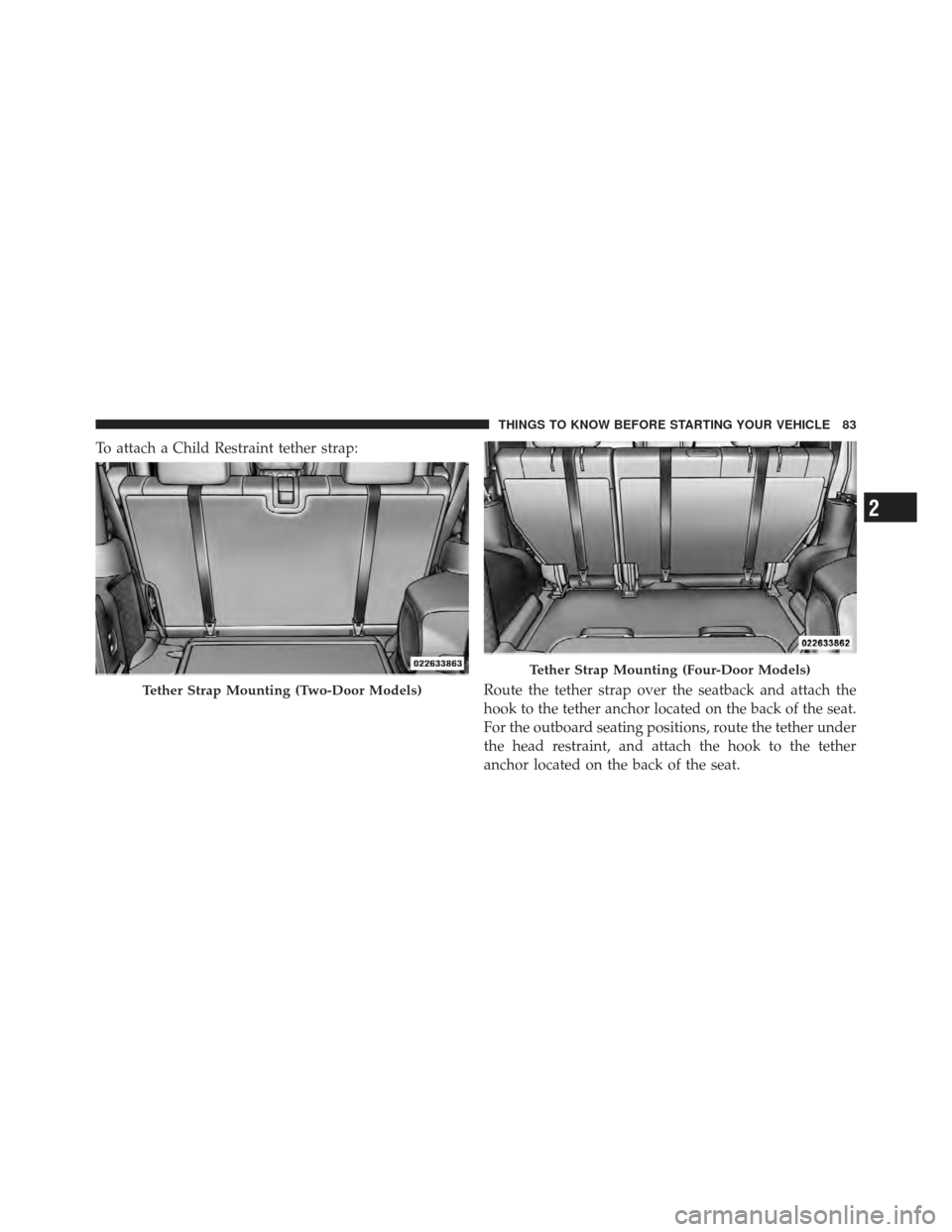
To attach a Child Restraint tether strap:Route the tether strap over the seatback and attach the
hook to the tether anchor located on the back of the seat.
For the outboard seating positions, route the tether under
the head restraint, and attach the hook to the tether
anchor located on the back of the seat.
Tether Strap Mounting (Two-Door Models)
Tether Strap Mounting (Four-Door Models)
2
THINGS TO KNOW BEFORE STARTING YOUR VEHICLE 83
Page 86 of 603
WARNING!
An incorrectly anchored tether strap could lead to
increased head motion and possible injury to the
child. Use only the anchor positions directly behind
the child seat to secure a child restraint top tether
strap.
Vehicles With Rear Web Buckles That May Need
To Be Twisted
•
In the rear seat, you may have trouble tightening the
lap/shoulder belt on the child restraint because the
buckle or latch plate is too close to the belt path
opening on the restraint. Disconnect the latch plate
from the buckle and twist the short buckle-end belt
several times to shorten it. Insert the latch plate into
the buckle with the release button facing out.
•If the belt still can’t be tightened, or if pulling and
pushing on the restraint loosens the belt, disconnect
the latch plate from the buckle, turn the buckle
around, and insert the latch plate into the buckle
again. If you still can’t make the child restraint secure,
try a different seating position.
Transporting Pets
Air Bags deploying in the front seat could harm your pet.
An unrestrained pet will be thrown about and possibly
injured, or injure a passenger during panic braking or in
an accident.
Pets should be restrained in the rear seat in pet harnesses
or pet carriers that are secured by seat belts.
84 THINGS TO KNOW BEFORE STARTING YOUR VEHICLE
Page 145 of 603
WARNING!
The head restraints for all occupants must be prop-
erly adjusted prior to operating the vehicle or occu-
pying a seat. Head restraints should never be ad-
justed while the vehicle is in motion. Driving a
vehicle with the head restraints improperly adjusted
or removed could cause serious injury or death in the
event of a collision.
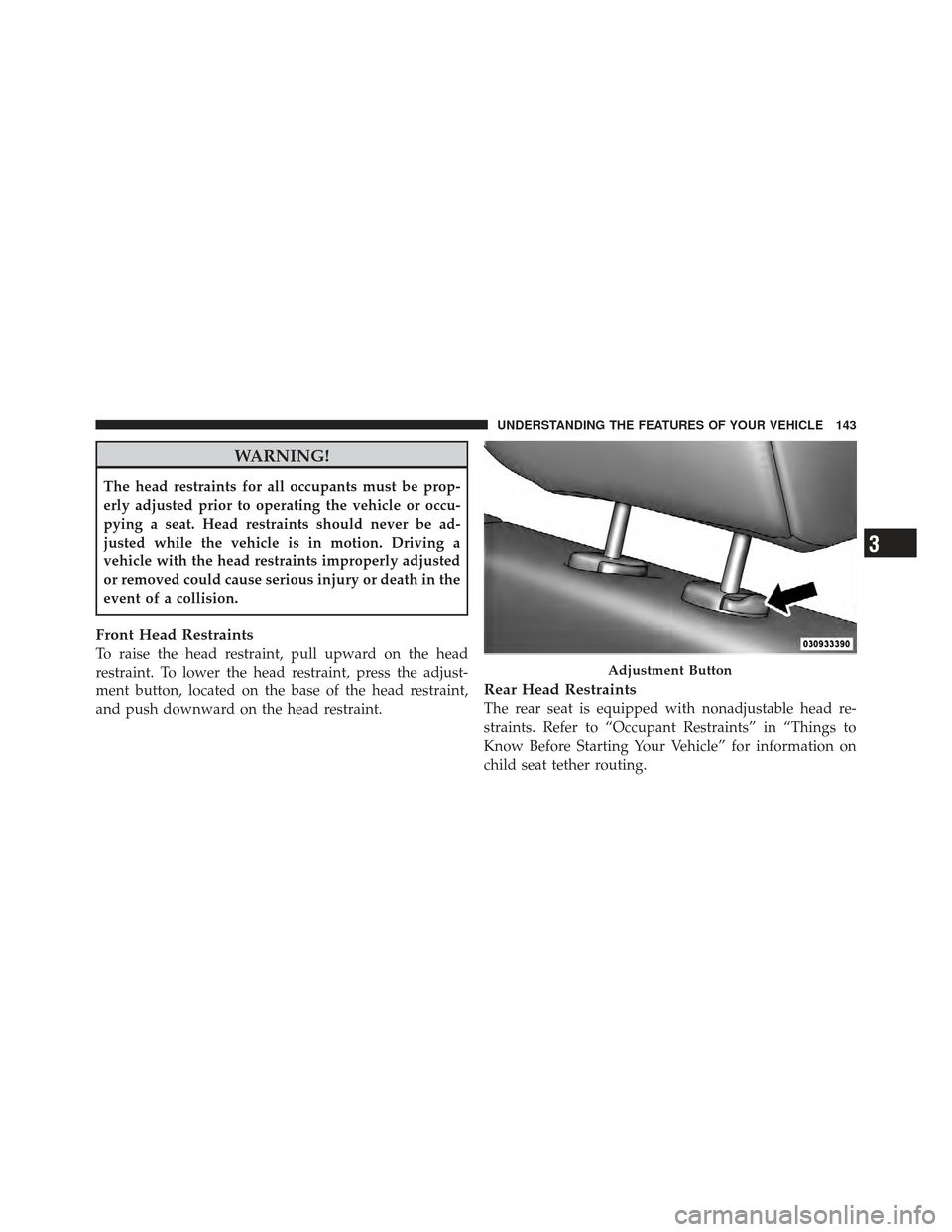
Front Head Restraints
To raise the head restraint, pull upward on the head
restraint. To lower the head restraint, press the adjust-
ment button, located on the base of the head restraint,
and push downward on the head restraint.
Rear Head Restraints
The rear seat is equipped with nonadjustable head re-
straints. Refer to “Occupant Restraints” in “Things to
Know Before Starting Your Vehicle” for information on
child seat tether routing.
Adjustment Button
3
UNDERSTANDING THE FEATURES OF YOUR VEHICLE 143
Page 150 of 603
To Raise The Rear Seat
Raise the seatback and lock it into place. If interference
from the cargo area prevents the seatback from fully
locking, you will have difficulty returning the seat to its
proper position.
NOTE:If the rear seatback is not fully latched, the
center shoulder belt will not be able to be extended for
use. If you cannot extend the center shoulder belt, make
sure your seatback is fully latched.
WARNING!
Be certain that the seatback is securely locked into
position. If the seatback in not securely locked into
position the seat will not provide the proper stability
for child seats and/or passengers. An improperly
latched seat could cause serious injury.
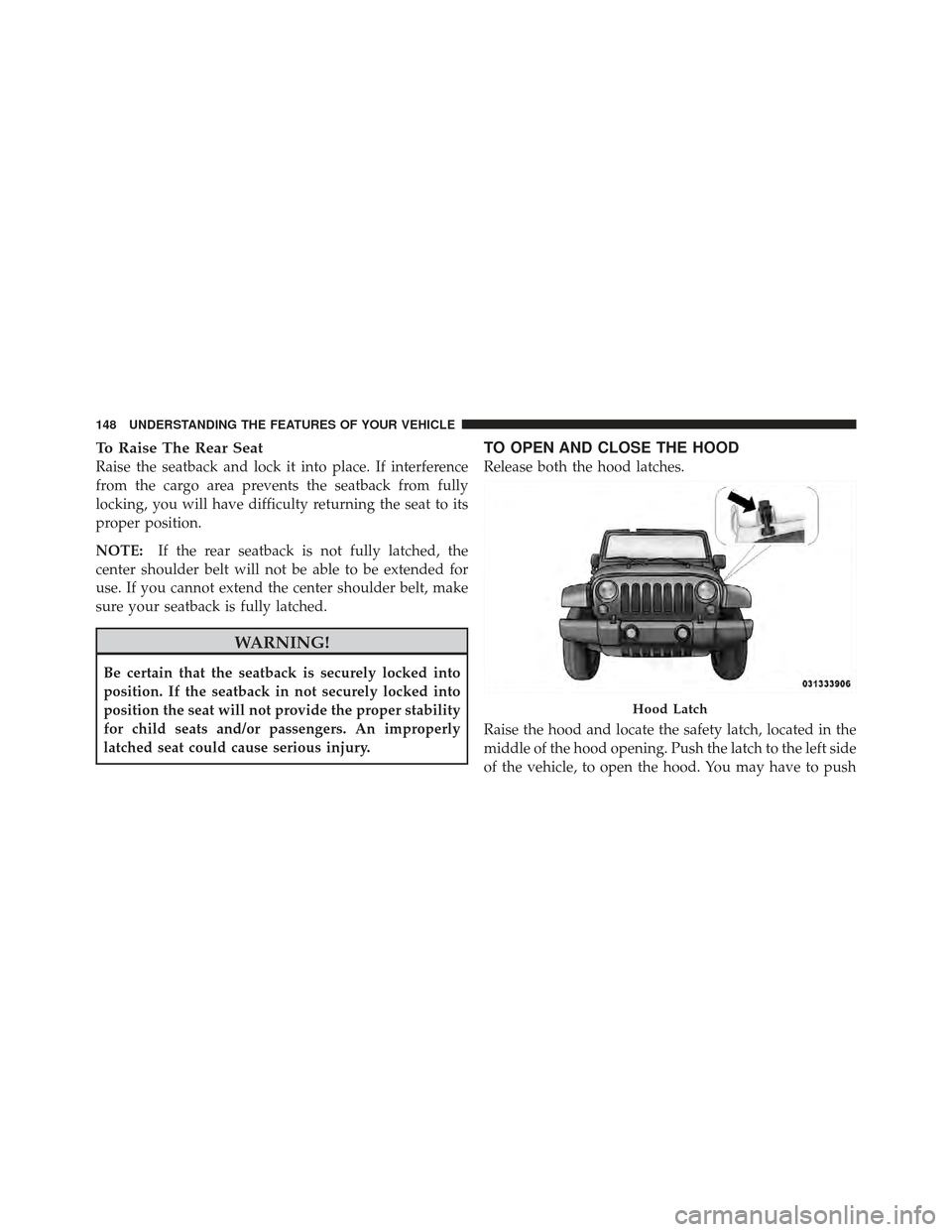
TO OPEN AND CLOSE THE HOOD
Release both the hood latches.
Raise the hood and locate the safety latch, located in the
middle of the hood opening. Push the latch to the left side
of the vehicle, to open the hood. You may have to push
Hood Latch
148 UNDERSTANDING THE FEATURES OF YOUR VEHICLE
Page 184 of 603
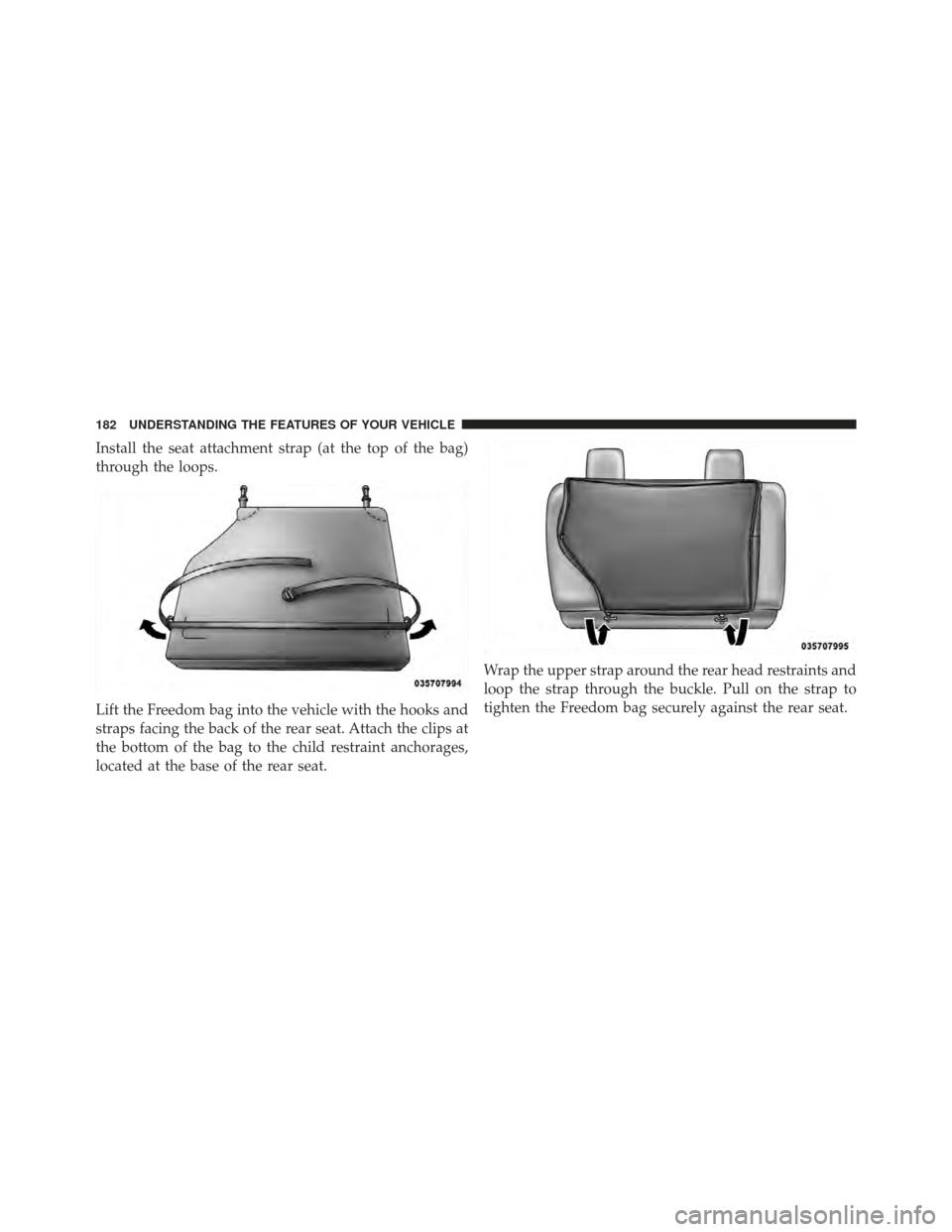
Install the seat attachment strap (at the top of the bag)
through the loops.
Lift the Freedom bag into the vehicle with the hooks and
straps facing the back of the rear seat. Attach the clips at
the bottom of the bag to the child restraint anchorages,
located at the base of the rear seat.Wrap the upper strap around the rear head restraints and
loop the strap through the buckle. Pull on the strap to
tighten the Freedom bag securely against the rear seat.
182 UNDERSTANDING THE FEATURES OF YOUR VEHICLE