Page 459 of 603
WARNING! (Continued)
•Guard against carbon monoxide with proper
maintenance. Have the exhaust system inspected
every time the vehicle is raised. Have any abnor-
mal conditions repaired promptly. Until repaired,
drive with all side windows fully open.
•Keep the swing gate closed when driving your
vehicle to prevent carbon monoxide and other
poisonous exhaust gases from entering the vehicle.
ADDING FUEL
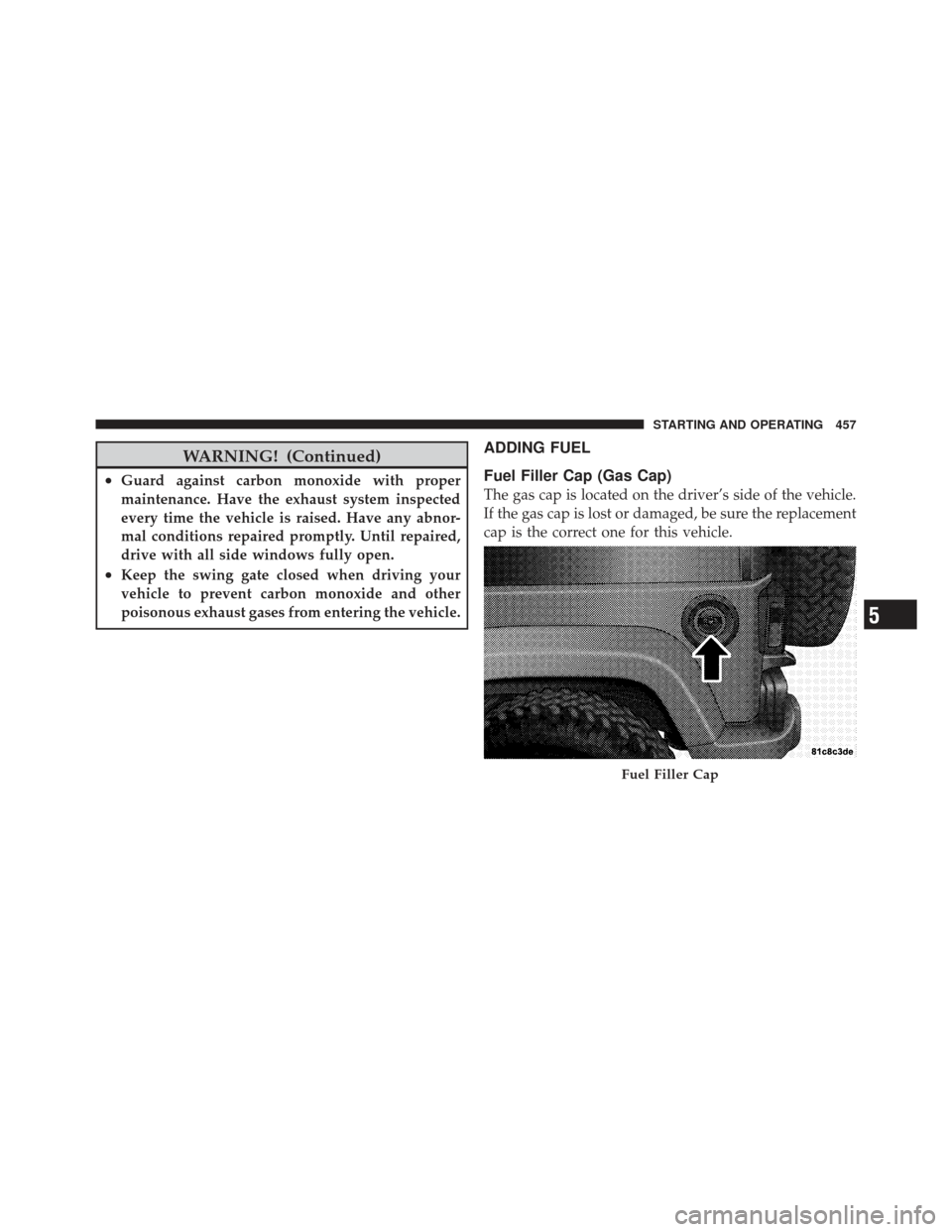
Fuel Filler Cap (Gas Cap)
The gas cap is located on the driver’s side of the vehicle.
If the gas cap is lost or damaged, be sure the replacement
cap is the correct one for this vehicle.
Fuel Filler Cap
5
STARTING AND OPERATING 457
Page 460 of 603

CAUTION!
•Damage to the fuel system or emission control
system could result from using an improper fuel
cap (gas cap). A poorly fitting cap could let impu-
rities into the fuel system. Also, a poorly fitting
aftermarket cap can cause the “Malfunction Indi-
cator Light (MIL)” to illuminate, due to fuel vapors
escaping from the system.
•To avoid fuel spillage and overfilling, do not “top
off” the fuel tank after filling.
WARNING!
•Never have any smoking materials lit in or near
the vehicle when the gas cap is removed or the
tank is being filled.(Continued)
WARNING! (Continued)
•Never add fuel when the engine is running. This is
in violation of most state and federal fire regula-
tions and may cause the MIL to turn on.
•A fire may result if gasoline is pumped into a
portable container that is inside of a vehicle. You
could be burned. Always place gas containers on
the ground while filling.
NOTE:
•When the fuel nozzle “clicks” or shuts off, the fuel
tank is full.
•Tighten the gas cap about 1/4 turn until you hear one
click. This is an indication that the cap is properly
tightened.
•If the gas cap is not tightened properly, the MIL will
come on. Be sure the gas cap is tightened every time
the vehicle is refueled.
458 STARTING AND OPERATING
Page 461 of 603

Loose Fuel Filler Cap Message
After fuel has been added, the vehicle diagnostic system
can determine if the fuel filler cap is possibly loose,
improperly installed, or damaged. If the system detects a
malfunction, the “gASCAP” message will display in the
odometer display. Tighten the gas cap until a�clicking�
sound is heard. This is an indication that the gas cap is
properly tightened. Press the odometer reset button to
turn the message off. If the problem persists, the message
will appear the next time the vehicle is started. This
might indicate a damaged cap. If the problem is detected
twice in a row, the system will turn on the MIL. Resolving
the problem will turn the MIL off.
VEHICLE LOADING
Certification Label
As required by National Highway Traffic Safety Admin-
istration regulations, your vehicle has a certification label
affixed to the driver’s side door or B-Pillar. This label contains the month and year of manufacture,
Gross Vehicle Weight Rating (GVWR), Gross Axle Weight
Rating (GAWR) front and rear, and Vehicle Identification
Number (VIN). A Month-Day-Hour (MDH) number is
included on this label and indicates the month, day, and
hour of manufacture. The bar code that appears on the
bottom of the label is your VIN.
Gross Vehicle Weight Rating (GVWR)
The GVWR is the total permissible weight of your vehicle
including driver, passengers, vehicle, options, trailer
tongue weight, and cargo. The label also specifies maxi-
mum capacities of front and rear axle systems (GAWR).
Total load must be limited, so GVWR, and front and rear
GAWR are not exceeded.5
STARTING AND OPERATING 459
Page 462 of 603

Payload
The payload of a vehicle is defined as the allowable load
weight a truck or any given vehicle can carry, including
the weight of the driver, all passengers, options and cargo.
Gross Axle Weight Rating (GAWR)
The GAWR is the maximum permissible load on the front
and rear axles. The load must be distributed in the cargo
area so that the GAWR of each axle is not exceeded.
Each axle’s GAWR is determined by the components in
the system with the lowest load carrying capacity (axle,
springs, tires, or wheels). Heavier axles or suspension
components, sometimes specified by purchasers for in-
creased durability, does not necessarily increase the ve-
hicle’s GVWR.
Tire Size
The tire size on the label represents the actual tire size on
your vehicle. Replacement tires must be equal to the load
capacity of this tire size.
Rim Size
This is the rim size that is appropriate for the tire size
listed.
Inflation Pressure
This is the cold tire inflation pressure for your vehicle for
all loading conditions up to full GAWR.
Curb Weight
The curb weight of a vehicle is defined as the total weight
of the vehicle with all fluids, including vehicle fuel, at full
capacity conditions, and with no occupants or cargo
loaded into the vehicle. The front and rear curb weight
values are determined by weighing your vehicle on a
commercial scale before any occupants or cargo are
added.
Loading
The actual total weight and the weight of the front and
rear of your vehicle at the ground can best be determined
by weighing it when it is loaded and ready for operation.
460 STARTING AND OPERATING
Page 505 of 603
MAINTAINING YOUR VEHICLE
CONTENTS
�Engine Compartment — 3.8L ............. 505
� Onboard Diagnostic System — OBD II ...... 506
▫ Loose Fuel Filler Cap Message ........... 506
� Emissions Inspection And Maintenance
Programs ............................ 507
� Replacement Parts ..................... 508
� Dealer Service ........................ 509
� Maintenance Procedures ................. 509
▫ Engine Oil ......................... 510 ▫
Engine Oil Filter ..................... 512
▫ Engine Air Cleaner Filter ............... 512
▫ Maintenance-Free Battery .............. 513
▫ Air Conditioner Maintenance ............ 514
▫ Body Lubrication .................... 515
▫ Windshield Wiper Blades ............... 516
▫ Adding Washer Fluid ................. 516
▫ Exhaust System ..................... 517
▫ Cooling System ..................... 520
7
Page 508 of 603

ONBOARD DIAGNOSTIC SYSTEM — OBD II
Your vehicle is equipped with a sophisticated onboard
diagnostic system called OBD II. This system monitors
the performance of the emissions, engine, and automatic
transmission control systems. When these systems are
operating properly, your vehicle will provide excellent
performance and fuel economy, as well as engine emis-
sions well within current government regulations.
If any of these systems require service, the OBD II system
will turn on the “Malfunction Indicator Light” (MIL). It
will also store diagnostic codes and other information to
assist your service technician in making repairs. Al-
though your vehicle will usually be drivable and not
need towing, see your authorized dealer for service as
soon as possible.CAUTION!
•Prolonged driving with the MIL on could cause
further damage to the emission control system. It
could also affect fuel economy and drivability. The
vehicle must be serviced before any emissions
tests can be performed.
•If the MIL is flashing while the engine is running,
severe catalytic converter damage and power loss
will soon occur. Immediate service is required.
Loose Fuel Filler Cap Message
After fuel is added, the vehicle diagnostic system can
determine if the fuel filler cap is possibly loose, improp-
erly installed, or damaged. A “gASCAP” message will be
displayed in the odometer. Tighten the gas cap until a
�clicking�sound is heard. This is an indication that the
gas cap is properly tightened. Press the odometer reset
button to turn the message off. If the problem persists,
506 MAINTAINING YOUR VEHICLE
Page 513 of 603

Engine Oil Selection
For best performance and maximum protection for all
engines under all types of operating conditions, the
manufacturer recommends engine oils that are API Cer-
tified and meet the requirements of Chrysler Material
Standard MS-6395.
American Petroleum Institute (API) Engine Oil
Identification Symbol
This symbol means that the oil has
been certified by the American
Petroleum Institute (API). The
manufacturer only recommends
API Certified engine oils.
CAUTION!
Do not use chemical flushes in your engine oil as the
chemicals can damage your engine. Such damage is
not covered by the New Vehicle Limited Warranty.
Engine Oil Viscosity (SAE Grade)
SAE 5W-20 engine oil is recommended for all operating
temperatures. This engine oil improves low temperature
starting and vehicle fuel economy.
The engine oil filler cap also shows the recommended
engine oil viscosity for your engine. For information on
engine oil filler cap location, refer to “Engine Compart-
ment” in “Maintaining Your Vehicle” for further informa-
tion.
Lubricants which do not have both, the engine oil certi-
fication mark and the correct SAE viscosity grade num-
ber, should not be used.
7
MAINTAINING YOUR VEHICLE 511
Page 551 of 603
Center High-Mounted Stop Lamp (CHMSL)
The stop lamp is mounted on a bracket that extends
upward from the tailgate behind the spare tire. If service
is needed, obtain the LED/Cover Assembly from your
local authorized dealer.
1. Remove the spare tire.2. Remove the four screws holding the lens/cover in
place on the spare tire carrier.
3. Disconnect the wire harness from the back of the LED
cover.
FLUID CAPACITIES
U.S.
Metric
Fuel (Approximate) — Two Door Models 18.5 Gallons70 Liters
Fuel (Approximate) — Four Door Models 22.5 Gallons85 Liters
Engine Oil with Filter
3.8 Liter Engine 6 Quarts5.7 Liters
Cooling System *
3.8 Liter Engine (MOPAR� Antifreeze/Engine Coolant 5
Year/100,000 Mile Formula or equivalent) 13 Quarts
12 Liters
* Includes coolant recovery bottle filled to MAX level.
7
MAINTAINING YOUR VEHICLE 549