Page 354 of 490

•Four Tire Pressure Monitoring Sensors
•Tire Pressure Monitoring Telltale Light
Tire Pressure Monitoring Low Pressure Warnings
The Tire Pressure Monitoring Telltale Light will illumi-
nate in the instrument cluster, a LOW TIRE message will
be displayed for a minimum of five seconds, and an
audible chime will be activated when one or more of the
four active road tire pressures are low. Should this occur,
you should stop as soon as possible, check the inflation
pressure of each tire on your vehicle, and inflate each tire
to the vehicle’s recommended cold placard pressure
value. The system will automatically update and the Tire
Pressure Monitoring Light will extinguish and the LOW
TIRE message will turn off once the updated tire pres-
sures have been received. The vehicle may need to be
driven for up to 20 minutes above 15 mph (24 km/h) to
receive this information.
Check TPMS Warnings
The Tire Pressure Monitoring Telltale Light will flash on
and off for 75 seconds and remain on solid when a system
fault is detected. The system fault will also sound a
chime. If the ignition key is cycled, this sequence will
repeat providing the system fault still exists. The Tire
Pressure Monitoring Telltale Light will turn off when the
fault condition no longer exists. A system fault can occur
with any of the following scenarios:
1. Jamming due to electronic devices or driving next to
facilities emitting the same radio frequencies as the TPM
sensors.
2. Installing some form of aftermarket window tinting
that affects radio wave signals.
3. Snow or ice around the wheels or wheel housings.
4. Using tire chains on the vehicle.
5. Using wheels/tires not equipped with TPM sensors.
352 STARTING AND OPERATING
Page 355 of 490

NOTE:Your vehicle is equipped with a compact spare
wheel and tire assembly.
1. The compact spare tire does not have a tire pressure
monitoring sensor. Therefore, the TPMS will not monitor
the tire pressure in the compact spare tire.
2.
If you install the compact spare tire in place of a road
tire that has a pressure below the low-pressure warning
limit, upon the next ignition key cycle, a chime will sound
and the Tire Pressure Monitoring Telltale Light and LOW
TIRE message will still turn ON due to the low tire.
3. However, after driving the vehicle for up to 20 min-
utes above 15 mph (24 km/h), the Tire Pressure Moni-
toring Telltale Light will flash on and off for 75 seconds
and then remain on solid.
4.
For each subsequent ignition key cycle, a chime will
sound and the Tire Pressure Monitoring Telltale Light will
flash on and off for 75 seconds and then remain on solid.
5. Once you repair or replace the original road tire and
reinstall it on the vehicle in place of the compact spare
tire, the TPMS will update automatically and the Tire
Pressure Monitoring Telltale Light will turn OFF, as long
as no tire pressure is below the low-pressure warning
limit in any of the four active road tires. The vehicle may
need to be driven for up to 20 minutes above 15 mph
(24 km/h) in order for the TPMS to receive this
information.
Premium System – If Equipped
The TPMS uses wireless technology with wheel rim
mounted electronic sensors to monitor tire pressure lev-
els. Sensors, mounted to each wheel as part of the valve
stem, transmit tire pressure readings to the receiver
module.
NOTE: It is particularly important for you to check the
tire pressure in all of your tires regularly and to maintain
the proper pressure.
5
STARTING AND OPERATING 353
Page 357 of 490
display to the vehicle’s recommended cold placard pres-
sure value. The system will automatically update, the
“LOW TIRE” text message will no longer be displayed,
the graphic display of the pressure value(s) will stop
flashing, and the Tire Pressure Monitoring Light will
extinguish once the updated tire pressure(s) have been
received. The vehicle may need to be driven for up to
20 minutes above 15 mph (24 km/h) to receive this
information.
Check TPMS Message
The Tire Pressure Monitoring Telltale Light will flash on
and off for 75 seconds, and remain on solid when a
system fault is detected. The system fault will also sound
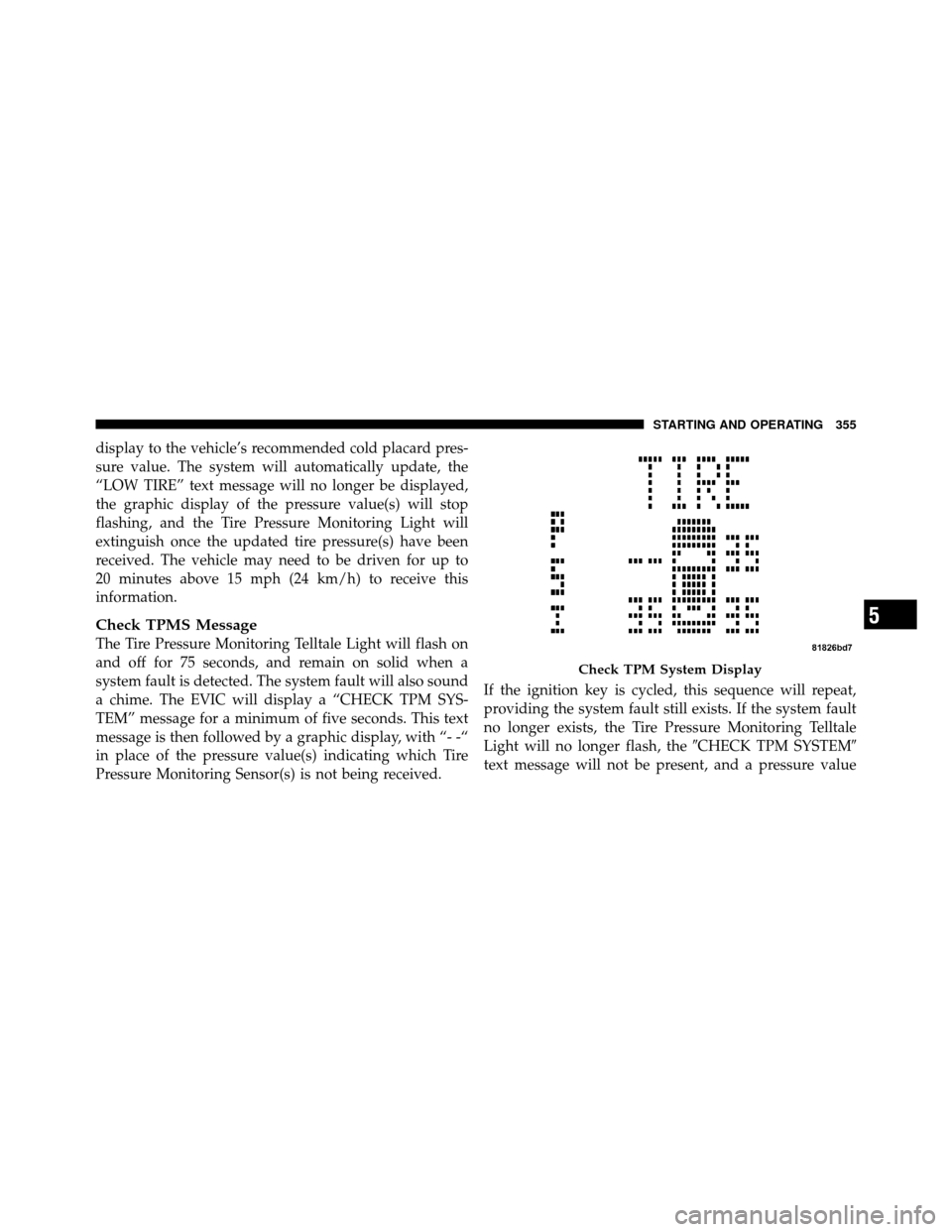
a chime. The EVIC will display a “CHECK TPM SYS-
TEM” message for a minimum of five seconds. This text
message is then followed by a graphic display, with “- -“
in place of the pressure value(s) indicating which Tire
Pressure Monitoring Sensor(s) is not being received.If the ignition key is cycled, this sequence will repeat,
providing the system fault still exists. If the system fault
no longer exists, the Tire Pressure Monitoring Telltale
Light will no longer flash, the
�CHECK TPM SYSTEM�
text message will not be present, and a pressure value
Check TPM System Display
5
STARTING AND OPERATING 355
Page 358 of 490

will be displayed instead of dashes. A system fault can
occur with any of the following scenarios:
1. Jamming due to electronic devices or driving next to
facilities emitting the same radio frequencies as the TPM
sensors.
2. Installing some form of aftermarket window tinting
that affects radio wave signals.
3. Snow or ice around the wheels or wheel housings.
4. Using tire chains on the vehicle.
5. Using wheels/tires not equipped with TPM sensors.
The EVIC will also display a�CHECK TPM SYSTEM�
message for a minimum of five seconds when a system
fault related to an incorrect sensor location fault is
detected. In this case, the �CHECK TPM SYSTEM�mes-
sage is then followed with a graphic display with pres-
sure values still shown. This indicates that the pressure values are still being received from the TPM sensors but
they may not be located in the correct vehicle position.
The system still needs to be serviced as long as the
�CHECK TPM SYSTEM�
message is displayed.
NOTE: Your vehicle is equipped with a compact spare
wheel and tire assembly.
1. The compact spare tire does not have a tire pressure
monitoring sensor. Therefore, the TPMS will not monitor
the tire pressure in the compact spare tire.
2. If you install the compact spare tire in place of a road
tire that has a pressure below the low-pressure warning
limit, upon the next ignition key cycle, a chime will
sound and the Tire Pressure Monitoring Telltale Light
will still turn ON due to the low tire. The “LOW TIRE”
text message and the graphic with the low tire pressure
flashing will be displayed.
356 STARTING AND OPERATING
Page 359 of 490
3. However, after driving the vehicle for up to 20 min-
utes above 15 mph (24 km/h), the Tire Pressure Moni-
toring Telltale Light will flash on and off for 75 seconds
and then remain on solid. In addition, the EVIC will
display a “CHECK TPM SYSTEM” message for a mini-
mum of five seconds and then display dashes (- -) in
place of the pressure values.
4. For each subsequent ignition key cycle, a chime will
sound and the Tire Pressure Monitoring Telltale Light
will flash on and off for 75 seconds and then remain on
solid, and the EVIC will display a “CHECK TPM SYS-
TEM” message for a minimum of five seconds and then
display dashes (- -) in place of the pressure values.
5. Once you repair or replace the original road tire and
reinstall it on the vehicle in place of the compact spare
tire, the TPMS will update automatically and the Tire
Pressure Monitoring Telltale Light will turn OFF, as long
as no tire pressure is below the low-pressure warninglimit in any of the four active road tires. The vehicle may
need to be driven for up to 20 minutes above 15 mph
(24 km/h) in order for the TPMS to receive this
information.
General Information
This device complies with Part 15 of the FCC rules and
RSS 210 of Industry Canada. Operation is subject to the
following conditions:
•This device may not cause harmful interference.
•This device must accept any interference received,
including interference that may cause undesired
operation.
The tire pressure sensors are covered under one of the
following licenses:
United States ................... KR5S18002015B
Canada ........................ 267T-S180015B
5
STARTING AND OPERATING 357
Page 380 of 490
RECREATIONAL TOWING (BEHIND MOTORHOME, ETC.)
Towing Condition Wheels OFF TheGroundManual Transmission Automatic Transmission
Flat Tow None
•Transmission in NEUTRAL
•Key in ACC No
Dolly Tow Front
NoOK(FWD Only)
Rear No No
On Trailer AllOK OK
CAUTION!
•Do not flat tow any vehicle equipped with a
automatic transmission. Damage to the drivetrain
will result. If these vehicles require towing, make
sure all drive wheels are off the ground.
(Continued)
CAUTION! (Continued)
•Front or rear wheel lifts should not be used.
Internal damage to the transmission or transfer
case will occur if a front or rear wheel lift is used
when recreational towing.
378 STARTING AND OPERATING
Page 381 of 490
WHAT TO DO IN EMERGENCIES
CONTENTS
�Hazard Warning Flashers ................ 380
� If Your Engine Overheats ................ 380
� Automatic Transmission Overheating ....... 381
� Jacking And Tire Changing ............... 382
▫ Jack Location ....................... 382
▫ Spare Tire Stowage ................... 383
▫ Preparations For Jacking ............... 383
▫ Jacking Instructions ................... 384 �
Jump-Starting Procedures ................ 388
▫ Preparations For Jump-Start ............. 389
▫ Jump-Starting Procedure ............... 391
� Freeing A Stuck Vehicle ................. 393
� Shift Lever Override ................... 394
� Towing A Disabled Vehicle ............... 395
▫ With Ignition Key .................... 395
▫ Without The Ignition Key .............. 396
6
Page 397 of 490
6. Move the shift lever into the NEUTRAL position.
7. The vehicle may then be started in NEUTRAL.
8. Reinstall the shift lever override access cover.
TOWING A DISABLED VEHICLE
With Ignition Key
Automatic Transmission
•
Front Wheel Drive (FWD) vehicles can be towed with
the front wheels elevated or on a flatbed truck (all four
wheelsOFFthe ground).
•All Wheel Drive (AWD) vehicles must be towed on a
flatbed truck (all four wheels OFFthe ground).
CAUTION!
DO NOT flat tow any vehicle equipped with an
automatic transmission. Damage to the drivetrain
will result.
Manual Transmission
•
Front Wheel Drive (FWD) or All Wheel Drive (AWD)
vehicles can be flat towed (all four wheels on the
ground) with the transmission in NEUTRAL.
•FWD vehicles can be towed with the front wheels
elevated.
•FWD or AWD vehicles can be towed on a flatbed truck
(all wheels OFFthe ground).
6
WHAT TO DO IN EMERGENCIES 395