Page 429 of 542
WARNING! (Continued)
•Turn on the Hazard Warning flasher.
•Block the wheel diagonally opposite the wheel to
be raised.
•Set the parking brake firmly and set an automatic
transmission in PARK; a manual transmission in
REVERSE.
•Never start or run the engine with the vehicle on a
jack.
•Do not let anyone sit in the vehicle when it is on a
jack.
•Do not get under the vehicle when it is on a jack.
•Only use the jack in the positions indicated and
for lifting this vehicle during a tire change.
•If working on or near a roadway, be extremely
careful of motor traffic.
CAUTION!
Do not attempt to raise the vehicle by jacking on
locations other than those indicated in the Jacking
Instructions for this vehicle.
1. Remove spare tire.
2. Remove jack and tools from mounting bracket. As-
semble the tools by connecting the driver to the exten-
sion, and then to the lug wrench.
Jack Warning Label
6
WHAT TO DO IN EMERGENCIES 427
Page 433 of 542
WARNING!
•Take care to avoid the radiator cooling fan when-
ever the hood is raised. It can start anytime the
ignition switch is on. You can be injured by
moving fan blades.
•Remove any metal jewelry such as watch bands or
bracelets that might make an inadvertent electrical
contact. You could be seriously injured.
•Batteries contain sulfuric acid that can burn your
skin or eyes and generate hydrogen gas which is
flammable and explosive. Keep open flames or
sparks away from the battery.
1. Set the parking brake, shift the automatic transmission
into PARK and turn the ignition to LOCK.
2. Turn off the heater, radio, and all unnecessary electri-
cal accessories.
Positive Battery Post6
WHAT TO DO IN EMERGENCIES 431
Page 434 of 542

3. If using another vehicle to jump-start the battery, park
the vehicle within the jumper cables reach, set the
parking brake and make sure the ignition is OFF.
WARNING!
Do not allow vehicles to touch each other as this
could establish a ground connection and personal
injury could result.
Jump-Starting Procedure
WARNING!
Failure to follow this procedure could result in per-
sonal injury or property damage due to battery ex-
plosion.
CAUTION!
Failure to follow these procedures could result in
damage to the charging system of the booster vehicle
or the discharged vehicle.
1. Connect the positive (+)end of the jumper cable to the
positive (+)post of the discharged vehicle.
2. Connect the opposite end of the positive (+)jumper
cable to the positive (+)post of the booster battery.
3. Connect the negative end (-)of the jumper cable to the
negative (-)post of the booster battery.
4. Connect the opposite end of the negative (-)jumper
cable to a good engine ground (exposed metal part of the
discharged vehicle’s engine) away from the battery and
the fuel injection system.
432 WHAT TO DO IN EMERGENCIES
Page 437 of 542
WARNING!
Fast spinning tires can be dangerous. Forces gener-
ated by excessive wheel speeds may cause damage, or
even failure, of the axle and tires. A tire could
explode and injure someone. Do not spin your vehi-
cle’s wheels faster than 30 mph (48 km/h) or for
longer than 30 seconds continuously without stop-
ping when you are stuck and do not let anyone near
a spinning wheel, no matter what the speed.
SHIFT LEVER OVERRIDE
If a malfunction occurs and the shift lever cannot be
moved out of the PARK position, you can use the
following procedure to temporarily move the shift lever:
1. Firmly set the parking brake.
2. Using a screwdriver or similar tool, carefully remove
the shift lever override access cover, located on the
PRNDL bezel.
6
WHAT TO DO IN EMERGENCIES 435
Page 438 of 542
3. Turn the ignition to the ON/RUN position without
starting the engine.
4. Press and maintain firm pressure on the brake pedal.
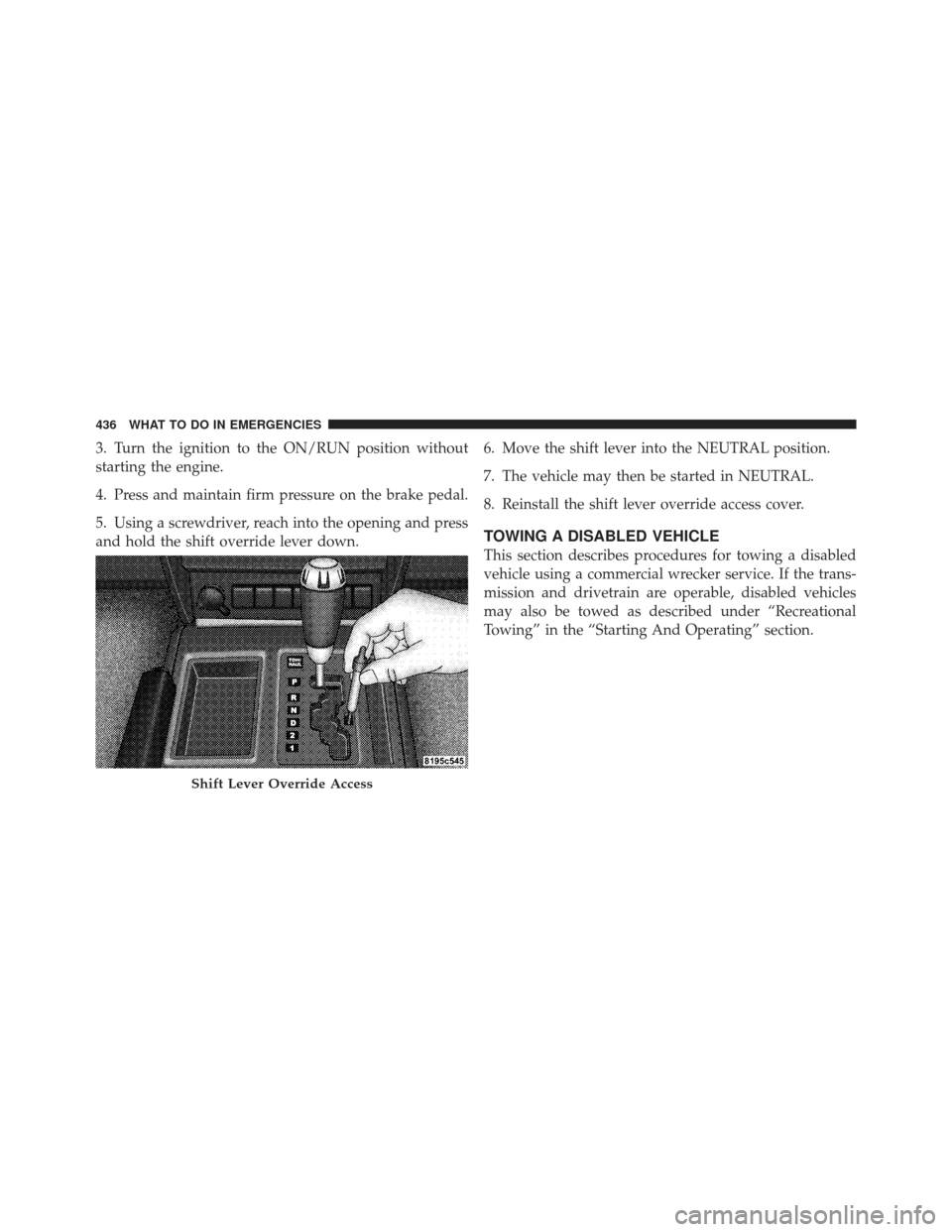
5. Using a screwdriver, reach into the opening and press
and hold the shift override lever down.6. Move the shift lever into the NEUTRAL position.
7. The vehicle may then be started in NEUTRAL.
8. Reinstall the shift lever override access cover.
TOWING A DISABLED VEHICLE
This section describes procedures for towing a disabled
vehicle using a commercial wrecker service. If the trans-
mission and drivetrain are operable, disabled vehicles
may also be towed as described under “Recreational
Towing” in the “Starting And Operating” section.
Shift Lever Override Access
436 WHAT TO DO IN EMERGENCIES
Page 441 of 542
CAUTION!
Towing faster than 30 mph (48 km/h) or farther than
15 miles (24 km) with rear wheels on the ground can
cause severe damage to the transmission. Such dam-
age is not covered by the New Vehicle Limited
Warranty.
If the transmission is not operable, or the vehicle must be
towed faster than 30 mph (48 km/h) or farther than
15 miles (24 km), tow with the rear wheels OFFthe
ground (on a flatbed, or with the rear wheels raised using
a wheel lift or towing dolly), or remove the driveshaft.
WARNING!
If the driveshaft is removed, the vehicle can roll even
if the transmission is in PARK, which could cause
serious injury or death.
The parking brake mustbe firmly engaged and the
wheels chocked during driveshaft removal and installa-
tion. The parking brake must remainengaged unless the
vehicle is securely and properly connected to the tow
vehicle, or the driveshaft is completely reinstalled. See
your authorized dealer for proper driveshaft removal
and reinstallation procedures, including flange
orientation/alignment, use of thread-locking compound,
proper bolt torque specifications, etc.
6
WHAT TO DO IN EMERGENCIES 439
Page 444 of 542
▫Cooling System ..................... 458
▫ Brake System ....................... 464
▫ Automatic Transmission ............... 466
▫ Transfer Case ....................... 468
▫ Front/Rear Axle Fluid ................. 469
▫ Sky Slider™ Top Care ................. 470
▫ Appearance Care And Protection From
Corrosion .......................... 472
� Fuses .............................. 478
▫ Totally Integrated Power Module ......... 478
� Replacement Bulbs .................... 484 �
Bulb Replacement ..................... 484
▫ Headlamp ......................... 484
▫ Front Turn Signal And Front Side Marker
Lamp ............................. 485
▫ Front Fog Lamp ..................... 485
▫ Rear Tail/Stop, Turn Signal, And Back-Up
Lamp ............................. 486
� Fluid Capacities ...................... 487
� Fluids, Lubricants, And Genuine Parts ....... 488
▫ Engine ............................ 488
▫ Chassis ........................... 489
442 MAINTAINING YOUR VEHICLE
Page 445 of 542
ENGINE COMPARTMENT — 3.7L
1 — Air Cleaner Filter6 — Washer Fluid Reservoir
2 — Engine Oil Dipstick 7 — Engine Coolant Reservoir
3 — Brake Fluid Reservoir 8 — Engine Oil Fill
4 — Integrated Power Module (Fuses) 9 — Coolant Pressure Cap
5 — Battery
7
MAINTAINING YOUR VEHICLE 443