Page 109 of 587
�Electrical Power Outlets ................. 221
� Power Inverter — If Equipped ............ 226
� Cupholders .......................... 228
� Storage ............................. 229
▫ Glove Compartment .................. 229
▫ Door Storage ....................... 230
▫ Center Console ...................... 230
� Cargo Area Features ................... 231
▫ Rechargeable Flashlight ................ 231 ▫
Cargo Storage Bins ................... 233
▫ Retractable Cargo Area
Cover — If Equipped ................. 234
▫ Cargo Tie-Down Hooks ................ 236
� Rear Window Features .................. 237
▫ Rear Window Wiper/Washer ............ 237
▫ Rear Window Defroster ................ 238
� Roof Luggage Rack — If Equipped ......... 239
3
UNDERSTANDING THE FEATURES OF YOUR VEHICLE 107
Page 110 of 587
MIRRORS
Inside Day/Night Mirror
A single ball joint mirror is provided in the vehicle. It is
a twist on mirror that has a fixed position. The mirror
head can be adjusted up, down, left, and right for various
drivers. The mirror should be adjusted to center on the
view through the rear window.
Headlight glare from vehicles behind you can be reduced
by moving the small control under the mirror to the night
position (toward the rear of the vehicle). The mirror
should be adjusted while set in the day position (toward
the windshield).
Adjusting Rearview Mirror
108 UNDERSTANDING THE FEATURES OF YOUR VEHICLE
Page 111 of 587
Automatic Dimming Mirror — If Equipped
This mirror automatically adjusts for headlight glare
from vehicles behind you. You can turn the feature on or
off by pressing the button at the base of the mirror. A light
in the button will illuminate to indicate when the dim-
ming feature is activated. The mirror is twisted on the
windshield button counterclockwise and requires no
tools for mounting.
CAUTION!
To avoid damage to the mirror during cleaning, never
spray any cleaning solution directly onto the mirror.
Apply the solution onto a clean cloth and wipe the
mirror clean.
Automatic Dimming Mirror
3
UNDERSTANDING THE FEATURES OF YOUR VEHICLE 109
Page 112 of 587
Outside Mirrors
To receive maximum benefit, adjust the outside mirrors
to center on the adjacent lane of traffic with a slight
overlap of the view obtained on the inside mirror.
WARNING!
Vehicles and other objects seen in the passenger side
convex mirror will look smaller and farther away
than they really are. Relying too much on your
passenger side convex mirror could cause you to
collide with another vehicle or other object. Use your
inside mirror when judging the size or distance of a
vehicle seen in the passenger side convex mirror.
Some vehicles will not have a convex passenger side
mirror.
Outside Mirrors Folding Feature
All outside mirrors are hinged and may be moved either
forward or rearward to resist damage. The hinges have
three detent positions: full forward, full rearward and
normal.
Outside Automatic Dimming Mirrors —
If Equipped
The drivers outside mirror will automatically adjust for
glare from vehicles behind you. This feature is controlled
by the inside automatic dimming mirror and can be
turned on or off by pressing the button at the base of the
inside mirror. The mirrors will automatically adjust for
headlight glare when the inside mirror adjusts.
Outside Power Mirrors
The power mirror switch is located on the driver’s side
door trim panel.
The power mirror controls consist of mirror select but-
tons and a four-way mirror control switch. To adjust a
110 UNDERSTANDING THE FEATURES OF YOUR VEHICLE
Page 114 of 587
Lift the cover to reveal the mirror. The light will turn on
automatically.
Sun Visor Extension — If Equipped
This feature has a pull out extension on the sun visor for
increased coverage.
BLIND SPOT MONITORING — IF EQUIPPED
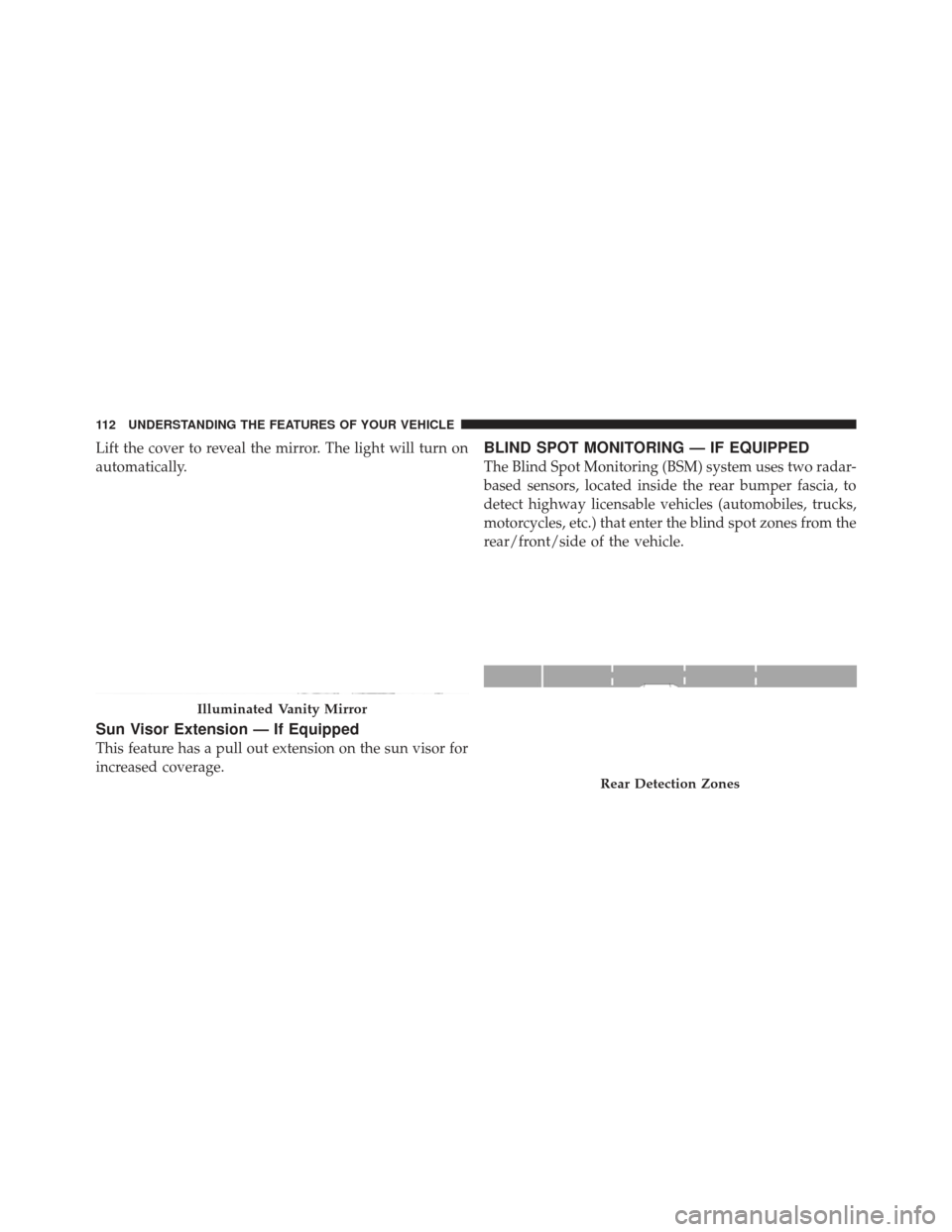
The Blind Spot Monitoring (BSM) system uses two radar-
based sensors, located inside the rear bumper fascia, to
detect highway licensable vehicles (automobiles, trucks,
motorcycles, etc.) that enter the blind spot zones from the
rear/front/side of the vehicle.
Illuminated Vanity Mirror
Rear Detection Zones
112 UNDERSTANDING THE FEATURES OF YOUR VEHICLE
Page 115 of 587

When the vehicle is started, the BSM warning light will
momentarily illuminate in both outside rear view mirrors
to let the driver know that the system is operational. The
BSM system sensors operate when the vehicle is in any
forward gear or REVERSE and enters stand by mode
when the vehicle is in PARK.
The BSM detection zone covers approximately one lane
on both sides of the vehicle (11 ft or 3.35 m). The zone
starts at the outside rear view mirror and extends ap-
proximately 20 ft (6 m) to the rear of the vehicle. The BSM
system monitors the detection zones on both sides of the
vehicle when the vehicle speed has reached approxi-
mately 6 mph (10 km/h) or higher and will alert the
driver of vehicles in these areas.NOTE:
•The BSM system does NOT alert the driver about
rapidly approaching vehicles that are outside the
detection zones.
•The BSM system detection zone DOES NOT change if
your vehicle is towing a trailer. Therefore, visually
verify the adjacent lane is clear for both your vehicle
and trailer before making a lane change. If the trailer
or other object (i.e., bicycle, sports equipment) extends
beyond the side of your vehicle, this may result in the
BSM warning light remaining illuminated the entire
time the vehicle is in a forward gear.3
UNDERSTANDING THE FEATURES OF YOUR VEHICLE 113
Page 116 of 587
The area on the rear fascia where the radar sensors are
located must remain free of snow, ice, and dirt/road
contamination so that the BSM system can function
properly. Do not block the area of the rear fascia where
the radar sensors are located with foreign objects (bum-
per stickers, bicycle racks, etc.).The BSM system notifies the driver of objects in the
detection zones by illuminating the BSM warning light
located in the outside mirrors.
Sensor Location (Driver Side Shown)
Warning Light Location
114 UNDERSTANDING THE FEATURES OF YOUR VEHICLE
Page 118 of 587
Entering From The Rear
Vehicles that come up from behind your vehicle on either
side and enter the rear detection zone with a relative
speed of less than 30 mph (48 km/h).Overtaking Traffic
If you pass another vehicle slowly (with a relative speed
less than 10 mph (16 km/h) and the vehicle remains in
the blind spot for approximately 1.5 seconds, the warning
light will be illuminated. If the difference in speed
between the two vehicles is greater than 10 mph
(16 km/h), the warning light will not illuminate.
Rear Monitoring
Overtaking/Approaching
116 UNDERSTANDING THE FEATURES OF YOUR VEHICLE