Page 336 of 587
NOTE:In cold weather, use of Recirculation mode may
lead to excessive window fogging. The Recirculation
mode is not allowed in the Floor/Defrost Mix and
Defrost modes to improve window clearing operation.
Recirculation will be disabled automatically if these
modes are selected.
Operating Tips
Window Fogging
Windows will fog on the inside when the humidity inside
the vehicle is high. This often occurs in mild or cool
temperatures when it’s rainy or humid. In most cases,
turning the air conditioning (pressing the A/C button) on
will clear the fog. Adjust the temperature control, air
direction, and blower speed to maintain comfort. As the temperature gets colder, it may be necessary to
direct air onto the windshield. Adjust the temperature
control and blower speed to maintain comfort. Higher
blower speeds will reduce fogging. Interior fogging on
the windshield can be quickly removed by selecting the
DEFROST mode.
Regular cleaning of the inside of the windows with a
non-filming cleaning solution (vinegar and water works
very well) will help prevent contaminates (cigarette
smoke, perfumes, etc.) from sticking to the windows.
Contaminates increase the rate of window fogging.
334 UNDERSTANDING YOUR INSTRUMENT PANEL
Page 337 of 587
Summer Operation
NOTE:In some cases during high temperature trailer
tow operation the Air Conditioning system performance
may be reduced. This is to help protect the engine from
overheating during the high load condition.
Your air conditioning system is also equipped with an
automatic recirculation system. When the system senses
a heavy load or high heat conditions, it may use partial
Recirculation A/C mode to provide additional comfort.
Winter Operation
When operating the system during the winter months,
make sure the air intake, located directly in front of the
windshield, is free of ice, slush, snow, or other obstructions.
Vacation Storage
Anytime you store your vehicle, or keep it out of service
(i.e. vacation) for two weeks or more, run the air condi-
tioning system at idle for about five minutes in the fresh
air and high blower setting. This will ensure adequate
system lubrication to minimize the possibility of com-
pressor damage when the system is started again.
4
UNDERSTANDING YOUR INSTRUMENT PANEL 335
Page 366 of 587

to allow more driver control of vehicle while maintain-
ing safe handling controls. The vehicle will lower (if
equipped with Air Suspension) to Aero Mode in High
Range. 4WD Low is not available in SPORT mode, if
4WD Low is selected the Selec-Terrain™ will auto-
matically switch back to AUTO.
•Snow– Tuning set for additional stability in inclement
weather. Use on and off road on loose traction surfaces
such as snow. When in Snow mode (depending on
certain operating conditions), the transmission may
use second gear (rather than first gear) during
launches, to minimize wheel slippage. If equipped
with air suspension, the level will change to Normal
Ride Height (NRH) if the transfer case is in high range.
The level will change to Off-Road 1 if the transfer case
is in Low range.
•Auto – Fully automatic full time four-wheel drive
operation can be used on and off road. Balances traction with seamless steering feel to provide im-
proved handling and acceleration over two-wheel
drive vehicles. If equipped with air suspension, the
level will change to NRH.
•Sand/Mud
– Off road calibration for use on low
traction surfaces such as mud, sand, or wet grass.
Driveline is maximized for traction. Some binding
may be felt on less forgiving surfaces. The electronic
brake controls are set to limit traction control manage-
ment of throttle and wheel spin. If equipped with air
suspension, the level will change to Off-Road 1.
•Rock – Off-road calibration only available in 4WD
Low range. The vehicle is raised (if equipped with Air
Suspension) for improved ground clearance. Traction
based tuning with improved steer-ability for use on
high traction off-road surfaces. Activates the Hill De-
scent Control for steep downhill control. Use for low
speed obstacles such as large rocks, deep ruts, etc. If
364 STARTING AND OPERATING
Page 367 of 587
equipped with air suspension, the vehicle level will
change to Off-Road 2. If the Selec-Terrain™ switch is in
ROCK mode, and the transfer case is switched from
4WD Low to 4WD High, the Selec-Terrain™ system
will return to AUTO.
Electronic Vehicle Information Center (EVIC)
Display Messages
When the appropriate conditions exist, a message will
appear in the EVIC display. Refer to “Electronic Vehicle
Information Center (EVIC)” in “Understanding Your
Instrument Panel” for further information.
QUADRA-LIFT™ — IF EQUIPPED
Description
The Quadra-Lift™ air suspension system provides full
time load leveling capability along with the benefit of
being able to adjust vehicle height by the push of a
button.
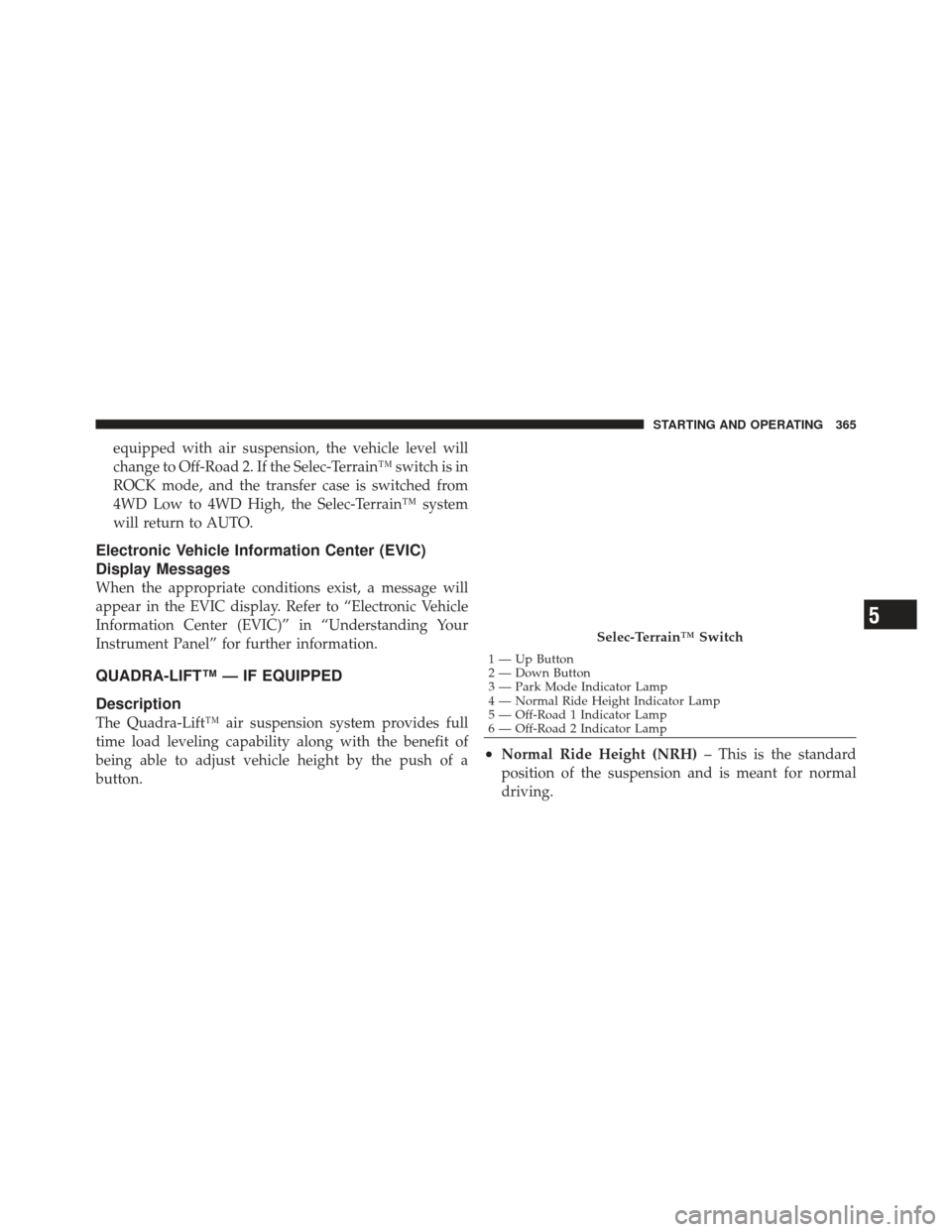
•Normal Ride Height (NRH)– This is the standard
position of the suspension and is meant for normal
driving.
Selec-Terrain™ Switch
1 — Up Button
2 — Down Button
3 — Park Mode Indicator Lamp
4 — Normal Ride Height Indicator Lamp
5 — Off-Road 1 Indicator Lamp
6 — Off-Road 2 Indicator Lamp
5
STARTING AND OPERATING 365
Page 370 of 587

To assist with changing a spare tire, the Quadra-Lift™ air
suspension system has a feature which allows the auto-
matic leveling to be disabled. Press and hold both the
“Up” and “Down” buttons simultaneously between 5 and
10 seconds, a message will appear in the EVIC stating
leveling has been disabled immediately after both buttons
have been released. Refer to “Electronic Vehicle Informa-
tion Center (EVIC)” in “Understanding Your Instrument
Panel” for further information. Driving the vehicle over
5 mph (8 km/h) will return the air suspension to normal
operation. Refer to “Jacking and Tire Changing” in “What
To Do In Emergencies” for further information.
WARNING!
The air suspension system uses a high pressure
volume of air to operate the system. To avoid per-
sonal injury or damage to the system, see your
authorized dealer for service.
Electronic Vehicle Information Center (EVIC)
Display Messages
When the appropriate conditions exist, a message will
appear in the EVIC display. Refer to “Electronic Vehicle
Information Center (EVIC)” in “Understanding Your
Instrument Panel” for further information.
An audible chime will be heard whenever a system error
has been detected.
Operation
The indicator lamps 3 through 6 will illuminate to show
the current position of the vehicle. Flashing indicator
lamps will show a position which the system is working
to achieve. When raising, if multiple indicator lamps are
flashing on the “Up” button, the highest flashing indica-
tor lamp is the position the system is working to achieve.
When lowering, if multiple indicators are flashing on the
�Up�button the lowest solid indicator lamp is the posi-
tion the system is working to achieve.
368 STARTING AND OPERATING
Page 372 of 587

(24 km/h) indicator lamp 4 will turn off and indicator
lamp 3 will flash until Park Mode is achieved at which
point indicator lamp 3 will go solid. If during the
height change to Park Mode, the vehicle speed exceeds
15 mph (24 km/h), the height change will be paused
until the vehicle speed either goes below 15 mph
(24 km/h) and the height change continues to Park
Mode, or exceeds 25 mph (40 km/h) and the vehicle
height will return to NRH. Park Mode may be selected
while the vehicle is not moving provided that the
engine is still running and all doors remain closed.
ON-ROAD DRIVING TIPS
Utility vehicles have higher ground clearance and a
narrower track to make them capable of performing in a
wide variety of off-road applications. Specific design
characteristics give them a higher center of gravity than
ordinary cars.An advantage of the higher ground clearance is a better
view of the road, allowing you to anticipate problems.
They are not designed for cornering at the same speeds as
conventional two-wheel drive vehicles any more than
low-slung sports cars are designed to perform satisfacto-
rily in off-road conditions. If at all possible, avoid sharp
turns or abrupt maneuvers. As with other vehicles of this
type, failure to operate this vehicle correctly may result in
loss of control or vehicle rollover.
OFF-ROAD DRIVING TIPS
NOTE:
Prior to off-road driving, remove the front air
dam to prevent damage. The front air dam is attached to
the lower front fascia with seven quarter turn fasteners
and can be removed by hand.
370 STARTING AND OPERATING
Page 407 of 587
CAUTION!
After inspecting or adjusting the tire pressure, al-
ways reinstall the valve stem cap. This will prevent
moisture and dirt from entering the valve stem,
which could damage it.
Inflation pressures specified on the placard are always
cold tire inflation pressure. Cold tire inflation pressure is
defined as the tire pressure after the vehicle has not been
driven for at least three hours, or driven less than 1 mile
(1.6 km) after a three-hour period. The cold tire inflation
pressure must not exceed the maximum inflation pres-
sure molded into the tire sidewall.
Check tire pressures more often if subject to a wide range
of outdoor temperatures, as tire pressures vary with
temperature changes. Tire pressures change by approximately 1 psi (7 kPa) per
12°F (7°C) of air temperature change. Keep this in mind
when checking tire pressure inside a garage, especially in
the winter.
Example: If garage temperature = 68°F (20°C) and the
outside temperature = 32°F (0°C) then the cold tire
inflation pressure should be increased by 3 psi (21 kPa),
which equals 1 psi (7 kPa) for every 12°F (7°C) for this
outside temperature condition.
Tire pressure may increase from 2 to 6 psi (13 to 40 kPa)
during operation. DO NOT reduce this normal pressure
build-up, or your tire pressure will be too low.
5
STARTING AND OPERATING 405
Page 411 of 587
your original equipment tire, replace (or repair) the
original equipment tire and reinstall on the vehicle at the
first opportunity.
WARNING!
Limited-use spares are for emergency use only. In-
stallation of this limited-use spare tire affects vehicle
handling. With this tire, do not drive more than the
speed listed on the limit-use spare wheel. Keep
inflated to the cold tire inflation pressure listed on
your Tire and Loading Information Placard located
on the driver ’s side door opening. Replace (or repair)
the original equipment tire at the first opportunity
and reinstall it on your vehicle. Failure to do so could
result in loss of vehicle control.
Tire Spinning
When stuck in mud, sand, snow, or ice conditions, do not
spin your vehicle’s wheels above 30 mph (48 km/h).
WARNING!
Fast spinning tires can be dangerous. Forces gener-
ated by excessive wheel speeds may cause tire dam-
age or failure. A tire could explode and injure some-
one. Do not spin your vehicle’s wheels faster than
30 mph (48 km/h) when you are stuck, and do not let
anyone near a spinning wheel no matter what the
speed.
5
STARTING AND OPERATING 409