Page 369 of 490

WARNING! (Continued)
•Towing any trailer will increase your stopping
distance. When towing you should allow for addi-
tional space between your vehicle and the vehicle
in front of you. Failure to do so could result in a
collision.
Towing Requirements – Trailer Lights And Wiring
Your authorized dealer offers a trailer wiring harness
designed specifically for your vehicle.
Whenever you pull a trailer, regardless of the trailer size,
stop lights and turn signals on the trailer are required for
motoring safety.
The Trailer Tow Package may include a four- and seven-
pin wiring harness. Use a factory approved trailer har-
ness and connector.
NOTE:Do not cut or splice wiring into the vehicles
wiring harness. The electrical connections are all complete to the vehicle
but you must mate the harness to a trailer connector.
Refer to the following illustrations.
Four-Pin Connector
1 — Female Pins
4 — Park
2 — Male Pin 5 — Left Stop/Turn
3 — Ground 6 — Right Stop/Turn
5
STARTING AND OPERATING 367
Page 370 of 490
Towing Tips
Before setting out on a trip, practice turning, stopping
and backing the trailer in an area away from heavy
traffic.
Manual Transmission – If Equipped
If using a manual transmission vehicle for trailer towing,
all starts must be in first gear to avoid excessive clutch
slippage.
Seven-Pin Connector
1 — Battery5 — Ground
2 — Backup Lamps 6 — Left Stop/Turn
3 — Right Stop/Turn 7 — Running Lamps
4 — Electric Brakes
368 STARTING AND OPERATING
Page 371 of 490
Automatic Transmission – If Equipped
The automatic transmission fluid and filter should be
changed if you REGULARLY tow a trailer for more than
45 minutes of continuous operation. Refer to “Mainte-
nance Schedule” for the proper maintenance intervals.
Electronic Speed Control – If Equipped
Do not use in hilly terrain or with heavy loads.
When using the speed control, if you experience speed
drops greater than 10 mph (16 km/h), disengage until
you can get back to cruising speed.
Use speed control in flat terrain and with light loads to
maximize fuel efficiency.
Cooling System
To reduce the potential for engine and transmission
overheating, take the following actions:
City Driving
When stopped for short periods of time, shift the trans-
mission into NEUTRAL but do not increase engine idle
speed.
Highway Driving
Reduce speed.
Air Conditioning
Turn off temporarily.
5
STARTING AND OPERATING 369
Page 372 of 490
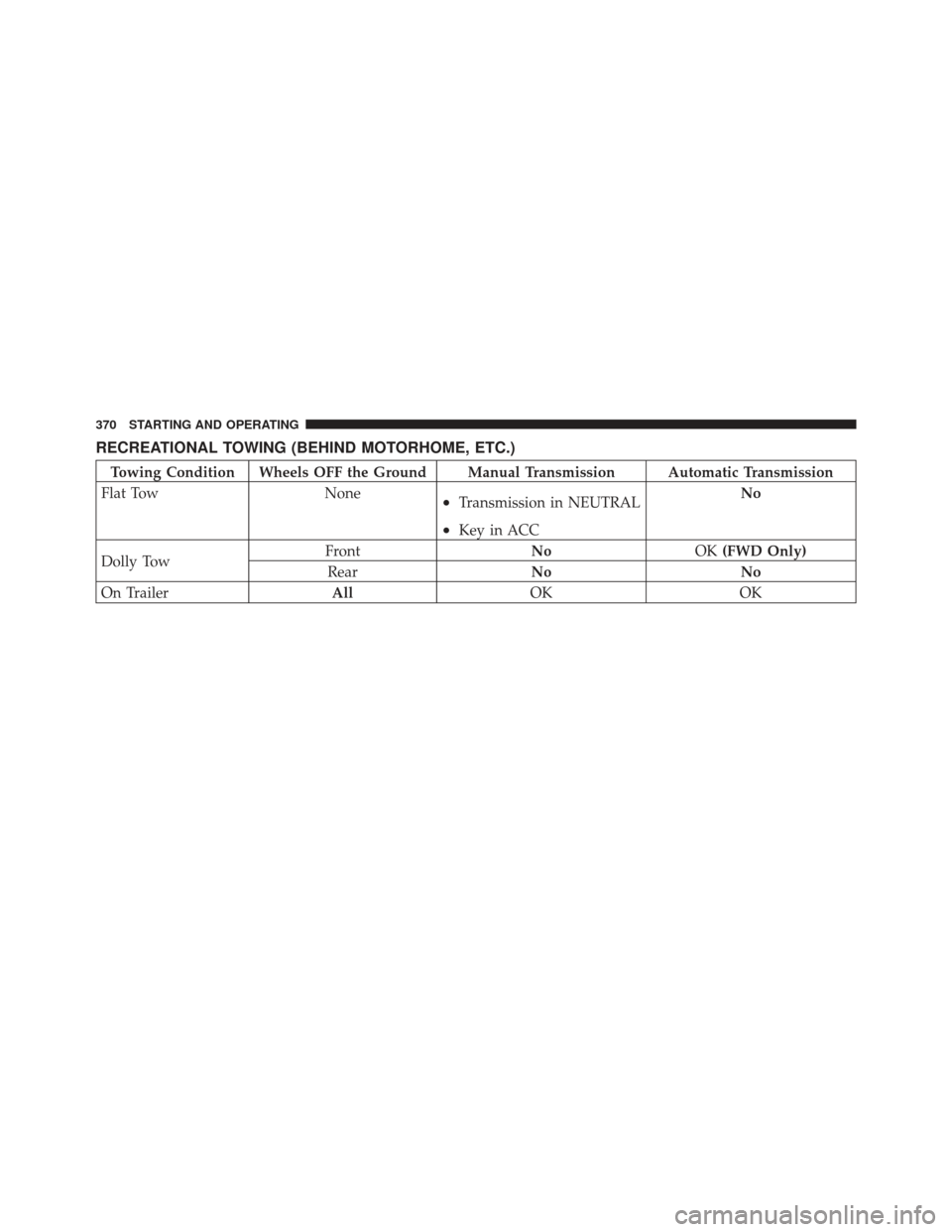
RECREATIONAL TOWING (BEHIND MOTORHOME, ETC.)
Towing Condition Wheels OFF the Ground Manual Transmission Automatic Transmission
Flat Tow None
•Transmission in NEUTRAL
•Key in ACC No
Dolly Tow Front
NoOK(FWD Only)
Rear No No
On Trailer AllOK OK
370 STARTING AND OPERATING
Page 373 of 490
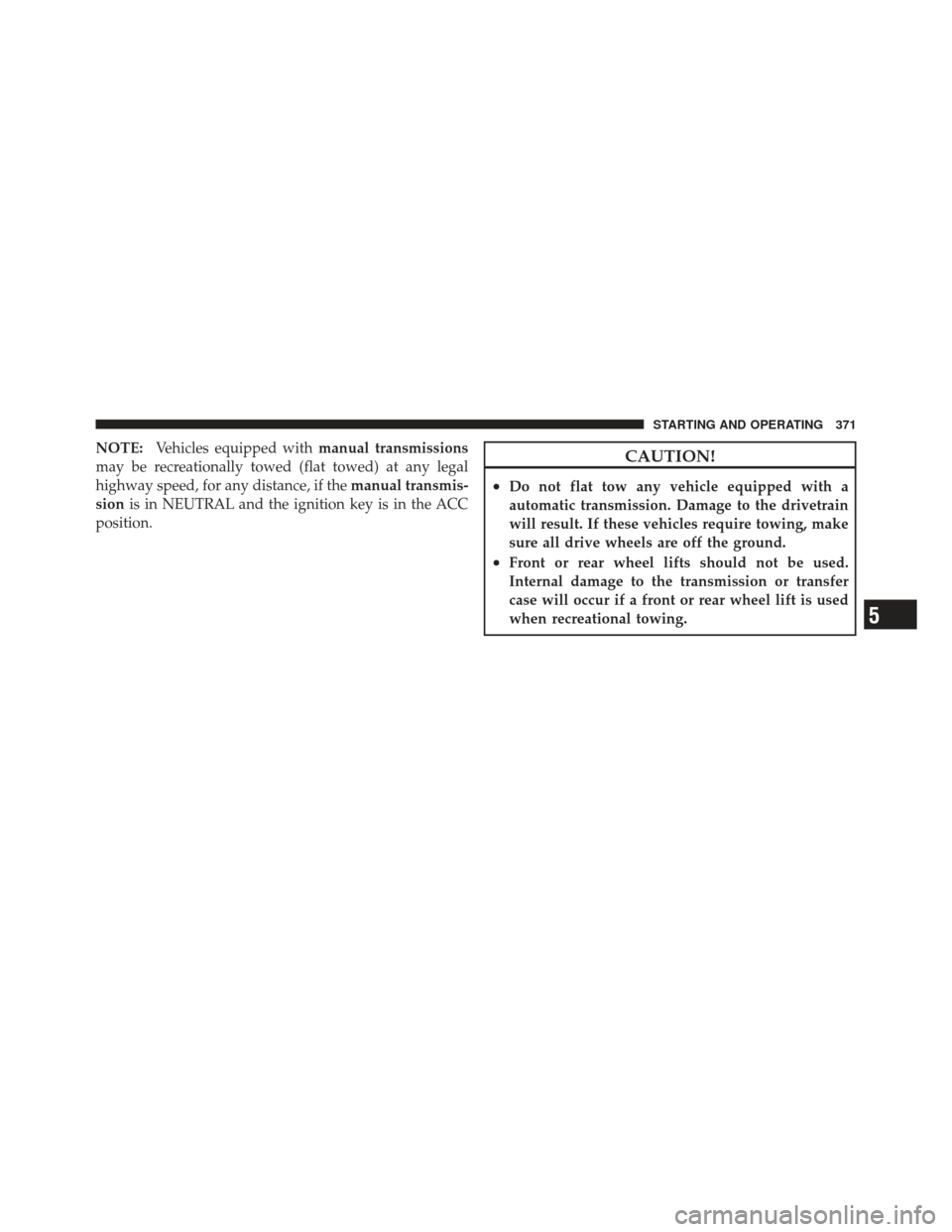
NOTE:Vehicles equipped with manual transmissions
may be recreationally towed (flat towed) at any legal
highway speed, for any distance, if the manual transmis-
sion is in NEUTRAL and the ignition key is in the ACC
position.CAUTION!
•Do not flat tow any vehicle equipped with a
automatic transmission. Damage to the drivetrain
will result. If these vehicles require towing, make
sure all drive wheels are off the ground.
•Front or rear wheel lifts should not be used.
Internal damage to the transmission or transfer
case will occur if a front or rear wheel lift is used
when recreational towing.
5
STARTING AND OPERATING 371
Page 375 of 490
WHAT TO DO IN EMERGENCIES
CONTENTS
�Hazard Warning Flashers ................ 374
� If Your Engine Overheats ................ 374
� Automatic Transmission Overheating ....... 375
� Jacking And Tire Changing ............... 376
▫ Jack Location ....................... 376
▫ Spare Tire Stowage ................... 377
▫ Preparations For Jacking ............... 377
▫ Jacking Instructions ................... 378
▫ Road Tire Installation ................. 383 �
Jump-Starting Procedures ................ 384
▫ Preparations For Jump-Start ............. 385
▫ Jump-Starting Procedure ............... 387
� Freeing A Stuck Vehicle ................. 389
� Shift Lever Override ................... 390
� Towing A Disabled Vehicle ............... 391
▫ With Ignition Key .................... 391
▫ Without The Ignition Key .............. 393
6
Page 377 of 490

CAUTION!
Driving with a hot cooling system could damage
your vehicle. If the pointer rises to the H (red) mark,
the instrument cluster will sound a chime. When
safe, pull over and stop the vehicle with the engine at
idle. Turn off the air conditioning and wait until the
pointer drops back into the normal range. If the
pointer remains on the H (red) mark for more than a
minute, turn the engine off immediately and call for
service.
WARNING!
You or others can be badly burned by hot engine
coolant (antifreeze) or steam from your radiator. If
you see or hear steam coming from under the hood,
do not open the hood until the radiator has had time
to cool. Never try to open a cooling system pressure
cap when the radiator or coolant bottle is hot.
AUTOMATIC TRANSMISSION OVERHEATING
During sustained high speed driving or trailer towing up
long grades on hot days, the automatic transmission oil
may become too hot.If this happens, the transmission overheat in-
dicator light will come on, and the vehicle will
slow slightly until the automatic transmission
cools down enough to allow a return to the
requested speed. If the high speed is maintained, the
overheating may reoccur, as before, in a cyclic fashion.6
WHAT TO DO IN EMERGENCIES 375
Page 378 of 490
JACKING AND TIRE CHANGING
WARNING!
•Do not attempt to change a tire on the side of the
vehicle close to moving traffic. Pull far enough off
the road to avoid the danger of being hit when
operating the jack or changing the wheel.
•Being under a jacked-up vehicle is dangerous. The
vehicle could slip off the jack and fall on you. You
could be crushed. Never put any part of your body
under a vehicle that is on a jack. If you need to get
under a raised vehicle, take it to a service center
where it can be raised on a lift.
•Never start or run the engine while the vehicle is
on a jack.(Continued)
WARNING! (Continued)
•The jack is designed to be used as a tool for
changing tires only. The jack should not be used to
lift the vehicle for service purposes. The vehicle
should be jacked on a firm level surface only.
Avoid ice or slippery areas.
Jack Location
The jack and jack-handle are stowed under the load floor
in the cargo area.
376 WHAT TO DO IN EMERGENCIES