Page 295 of 490

Use each gear in numerical order, do not skip a gear. Be
sure the transmission is in first gear, (not third), when
starting from a standing position. Damage to the clutch
can result from starting in third gear.
For most city driving, you will find it easier to use only
the lower gears. For steady highway driving with light
accelerations, fifth gear is recommended.
Never drive with your foot resting on the clutch pedal,
and never try to hold the vehicle on a hill with the clutch
pedal partially engaged. This will cause abnormal wear
on the clutch.
Never shift into REVERSE until the vehicle has come to a
complete stop.
NOTE:During cold weather, until the transmission
lubricant is warm, you may experience slightly higher
shift efforts. This is normal and not harmful to the
transmission.Recommended Shift Speeds
To use your manual transmission for optimal fuel
economy, it should be upshifted as listed in the following
table.
Manual Transmission Recommended Shift Speeds
Units in mph (km/h)
Engine Size Accel-
eration Rate 1to2 2to3 3to4 4to5
All En- gines Accel 14 (23) 23 (37) 29 (47) 45 (72)
Cruise 12 (19) 18 (29) 25 (40) 32 (52)
Downshifting
Proper downshifting will improve fuel economy and
prolong engine life.
5
STARTING AND OPERATING 293
Page 300 of 490

DRIVE
This range is used for most city and highway driving.
AUTOSTICK�— IF EQUIPPED
AutoStick�is a driver-interactive transmission that offers
six manual ratio changes to provide you with more
control. AutoStick� allows you to maximize engine brak-
ing, eliminate undesirable upshifts and downshifts, and
improve overall vehicle performance. This system can
also provide you with more control during passing, city
driving, cold slippery conditions, mountain driving,
trailer towing, and many other situations. Automatic
ratio changes upward will only occur to protect the
Continuously Variable Automatic Transmission (CVT)
and/or the engine from overspeed. Changes down will
only happen at minimum engine speed to prevent stall-
ing.
Operation
NOTE: AutoStick� is not available until the CVT warms
up in cold weather.
AutoStick� operation is activated in the DRIVE position
by moving the shift lever side-to-side. Moving the shift
lever to the (+) side will activate AutoStick �and shift up
to the next higher manual ratio, unless you are already
operating in or near Overdrive, in which case sixth gear
ratio will be selected. In like manner, moving the shift
lever to (-) will activate AutoStick� and shift to the next
lower manual ratio. After AutoStick �is activated, the
manual ratio selected is displayed in the transmission
ratio display and tipping the shift lever to the (+) or (-)
direction will cause an upshift or downshift by one ratio.
298 STARTING AND OPERATING
Page 305 of 490
If necessary, add fluid to restore to the proper indicated
level. With a clean cloth, wipe any spilled fluid from all
surfaces. Refer to “Fluids, Lubricants, and Genuine
Parts” in “Maintaining Your Vehicle” for further
information.
PARKING BRAKE
Before leaving the vehicle, make sure that the parking
brake is fully applied. Also, be certain to leave an
automatic transmission in PARK, or manual transmission
in REVERSE or first gear.
The parking brake lever is located in the center console.
To apply the parking brake, pull the lever up as firmly as
possible. To release the parking brake, pull the lever up
slightly, press the center button, then lower the lever
completely.When the parking brake is applied with the ignition
switch in the ON position, the “Brake Warning Light” in
the instrument cluster will illuminate.
Parking Brake
5
STARTING AND OPERATING 303
Page 306 of 490
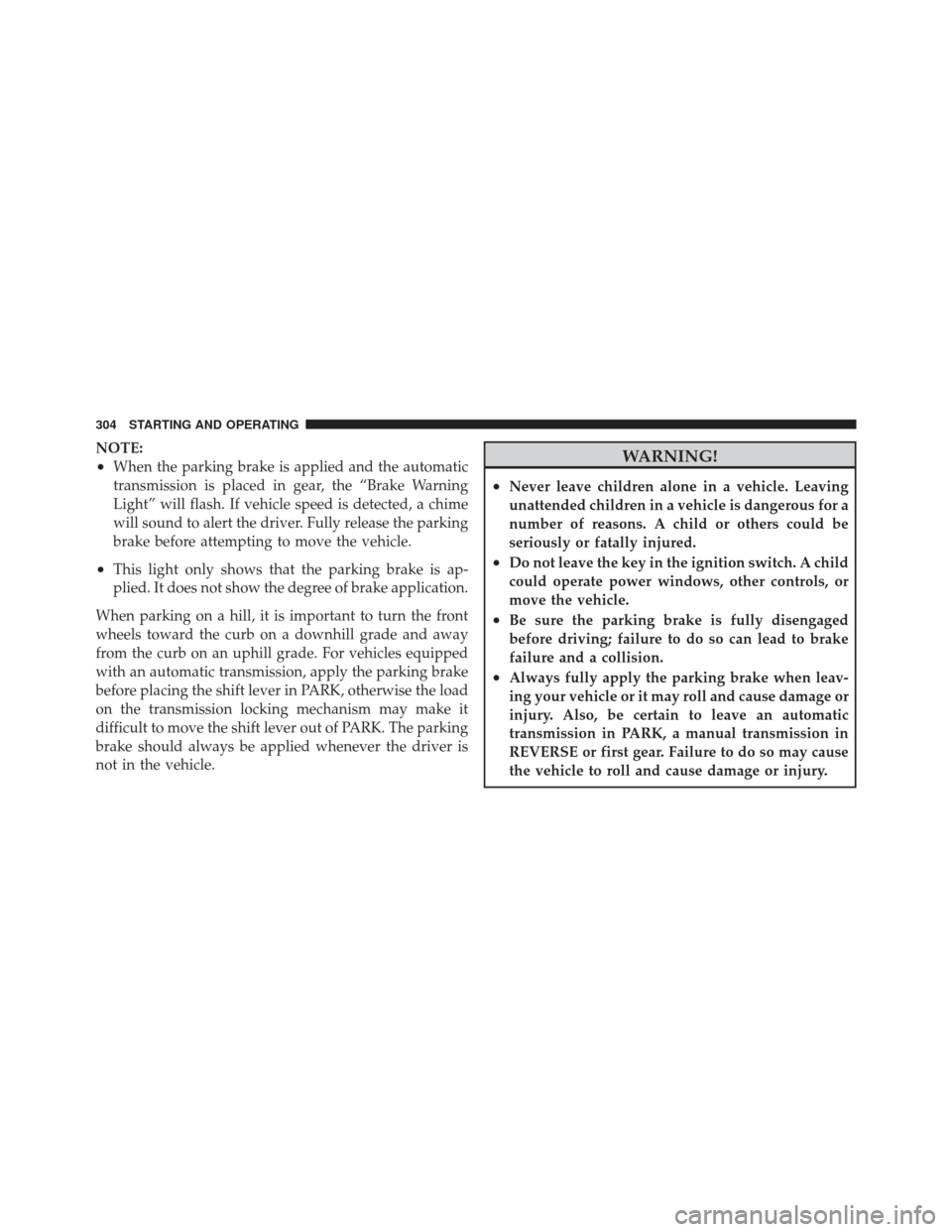
NOTE:
•When the parking brake is applied and the automatic
transmission is placed in gear, the “Brake Warning
Light” will flash. If vehicle speed is detected, a chime
will sound to alert the driver. Fully release the parking
brake before attempting to move the vehicle.
•This light only shows that the parking brake is ap-
plied. It does not show the degree of brake application.
When parking on a hill, it is important to turn the front
wheels toward the curb on a downhill grade and away
from the curb on an uphill grade. For vehicles equipped
with an automatic transmission, apply the parking brake
before placing the shift lever in PARK, otherwise the load
on the transmission locking mechanism may make it
difficult to move the shift lever out of PARK. The parking
brake should always be applied whenever the driver is
not in the vehicle.
WARNING!
•Never leave children alone in a vehicle. Leaving
unattended children in a vehicle is dangerous for a
number of reasons. A child or others could be
seriously or fatally injured.
•Do not leave the key in the ignition switch. A child
could operate power windows, other controls, or
move the vehicle.
•Be sure the parking brake is fully disengaged
before driving; failure to do so can lead to brake
failure and a collision.
•Always fully apply the parking brake when leav-
ing your vehicle or it may roll and cause damage or
injury. Also, be certain to leave an automatic
transmission in PARK, a manual transmission in
REVERSE or first gear. Failure to do so may cause
the vehicle to roll and cause damage or injury.
304 STARTING AND OPERATING
Page 314 of 490

HDC has the capability to sense terrain and will only
activate when the vehicle is descending a hill. It will not
activate on level ground. If desired, HDC can be fully
deactivated by putting the vehicle into ESC “Full Off”
mode. This is done by pressing and holding the “ESC
Off” button for five seconds. Refer to “Electronic Stability
Control (ESC)” in this section of the manual.
HDC operation can be overridden with brake application
to slow the vehicle down below the HDC control speed.
Conversely, if more speed is desired during HDC control,
the accelerator pedal will increase vehicle speed like
normal. When either the brake or the accelerator is
released, HDC will control the vehicle back to the origi-
nal set speed.
HDC is only intended for low speed off-road driving. At
vehicle speeds above 31 mph (50 km/h) HDC will no
longer function. If the “HDC Indicator Light” begins to
flash this indicates that the brakes are getting too hot and
the vehicle should be stopped to allow the brakes to cool.WARNING!
HDC is only intended to assist the driver in control-
ling vehicle speed when descending hills. The driver
must remain attentive to the driving conditions and
is responsible for maintaining a safe vehicle speed.
Hill Start Assist (HSA) – Manual Transmission
Only
The HSA system is designed to assist the driver when
starting a vehicle from a stop on a hill. HSA will maintain
the level of brake pressure the driver applied for a short
period of time after the driver takes their foot off of the
brake pedal. If the driver does not apply the throttle
during this short period of time, the system will release
brake pressure and the vehicle will roll down the hill. The
system will release brake pressure in proportion to
amount of throttle applied as the vehicle starts to move in
the intended direction of travel.
312 STARTING AND OPERATING
Page 370 of 490
Towing Tips
Before setting out on a trip, practice turning, stopping
and backing the trailer in an area away from heavy
traffic.
Manual Transmission – If Equipped
If using a manual transmission vehicle for trailer towing,
all starts must be in first gear to avoid excessive clutch
slippage.
Seven-Pin Connector
1 — Battery5 — Ground
2 — Backup Lamps 6 — Left Stop/Turn
3 — Right Stop/Turn 7 — Running Lamps
4 — Electric Brakes
368 STARTING AND OPERATING
Page 372 of 490
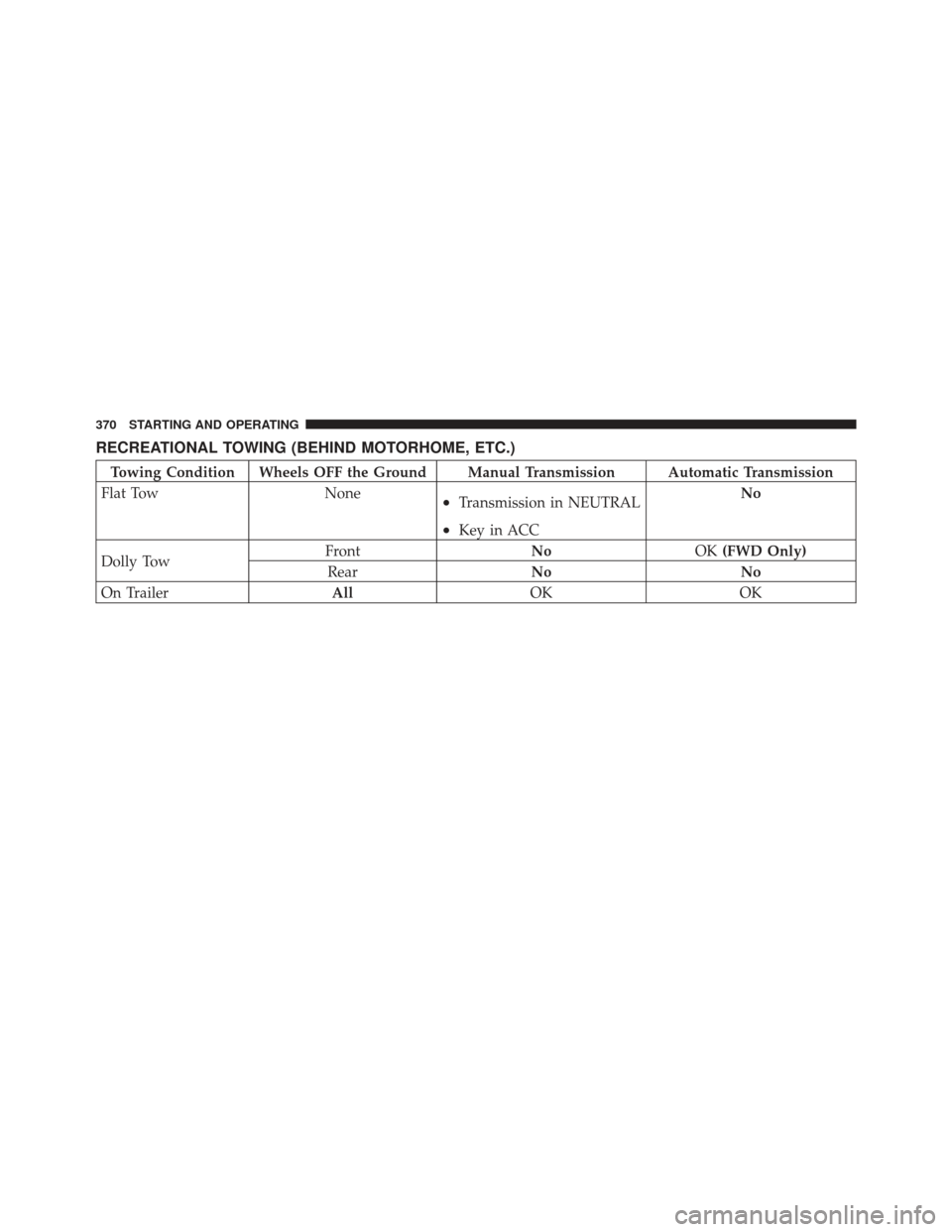
RECREATIONAL TOWING (BEHIND MOTORHOME, ETC.)
Towing Condition Wheels OFF the Ground Manual Transmission Automatic Transmission
Flat Tow None
•Transmission in NEUTRAL
•Key in ACC No
Dolly Tow Front
NoOK(FWD Only)
Rear No No
On Trailer AllOK OK
370 STARTING AND OPERATING
Page 373 of 490
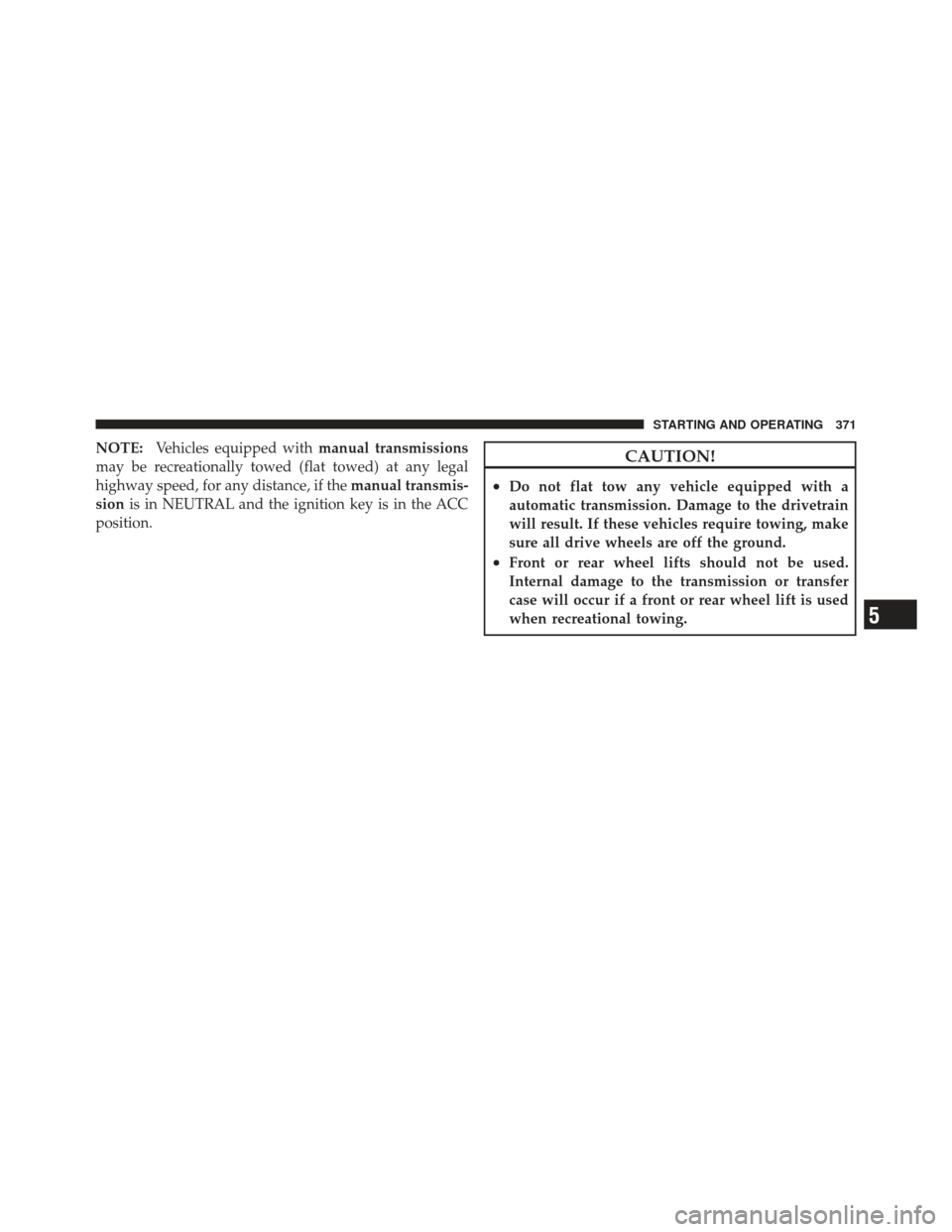
NOTE:Vehicles equipped with manual transmissions
may be recreationally towed (flat towed) at any legal
highway speed, for any distance, if the manual transmis-
sion is in NEUTRAL and the ignition key is in the ACC
position.CAUTION!
•Do not flat tow any vehicle equipped with a
automatic transmission. Damage to the drivetrain
will result. If these vehicles require towing, make
sure all drive wheels are off the ground.
•Front or rear wheel lifts should not be used.
Internal damage to the transmission or transfer
case will occur if a front or rear wheel lift is used
when recreational towing.
5
STARTING AND OPERATING 371