2011 JAGUAR XF Pin
[x] Cancel search: PinPage 170 of 225

L
(FM8) SEMCON JLR OWNER GUIDE VER 1.00 EURO
LANGUAGE: english-en; MARQUE: jaguar; MODEL: XF
Fluid level checks
170
Jaguar recommends:
TOPPING UP THE OIL
Overfilling with oil could result in severe
engine damage.
1. Unscrew the oil filler cap.
2. Add oil as indicated by the message centre
display.
3. Wait five minutes fo r the oil level to
stabilise then re-check.
It is essential to use the correct specification
oil, and to ensure it is suitable for the climatic
conditions in which the vehicle is to be
operated.
ENGINE OIL CONSUMPTION
A certain amount of oil consumption is normal.
The rate of consumpt ion will depend on the
following:
• The quality and viscosity of the oil.
• Climatic conditions.
• The speed at which the engine is being
operated.
• Road conditions.
Drivers should expect above normal
consumption when the engi ne is new, and after
running-in if high speeds are sustained.
CHECKING THE COOLANT LEVEL
Running the engine without coolant will
cause serious engine damage.
If persistent coolant loss is noticed,
seek qualified assistance immediately.
The coolant level in the expansion tank should
be checked at least weekly (more frequently in
high mileage or severe operating conditions).
Always check the level when the system is
cold.
Ensure the coolant level is maintained between
the level indicator marks, as shown in the
illustrations.
Diesel engines
Petrol engines
Page 171 of 225

R
(FM8) SEMCON JLR OWNER GUIDE VER 1.00 EURO
LANGUAGE: english-en; MARQUE: jaguar; MODEL: XF
Fluid level checks
171
If the message LOW COOLANT LEVEL is
displayed in the message centre, stop the
vehicle as soon as safe ty permits and top-up
the coolant reservoir with the recommended
antifreeze/water mix.
If the message centre displays the message
ENGINE OVERHEATING, pull off the
carriageway and allow the e ngine to idle for five
minutes and then switch off the ignition for ten
minutes. Switch on the engine and, provided
that the warning does not occur, continue your
journey, avoiding hars h acceleration. Seek
qualified assistance as soon as possible.
TOPPING UP THE COOLANT
Never remove the filler cap when the
engine is hot.
Antifreeze is highly inflammable. Do
not allow antifreeze to come into
contact with naked flames or other
sources of ignition (e.g. a hot engine)
- a fire may result.
Unscrew the filler cap slowly,
allowing the pressure to escape
before removing completely.
When travelling in territories where the
water supply contains salt, always
ensure you carry a supply of fresh (rain
or distilled) water. Topping up with salt
water will cause serious engine
damage.
Top-up to the upper le vel indicator mark
located on the side of the expansion tank. Use
only a 50% mix of water and antifreeze to
specification WSS M97B44 (coloured orange)
Extended Life Coolant.
Ensure the cap is tightened fully after top-up is
completed by turning the cap until the ratchet
cap clicks. Note:
In an emergency, if the approved
antifreeze is unavailable, top-up the system
with clean water, but be aware of the resultant
reduction in frost protection. Do not top-up or
refill with conventional an tifreeze formulations.
If in doubt consult a qualified technician.
BRAKE FLUID CHECK
Seek qualified assistance
immediately if brak e pedal travel is
unusually long, unusua lly short or if
there is any signific ant loss of brake
fluid. Driving under such conditions
could result in extended stopping
distances or complete brake failure.
Note: If the warning lamp illuminates or the
message is displayed while the vehicle is being
driven, stop the vehicle as soon as safety
permits by gently appl ying the brakes. Check
and top-up the fluid level if necessary.
Brake fluid is highly toxic - keep
containers sealed and out of the reach
of children. If accidental consumption
is suspected, seek medical attention
immediately.
If the fluid comes into contact with the
skin or eyes, rins e immediately with
plenty of water.
Brake fluid is highly inflammable. Do
not allow brake fluid to come into
contact with naked flames or other
sources of ignition (e.g. a hot engine).
If the quantity of fluid in the brake
reservoir drops below the
recommended level, a red warning
lamp in the inst rument panel will
illuminate and the message Brake
Fluid Low will be displayed in the
message centre.
Page 172 of 225
L
(FM8) SEMCON JLR OWNER GUIDE VER 1.00 EURO
LANGUAGE: english-en; MARQUE: jaguar; MODEL: XF
Fluid level checks
172
Do not drive the vehi cle with the fluid
level below the MIN mark.
With the vehicle on level ground, check the
fluid level at least every week (more frequently
in high mileage or arduous operating
conditions).
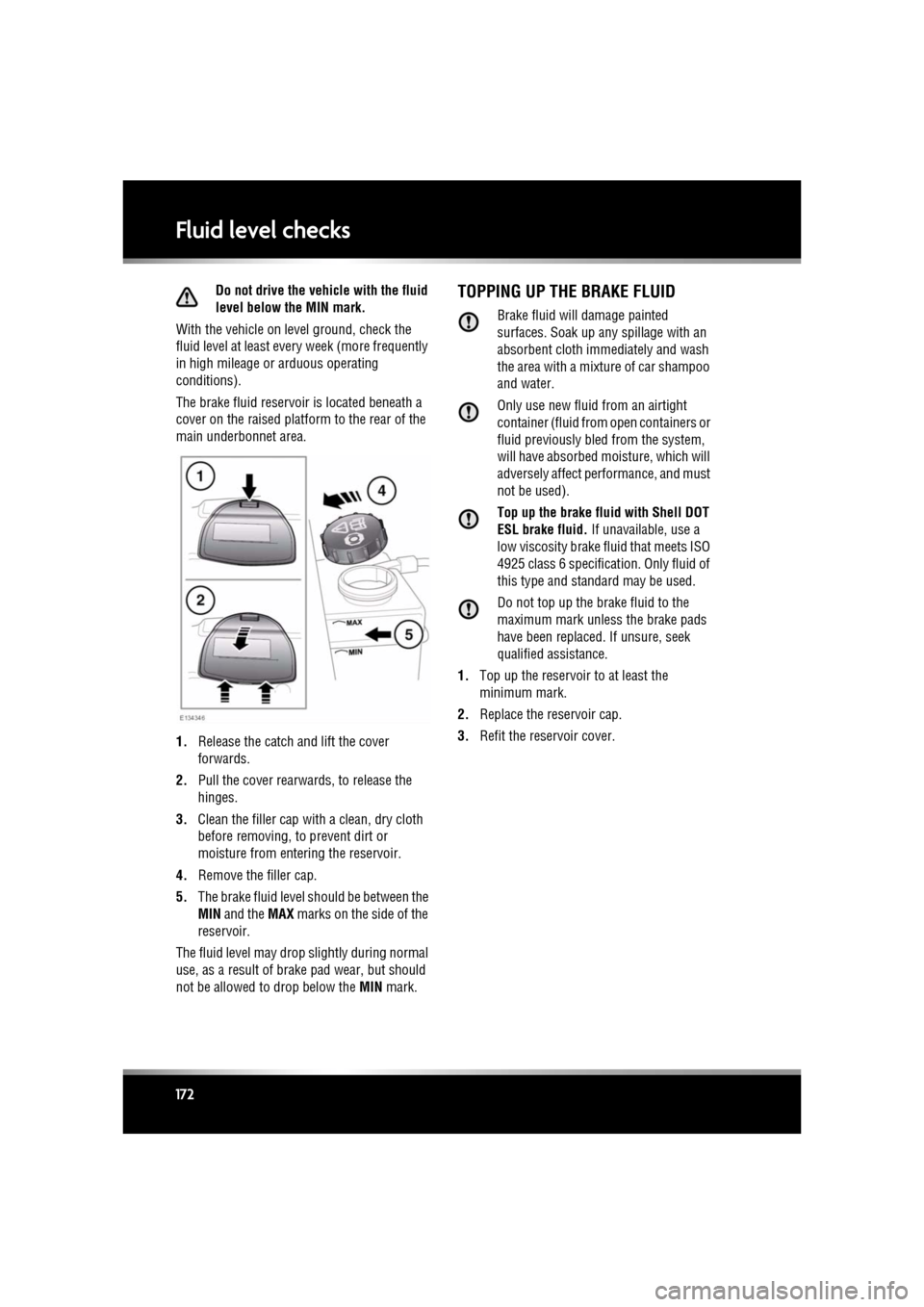
The brake fluid reservoi r is located beneath a
cover on the raised platform to the rear of the
main underbonnet area.
1. Release the catch and lift the cover
forwards.
2. Pull the cover rearwards, to release the
hinges.
3. Clean the filler cap with a clean, dry cloth
before removing, to prevent dirt or
moisture from entering the reservoir.
4. Remove the filler cap.
5. The brake fluid level should be between the
MIN and the MAX marks on the side of the
reservoir.
The fluid level may drop slightly during normal
use, as a result of brake pad wear, but should
not be allowed to drop below the MIN mark.TOPPING UP THE BRAKE FLUID
Brake fluid will damage painted
surfaces. Soak up any spillage with an
absorbent cloth immediately and wash
the area with a mixture of car shampoo
and water.
Only use new fluid from an airtight
container (fluid from open containers or
fluid previously bled from the system,
will have absorbed moisture, which will
adversely affect performance, and must
not be used).
Top up the brake fluid with Shell DOT
ESL brake fluid. If unavailable, use a
low viscosity brake fluid that meets ISO
4925 class 6 specificat ion. Only fluid of
this type and standard may be used.
Do not top up the brake fluid to the
maximum mark unless the brake pads
have been replaced. If unsure, seek
qualified assistance.
1. Top up the reservoir to at least the
minimum mark.
2. Replace the reservoir cap.
3. Refit the reservoir cover.
Page 173 of 225

R
(FM8) SEMCON JLR OWNER GUIDE VER 1.00 EURO
LANGUAGE: english-en; MARQUE: jaguar; MODEL: XF
Fluid level checks
173
POWER STEERING FLUID CHECK
Power steering fluid is highly toxic.
Keep containers sealed and out of
reach of children. If accidental
consumption of fluid is suspected,
seek medical atte ntion immediately.
If the fluid comes into contact with the
skin or eyes, rinse immediately with
plenty of water.
Power steering fluid is highly
inflammable. Do not allow power
steering fluid to come into contact
with naked flames or other sources of
ignition (e.g. a hot engine).
The engine must not be started if the
fluid level has dropped below the MIN
mark.
Seek qualified assistance immediately if
there is a noticeable drop in the fluid
level.
If fluid loss is slow, the reservoir may
be topped-up to the upper level mark to
enable the vehicle to be driven to a
repair facility for examination. However,
it is recommended that you seek
qualified assistance before driving the
vehicle.
Check and top-up the flui d with the vehicle on
level ground, with the e ngine switched off and
the system cold. Ensure that the steering wheel
is not turned after stopping the engine.
The level of fluid can be seen through the
translucent body of the reservoir.
The fluid level should be between the MIN and
the MAX marks.
TOPPING UP THE POWER STEERING
FLUID
It is imperative that the power steering
system does not become contaminated
in any way. Always use new fluid and
clean the area around the filler neck
both before removing the filler cap and
after topping up. Never return drained
fluid to the system.
Power steering fluid will damage
painted surfaces. Soak up any spillage
with an absorbent cloth immediately
and wash the area with a mixture of car
shampoo and water.
1. Clean the filler cap before removing to
prevent dirt from entering the reservoir.
2. Remove filler cap.
3. Using Mobil ATF320 PAS fluid, top-up the
reservoir until the fluid level is between the
MIN and MAX marks.
4. Replace filler cap.
Page 174 of 225

L
(FM8) SEMCON JLR OWNER GUIDE VER 1.00 EURO
LANGUAGE: english-en; MARQUE: jaguar; MODEL: XF
Fluid level checks
174
CHECKING THE WASHER FLUID
Do not allow screen washer fluid to
come into contact with naked flames
or sources of ignition.
If the vehicle is operated in
temperatures below 4°C (40°F), use a
washer fluid with frost protection.
Only use approved washer fluid.
Take care to avoid spillage, particularly
if an undiluted or high concentration is
being used. If spillage occurs, wash the
affected area immediately with water.
The washer reservoir supplies the windscreen
and headlamp washer jets.
Check and top-up the reservoir level at least
every week.
Fill with Jaguar Windscreen Washer Fluid,
diluted with clean water, as specified in the
instructions on the bottle. Using a
non-approved fluid may adversely affect the
wiper blade rubber, result ing in ineffectual and
noisy wiping.
Operate the washers periodically to check that
the nozzles are clear and properly directed.
TOPPING UP THE WASHER FLUID
1. Clean the filler cap before opening to
prevent dirt from entering the reservoir.
2. Open filler cap.
3. Top-up the reservoir until the fluid is visible
in the filler neck.
4. Close filler cap.
Page 179 of 225

R
(FM8) SEMCON JLR OWNER GUIDE VER 1.00 EURO
LANGUAGE: english-en; MARQUE: jaguar; MODEL: XF
Technical specifications
179
CAPACITIES
The quoted capacities are approximate and
provided as a guide only. All levels must be
checked using the level marks or information
displayed in the message centre, as applicable. Item Variant Capacity
Fuel tank (usable) Diesel
68.1 litres (15 gallons)
Petrol 69.5 litres (15.3 gallons)
Fuel capacity (when the fuel gauge
indicates empty) Diesel 64 litres (14.1 gallons)
Petrol 64 litres (14.1 gallons)
Reserve capacity (when the fuel
gauge indicates empty) Diesel 5.5 litres (1.2 gallons)
Petrol 5.5 litres (1.2 gallons)
Engine oil refill and filter change I4 Diesel 5.86 litres (10.3 pints)
V6 Diesel 6.4 litres (11.3 pints)
V6 Petrol 6.5 litres (11.4 pints)
V8 Petrol 7.25 litres (12.8 pints)
Washer reservoir With headlamp wash 5.5 litres (9.7 pints)
Without headlamp wash 4.4 litres (7.7 pints)
Cooling system (fill from dry) I4 Diesel 11.56 litres (20.3 pints)
V6 Diesel 12.5 litres (22 pints)
V6 Petrol 9.25 litres (16.3 pints)
V8 Petrol (Normally Aspi rated) 12.5 litres (22 pints)
V8 Petrol (Supercharged ) 12.3 litres (21.6 pints)
Cooling system (service fill) I 4 Diesel8.2 litres (14.4 pints)
V6 Diesel 9.7 litres (17.1 pints)
V6 Petrol 7.42 litres (13.1 pints)
V8 Petrol (Normally Aspira ted) 7.5 litres (13.2 pints)
V8 Petrol (Supercharged) - both
drain points used 8.6 litres (15.1 pints)
Page 185 of 225

R
(FM8) SEMCON JLR OWNER GUIDE VER 1.00 EURO
LANGUAGE: english-en; MARQUE: jaguar; MODEL: XF
Tyres
185
TyresTYRE CARE
Do not drive the vehi cle if a tyre is
damaged, excessively worn, or
incorrectly inflated.
Avoid contaminating the tyres with
vehicle fluids as they may cause
damage to the tyre.
Avoid spinning the wheels. The forces
released can damage the structure of
the tyre and cause it to fail.
If wheel spin is unavoidable due to a
loss of traction (in deep snow, for
example), do not exceed 50 km/h (30
mph).
Do not exceed the maximum pressure
stated on the sidewall of the tyre.
TYRE PRESSURES
Never drive your vehicle if the tyre
pressures are incorrect.
Pressure checks should only be
carried out when the tyres are cold,
and the vehicle has been stationary
for more than three hours. A hot tyre at
or below recommended cold inflation
pressure is dangerously
under-inflated.
If the vehicle has been parked in
strong sunlight, or used in high
ambient temperatures, do not reduce
the tyre pressures. Move the vehicle
into the shade and allow the tyres to
cool before re-checking the
pressures.
CHECKING THE TYRE PRESSURES
The recommended tyre pressures are listed on
a label located in the driver’s door opening.
Check the tyres, including the spare, for
condition and pressure on a weekly basis and
before long journeys.
If tyre pressures are checked while the vehicle
is inside a protected covered area (e.g. a
garage) and subsequent ly driven in lower
outdoor temperatures, tyre under-inflation
could occur.
A slight pressure loss occurs naturally with
time. If this exceeds 0. 14 bar (2 psi, 14 kPa,)
per week, have the cause investigated and
rectified by qualified assistance.
If it is necessary to check tyre pressures when
the tyres are warm, you should expect the
pressures to have increased by up to 0.3 - 0.4
bar (4 - 6 psi, 30 - 40 kpa). Do not reduce the
tyre pressures to the cold inflation pressure
under these circumstances. Allow the tyres to
cool fully before ad justing the pressures.
TYRE VALVES
Keep the valve caps screwed down firmly to
prevent water or dirt entering the valve. Check
the valves for leaks when checking the tyre
pressures.
Page 187 of 225
R
(FM8) SEMCON JLR OWNER GUIDE VER 1.00 EURO
LANGUAGE: english-en; MARQUE: jaguar; MODEL: XF
Tyres
187
APPROVED WINTER TYRE SIZES
Front :
• Dunlop Wintersport M3 - 235/55R17 99H,
245/45R18 96V, 245/45R18 100V,
245/40R19 98V.
• W240 Pirelli Sotto Zero - 245/45R18 100V,
245/40R19 98V, 255/35R20 97V.
Rear:
• Dunlop Wintersport M3 - 235/55R17 99H,
245/45R18 96V, 245/45R18 100V,
245/40R19 98V.
• W240 Pirelli Sotto Zero - 245/45R18 100V,
245/40R19 98V, 285/30R20 97V.
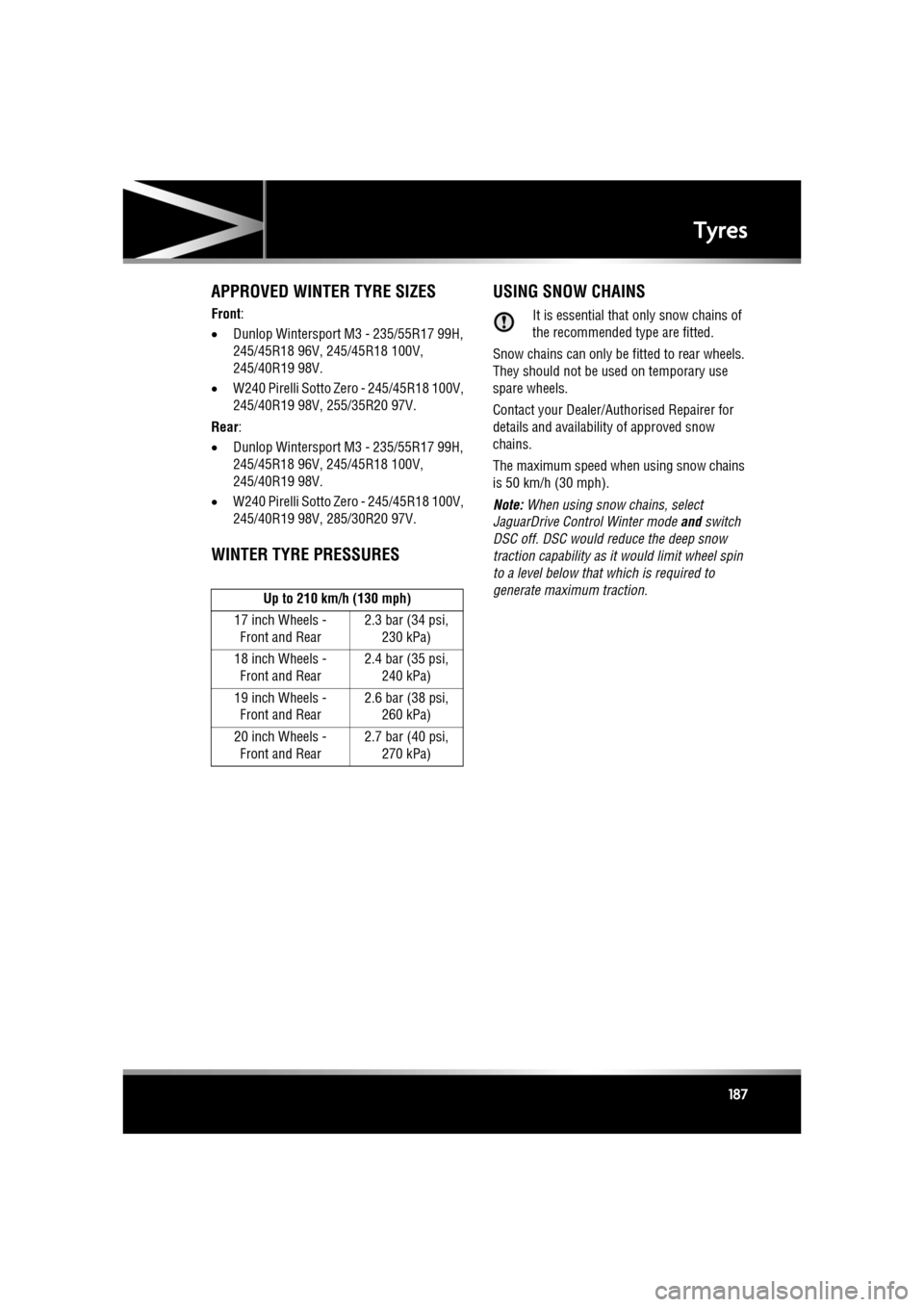
WINTER TYRE PRESSURES USING SNOW CHAINS
It is essential that
only snow chains of
the recommended type are fitted.
Snow chains can only be fitted to rear wheels.
They should not be used on temporary use
spare wheels.
Contact your Dealer/Authorised Repairer for
details and availabilit y of approved snow
chains.
The maximum speed when using snow chains
is 50 km/h (30 mph).
Note: When using snow chains, select
JaguarDrive Contro l Winter mode and switch
DSC off. DSC would reduce the deep snow
traction capability as it would limit wheel spin
to a level below that which is required to
generate maximum traction.
Up to 210 km/h (130 mph)
17 inch Wheels - Front and Rear 2.3 bar (34 psi,
230 kPa)
18 inch Wheels - Front and Rear 2.4 bar (35 psi,
240 kPa)
19 inch Wheels - Front and Rear 2.6 bar (38 psi,
260 kPa)
20 inch Wheels - Front and Rear 2.7 bar (40 psi,
270 kPa)