Page 27 of 488
To raise the head restraint, pull it up.To lower, push and hold the lock knob and push
the head restraint down.Removal
Use the following procedure to remove the
adjustable head restraints.
1. Pull the head restraint up to the highest position.
2. Push and hold the lock knob.
3. Remove the head restraint from the seat.
4. Store the head restraint properly in a secure place so it is not loose in the
vehicle.
Reinstall and properly adjust the head restraint
before an occupant uses the seating position.
SSS0993SSS0994SSS0995
1-6Safety — Seats, seat belts and supplemental restraint system
�—
—
01/11/10—pattie
�
Page 28 of 488

Install
1. Align the head restraint stalks with theholes in the seat. Make sure that the head
restraint is facing the correct direction.
The stalk with the adjustment notches
�1
must be installed in the hole with the lock
knob
�2.
2. Push and hold the lock knob and push the head restraint down.
3. Properly adjust the head restraint before an occupant uses the seating position.
Front-seat Active Head Restraints
The Active Head Restraint moves forward utiliz-
ing the force that the seatback receives from
the occupant in a rear-end collision. The move-
ment of the head restraint helps support the
occupant’s head by reducing its backward
movement and helping absorb some of the
forces that may lead to whiplash-type injuries.
Active Head Restraints are effective for colli-
sions at low to medium speeds in which it is
said that whiplash-type injury occurs most.
Active Head Restraints operate only in certain
rear-end collisions. After the collision, the head
restraints return to their original positions. Adjust the Active Head Restraints properly as
described earlier in this section.
ADJUSTABLE HEADRESTS
WARNING
The adjustable headrests supplement the
other vehicle safety systems. They may provide
additional protection against injury in certain
rear end collisions. Adjust the headrest prop-
erly, as specified in this section. Check the ad-
justment after someone else uses the seat. Do
not attach anything to the headrest stalks or
remove the headrest. Do not use the seat if the
headrest has been removed. If the headrest
was removed, install and properly adjust the
headrest before an occupant uses the seating
position. Failure to follow these instructions
can reduce the effectiveness of the headrests.
This may increase the risk of serious injury or
death in a collision.
SSS0996SSS0508
Safety — Seats, seat belts and supplemental restraint system1-7
�—
—
01/11/10—pattie
�
Page 29 of 488
The illustration shows the seating positions
equipped with adjustable headrests.
Indicates the seating position is
equipped with an adjustable headrest.
Components
1. Adjustable headrest
2. Adjustment notches
3. Lock knob
4. Stalks
Adjustment
Adjust the headrest so the center is level with
the center of your ears.
SSS1015SSS0992SSS0997
1-8Safety — Seats, seat belts and supplemental restraint system
�—
—
01/11/10—pattie
�
Page 30 of 488
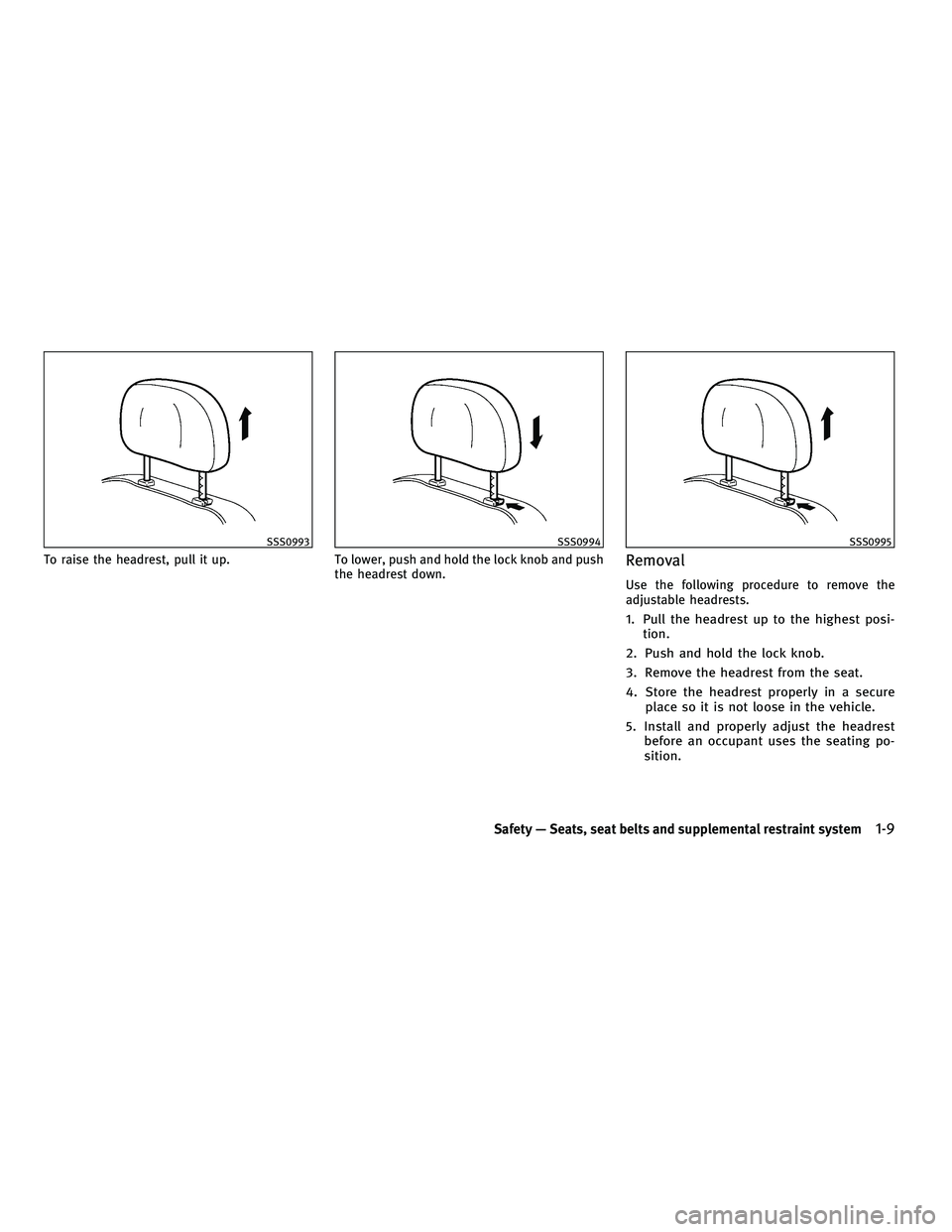
To raise the headrest, pull it up.To lower, push and hold the lock knob and push
the headrest down.Removal
Use the following procedure to remove the
adjustable headrests.
1. Pull the headrest up to the highest posi- tion.
2. Push and hold the lock knob.
3. Remove the headrest from the seat.
4. Store the headrest properly in a secure place so it is not loose in the vehicle.
5. Install and properly adjust the headrest before an occupant uses the seating po-
sition.
SSS0993SSS0994SSS0995
Safety — Seats, seat belts and supplemental restraint system1-9
�—
—
01/11/10—pattie
�
Page 31 of 488
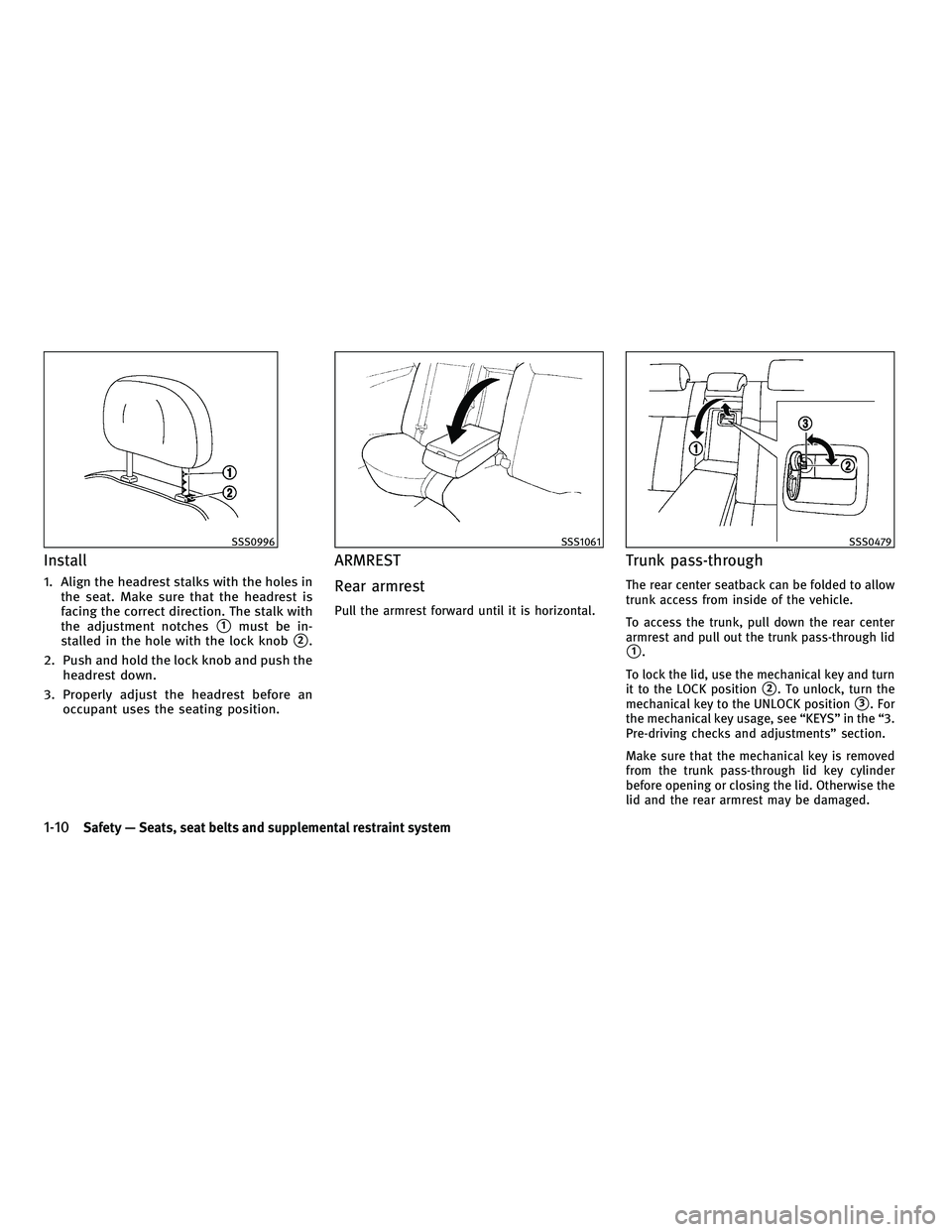
Install
1. Align the headrest stalks with the holes inthe seat. Make sure that the headrest is
facing the correct direction. The stalk with
the adjustment notches
�1must be in-
stalled in the hole with the lock knob
�2.
2. Push and hold the lock knob and push the headrest down.
3. Properly adjust the headrest before an occupant uses the seating position.
ARMREST
Rear armrest
Pull the armrest forward until it is horizontal.
Trunk pass-through
The rear center seatback can be folded to allow
trunk access from inside of the vehicle.
To access the trunk, pull down the rear center
armrest and pull out the trunk pass-through lid
�1.
To lock the lid, use the mechanical key and turn
it to the LOCK position
�2. To unlock, turn the
mechanical key to the UNLOCK position
�3. For
the mechanical key usage, see “KEYS” in the “3.
Pre-driving checks and adjustments” section.
Make sure that the mechanical key is removed
from the trunk pass-through lid key cylinder
before opening or closing the lid. Otherwise the
lid and the rear armrest may be damaged.
SSS0996SSS1061SSS0479
1-10Safety — Seats, seat belts and supplemental restraint system
�—
—
01/11/10—pattie
�
Page 32 of 488
PRECAUTIONS ON SEAT BELT USAGE
If you are wearing your seat belt properly
adjusted, and you are sitting upright and well
back in your seat with both feet on the floor,
your chances of being injured or killed in an
accident and/or the severity of injury may be
greatly reduced. INFINITI strongly encourages
you and all of your passengers to buckle up
every time you drive, even if your seating
position includes a supplemental air bag.
Most U.S. states and Canadian provinces or ter-
ritories specify that seat belts be worn at all
times when a vehicle is being driven.
SSS0136A
SSS0134A
SEAT BELTS
Safety — Seats, seat belts and supplemental restraint system1-11
�—
—
01/11/10—pattie
�
Page 33 of 488

WARNING
●Every person who drives or rides in this ve-
hicle should use a seat belt at all times. Chil-
dren should be properly restrained in the
rear seat and, if appropriate, in a child
restraint.
● The seat belt should be properly adjusted to
a snug fit. Failure to do so may reduce the
effectiveness of the entire restraint system
and increase the chance or severity of injury
in an accident. Serious injury or death can
occur if the seat belt is not worn properly.
● Always route the shoulder belt over your
shoulder and across your chest. Never run
the belt behind your back, under your arm or
across your neck. The belt should be away
from your face and neck, but not falling off
your shoulder.
● Position the lap belt as low and snug as
possible AROUND THE HIPS, NOT THE WAIST.
A lap belt worn too high could increase the
risk of internal injuries in an accident.
● Be sure the seat belt tongue is securely fas-
tened to the proper buckle.
● Do not wear the seat belt inside out or
twisted. Doing so may reduce its
effectiveness. ●
Do not allow more than one person to use the
same seat belt.
● Never carry more people in the vehicle than
there are seat belts.
● If the seat belt warning light glows continu-
ously while the ignition is turned ON with all
doors closed and all seat belts fastened, it
may indicate a malfunction in the system.
Have the system checked by an INFINITI
retailer.
● No changes should be made to the seat belt
system. For example, do not modify the seat
belt, add material or install devices that may
change the seat belt routing or tension. Do-
ing so may affect the operation of the seat
belt system. Modifying or tampering with
the seat belt system may result in serious
personal injury.
● Once a seat belt pretensioner has activated,
it cannot be reused and must be replaced
together with the retractor. See an INFINITI
retailer.
● Removal and installation of the pretensioner
seat belt system components should be
done by an INFINITI retailer. ●
All seat belt assemblies, including retractors
and attaching hardware, should be in-
spected after any collision by an INFINITI re-
tailer. INFINITI recommends that all seat belt
assemblies in use during a collision be re-
placed unless the collision was minor and
the belts show no damage and continue to
operate properly.
Seat belt assemblies not in use during a col-
lision should also be inspected and replaced
if either damage or improper operation is
noted.
● All child restraints and attaching hardware
should be inspected after any collision. Al-
ways follow the restraint manufacturer’s in-
spection instructions and replacement rec-
ommendations. The child restraints should
be replaced if they are damaged.
1-12Safety — Seats, seat belts and supplemental restraint system
�—
—
01/11/10—pattie
�
Page 34 of 488

PREGNANT WOMEN
INFINITI recommends that pregnant women use
seat belts. The seat belt should be worn snug,
and always position the lap belt as low as
possible around the hips, not the waist, and
place the shoulder belt over your shoulder and
across your chest. Never run the lap/shoulder
belt over your abdominal area. Contact your
doctor for specific recommendations.
INJURED PERSONS
INFINITI recommends that injured persons use
seat belts, depending on the injury. Check with
your doctor for specific recommendations.
PRE-CRASH SEAT BELTS WITH
COMFORT FUNCTION (front seats) (if
so equipped)
The pre-crash seat belt tightens the seat belt
with a motor to help restrain front seat occu-
pants. This helps reduce the risk of injury in a
collision.
The motor retracts the seat belt under the
following emergency conditions:
●During emergency braking
● During sudden steering maneuvers ●
Activation of the Intelligent Brake Assist
(IBA) system. (See “INTELLIGENT BRAKE AS-
SIST (IBA) SYSTEM” in the “5. Starting and
driving” section.)
The pre-crash seat belt will not be active when:
● the seat belt is not fastened
● the vehicle speed is under 10 MPH (15 km/h)
during emergency braking
● the vehicle speed is under 16 MPH (30 km/h)
during sudden steering maneuvers.
The pre-crash seat belt will not be active when
the brake pedal is not depressed except when
sudden steering maneuvers occur and the Intel-
ligent Brake Assist (IBA) system activates.
The motor also retracts the seat belt when the
seat belt is fastened or unfastened. When the
seat belt is fastened, the motor tightens the
seat belt for a snug fit. When the seat belt is
unfastened, the motor retracts the seat belt. If
the seat belt is not fully retracted, the motor
retracts the seat belt when the door is opened.
Always wear your seat belt correctly and sit
upright and well back.
If the motor cannot retract the seat belt when
the seat belt is fastened or unfastened, it may
SSS0016
SSS0014
Safety — Seats, seat belts and supplemental restraint system1-13
�—
—
01/13/10—pattie
�