2011 HYUNDAI VELOSTER ECU
[x] Cancel search: ECUPage 88 of 386

Features of your vehicle
14 4
Operating door locks from out-
side the vehicle
• Turn the key toward the rear of the
vehicle to unlock and toward the front
of the vehicle to lock.
• If you lock/unlock the door with a key,
all vehicle doors will lock/unlock auto-
matically. (if equipped)
• Doors can also be locked and
unlocked with the transmitter or smart
key. (if equipped)
• Once the doors are unlocked, they may
be opened by pulling the door handle.
• When closing the door, push the door
by hand. Make sure that doors are
closed securely.
✽NOTICE
• In cold and wet climates, door lock
and door mechanisms may not work
properly due to freezing conditions.
• If the door is locked/unlocked multi-
ple times in rapid succession with
either the vehicle key or door lock
switch, the system may stop operating
temporarily in order to protect the
circuit and prevent damage to system
components.
In case of an emergency
If the power door lock switch does not
operate electrically, the only way to lock
the door(s) is with the ignition key from
the outside key hole.
Doors without the outside key hole, you
can lock the door as follows:
1. Open the door.
2. Lock doors by pushing each lock but-
ton.
3. Close the door securely.
Once the tailgate is closed when the
power door lock switch does not operate
electrically, you will not be able to open
the tailgate.
DOOR LOCKS
WARNING
• If you don't close the door
securely, the door may open
again.
• Be careful that someone's body
and hands are not trapped when
closing the door.
OFS040009
UnlockLock
procarmanuals.com
Page 91 of 386
417
Features of your vehicle
Impact sensing door unlock sys-
tem (if equipped)
All doors will automatically unlock when
an impact causes the air bags to deploy.
Speed sensing door lock system
(if equipped)
All doors will automatically lock after the
vehicle speed exceeds 15 km/h.
For deactivation of this feature, contact
an autherized HYUNDAI dealer.
Engine off door unlock system
(if equipped)
All doors will be automatically unlock:
Without smart key system
When the key is removed from the igni-
tion switch.
With smart key system
When the ENGINE START/STOP button
is in the OFF position.
For deactivation of this feature, contact
an autherized HYUNDAI dealer.
Deadlock system (if equipped)
Some vehicles are equipped with a
deadlock system. Deadlocks prevent
opening a door from either inside or out-
side the vehicle once the deadlocks have
been activated providing an additional
measure of vehicle security.
To lock the vehicle by using the deadlock
function, the doors must be locked by
using the transmitter or the smart key. To
unlock the vehicle, the transmitter or
smart key must be used again.
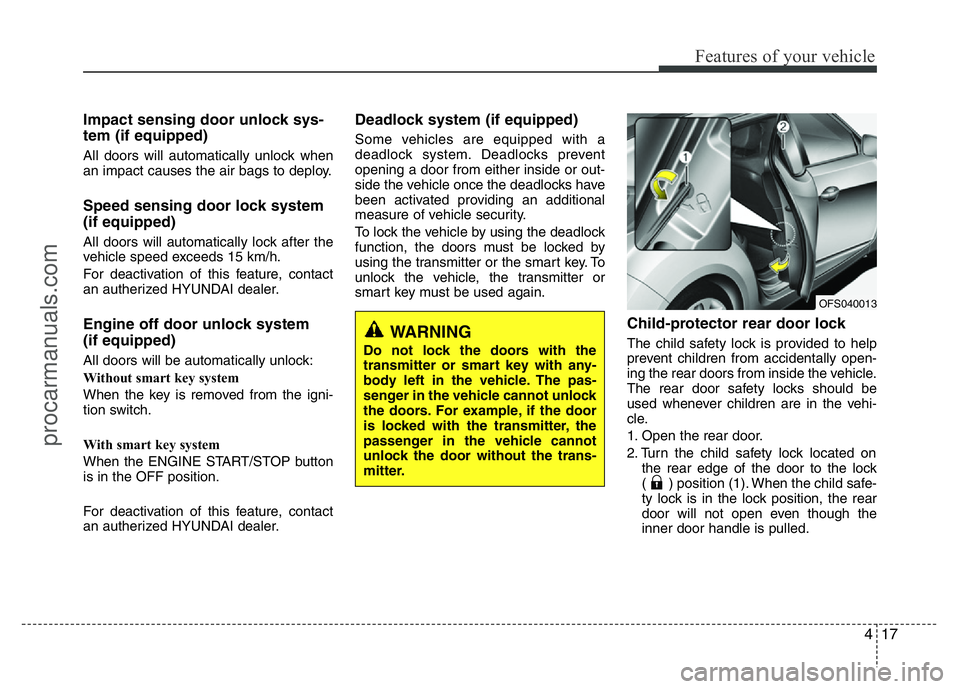
Child-protector rear door lock
The child safety lock is provided to help
prevent children from accidentally open-
ing the rear doors from inside the vehicle.
The rear door safety locks should be
used whenever children are in the vehi-
cle.
1. Open the rear door.
2. Turn the child safety lock located on
the rear edge of the door to the lock
( ) position (1). When the child safe-
ty lock is in the lock position, the rear
door will not open even though the
inner door handle is pulled.
OFS040013
WARNING
Do not lock the doors with the
transmitter or smart key with any-
body left in the vehicle. The pas-
senger in the vehicle cannot unlock
the doors. For example, if the door
is locked with the transmitter, the
passenger in the vehicle cannot
unlock the door without the trans-
mitter.
procarmanuals.com
Page 94 of 386

Features of your vehicle
20 4
Closing the tailgate
To close the tailgate, lower and push
down the tailgate firmly. Make sure that
the tailgate is securely latched.
Emergency tailgate safety release
Your vehicle is equipped with the emer-
gency tailgate safety release located on
the bottom of the tailgate. When some-
one is inadvertently locked in the lug-
gage compartment, the tailgate can be
opened by inserting the key or screw
driver to hole and pushing the tailgate.
WARNING- Exhaust
fumes
If you drive with the tailgate open,
you will draw dangerous exhaust
fumes into your vehicle which can
cause serious injury or death to
vehicle occupants.
If you must drive with the tailgate
open, keep the air vents and all win-
dows open so that additional out-
side air comes into the vehicle.
WARNING- Rear cargo
area
Occupants should never ride in the
rear cargo area where no restraints
are available. To avoid injury in the
event of an accident or sudden
stops, occupants should always be
properly restrained.
OFS040015OFS040016
procarmanuals.com
Page 103 of 386
429
Features of your vehicle
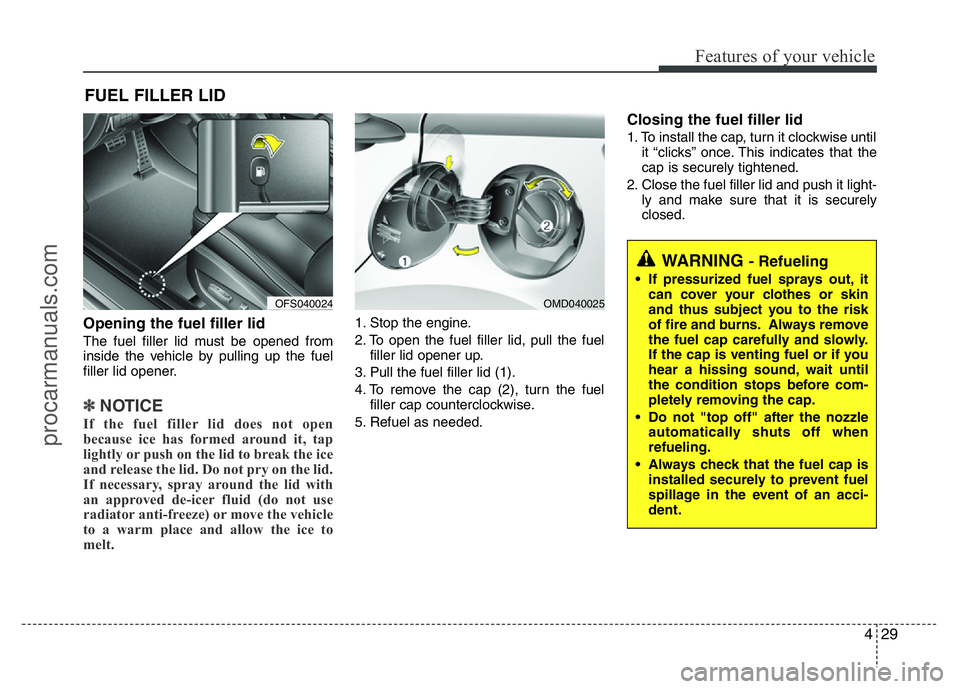
Opening the fuel filler lid
The fuel filler lid must be opened from
inside the vehicle by pulling up the fuel
filler lid opener.
✽NOTICE
If the fuel filler lid does not open
because ice has formed around it, tap
lightly or push on the lid to break the ice
and release the lid. Do not pry on the lid.
If necessary, spray around the lid with
an approved de-icer fluid (do not use
radiator anti-freeze) or move the vehicle
to a warm place and allow the ice to
melt.
1. Stop the engine.
2. To open the fuel filler lid, pull the fuel
filler lid opener up.
3. Pull the fuel filler lid (1).
4. To remove the cap (2), turn the fuel
filler cap counterclockwise.
5. Refuel as needed.
Closing the fuel filler lid
1. To install the cap, turn it clockwise until
it “clicks” once. This indicates that the
cap is securely tightened.
2. Close the fuel filler lid and push it light-
ly and make sure that it is securely
closed.
FUEL FILLER LID
WARNING - Refueling
• If pressurized fuel sprays out, it
can cover your clothes or skin
and thus subject you to the risk
of fire and burns. Always remove
the fuel cap carefully and slowly.
If the cap is venting fuel or if you
hear a hissing sound, wait until
the condition stops before com-
pletely removing the cap.
• Do not "top off" after the nozzle
automatically shuts off when
refueling.
• Always check that the fuel cap is
installed securely to prevent fuel
spillage in the event of an acci-
dent.
OFS040024OMD040025
procarmanuals.com
Page 104 of 386

Features of your vehicle
30 4
(Continued)
Use only approved portable plas-
tic fuel containers designed to
carry and store gasoline.
• Do not use cellular phones while
refueling. Electric current and/or
electronic interference from cel-
lular phones can potentially
ignite fuel vapors causing a fire.
• When refueling, always shut the
engine off. Sparks produced by
electrical components related to
the engine can ignite fuel vapors
causing a fire. Once refueling is
complete, check to make sure the
filler cap and filler door are
securely closed, before starting
the engine.
• DO NOT use matches or a lighter
and DO NOT SMOKE or leave a lit
cigarette in your vehicle while at
a gas station especially during
refueling. Automotive fuel is
highly flammable and can, when
ignited, result in fire.
(Continued)(Continued)
• Do not get back into a vehicle
once you have begun refueling
since you can generate static
electricity by touching, rubbing
or sliding against any item or fab-
ric (polyester, satin, nylon, etc.)
capable of producing static elec-
tricity. Static electricity discharge
can ignite fuel vapors resulting in
rapid burning. If you must re-
enter the vehicle, you should
once again eliminate potentially
dangerous static electricity dis-
charge by touching a metal part
of the vehicle, away from the fuel
filler neck, nozzle or other gaso-
line source.
• When using an approved
portable fuel container, be sure to
place the container on the
ground prior to refueling. Static
electricity discharge from the
container can ignite fuel vapors
causing a fire. Once refueling has
begun, contact with the vehicle
should be maintained until the
filling is complete.
(Continued)WARNING - Refueling dan-
gers
Automotive fuels are flammable
materials. When refueling, please
note the following guidelines care-
fully. Failure to follow these guide-
lines may result in severe personal
injury, severe burns or death by fire
or explosion.
• Read and follow all warning at the
gas station facility.
• Before refueling note the location
of the Emergency Gasoline Shut-
Off, if available, at the gas station
facility.
• Before touching the fuel nozzle,
you should eliminate potentially
dangerous static electricity dis-
charge by touching another metal
part of the vehicle, a safe dis-
tance away from the fuel filler
neck, nozzle, or other gas source.
(Continued)
procarmanuals.com
Page 105 of 386
431
Features of your vehicle
(Continued)
• If a fire breaks out during refuel-
ing, leave the vicinity of the vehi-
cle, and immediately contact the
manager of the gas station and
then contact the local fire depart-
ment. Follow any safety instruc-
tions they provide.CAUTION
• Make sure to refuel your vehicle
according to the “Fuel require-
ments” suggested in section 1.
• If the fuel filler cap requires
replacement, use only a genuine
HYUNDAI cap or the equivalent
specified for your vehicle. An
incorrect fuel filler cap can result
in a serious malfunction of the
fuel system or emission control
system.
• Do not spill fuel on the exterior
surfaces of the vehicle. Any type
of fuel spilled on painted surfaces
may damage the paint.
• After refueling, make sure the fuel
cap is installed securely to pre-
vent fuel spillage in the event of
an accident.
procarmanuals.com
Page 131 of 386
457
Features of your vehicle
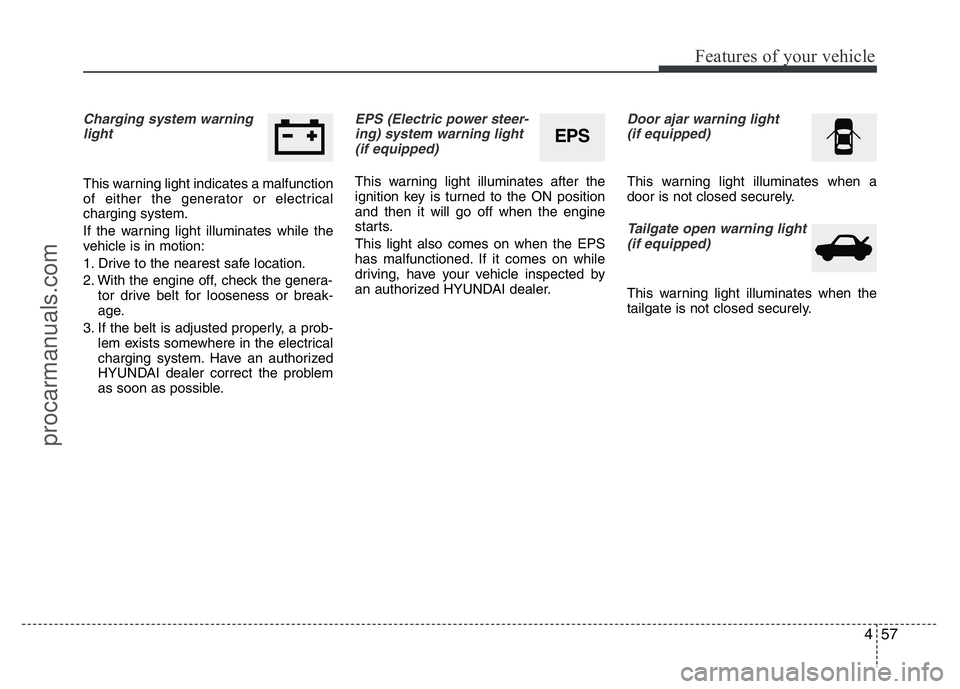
Charging system warning
light
This warning light indicates a malfunction
of either the generator or electrical
charging system.
If the warning light illuminates while the
vehicle is in motion:
1. Drive to the nearest safe location.
2. With the engine off, check the genera-
tor drive belt for looseness or break-
age.
3. If the belt is adjusted properly, a prob-
lem exists somewhere in the electrical
charging system. Have an authorized
HYUNDAI dealer correct the problem
as soon as possible.
EPS (Electric power steer-
ing) system warning light
(if equipped)
This warning light illuminates after the
ignition key is turned to the ON position
and then it will go off when the engine
starts.
This light also comes on when the EPS
has malfunctioned. If it comes on while
driving, have your vehicle inspected by
an authorized HYUNDAI dealer.
Door ajar warning light
(if equipped)
This warning light illuminates when a
door is not closed securely.
Tailgate open warning light
(if equipped)
This warning light illuminates when the
tailgate is not closed securely.
EPS
procarmanuals.com
Page 137 of 386
463
Features of your vehicle
Sunroof open warning chime
(if equipped)
If the driver turns off the engine and
opens the driver-side door when the sun-
roof is not fully closed, the warning chime
will sound for approximately 7 seconds.
Close the sunroof securely when leaving
your vehicle.
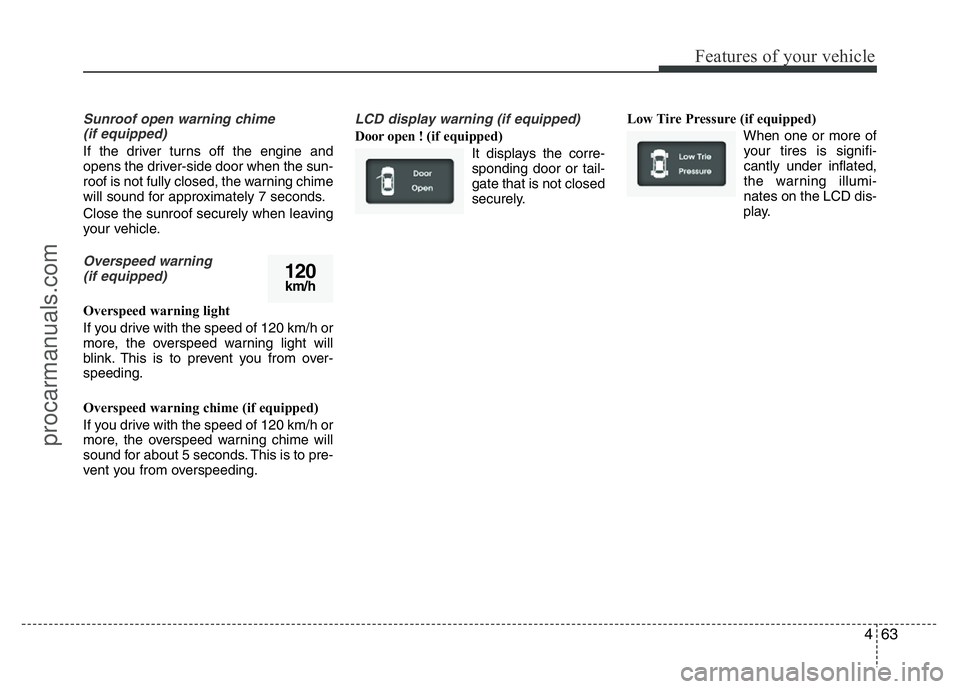
Overspeed warning
(if equipped)
Overspeed warning light
If you drive with the speed of 120 km/h or
more, the overspeed warning light will
blink. This is to prevent you from over-
speeding.
Overspeed warning chime (if equipped)
If you drive with the speed of 120 km/h or
more, the overspeed warning chime will
sound for about 5 seconds. This is to pre-
vent you from overspeeding.
LCD display warning (if equipped)
Door open ! (if equipped)
It displays the corre-
sponding door or tail-
gate that is not closed
securely.Low Tire Pressure (if equipped)
When one or more of
your tires is signifi-
cantly under inflated,
the warning illumi-
nates on the LCD dis-
play.
120km/h
procarmanuals.com