2011 HYUNDAI TUCSON Acc
[x] Cancel search: AccPage 10 of 382

13
Introduction
Your new vehicle is designed to use only
unleaded fuel having a pump octane
number ((R+M)/2) of 87 or higher.
Your new vehicle is designed to obtain
maximum performance with UNLEADED
FUEL, as well as minimize exhaust emis-
sions and spark plug fouling.Gasoline containing alcohol andmethanol
Gasohol, a mixture of gasoline and
ethanol (also known as grain alcohol), and gasoline or gasohol containing
methanol (also known as wood alcohol)
are being marketed along with or instead
of leaded or unleaded gasoline. Do not use gasohol containing more than 10% ethanol, and do not use gasoline or
gasohol containing any methanol. Either
of these fuels may cause drivability prob- lems and damage to the fuel system.
Discontinue using gasohol of any kind if
drivability problems occur.
Vehicle damage or drivability problems
may not be covered by the manufactur-
er’s warranty if they result from the use of:
1. Gasohol containing more than 10% ethanol.
2. Gasoline or gasohol containing methanol.
3. Leaded fuel or leaded gasohol.
FUEL REQUIREMENTS
CAUTION
Never add any fuel system cleaning
agents to the fuel tank other than what has been specified. (Consult
an authorized HYUNDAI dealer fordetails.)
WARNING
• Do not "top off" after the nozzle automatically shuts off when refueling.
Tighten the cap until it clicks one time, otherwise the Check Engine
light will illuminate.
Always check that the fuel cap is installed securely to prevent fuel
spillage in the event of an acci- dent.
Page 11 of 382
Introduction
4
1
"E85" fuel is an alternative fuel com-
prised of 85 percent ethanol and 15 per-
cent gasoline, and is manufactured
exclusively for use in Flexible Fuel
Vehicles. “E85” is not compatible with
your vehicle. Use of “E85” may result in
poor engine performance and damage to
your vehicle's engine and fuel system.
HYUNDAI recommends that customers do not use fuel with an ethanol content
exceeding 10 percent.Do not use methanol
Fuels containing methanol (wood alco-
hol) should not be used in your vehicle.
This type of fuel can reduce vehicle per-
formance and damage components of the fuel system.
Gasolines for cleaner air
To help contribute to cleaner air,
HYUNDAI recommends you use gaso-
lines treated with detergent additives,
which help prevent deposit formation in
the engine. These gasolines will help the
engine run cleaner and enhance per-
formance of the Emission Control System.
Operation in foreign countries
If you are going to drive your vehicle in
another country, be sure to:
Observe all regulations regarding reg-
istration and insurance.
Determine that acceptable fuel is avail- able.
CAUTION
Your New Vehicle Limited Warranty
may not cover damage to the fuelsystem and any performance prob-
lems that are caused by the use offuels containing methanol.
CAUTION
Never use gasohol which containsmethanol. Discontinue use of any gasohol product which impairs dri-
vability.
CAUTION
Your New Vehicle Limited Warrantydoes not cover damage to the fuel
system or any performance prob- lems caused by the use of “E85” fuel.
Page 12 of 382
15
Introduction
As with other vehicles of this type, failure
to operate this vehicle correctly mayresult in loss of control, an accident or
vehicle rollover.
Specific design characteristics (higher
ground clearance, track, etc.) give this
vehicle a higher center of gravity than
other types of vehicles. It is not designed
for cornering at the same speeds as a
conventional 2-wheel drive sedans or
sports coupe. Avoid sharp turns or abrupt
maneuvers. Failure to operate this vehi-
cle correctly may result in loss of control,
an accident or vehicle rollover.Be sure
to read the “Reducing the risk of a
rollover” driving guidelines, in section
5 of this manual. No special break-in period is needed.
By following a few simple precautions
for the first 600 miles (1,000 km) you
may add to the performance, economy
and life of your vehicle.
Do not race the engine.
While driving, keep your engine speed
(rpm, or revolutions per minute)
between 2,000 rpm and 4,000 rpm.
Do not maintain a single speed for long periods of time, either fast or slow.
Varying engine speed is needed to
properly break-in the engine.
Avoid hard stops, except in emergen- cies, to allow the brakes to seat prop-
erly.
Don't let the engine idle longer than 3 minutes at one time.
Don't tow a trailer during the first 1,200
miles (2,000 km) of operation.
VEHICLE BREAK-IN PROCESS
VEHICLE HANDLING
INSTRUCTIONS
Page 13 of 382
Introduction
6
1
This vehicle is equipped with an event
data recorder (EDR). The main pur-
pose of an EDR is to record, in certaincrash or near crash-like situations,
such as an air bag deployment or hit-
ting a road obstacle, data that will
assist in understanding how a vehi-
cle's systems performed. The EDR is
designed to record data related to
vehicle dynamics and safety systems
for a short period of time, typically 30
seconds or less. The EDR in this vehi-
cle is designed to record such data as:
* How various systems in your vehicle
were operating:
* Whether or not the driver and pas- senger safety belts were buckled/ fastened;
* How far (if at all) the driver was depressing the accelerator and/or
brake pedal; and,
* How fast the vehicle was traveling. These data can help provide a better
understanding of the circumstances
in which crashes and injuries occur.
NOTE: EDR data are recorded by your
vehicle only if a nontrivial crash situa-
tion occurs; no data are recorded by the EDR under normal driving condi-
tions and no personal data (e.g.,
name, gender, age, and crash loca-
tion) are recorded. However, other
parties, such as law enforcement, could combine the EDR data with the
type of personally identifying data
routinely acquired during a crash
investigation.
To read data recorded by an EDR, spe-
cial equipment is required, and
access to the vehicle or the EDR is needed.
In addition to the vehicle manufactur-
er, other parties, such as law enforce-
ment, that have the special equip-
ment, can read the information if they
have access to the vehicle or the EDR.
VEHICLE DATA COLLECTION AND EVENT DATA RECORDERS
Page 16 of 382
Your vehicle at a glance
2
2
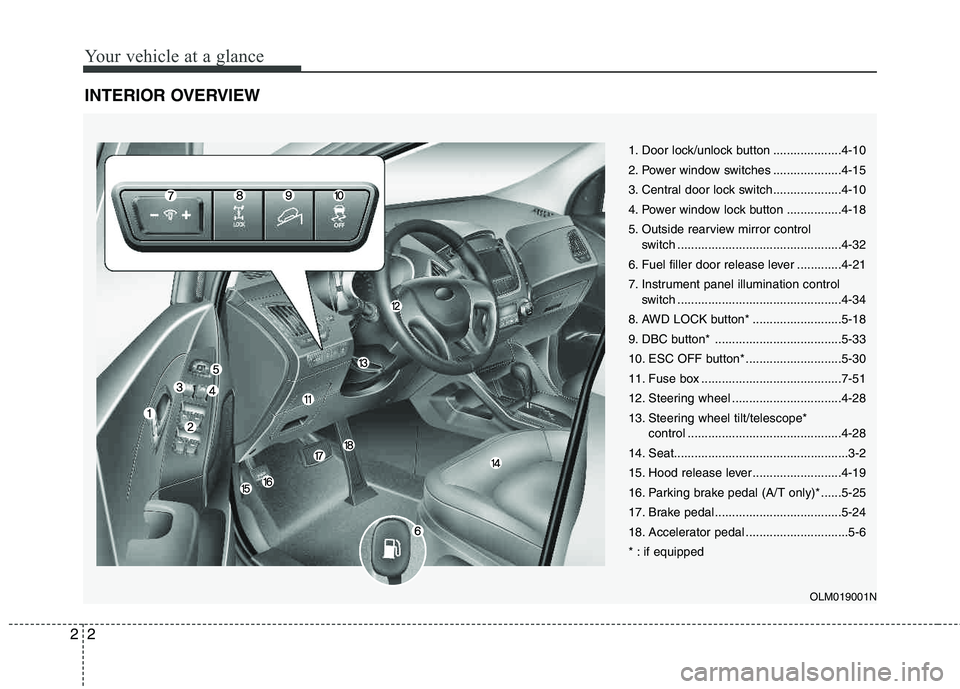
INTERIOR OVERVIEW
1. Door lock/unlock button ....................4-10
2. Power window switches ....................4-15
3. Central door lock switch....................4-10
4. Power window lock button ................4-18
5. Outside rearview mirror control
switch ................................................4-32
6. Fuel filler door release lever .............4-21
7. Instrument panel illumination control switch ................................................4-34
8. AWD LOCK button* ..........................5-18
9. DBC button* .....................................5-33
10. ESC OFF button* ............................5-30
11. Fuse box .........................................7-51
12. Steering wheel ................................4-28
13. Steering wheel tilt/telescope* control .............................................4-28
14. Seat...................................................3-2
15. Hood release lever ..........................4-19
16. Parking brake pedal (A/T only)* ......5-25
17. Brake pedal .....................................5-24
18. Accelerator pedal ..............................5-6
* : if equipped
OLM019001N
Page 21 of 382
33
Safety features of your vehicle
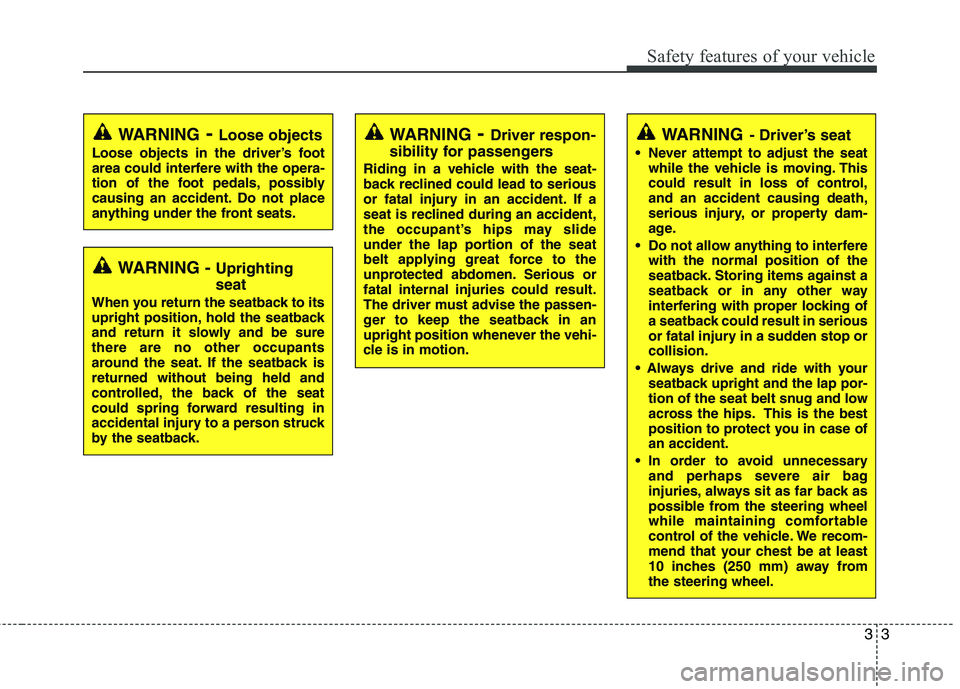
WARNING- Driver’s seat
Never attempt to adjust the seatwhile the vehicle is moving. This
could result in loss of control,and an accident causing death,
serious injury, or property dam-
age.
Do not allow anything to interfere with the normal position of the
seatback. Storing items against a
seatback or in any other way
interfering with proper locking of
a seatback could result in serious
or fatal injury in a sudden stop orcollision.
seatback upright and the lap por-
tion of the seat belt snug and low
across the hips. This is the best
position to protect you in case of an accident.
In order to avoid unnecessary and perhaps severe air bag
injuries, always sit as far back as
possible from the steering wheel
while maintaining comfortable
control of the vehicle. We recom-
mend that your chest be at least
10 inches (250 mm) away fromthe steering wheel.
WARNING - Uprighting seat
When you return the seatback to its
upright position, hold the seatback
and return it slowly and be sure there are no other occupants
around the seat. If the seatback isreturned without being held and
controlled, the back of the seat
could spring forward resulting in
accidental injury to a person struck
by the seatback.
WARNING- Loose objects
Loose objects in the driver’s foot
area could interfere with the opera-
tion of the foot pedals, possibly
causing an accident. Do not place
anything under the front seats.
WARNING- Driver respon-
sibility for passengers
Riding in a vehicle with the seat-
back reclined could lead to serious
or fatal injury in an accident. If a
seat is reclined during an accident,
the occupant’s hips may slide
under the lap portion of the seat
belt applying great force to the
unprotected abdomen. Serious or fatal internal injuries could result.
The driver must advise the passen-
ger to keep the seatback in an
upright position whenever the vehi-
cle is in motion.
Page 22 of 382
Safety features of your vehicle
4
3
(Continued)
When resetting the seatback to
the upright position, make sure it
is securely latched by pushing it
forward and rearward.
To avoid the possibility of burns, from a hot rear floor surface do
not remove the carpet in the
cargo area. Emission control
devices beneath this floor gener- ate high temperatures.WARNING- Rear seatbacks
The rear seatback must be
securely latched. If not, passen-
gers and objects could be thrown
forward resulting in serious
injury or death in the event of a
sudden stop or collision.
Luggage and other cargo should be laid flat in the cargo area. If
objects are large, heavy, or must
be piled, they must be secured.
Under no circumstances should
cargo be piled higher than the
seatbacks. Failure to follow thesewarnings could result in serious
injury or death in the event of a
sudden stop, collision or rollover.
No passenger should ride in the cargo area or sit or lie on folded
seatbacks while the vehicle is
moving. All passengers must be
properly seated in seats and
restrained properly while riding.
(Continued)
WARNING
After adjusting the seat, always
check that it is securely locked into
place by attempting to move the
seat forward or rearward without
using the lock release lever.
Sudden or unexpected movement
of the driver's seat could cause you
to lose control of the vehicle result- ing in an accident.
Page 26 of 382
Safety features of your vehicle
8
3
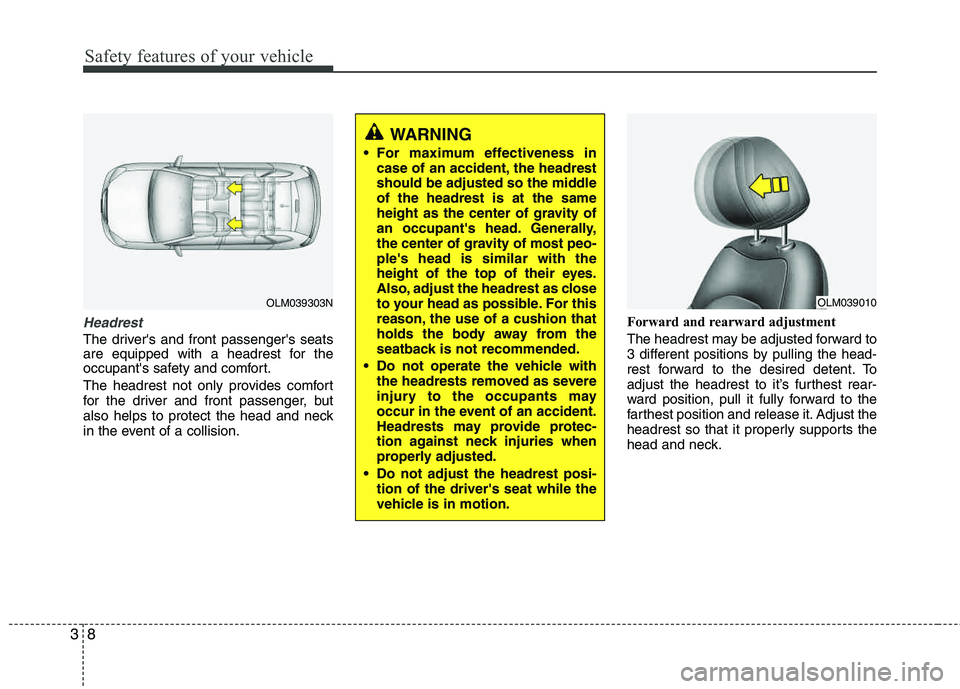
Headrest
The driver's and front passenger's seats
are equipped with a headrest for the
occupant's safety and comfort.
The headrest not only provides comfort
for the driver and front passenger, but
also helps to protect the head and neck
in the event of a collision. Forward and rearward adjustment
The headrest may be adjusted forward to
3 different positions by pulling the head-
rest forward to the desired detent. To
adjust the headrest to it’s furthest rear-
ward position, pull it fully forward to the
farthest position and release it. Adjust the
headrest so that it properly supports the
head and neck.
OLM039303N
WARNING
For maximum effectiveness in case of an accident, the headrest
should be adjusted so the middleof the headrest is at the same
height as the center of gravity of
an occupant's head. Generally,
the center of gravity of most peo- ple's head is similar with the
height of the top of their eyes.
Also, adjust the headrest as close
to your head as possible. For this
reason, the use of a cushion that
holds the body away from the
seatback is not recommended.
Do not operate the vehicle with the headrests removed as severe
injury to the occupants may
occur in the event of an accident.
Headrests may provide protec-
tion against neck injuries when
properly adjusted.
Do not adjust the headrest posi- tion of the driver's seat while the
vehicle is in motion.
OLM039010