2011 HYUNDAI TUCSON time
[x] Cancel search: timePage 43 of 382

325
Safety features of your vehicle
✽✽NOTICE
Both the driver's and front passen- ger's pre-tensioner seat belts may be
activated in certain frontal or side col-
lisions or rollovers.
The pre-tensioners will not be activat-
ed if the seat belts are not being worn
at the time of the collision.
When the pre-tensioner seat belts are activated, a loud noise may be heard
and fine dust, which may appear to be
smoke, may be visible in the passenger
compartment. These are normal oper-
ating conditions and are not haz-
ardous.
Although it is harmless, the fine dust may cause skin irritation and should
not be breathed for prolonged peri-
ods. Wash all exposed skin areas thor-
oughly after an accident in which the
pre-tensioner seat belts were activat-
ed.
✽
✽ NOTICE
Because the sensor that activates the
SRS air bag is connected with the pre-
tensioner seat belt, the SRS air bag
warning light ( ) on the instrument
panel will illuminate for approximately
6 seconds after the ignition switch has
been turned to the ON position, and
then it should turn off.
WARNING
To obtain maximum benefit from a pre-tensioner seat belt:
1. The seat belt must be worn cor- rectly and adjusted to the proper
position. Please read and follow
all of the important information
and precautions about your vehi-
cle’s occupant safety features –
including seat belts and air bags
– that are provided in this manu-al.
2. Be sure you and your passen- gers always wear seat belts prop-
erly.CAUTION
If the pre-tensioner seat belt is not
working properly, this warning lightwill illuminate even if there is no
malfunction of the SRS air bag. Ifthe SRS air bag warning light doesnot illuminate when the ignition switch is turned ON, or if it remains
illuminated after illuminating for approximately 6 seconds, or if itilluminates while the vehicle is
being driven, please have anauthorized HYUNDAI dealer inspect the pre-tensioner seat belt and SRSair bag system as soon as possible.
Page 44 of 382
Safety features of your vehicle
26
3
Seat belt precautions(Continued)
Improper handling of the pre-ten-
sioner seat belt assemblies, and failure to heed the warnings not
to strike, modify, inspect, replace,
service or repair the pre-tensioner
seat belt assemblies may lead to
improper operation or inadvertent
activation and serious injury.
Always wear the seat belts when driving or riding in a motor vehi-
cle.
If the vehicle or pre-tensioner seat belt must be discarded, contact
an authorized HYUNDAI dealer.
WARNING
All occupants of the vehicle must wear their seat belts at all times.
Seat belts and child restraints reduce the risk of serious or fatal
injuries for all occupants in the
event of a collision or sudden stop.
Without a seat belt, occupants
could be shifted too close to a
deploying air bag, strike the interior
structure or be thrown from the
vehicle. Properly worn seat belts
greatly reduce these hazards.
Even with advanced air bags,
unbelted occupants can be severe-
ly injured by a deploying air bag.
Always follow the precautions
about seat belts, air bags and occu-
pant safety contained in this manu- al.
WARNING
Pre-tensioners are designed to operate only one time. After acti-
vation, pre-tensioner seat belts
must be replaced. All seat belts,
of any type, should always be
replaced after they have been
worn during a collision.
The pre-tensioner seat belt assembly mechanisms become
hot during activation. Do not
touch the pre-tensioner seat belt
assemblies for several minutes
after they have been activated.
Do not attempt to inspect or replace the pre-tensioner seat
belts yourself. This must be done
by an authorized HYUNDAI dealer.
Do not strike the pre-tensioner seat belt assemblies.
Do not attempt to service or repair the pre-tensioner seat belt
system in any manner.
(Continued)
Page 45 of 382
327
Safety features of your vehicle
Infant or small child
All 50 states have child restraint laws. You
should be aware of the specific require-
ments in your state. Child and/or infant
seats must be properly placed and
installed in the rear seat. For more infor-
mation about the use of these restraints,
refer to “Child restraint system” in this section.✽✽NOTICE
Small children are best protected from
injury in an accident when properly
restrained in the rear seat by a child
restraint system that meets the require-
ments of the Federal Motor Vehicle
Safety Standards. Before buying any
child restraint system, make sure that it
has a label certifying that it meets
Federal Motor Vehicle Safety Standard
213. The restraint must be appropriate
for your child's height and weight.
Check the label on the child restraint for
this information. Refer to “Child
restraint system” in this section.Larger children
Children who are too large for child
restraint systems should always occupy
the rear seat and use the available
lap/shoulder belts. The lap portion should
be fastened and snugged on the hips
and as low as possible. Check if the belt
fits periodically. A child's squirming could
put the belt out of position. Children are
given the most safety in the event of an
accident when they are restrained by a
proper restraint system in the rear seat. If
a larger child (over age 12) must be seat-ed in the front seat, the child should be
securely restrained by the available lap/shoulder belt and the seat should be
placed in the rearmost position. Children
age 12 and under should be restrained
securely in the rear seat. NEVER place a child age 12 and under in the front seat.
NEVER place a rear facing child seat in
the front seat of a vehicle.
WARNING
Every person in your vehicle needs
to be properly restrained at all
times, including infants and chil-
dren. Never hold a child in yourarms or lap when riding in a vehi-
cle. The violent forces created dur-
ing a crash will tear the child from
your arms and throw the child
against the interior. Always use a
child restraint appropriate for your
child's height and weight.
Page 49 of 382
331
Safety features of your vehicle
WARNING
To reduce the chance of serious or fatal injuries:
Children of all ages are safer when restrained in the rear seat.
A child riding in the front passen-
ger seat can be forcefully struck
by an inflating air bag resulting in serious or fatal injuries.
Always follow the child restraint system manufacturer’s instruc-
tions for installation and use of
the child restraint.
Always make sure the child seat is secured properly in the car and
your child is securely restrained
in the child seat.
Never hold a child in your arms or lap when riding in a vehicle. The
violent forces created during a
crash will tear the child from your
arms and throw the child against
the car’s interior.
Never put a seat belt over your- self and a child. During a crash, the belt could press deep into the
child causing serious internal injuries.
(Continued)(Continued)
Never leave children unattendedin a vehicle – not even for a short
time. The car can heat up very
quickly, resulting in serious
injuries to children inside. Even
very young children may inadver-
tently cause the vehicle to move,entangle themselves in the win-
dows, or lock themselves or oth-
ers inside the vehicle.
Never allow two children, or any two persons, to use the same seat belt.
Children often squirm and repo- sition themselves improperly.
Never let a child ride with the shoulder belt under their arm or
behind their back. Always proper-
ly position and secure children in the rear seat.
Never allow a child to stand-up or kneel on the seat or floor of a
moving vehicle. During a colli-
sion or sudden stop, the child
can be violently thrown against
the vehicle’s interior, resulting in
serious injury.
(Continued)(Continued)
Never use an infant carrier or achild safety seat that "hooks"
over a seatback, it may not pro-vide adequate security in an acci-dent.
Seat belts can become very hot, especially when the car is parked
in direct sunlight. Always check
seat belt buckles before fasten-
ing them over a child.
Page 52 of 382
Safety features of your vehicle
34
3
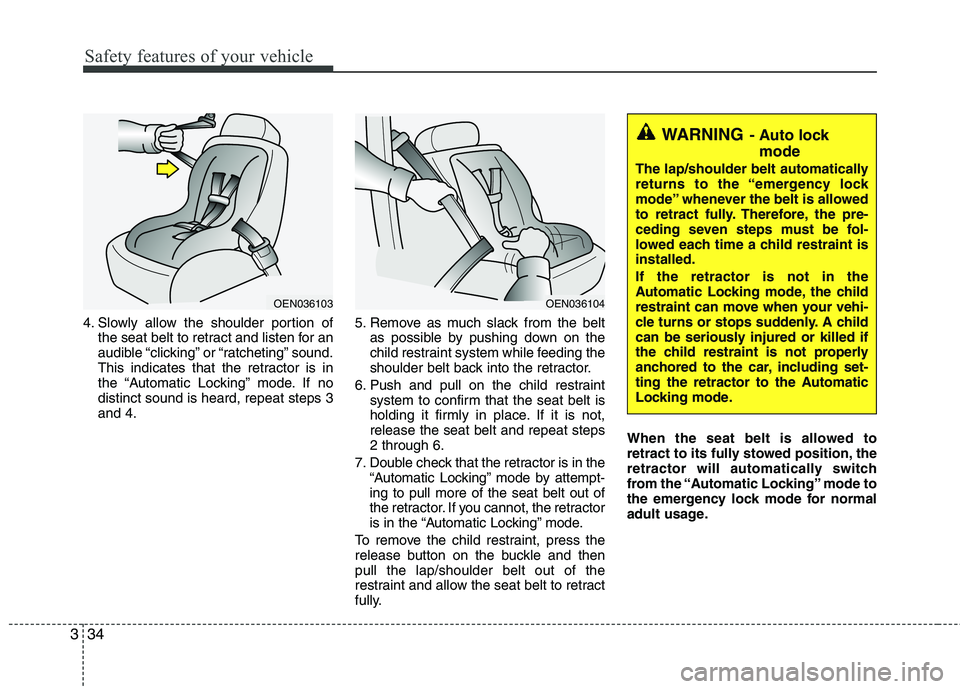
4. Slowly allow the shoulder portion of
the seat belt to retract and listen for an
audible “clicking” or “ratcheting” sound.
This indicates that the retractor is in
the “Automatic Locking” mode. If nodistinct sound is heard, repeat steps 3and 4. 5. Remove as much slack from the belt
as possible by pushing down on the
child restraint system while feeding the
shoulder belt back into the retractor.
6. Push and pull on the child restraint system to confirm that the seat belt is
holding it firmly in place. If it is not,release the seat belt and repeat steps 2 through 6.
7. Double check that the retractor is in the “Automatic Locking” mode by attempt- ing to pull more of the seat belt out of
the retractor. If you cannot, the retractor
is in the “Automatic Locking” mode.
To remove the child restraint, press the
release button on the buckle and then pull the lap/shoulder belt out of the
restraint and allow the seat belt to retract
fully. When the seat belt is allowed to
retract to its fully stowed position, the
retractor will automatically switch
from the “Automatic Locking” mode to
the emergency lock mode for normal
adult usage.
OEN036104OEN036103
WARNING- Auto lock
mode
The lap/shoulder belt automatically
returns to the “emergency lock
mode” whenever the belt is allowed
to retract fully. Therefore, the pre-
ceding seven steps must be fol-
lowed each time a child restraint isinstalled. If the retractor is not in the
Automatic Locking mode, the child
restraint can move when your vehi-
cle turns or stops suddenly. A child
can be seriously injured or killed if
the child restraint is not properly
anchored to the car, including set-
ting the retractor to the Automatic
Locking mode.
Page 57 of 382

339
Safety features of your vehicle
How does the air bag system operate
Air bags are activated (able to inflate ifnecessary) only when the ignition
switch is turned to the ON or STARTposition.
Air bags inflate in the event of a seri- ous frontal collision or side collision (if
equipped with a side air bag or curtainair bag) in order to help protect the
occupants from serious physical injury.
Also, the side and/or curtain air bags
inflate in the event of a rollover in order
to help protect the occupants from seri-
ous physical injury.
There is no single speed at which the air bags will inflate.
Generally, air bags are designed to
inflate based upon the severity of a col-
lision and its direction. These two fac-
tors determine whether the sensors
produce an electronic deployment/inflation signal.
Air bag deployment depends on a number of factors including vehicle speed, angles of impact and the densi-
ty and stiffness of the vehicles or
objects which your vehicle hits in the
collision. The determining factors are
not limited to those mentioned above. The front air bags will completely inflate
and deflate in an instant.
It is virtually impossible for you to see
the air bags inflate during an accident.
It is much more likely that you will sim- ply see the deflated air bags hanging
out of their storage compartments afterthe collision.
In order to help provide protection in a severe collision, the air bags must
inflate rapidly. The speed of air bag infla-
tion is a consequence of the extremely
short time in which a collision occurs and the need to inflate the air bag
between the occupant and the vehicle
structures before the occupant impacts
those structures. This speed of inflation
reduces the risk of serious or life-threat-
ening injuries in a severe collision and is
thus a necessary part of air bag design.
However, air bag inflation can also
cause injuries which can include facial
abrasions, bruises and broken bones because the inflation speed also caus-
es the air bags to expand with a great
deal of force.
There are even circumstances under which contact with the air bag can
cause fatal injuries, especially if the
occupant is positioned excessively
close to the air bag.
WARNING
To avoid severe personal injury or death caused by deploying air
bags in a collision, the driver
should sit as far back from the
steering wheel air bag as possi-
ble (at least 10 inches (250 mm)
away). The front passengers
should always move their seats
as far back as possible and sit
back in their seat.
Air bags inflate instantly in the event of collision, and passen-
gers may be injured by the air bag
expansion force if they are not in
proper position.
Air bag inflation may cause injuries including facial or bodily
abrasions, injuries from broken
glasses or burns.
Page 66 of 382
Safety features of your vehicle
48
3
(Continued)
Accident statistics show that chil-
dren are safer if they are
restrained in the rear, as opposed
to the front seat. It is recommend-
ed that child restraints be secured
in a rear seat, including an infant
riding in a rear-facing infant seat,
a child riding in a forward-facing
child seat and an older child rid- ing in a booster seat.
Air bags can only be used once – have an authorized HYUNDAI
dealer replace the air bag imme-
diately after deployment.
The occupant classification sys- tem may not work properly if
water, coffee or any other liquid
including rain gets on the seat.
Keep the front seat dry at all times.
Do not place an electronic device such as a laptop computer on the
front passenger seat. Its elec-
tronic field may cause the OCS to
switch to the "on" condition and
thus allow the passenger air bag
to deploy needlessly in a colli-
sion, increasing your repaircosts.(Continued)
If the front passenger seat isoccupied by a child who is not in
a CRS, the "PASSENGER AIR
BAG OFF" indicator may or may
not be on and the passenger air
bag may or may not deploy in a
collision. Have the child move to a
rear seat to increase their safety.
Do not modify or replace the front passenger seat. Don't place any-
thing on or attach anything such
as a blanket or seat heater to the
front passenger seat. This can
adversely affect the occupant
classification system.
Do not place sharp objects on the front passenger seat. These may
damage the occupant classifica-
tion system, if they puncture the seat cushion.
Do not use accessory seat cov- ers on the front seats.
(Continued)WARNING
Even though your vehicle is equipped with the occupant clas-
sification system, never install a
child restraint system in the front
passenger's seat. A deploying air
bag can forcefully strike a childresulting in serious injuries or
death. Any child age 12 and under should ride in the rear seat.
Children too large for child
restraints should use the avail-
able lap/shoulder belts. No mat-
ter what type of crash, children of
all ages are safer when restrainedin the rear seat.
If the "PASSENGER AIR BAG OFF" indicator is illuminated
when the front passenger's seat
is occupied by an adult and
he/she sits properly (sitting
upright with the seatback in an
upright position, centered on the seat cushion with their seat belt
on, legs comfortably extended
and their feet on the floor), have
that person sit in the rear seat.
(Continued)
Page 69 of 382
351
Safety features of your vehicle
✽✽NOTICE
Be sure to read information about the SRS on the labels provided on the sun
visor.
Advanced air bags are combined with pre-tensioner seat belts to help pro-
vide enhanced occupant protection in
frontal crashes. Front air bags are not
intended to deploy in collisions in
which protection can be provided by
the pre-tensioner seat belt.
(Continued)
Move your seat as far back aspractical from the front air bags,
while still maintaining control of
the vehicle.
You and your passengers should never sit or lean unnecessarily
close to the air bags. Improperly
positioned driver and passengers
can be severely injured by inflat-
ing air bags.
Never lean against the door or center console – always sit in an upright position.
Do not allow a passenger to ride in the front seat when the “PAS-
SENGER AIR BAG OFF” indicator
is illuminated, because the air
bag will not deploy in the event of
a moderate or severe frontal crash.
(Continued)WARNING
Always use seat belts and child
restraints – every trip, every time,
everyone! Air bags inflate with con-
siderable force and in the blink of
an eye. Seat belts help keep occu-
pants in proper position to obtain
maximum benefit from the air bag.
Even with advanced air bags,
improperly belted and unbelted
occupants can be severely injured
when the air bag inflates. Always
follow the precautions about seat
belts, air bags and occupant safety
contained in this manual.
To reduce the chance of serious or fatal injuries and receive the maxi-
mum safety benefit from yourrestraint system:
Never place a child in any child or booster seat in the front seat.
ABC – Always Buckle Children in the back seat. It is the safest
place for children of any age to
ride.
Front and side air bags can injure occupants improperly positioned
in the front seats.
(Continued)WARNING
If you are considering modification
of your vehicle due to a disability,please contact the HyundaiCustomer Assistance Center at 1- 800-633-5151.