2011 Hyundai Santa Fe Automatic transaxle
[x] Cancel search: Automatic transaxlePage 329 of 408

Maintenance
10
7
G040200AEN-EU
MAINTENANCE UNDER SEVERE USAGE CONDITIONS
SEVERE DRIVING CONDITIONS
A - Repeatedly driving short distance of less than 5 miles (8 km) in normal temper-
ature or less than 10 miles (16 km) in freezing temperature
B - Extensive engine idling or low speed driving for long distances
C - Driving on rough, dusty, muddy, unpaved, graveled or salt- spread roads
D - Driving in areas using salt or other corrosive materials or in very cold weather
E - Driving in sandy areas F - Driving in heavy traffic area over 90°F (32°C)
G - Driving on uphill, downhill, or mountain road
H - Towing a Trailer, or using a camper, or roof rack
I - Driving as a patrol car, taxi, other commercial use or vehicle towing
J - Driving over 106 mph (170 km/h)
K - Frequently driving in stop-and-go conditions
ENGINE OIL AND FILTER
AIR CLEANER FILTER
SPARK PLUGS
AUTOMATIC TRANSAXLE FLUID
MANUAL TRANSAXLE FLUID
FRONT DISC BRAKE/PADS, CALIPERS AND ROTORS
REAR DISC BRAKE/PADS, PARKING BRAKE
STEERING GEAR BOX, LINKAGE & BOOTS/
LOWER ARM BALL JOINT, UPPER ARM BALL JOINT
DRIVE SHAFTS AND BOOTS
TRANSFER CASE OIL (AWD)
REAR AXLE OIL (AWD)
CLIMATE CONTROL AIR FILTER
(FOR EVAPORATOR AND BLOWER UNIT)
PROPELLER SHAFT
R
R
R
R
R
I
I
I
I
R
R
R
I EVERY 3,750 MILES (6,000 KM) OR 6 MONTHS
MORE FREQUENTLY
MORE FREQUENTLY
EVERY 60,000 MILES (96,000 KM)
EVERY 80,000 MILES (12,000 KM)
MORE FREQUENTLY
MORE FREQUENTLY
MORE FREQUENTLY
EVERY 7,500 MILES (12,000 KM) OR 6 MONTHS
EVERY 80,000 MILES (120,000 KM)
EVERY 80,000 MILES (120,000 KM)
MORE FREQUENTLY
EVERY 7,500 MILES (12,000 KM) OR 6 MONTHS
A, B, C, D, E, F, G, H, I, K
C, E
B, H
A, C, E, F, G, I
A, C, E, F, G, I
C, D, G, H
C, D, G, H
C, D, E, F, G, H, I
C, D, E, F, G, H, I, J
C, E, G, H, I, J
C, E, G, H, I, J
C, E
C, E
MAINTENANCE ITEM
MAINTENANCE
OPERATION MAINTENANCE
INTERVALS DRIVING
CONDITION
The following items must be serviced more frequently on cars normally used under severe driving conditions. Refer to the chart
below for the appropriate maintenance intervals.
R : Replace I : Inspect and, after inspection, clean, adjust, repair or replace if neces\
sary
Page 331 of 408

Maintenance
12
7
G050700AUN
Vacuum crankcase ventilation
hoses (if equipped)
Inspect the surface of hoses for evidence
of heat and/or mechanical damage. Hard
and brittle rubber, cracking, tears, cuts,
abrasions, and excessive swelling indi-
cate deterioration. Particular attention
should be paid to examine those hose
surfaces nearest to high heat sources,
such as the exhaust manifold.
Inspect the hose routing to assure that
the hoses do not come in contact with
any heat source, sharp edges or moving
component which might cause heat dam-
age or mechanical wear. Inspect all hose
connections, such as clamps and cou-
plings, to make sure they are secure, and
that no leaks are present. Hoses should
be replaced immediately if there is any
evidence of deterioration or damage.
G050800AFD
Air cleaner filter
A Genuine HYUNDAI air cleaner filter is
recommended when the filter is replaced.
G050900AUN
Spark plugs
Make sure to install new spark plugs of
the correct heat range.
G051000AFD
Valve clearance
Inspect excessive valve noise and/or
engine vibration and adjust if necessary.
An authorized HYUNDAI dealer should
perform the operation.
G051100AUN
Cooling system
Check the cooling system parts, such as
radiator, coolant reservoir, hoses and
connections for leakage and damage.
Replace any damaged parts.
G051200AUN
Coolant
The coolant should be changed at the
intervals specified in the maintenance
schedule.
G051300AUN
Manual transaxle fluid
(if equipped)
Inspect the manual transaxle fluid
according to the maintenance schedule.
G051400AXM
Automatic transaxle fluid
(if equipped)
Automatic transaxle fluid should not be
checked under normal usage conditions.
But in severe conditions, the fluid should
be changed at an authorized HYUNDAI
dealer in accordance to the scheduled
maintenance at the beginning of this
chapter.
✽ ✽
NOTICE
Automatic transaxle fluid color is basi-
cally red.
As the vehicle is driven, the automatic
transaxle fluid will begin to look darker.
It is normal condition and you should
not judge the need to replace the fluid
based upon the changed color.
Page 332 of 408
713
Maintenance
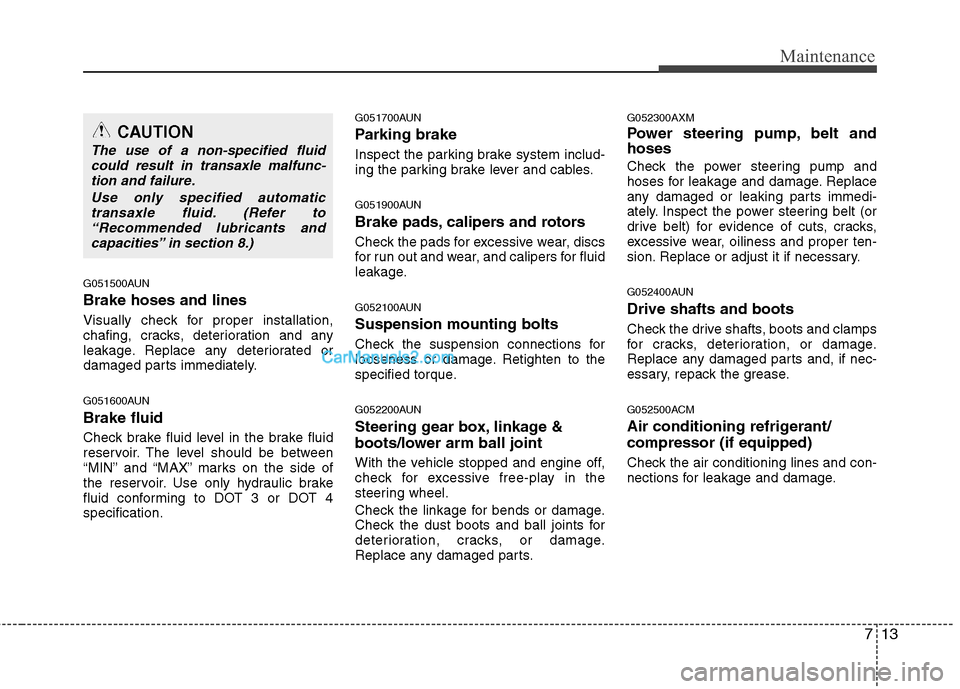
G051500AUN
Brake hoses and lines
Visually check for proper installation,
chafing, cracks, deterioration and any
leakage. Replace any deteriorated or
damaged parts immediately.
G051600AUN
Brake fluid
Check brake fluid level in the brake fluid
reservoir. The level should be between
“MIN” and “MAX” marks on the side of
the reservoir. Use only hydraulic brake
fluid conforming to DOT 3 or DOT 4
specification.
G051700AUN
Parking brake
Inspect the parking brake system includ-
ing the parking brake lever and cables.
G051900AUN
Brake pads, calipers and rotors
Check the pads for excessive wear, discs
for run out and wear, and calipers for fluid
leakage.
G052100AUN
Suspension mounting bolts
Check the suspension connections for
looseness or damage. Retighten to the
specified torque.
G052200AUN
Steering gear box, linkage &
boots/lower arm ball joint
With the vehicle stopped and engine off,
check for excessive free-play in the
steering wheel.
Check the linkage for bends or damage.
Check the dust boots and ball joints for
deterioration, cracks, or damage.
Replace any damaged parts.
G052300AXM
Power steering pump, belt and
hoses
Check the power steering pump and
hoses for leakage and damage. Replace
any damaged or leaking parts immedi-
ately. Inspect the power steering belt (or
drive belt) for evidence of cuts, cracks,
excessive wear, oiliness and proper ten-
sion. Replace or adjust it if necessary.
G052400AUN
Drive shafts and boots
Check the drive shafts, boots and clamps
for cracks, deterioration, or damage.
Replace any damaged parts and, if nec-
essary, repack the grease.
G052500ACM
Air conditioning refrigerant/
compressor (if equipped)
Check the air conditioning lines and con-
nections for leakage and damage.
CAUTION
The use of a non-specified fluidcould result in transaxle malfunc-tion and failure.
Use only specified automatictransaxle fluid. (Refer to“Recommended lubricants andcapacities” in section 8.)
Page 360 of 408
741
Maintenance
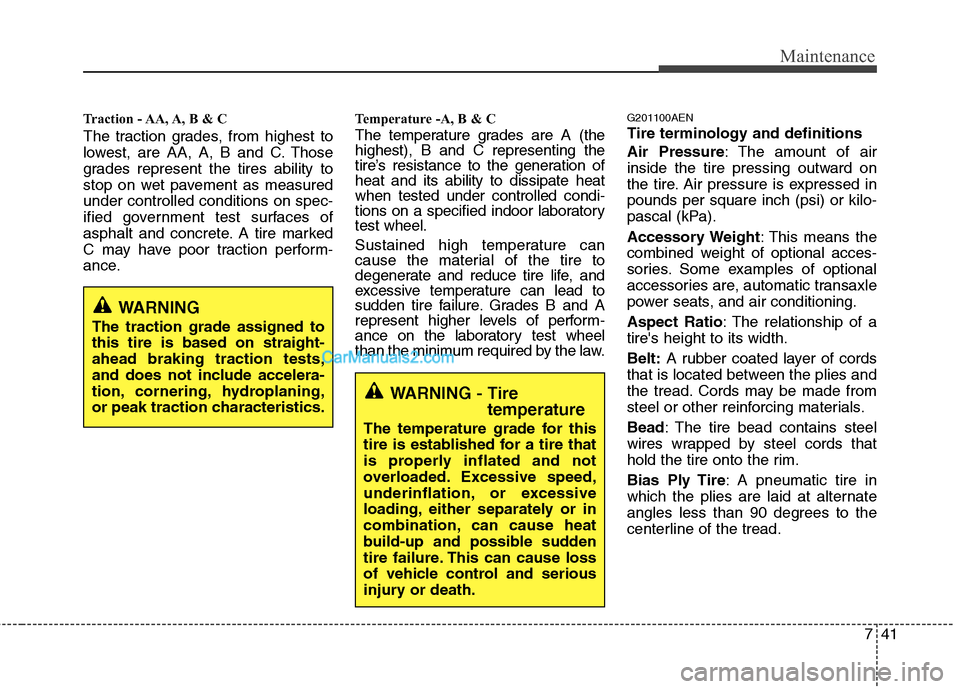
Traction - AA, A, B & C
The traction grades, from highest to
lowest, are AA, A, B and C. Those
grades represent the tires ability to
stop on wet pavement as measured
under controlled conditions on spec-
ified government test surfaces of
asphalt and concrete. A tire marked
C may have poor traction perform-
ance.
Temperature -A, B & C
The temperature grades are A (the
highest), B and C representing the
tire’s resistance to the generation of
heat and its ability to dissipate heat
when tested under controlled condi-
tions on a specified indoor laboratory
test wheel.
Sustained high temperature can
cause the material of the tire to
degenerate and reduce tire life, and
excessive temperature can lead to
sudden tire failure. Grades B and A
represent higher levels of perform-
ance on the laboratory test wheel
than the minimum required by the law.
G201100AEN
Tire terminology and definitions
Air Pressure: The amount of air
inside the tire pressing outward on
the tire. Air pressure is expressed in
pounds per square inch (psi) or kilo-
pascal (kPa).
Accessory Weight : This means the
combined weight of optional acces-
sories. Some examples of optional
accessories are, automatic transaxle
power seats, and air conditioning.
Aspect Ratio : The relationship of a
tire's height to its width.
Belt: A rubber coated layer of cords
that is located between the plies and
the tread. Cords may be made from
steel or other reinforcing materials.
Bead : The tire bead contains steel
wires wrapped by steel cords that
hold the tire onto the rim.
Bias Ply Tire : A pneumatic tire in
which the plies are laid at alternate
angles less than 90 degrees to the
centerline of the tread.
WARNING
The traction grade assigned to
this tire is based on straight-
ahead braking traction tests,
and does not include accelera-
tion, cornering, hydroplaning,
or peak traction characteristics.
WARNING - Tire temperature
The temperature grade for this
tire is established for a tire that
is properly inflated and not
overloaded. Excessive speed,
underinflation, or excessive
loading, either separately or in
combination, can cause heat
build-up and possible sudden
tire failure. This can cause loss
of vehicle control and serious
injury or death.
Page 395 of 408
Specifications, Consumer information, Reporting safety defects
4
8
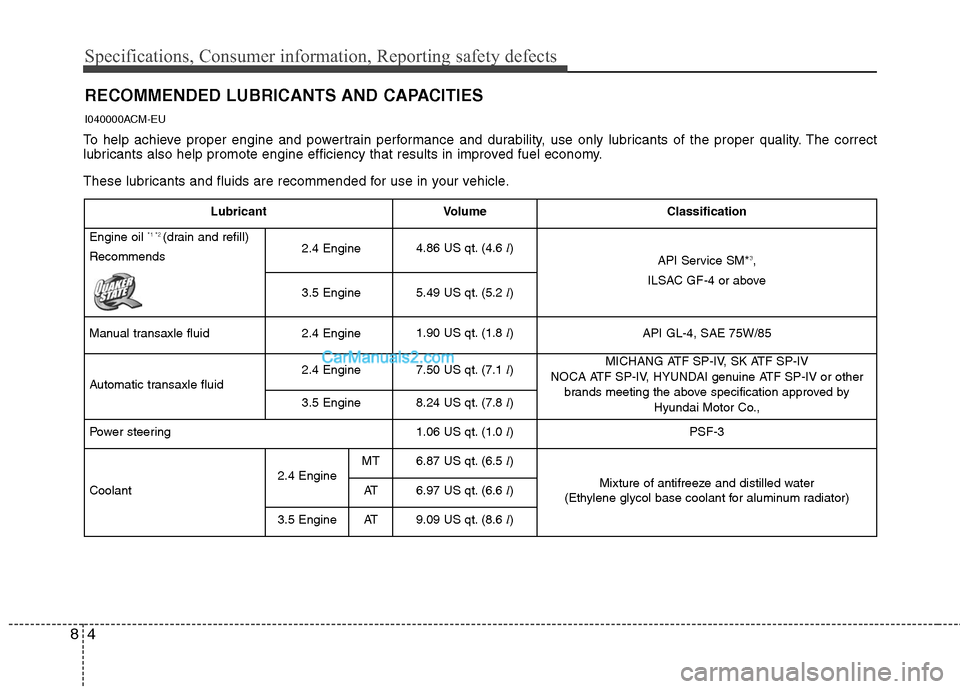
RECOMMENDED LUBRICANTS AND CAPACITIES
To help achieve proper engine and powertrain performance and durability, use only lubricants of the proper quality. The correct
lubricants also help promote engine efficiency that results in improved fuel economy.
These lubricants and fluids are recommended for use in your vehicle.
I040000ACM-EU
LubricantVolumeClassification
Engine oil *1 *2 (drain and refill)
Recommends2.4 Engine4.86 US qt. (4.6 l)API Service SM*3,
ILSAC GF-4 or above
3.5 Engine5.49 US qt. (5.2 l)
Manual transaxle fluid2.4 Engine1.90 US qt. (1.8 l)API GL-4, SAE 75W/85
Automatic transaxle fluid2.4 Engine7.50 US qt. (7.1 l)MICHANG ATF SP-IV, SK ATF SP-IV
NOCA ATF SP-IV, HYUNDAI genuine ATF SP-IV or other brands meeting the above specification approved by Hyundai Motor Co.,
3.5 Engine8.24 US qt. (7.8 l)
Power steering1.06 US qt. (1.0 l)PSF-3
Coolant 2.4 EngineMT6.87 US qt. (6.5 l)
Mixture of antifreeze and distilled water
(Ethylene glycol base coolant for aluminum radiator)AT6.97 US qt. (6.6 l)
3.5 EngineAT9.09 US qt. (8.6 l)
Page 396 of 408
85
Specifications, Consumer information, Reporting safety defects
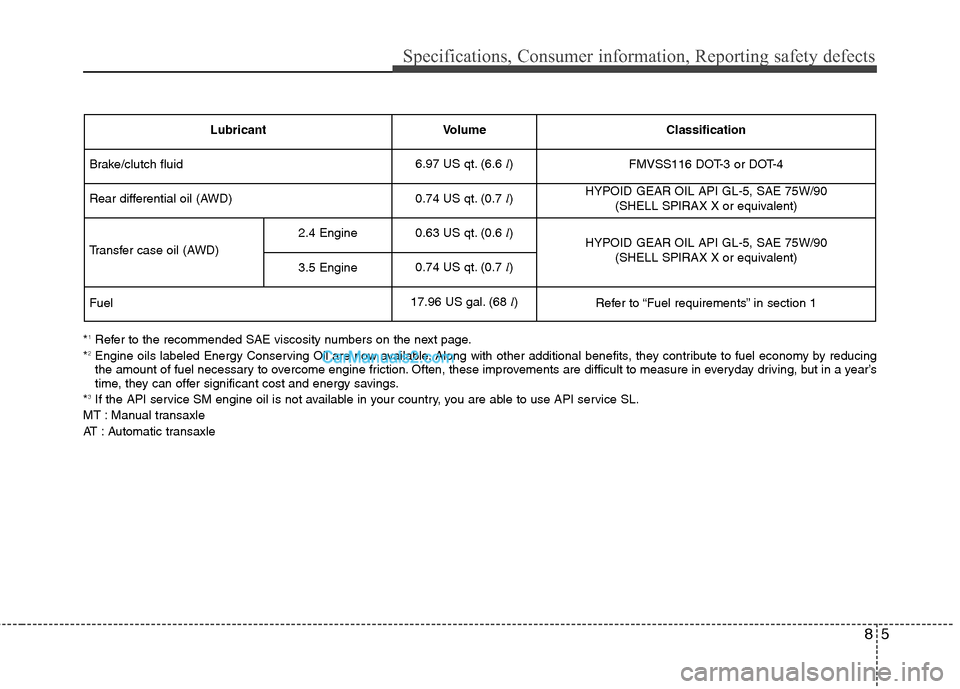
*1Refer to the recommended SAE viscosity numbers on the next page.
*2Engine oils labeled Energy Conserving Oil are now available. Along with other additional benefits, they contribute to fuel econo my by reducing
the amount of fuel necessary to overcome engine friction. Often, these improvements are difficult to measure in everyday driving , but in a year’s
time, they can offer significant cost and energy savings.
*
3If the API service SM engine oil is not available in your country, you are able to use API service SL.
MT : Manual transaxle
AT : Automatic transaxle
LubricantVolumeClassification
Brake/clutch fluid6.97 US qt. (6.6 l)FMVSS116 DOT-3 or DOT-4
Rear differential oil (AWD)0.74 US qt. (0.7 l)HYPOID GEAR OIL API GL-5, SAE 75W/90
(SHELL SPIRAX X or equivalent)
Transfer case oil (AWD)
2.4 Engine0.63 US qt. (0.6 l)HYPOID GEAR OIL API GL-5, SAE 75W/90
(SHELL SPIRAX X or equivalent)
3.5 Engine0.74 US qt. (0.7 l)
Fuel17.96 US gal. (68 l)Refer to “Fuel requirements” in section 1
Page 403 of 408

Index
2I
Air bags-advanced supplemental restraint system ········3-36Air bag warning label ··················\
··················\
··············3-62
Air bag warning light ··················\
··················\
··············3-59
Curtain air bag ··················\
··················\
··················\
·······3-50
Driver's and passenger's front air bag··········\
················3-45
Occupant classification system ··················\
·················3-40\
Side impact air bag ··················\
··················\
··················\
3-49
Air cleaner ··················\
··················\
··················\
···············7-22
All wheel drive (AWD)··················\
··················\
··············5-16
Appearance care··················\
··················\
··················\
·······7-63 Exterior care ··················\
··················\
··················\
··········7-63
Interior care ··················\
··················\
··················\
·········7-668
Audio system ··················\
··················\
··················\
···········4-99 Antenna··················\
··················\
··················\
··················\
4-99
Steering wheel audio control ··················\
··················\
···4-99
Automatic climate control system ··················\
···············4-76 Air conditioning ··················\
··················\
··················\
····4-82
Automatic heating and air conditioning ··················\
····4-77
Manual heating and air conditioning··················\
·········4-67
Automatic transaxle ··················\
··················\
··················\
·5-10 Ignition key interlock system ··················\
··················\
··5-12
Shift lock system ··················\
··················\
··················\
···5-13
Sports mode ··················\
··················\
··················\
···········5-14 Battery··················\
··················\
··················\
··················\
····7-29
Before driving ··················\
··················\
··················\
············5-3
Brake system··················\
··················\
··················\
············5-23
Anti-lock brake system (ABS) ··················\
·················5-26\
Electronic stability control (ESC) ··················\
············5-28
Parking brake··················\
··················\
··················\
········5-24
Power brakes ··················\
··················\
··················\
········5-23
Brake fluid ··················\
··················\
··················\
···············7-18
Bulb wattage ··················\
··················\
··················\
··············8-2
California Perchlorate Notice ··················\
··················\
··· 7-72
Child restraint system ··················\
··················\
················3-28 Placing a passenger seat belt intothe auto lock mode ··················\
··················\
················3-30
Securing a child restraint seat with tether anchor system··················\
··················\
··············3-32
Securing a child restraint seat with child seat lower anchor system ··················\
···············3-34
Climate control air filter ··················\
··················\
············7-24
Consumer information ··················\
··················\
·················8-9
Cruise control system ··················\
··················\
················5-33
AB
C