Page 300 of 427
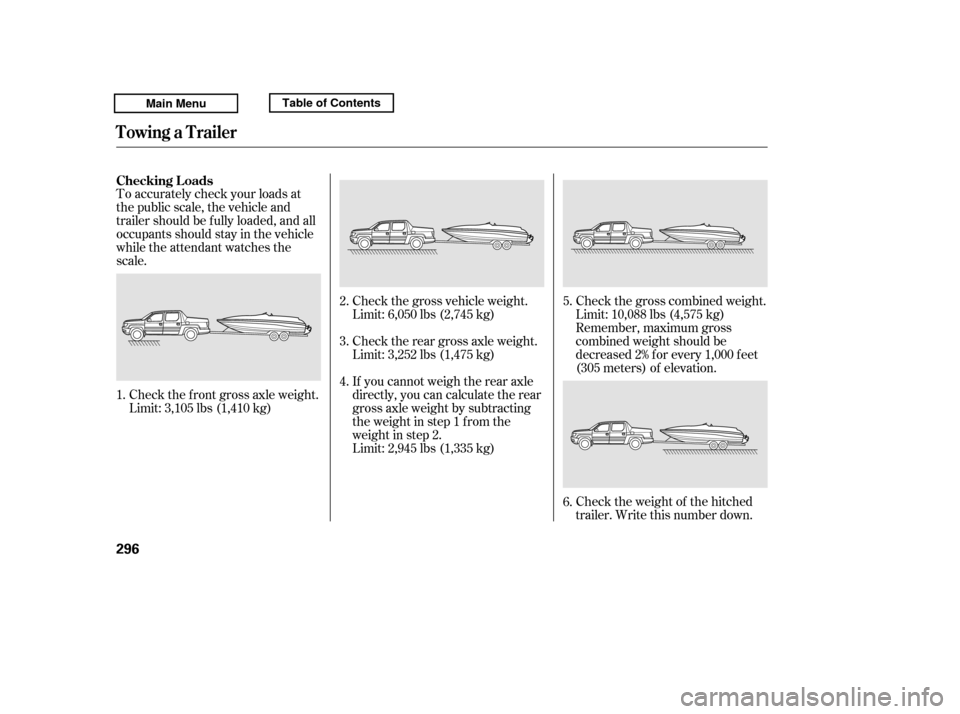
To accurately check your loads at
the public scale, the vehicle and
trailer should be f ully loaded, and all
occupants should stay in the vehicle
while the attendant watches the
scale.Check the f ront gross axle weight.
Limit: 3,105 lbs (1,410 kg) Check the gross vehicle weight.
Limit: 6,050 lbs (2,745 kg)
Check the weight of the hitched
trailer. Write this number down.
Check the gross combined weight.
Limit: 10,088 lbs (4,575 kg)
Remember, maximum gross
combined weight should be
decreased 2% f or every 1,000 f eet
(305 meters) of elevation.
If you cannot weigh the rear axle
directly, you can calculate the rear
gross axle weight by subtracting
the weight in step 1 from the
weight in step 2.
Limit: 2,945 lbs (1,335 kg)
Check the rear gross axle weight.
Limit: 3,252 lbs (1,475 kg)
1. 2. 3.4.
5. 6.
Checking L oads
Towing a Trailer
296
Main MenuTable of Contents
Page 301 of 427
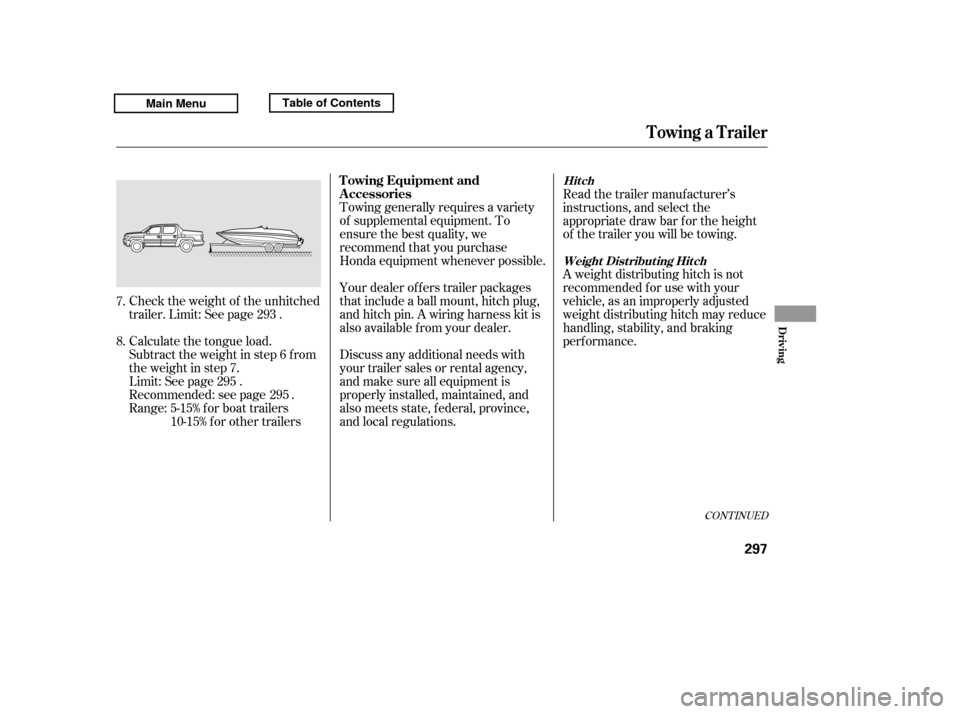
Check the weight of the unhitched
trailer. Limit: See page .Towing generally requires a variety
of supplemental equipment. To
ensure the best quality, we
recommend that you purchase
Honda equipment whenever possible.
Discuss any additional needs with
your trailer sales or rental agency,
and make sure all equipment is
properly installed, maintained, and
also meets state, f ederal, province,
and local regulations.
Your dealer of f ers trailer packages
that include a ball mount, hitch plug,
and hitch pin. A wiring harness kit is
also available f rom your dealer. Read the trailer manufacturer’s
instructions, and select the
appropriate draw bar f or the height
of the trailer you will be towing.
A weight distributing hitch is not
recommended f or use with your
vehicle, as an improperly adjusted
weight distributing hitch may reduce
handling, stability, and braking
perf ormance.
Calculate the tongue load.
Subtract the weight in step 6 f rom
the weight in step 7.
Limit: See page .
Recommended: see page .
Range: 5-15% f or boat trailers
10-15% f or other trailers
7. 8.
293
295 295
CONT INUED
T owing Equipment and
A ccessoriesHitch
Weight Distributing Hitch
Towing a Trailer
Driving
297
Main MenuTable of Contents
Page 302 of 427
There are two common types of
trailer brakes: surge and electric.
Surge brakes are common f or boat
trailers, since the brakes will get wet.
If you choose electric brakes, be
sure they are electronically actuated.
Do not attempt to tap into your
vehicle’s hydraulic system. No
matter how successf ul it may seem,
any attempt to attach trailer brakes
to your vehicle’s hydraulic system
will lower braking ef f ectiveness and
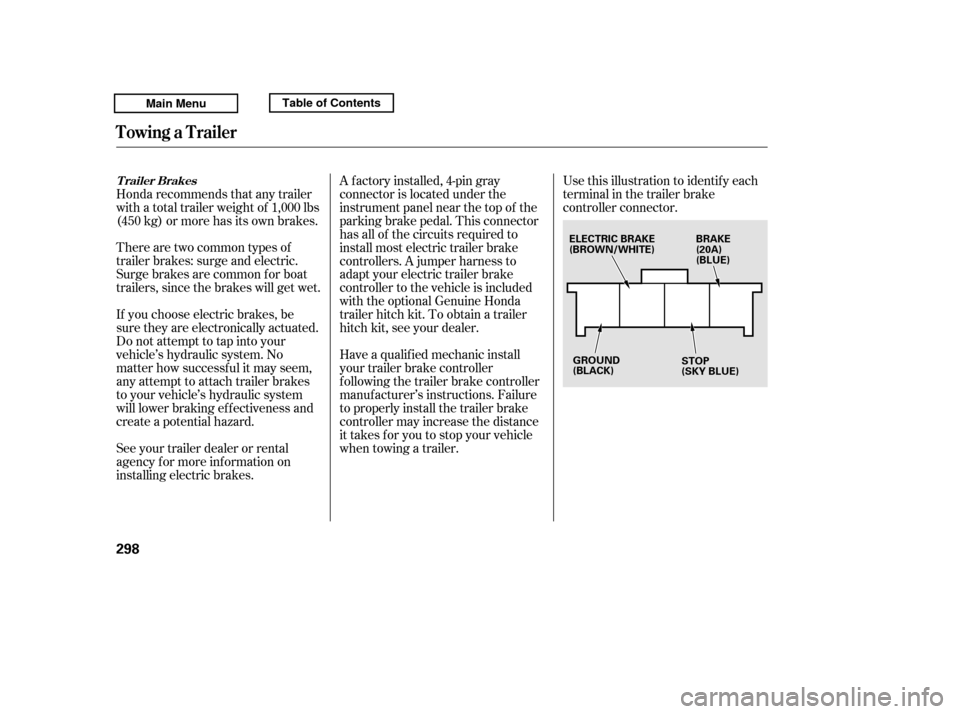
create a potential hazard.A f actory installed, 4-pin gray
connector is located under the
instrument panel near the top of the
parking brake pedal. This connector
has all of the circuits required to
install most electric trailer brake
controllers. A jumper harness to
adapt your electric trailer brake
controller to the vehicle is included
with the optional Genuine Honda
trailer hitch kit. To obtain a trailer
hitch kit, see your dealer.
Have a qualif ied mechanic install
your trailer brake controller
f ollowing the trailer brake controller
manuf acturer’s instructions. Failure
to properly install the trailer brake
controller may increase the distance
it takes f or you to stop your vehicle
when towing a trailer.Use this illustration to identif y each
terminal in the trailer brake
controller connector.
Honda recommends that any trailer
with a total trailer weight of 1,000 lbs
(450 kg) or more has its own brakes.
Seeyourtrailerdealerorrental
agency f or more inf ormation on
installing electric brakes.
Trailer Brakes
Towing a Trailer
298
BRAKE
(20A)
(BLUE)
ELECTRIC BRAKE
(BROWN/WHITE)
GROUND
(BLACK) STOP
(SKY BLUE)
Main MenuTable of Contents
Page 303 of 427

Always use saf ety chains when you
tow a trailer. Make sure the chains
are secured to the trailer and hitch,
and that they cross under the tongue
and can catch the trailer if it
becomes unhitched. Leave enough
slack to allow the trailer to turn
corners easily, but do not let the
chains drag on the ground.When towing a trailer, we
recommend that you carry a f ull-size
spare wheel and tire for your vehicle
and trailer. See page f or proper
tire size, page f or how to store a
full size wheel and tire, and page
f or inf ormation on changing a
flat tire.
Remember to unhitch the trailer
bef ore changing a f lat. Ask your
trailer sales or rental agency where
and how to store the trailer’s spare
tire.
This device is recommended if your
trailer tends to sway. Your trailer
dealer or rental agency can tell you
what kind of sway control you need
and how to install it.
Many states and provinces require
special exterior mirrors when towing
a trailer. Even if they don’t, you
should install special mirrors if you
cannot clearly see behind you, or if
the trailer creates a blind spot. 366
353
361
Saf et y Chains
Sway Cont rol Spare Tires
Trailer Mirrors
Towing a Trailer
Driving
299
Main MenuTable of Contents
Page 304 of 427
�´
Trailer lights and equipment must
comply with f ederal, state, province/
territory, and local regulations.
Check trailer light requirements f or
the areas where you plan to tow, and
use only equipment designed f or
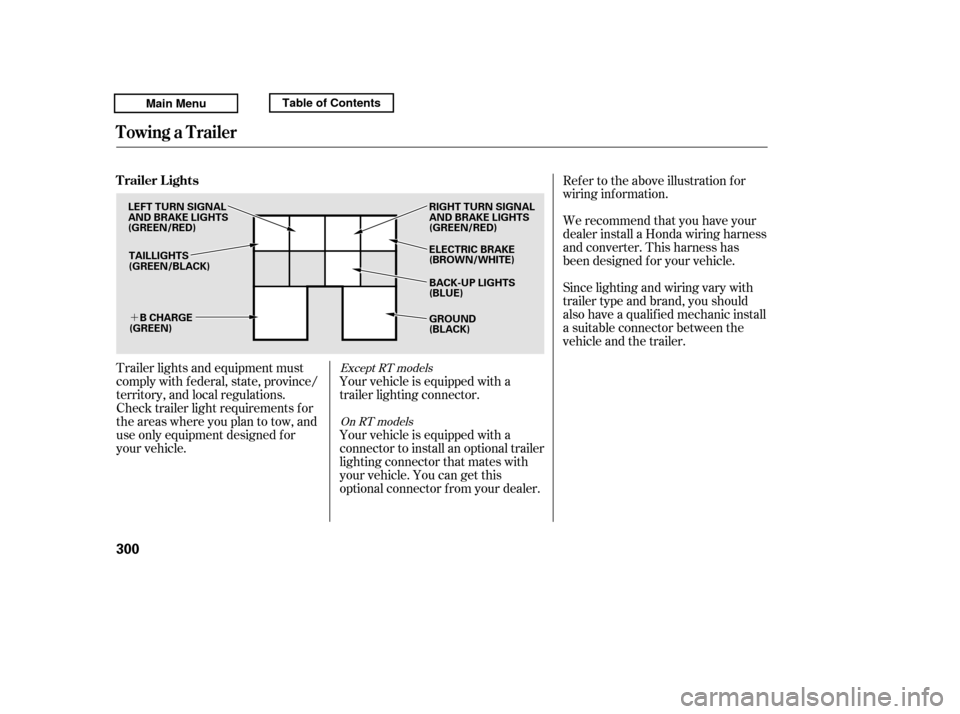
your vehicle.Ref er to the above illustration f or
wiring information.
We recommend that you have your
dealer install a Honda wiring harness
and converter. This harness has
been designed f or your vehicle.
Your vehicle is equipped with a
trailer lighting connector.
Your vehicle is equipped with a
connector to install an optional trailer
lighting connector that mates with
your vehicle. You can get this
optional connector f rom your dealer. Since lighting and wiring vary with
trailer type and brand, you should
also have a qualif ied mechanic install
a suitable connector between the
vehicle and the trailer.Except RT models
On RT models
Trailer Lights
Towing a Trailer
300
TAILLIGHTS
(GREEN/BLACK) ELECTRIC BRAKE
(BROWN/WHITE)
RIGHT TURN SIGNAL
AND BRAKE LIGHTS
(GREEN/RED) GROUND
(BLACK)
B CHARGE
(GREEN)
LEFT TURN SIGNAL
AND BRAKE LIGHTS
(GREEN/RED)
BACK-UP LIGHTS
(BLUE)
Main MenuTable of Contents
Page 305 of 427
CONT INUED
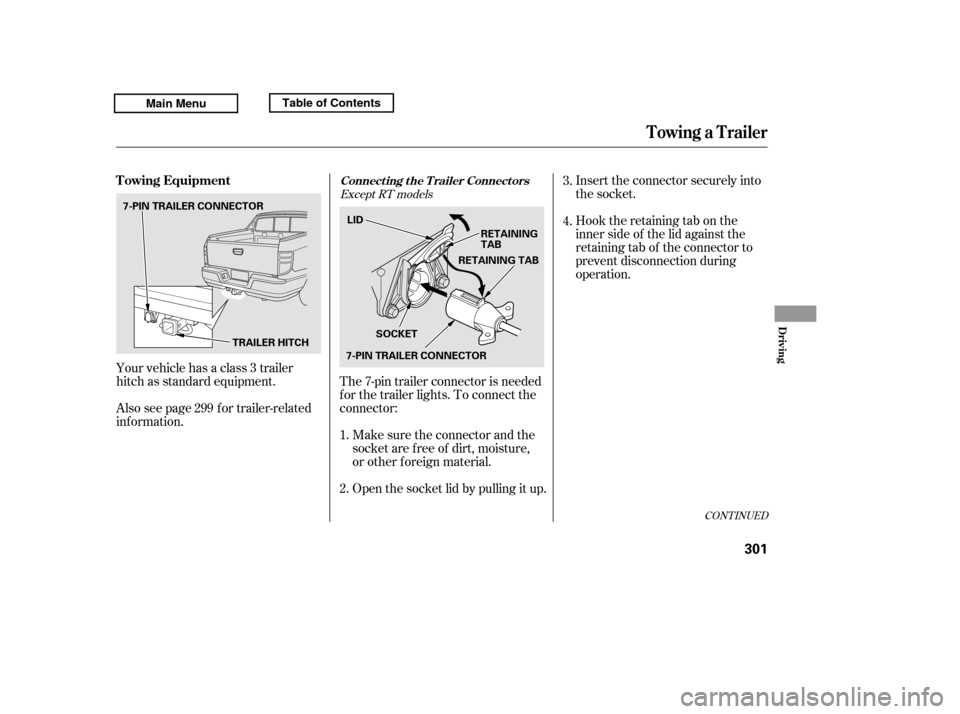
Insert the connector securely into
the socket.
Hook the retaining tab on the
inner side of the lid against the
retaining tab of the connector to
prevent disconnection during
operation.
Your vehicle has a class 3 trailer
hitch as standard equipment. Make sure the connector and the
socketarefreeof dirt,moisture,
or other f oreign material.
Open the socket lid by pulling it up.
Also see page f or trailer-related
inf ormation.
The 7-pin trailer connector is needed
f or the trailer lights. To connect the
connector: 1. 2.3. 4.
299
Except RT models
Towing Equipment
Towing a Trailer
Connect ing t he T railer Connect ors
Driving
301
TRAILER HITCH
7-PIN TRAILER CONNECTOR
7-PIN TRAILER CONNECTORLID
RETAINING TAB
SOCKET RETAINING TAB
Main MenuTable of Contents
Page 306 of 427
�´
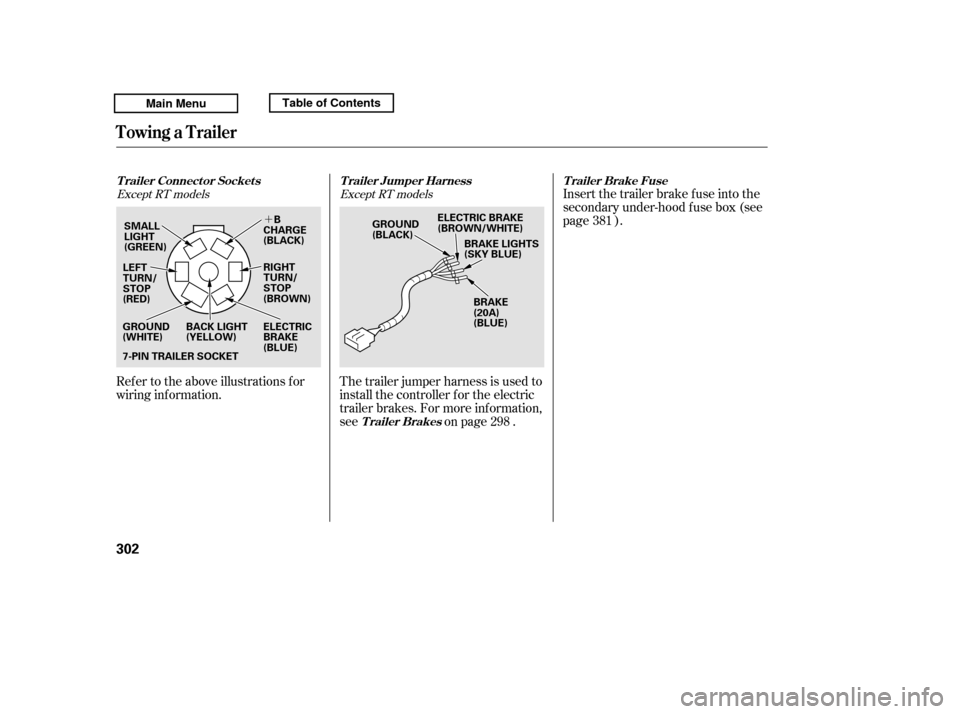
Ref er to the above illustrations f or
wiring information.The trailer jumper harness is used to
install the controller f or the electric
trailer brakes. For more inf ormation,
see on page .Insert the trailer brake f use into the
secondary under-hood f use box (see
page ).
298 381
Except RT models Except RT models
T railer Connect or Socket s T railer Jumper Harness
Trailer BrakesT railer Brake Fuse
Towing a Trailer
302
7-PIN TRAILER SOCKET
SMALL
LIGHT
(GREEN)
BACK LIGHT
(YELLOW)
GROUND
(WHITE) GROUND
(BLACK)
ELECTRIC BRAKE
(BROWN/WHITE)
LEFT
TURN/
STOP
(RED) BRAKE
(20A)
(BLUE)
B
CHARGE
(BLACK)
RIGHT
TURN/
STOP
(BROWN)
ELECTRIC
BRAKE
(BLUE) BRAKE LIGHTS
(SKY BLUE)
Main MenuTable of Contents
Page 307 of 427

The added weight, length, and
height of a trailer will af f ect your
vehicle’s handling and perf ormance,
so driving with a trailer requires
some special driving skills and
techniques.
The vehicle has been properly
serviced, and the tires, brakes,
suspension, cooling system, and
lights are in good operating
condition.
The trailer has been properly
serviced and is in good condition.
All weights and loads are within
limits.
Thehitch,safetychains,andany
other attachments are secure.
Allitemsonandinthetrailerare
properly secured and cannot shif t
while you drive.
When preparing to tow, and bef ore
driving away, be sure to check the
f ollowing:
Towing perf ormance can be
af f ected by high altitude, high
temperature, or when climbing
steep grades. Theref ore, premium
f uel (premium unleaded gasoline
with pump octane number of 91 or
higher) is recommended when
towing more than 3,500 lbs (1,590
kg).
The trailer tires and spare are in
good condition and inf lated as
recommended by the trailer
maker.
Your vehicle tires and spare are in
good condition and properly
inf lated.
The lights and brakes on your
vehicle and the trailer are working
properly.
Foryoursafetyandthesafetyof
others,taketimetopracticedriving
maneuvers bef ore heading f or the
open road, and f ollow the guidelines
on the f ollowing page.
CONT INUED
Driving Saf ely With a T railer
Pre-T ow Checklist
Towing a Trailer
Driving
303
Main MenuTable of Contents