Page 408 of 574
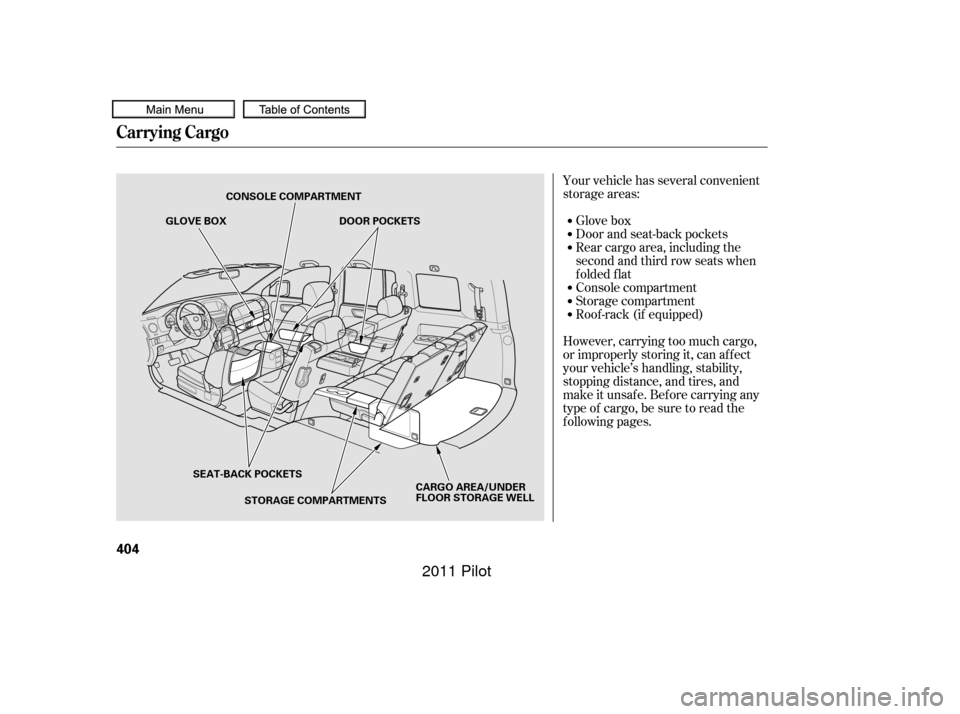
Your vehicle has several convenient
storage areas:Glove box
Rear cargo area, including the
second and third row seats when
folded flat
Console compartment
Storage compartment Door and seat-back pockets
Roof -rack (if equipped)
However, carrying too much cargo,
or improperly storing it, can af f ect
your vehicle’s handling, stability,
stopping distance, and tires, and
make it unsaf e. Bef ore carrying any
type of cargo, be sure to read the
f ollowing pages.
Carrying Cargo
404
GLOVE BOX CONSOLE COMPARTMENT
SEAT-BACK POCKETS CARGO AREA/UNDER
FLOOR STORAGE WELL
DOOR POCKETS
STORAGE COMPARTMENTS
10/01/26 19:32:57 31SZA620_409
2011 Pilot
Page 414 of 574

Because your vehicle rides higher
of f the ground, it has a high center
of gravity that can cause it to roll
over if you make abrupt turns. Utility
vehicles have a signif icantly higher
roll over rate than other types of
vehicles.
To prevent rollovers or loss of
control:Take corners at slower speeds
than you would with a passenger
vehicle.
Avoid sharp turns and abrupt
maneuvers whenever possible. Do not modif y your vehicle in any
way that would raise the center of
gravity.
Do not carry heavy cargo on the
roof .
Your vehicle has higher ground
clearance that allows you to travel
over bumps, obstacles, and rough
terrain. It also provides good
visibility so you can anticipate
problems earlier. Youshoulddothefollowingchecks
and adjustments bef ore you drive
your vehicle.
Make sure all windows, mirrors,
and outside lights are clean and
unobstructed. Remove f rost, snow,
or ice.
Check that the hood is f ully closed.
Visually check the tires. If a tire
looks low, use a gauge to check its
pressure.
Check that any items you may be
carrying are stored properly or
f astened down securely.
Check the seat adjustment (see
page ).
Your vehicle is equipped with a f our-
wheel drive (4WD) system. When
the system senses a loss of front-
wheel traction, it automatically
transf ers some power to the rear
wheels. This gives you better
traction and mobility.
You still need to exercise the same
care when accelerating, steering, and
brakingthatyouwouldinatwo-
wheel drive vehicle. 1.
2.
3.
4.
5.
154
See page f or of f -highway driving
guidelines.
4WD models only
449
Driving Guidelines, Preparing to Drive
Driving Guidelines Preparing to Drive
410
10/01/26 19:34:09 31SZA620_415
2011 Pilot
Page 437 of 574

Driving with varying tire or wheel
sizes may cause the VSA to
malf unction. When replacing tires,
make sure they are of the same size
and type as your original tires (see
page ).
If you install winter tires, make sure
they are the same size as those that
were originally supplied with your
vehicle. Exercise the same caution
during winter driving as you would if
your vehicle was not equipped with
VSA.Your vehicle is equipped with a hill
start assist f eature to help prevent
the vehicle f rom rolling on inclines
as you move your f oot f rom the
brake pedal to the accelerator.
This f eature starts operating a f ew
seconds af ter you are in any drive
gear position (when f aced uphill) or
in reverse (when f aced downhill).
This f eature requires that the
vehicle has come to a complete stop
bef ore it can work.
Hillstartassistmaynotholda
heavily loaded vehicle, such as when
your vehicle is connected to a trailer,
or prevent your vehicle f rom rolling
downhill on a very steep or slippery
slope.
502
VSA and Tire Sizes
Hill Start Assist
Vehicle Stability A ssist (VSA), aka Electronic Stability Control (ESC), System
Driving
433
10/01/26 19:38:20 31SZA620_438
2011 Pilot
Page 500 of 574

To saf ely operate your vehicle, your
tires must be the proper type and
size, in good condition with adequate
tread, and correctly inf lated.Keeping the tires properly inf lated
provides the best combination of
handling, tread lif e, and riding
comf ort.
The f ollowing pages give more
detailed inf ormation on how to take
care of your tires and what to do
when they need to be replaced. Underinf lated tires wear unevenly,
adversely affect handling and fuel
economy, and are more likely to
fail from being overheated.
Overinf lated tires can make your
vehicleridemoreharshly,are
more prone to damage f rom road
hazards, and wear unevenly.
Thetirepressuremonitoringsystem
(TPMS) warns you when a tire
pressure is low. See page or f or more inf ormation. Even though your vehicle is
equipped with TPMS, we
recommend that you visually check
your tires every day. If you think a
tire might be low, check it
immediately with a tire gauge.
Use a gauge to measure the air
pressure in each tire at least once a
month. Even tires that are in good
condition may lose 1 to 2 psi (10 to
20 kPa, 0.1 to 0.2 kgf /cm ) per
month. Remember to check the
sparetireatthesametime.
420
423
Inf lation Guidelines
Tires
496
Using tires that are excessively
worn or improperly inflated can
cause a crash in which you can
be seriously hurt or killed.
Follow all instructions in this
owner’s manual regarding tire
inflation and maintenance.
10/01/26 19:49:06 31SZA620_501
2011 Pilot
Page 505 of 574
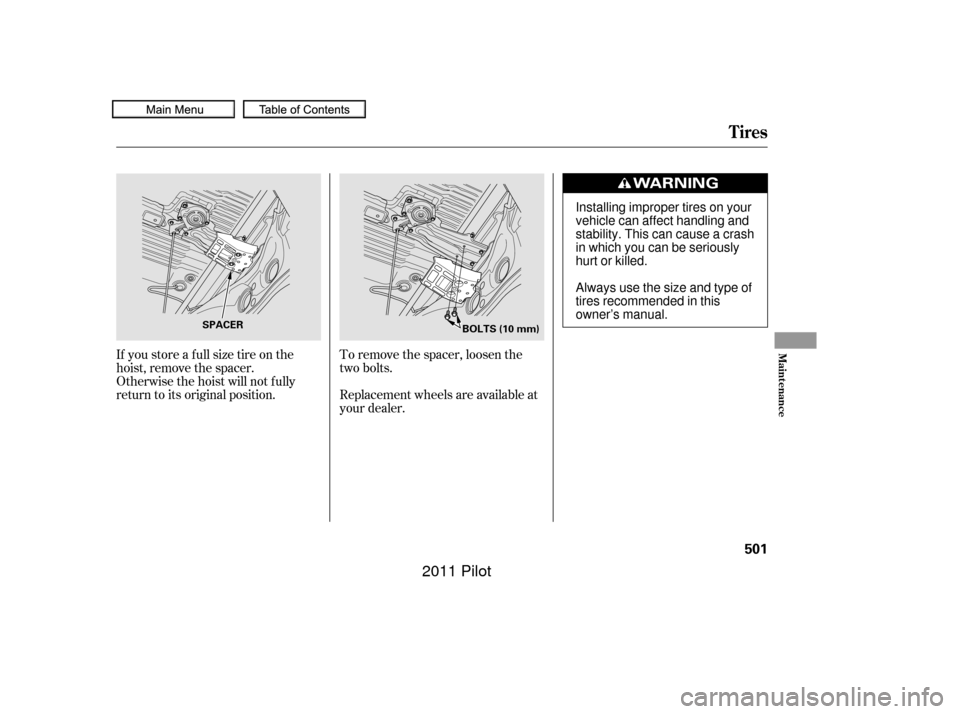
If you store a f ull size tire on the
hoist, remove the spacer.
Otherwise the hoist will not f ully
return to its original position.To remove the spacer, loosen the
two bolts.
Replacement wheels are available at
your dealer.
Tires
Maint enance
501
SPACER
BOLTS (10 mm)
Installing improper tires on your
vehicle can affect handling and
stability. This can cause a crash
in which you can be seriously
hurt or killed.
Always use the size and type of
tires recommended in this
owner’s manual.
10/01/26 19:49:59 31SZA620_506
2011 Pilot
Page 542 of 574

�µ�µ�Î
�Î
�Î�Î
�Î
�Î�Î
�Î �Î
�Î
�Î
�Î
�Î
�Î
Specif ications
538
Seating Capacities Air Conditioning Dimensions Capacities
Weights 1.98 US gal (7.5
)
2.48 US gal (9.4)
4.5 US qt (4.3
)
4.2 US qt (4.0
)
5.3 US qt (5.0
)
190.9 in (4,850 mm)
78.5 in (1,995 mm)
70.9 in (1,802 mm)
21.00 US gal (79.5
)
Total
Front
Second
Third 33 2
8
Refrigerant type
Charge quantity
Lubricant type
ND-OIL8
21.2 22.9 oz (600 650 g) HFC-134a (R-134a)
The GCWR must be reduced 2 percent for every 1,000 feet (305
meters) of elevation. See the tire information label atta-
ched to the driver’s doorjamb.
8,466 lbs (3,840 kg)
Length
Width
Height
Wheelbase
Track
67.5 in (1,715 mm) 67.7 in (1,720 mm)
109.3 in (2,775 mm)
Excluding the oil remaining in the engine
0.196 US gal (0.74
)
Including the coolant in the reserve tank and that remaining in the
engine
Reserve tank capacity: 4.2 US qt (4.0
)
Fuel tank
Engine
coolant
Engine oil
Automatic
transmission
fluid
Rear
differential
fluid (4WD)
Transfer
assembly
fluid (4WD)
Windshield
washer
reservoir
6.9 US qt (6.5)
72.7 in (1,846 mm)
9,579 lbs (4,345 kg)
3.6 US qt (3.4
)
8.6 US qt (8.1)
3.6 US qt (3.4)
8.6 US qt (8.1)
2.79 US qt (2.64)
3.01 US qt (2.85)
0.45 US qt (0.43
)
0.48 US qt (0.45)
Gross vehicle weight rating
Gross combined weight
rating (GCWR) Approx.
Front
Rear
1:
2:U.S. vehicles
Canadian
vehicles
1 :
2 : Except U.S. LX models
U.S. LX models
2WD models
1:
2:
3: 4WDmodels 2WD
4WDChange
Total
Change
Including
filter
Without
filter
Total
Change
Total
Change
Total
Change
Total
Change
Total
1 1
2
1
2
2
3
10/01/26 19:55:55 31SZA620_543
2011 Pilot
Page 543 of 574

�µ
�µ
�µ
�µ
�Î �µ
�µ
�µ
�µ
�µ
�µ
�µ
�µ
�µ
�µ
�µ
�µ
�µ
�µ
�µ
�µ
�µ
�Î
Specif ications
Technical Inf ormation
539
Battery Fuses
Engine
Alignment
Tires
Lights
60 W
12 V
12 V 55 W
12 V 8 W
12 V 4 CP
8W
5W
1.4 W
2CP
12 V
12 V
12 V
12 V 12 V 12 V
28/8 W
3CP
12 V 5 W
12 V 18 W 55 W
12 V 60 W
12 V
Capacity 12 V
12 V 60 AH/5 HR
72 AH/20 HR
12 V 21/5 W
12 V 21/5 W
5W
12 V Interior
Rear
Under-hood
Type
BorexStroke
Displacement
Compression ratio
Spark plugs
Water cooled 4-stroke SOHC i-VTEC
VCM 6-cylinder (V6) gasoline engine 3.50 x 3.66 in (89.0 x 93.0 mm) 212 cu-in (3,471 cm
)
10.5 : 1
SXU22HCR11
ILZKR7B11
Toe-in
Camber
Caster 0.00 in (0.0 mm)
0.08 in (2.0 mm)
0°30’
0°30’
4°12’
Size
Pressure P245/65R17 105T
T165/80D17 104M
32 psi (220 kPa , 2.2 kgf/cm
)
60 psi (420 kPa , 4.2 kgf/cm)
See page
530or the fuse label
attached on the side panel.
See page 529or the fuse label
attached to the inside of the fuse
box lid.
See page 528and 529or the fuse
box cover.
Headlights
Daytime running lights
Front side marker lights
Front turn signal/
parking lights
Front fog lights
Rear turn signal/taillights
Stop/taillights
Rear side marker lights
Back-up lights
License plate lights
Individual map lights
Cargo area lights
High-mount brake lights
Vanity mirror lights
Door courtesy lights
Front/Rear
Spare
Front/Rear
Spare Front
Rear
Front
Rear
Front
Front
Rear
: (H11) (HB3)
(HB3)
DENSO:
NGK:
(H11)
High
Low
Except LX models
10/01/26 19:56:25 31SZA620_544
2011 Pilot
Page 546 of 574
�µ
�µ
�µ
�µ
�µ
�µ
�µ
�µ
�µ
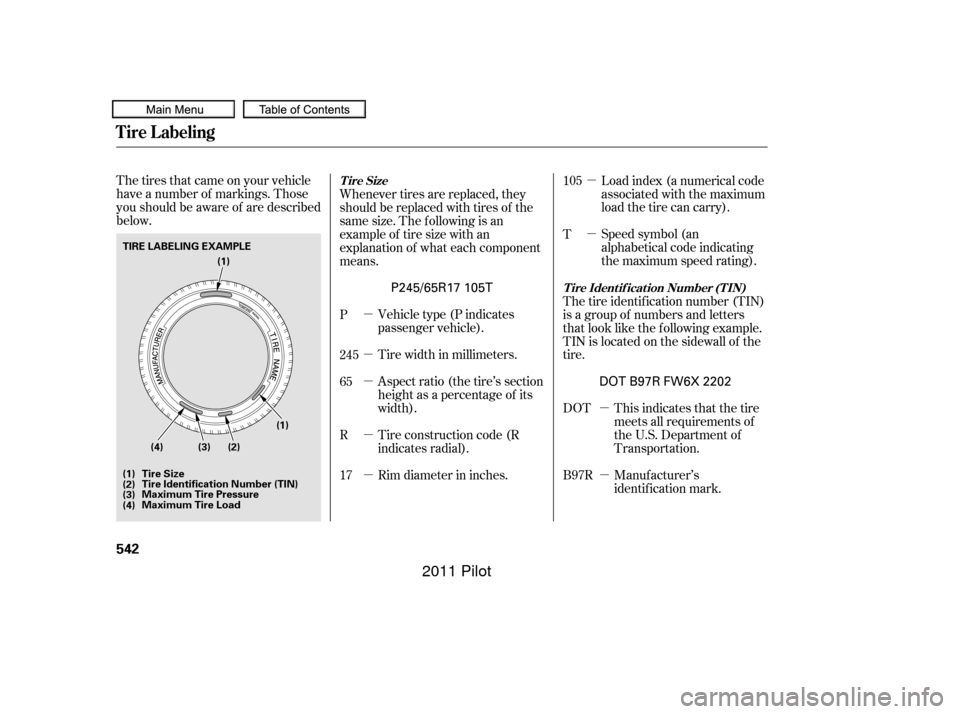
The tires that came on your vehicle
have a number of markings. Those
you should be aware of are described
below.
Load index (a numerical code
associated with the maximum
load the tire can carry).
Speed symbol (an
alphabetical code indicating
the maximum speed rating).
Whenever tires are replaced, they
should be replaced with tires of the
same size. The f ollowing is an
exampleof tiresizewithan
explanation of what each component
means.
Vehicletype(Pindicates
passenger vehicle).
Tire width in millimeters.
Aspect ratio (the tire’s section
height as a percentage of its
width).
Tire construction code (R
indicates radial).
Rim diameter in inches. The tire identif ication number (TIN)
is a group of numbers and letters
that look like the f ollowing example.
TIN is located on the sidewall of the
tire.
This indicates that the tire
meets all requirements of
the U.S. Department of
Transportation.
Manuf acturer’s
identification mark.
P
R
DOT
B97R
245
65
17 105
T
Tire Labeling
Tire Size
T ire Ident if icat ion Number (T IN)
542
TIRE LABELING EXAMPLE
(1)
(2)
(3)
(4)Tire Size
Tire Identification Number (TIN)
Maximum Tire Pressure
Maximum Tire Load (1)
(1)
(3) (2)
(4)
DOT B97R FW6X 2202
P245/65R17 105T
10/01/26 19:56:57 31SZA620_547
2011 Pilot