Page 455 of 574

If you get stuck, engage the VTM-4
Lock (see page ). Caref ully try to
go in the direction (f orward or
reverse) that you think will get you
unstuck. Do not spin the tires at high
speeds. It will not help you get out
and may cause damage to the
transmission or VTM-4 system.
If you are still unable to f ree yourself ,
your vehicle is equipped with f ront
and rear tow hooks designed f or this
purpose.
Bef ore driving through water, stop,
get out if necessary, and make sure
that:
If the water is deeper than the wheel
hubs, some additional service may
be required. This service is not
covered by your warranties. After driving through water, test
your brakes. If they got wet, gently
‘‘pump’’ them while driving slowly
until they operate normally. If you decide it is saf e to drive
through water, choose a suitable
speed and engage the VTM-4 Lock.
Proceed without shif ting or changing
speeds, and do not stop the vehicle
or shut of f the engine.The banks and surf ace under the
water provide good traction. The
water may hide hazards such as
rocks, holes, or mud.
The water is not f lowing too f ast.
Deep rushing water can sweep you
downstream. Even very shallow
rushingwatercanwashthe
ground f rom under your tires and
cause you to lose traction and
possibly roll over. The banks are sloped so you can
drive out. The water is not deep enough to
cover your wheel hubs, axles, or
exhaust pipe. You could stall and
not be able to restart your engine.
The water can also damage
important vehicle components. 418
CONT INUED
Of f -Highway Driving Guidelines
If You Get Stuck
Crossing a Stream
Driving
451
10/01/26 19:41:51 31SZA620_456
2011 Pilot
Page 457 of 574
This section explains why it is
important to keep your vehicle well
maintained and how to f ollow basic
maintenance saf ety precautions.
This section also includes
instructions on how to read the
maintenance inf ormation messages
on the inf ormation display or multi-
inf ormation display (depending on
models), and instructions f or simple
maintenance tasks you may want to
take care of yourself .
If you have the skills and tools to
perf orm more complex maintenance
tasks on your vehicle, you may want
to purchase the service manual. See
page f or inf ormation on how to
obtain a copy, or see your dealer.......................
Maintenance Saf ety .454
............
Maintenance Inf ormation . 455
..............................
Fluid Locations .470
......
Engine Compartment Covers . 471
........................
Adding Engine Oil .472
Changing the Engine Oil and ...........................................
Filter .473
..............................
Engine Coolant .475
....................
Windshield Washers .477
....
Automatic Transmission Fluid . 478
.................
Rear Dif f erential Fluid . 480
.............
Transf er Assembly Fluid . 480
....................................
Brake Fluid .481
....................
Power Steering Fluid . 482
....................................
Timing Belt .482
.............................................
Lights .483
..................
Dust and Pollen Filter . 490
................
Cleaning the Seat Belts . 490
.....................................
Floor Mats .491
.................................
Wiper Blades .492
...............................................
Tires .496
...................
Checking the Battery . 504
.............................
Vehicle Storage .505
..................................
Interior Care .506
557
Maintenance
Maint enance
453
10/01/26 19:42:06 31SZA620_458
2011 Pilot
Page 471 of 574

�Ì�µ
�µ�µ
We recommend the use of Honda
parts and f luids whenever you have
maintenance done. These are
manuf actured to the same high-
quality standards as the original
components, so you can be conf ident
of their perf ormance and durability.
U.S. Vehicles:
According to state and federal
regulations, f ailure to perf orm
maintenance on the items marked
with will not void your emissions
warranties. However, all
maintenance services should be
perf ormed in accordance with the
intervals indicated by the odometer/
trip meter display or the multi-
inf ormation display.Youshouldcheckthefollowing
items at the specif ied intervals. If
you are unsure of how to perf orm
any check, turn to the appropriate
page listed.
Engine oil level Check every
time you fill the fuel tank. See
page .
Engine coolant level Check the
radiator reserve tank every time
you f ill the f uel tank. See page .
Automatic transmission Check
the f luid level monthly. See page .398
398
478
CONT INUED
Maintenance Inf ormation
Maintenance, replacement, or
repair of emissions control
devices and systems may be done
by any automotive repair
establishment or individual using
parts that are ‘‘certif ied’’ to EPA
standards. Owner’s Maintenance Checks
Maint enance
467
10/01/26 19:44:30 31SZA620_472
2011 Pilot
Page 473 of 574

�Î
�Î�Ì �Ì �Î
�Î
�µ�µ�Ì
�Î
�Î
Maintenance Inf ormation
469
Maintenance Main Items
Replace engine oil
Replace engine oil and oil filter
Inspect front and rear brakes
Check parking brake adjustment
Inspect these items: Tie rod ends, steering gear box, and boots
Suspension components
Driveshaft boots
Brake hoses and lines (including ABS/VSA)
All fluid levels and condition of fluids
Exhaust system
Fuel lines and connections Maintenance Sub Items
Rotate tires
Replace air cleaner element
Replace dust and pollen filter
Inspect drive belt
Replace transmission and transfer fluid
Replace spark plugs
Replace timing belt and inspect water pump
Inspect valve clearance
Replace engine coolant
Replace VTM-4 rear differential fluid
Symbol
Symbol
A B 1
2
3
4
5
61
1
22
See information on maintenance and emissions warranty on page . If the message, ‘‘SERVICE’’ does not appear more than 12 months after the
display is reset, change the engine oil every year.Independent of the maintenance messages in the information display,
replace the brake fluid every 3 years.
Inspect idle speed every 160,000 miles (256,000 km).
Adjust the valves during services A, B, 1, 2, or 3 if they are noisy.
:
NOTE : 467
1:
2 : 4WD models only
If you drive in dusty conditions, replace every 15,000
miles (24,000 km).
If you drive primarily in urban areas that have high
concentrations of soot in the air from industry and from
diesel-powered vehicles, replace every 15,000 miles
(24,000 km).
If you drive regularly in very high temperatures
(over 110°F, 43°C), in very low temperatures
(under 20°F, 29°C), or towing a trailer, replace every
60,000 miles (U.S.)/100,000 km (Canada).
Driving in mountainous areas at very low vehicle
speeds or trailer towing results in higher level of
mechanical (shear) stress to fluid. This requires
differential fluid changes more frequently than
recommended by the maintenance information. If you
regularly drive your vehicle under these conditions,
have the differential fluid changed at 7,500 miles
(12,000 km), then every 15,000 miles (24,000 km).
Maintenance Information
10/01/26 19:44:45 31SZA620_474
2011 Pilot
Page 474 of 574
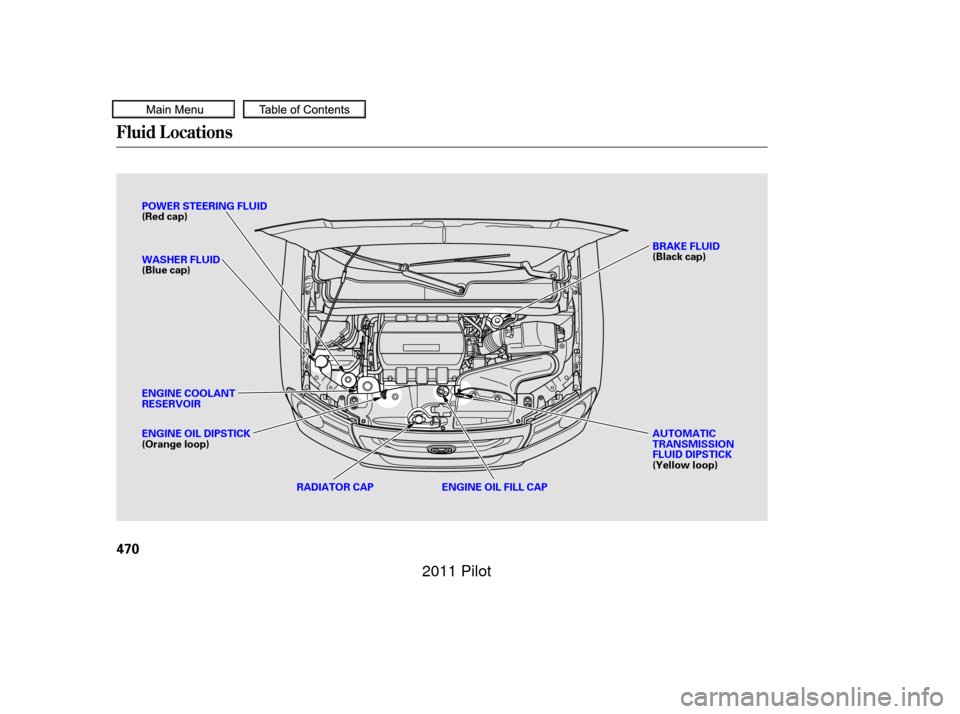
Fluid Locations
470
WASHER FLUID
(Blue cap)RADIATOR CAP
ENGINE OIL DIPSTICK
(Orange loop)
AUTOMATIC
TRANSMISSION
FLUID DIPSTICK
(Yellow loop)
POWER STEERING FLUID
(Red cap)
ENGINE COOLANT
RESERVOIR
ENGINE OIL FILL CAPBRAKE FLUID
(Black cap)
10/01/26 19:44:50 31SZA620_475
2011 Pilot
Page 477 of 574
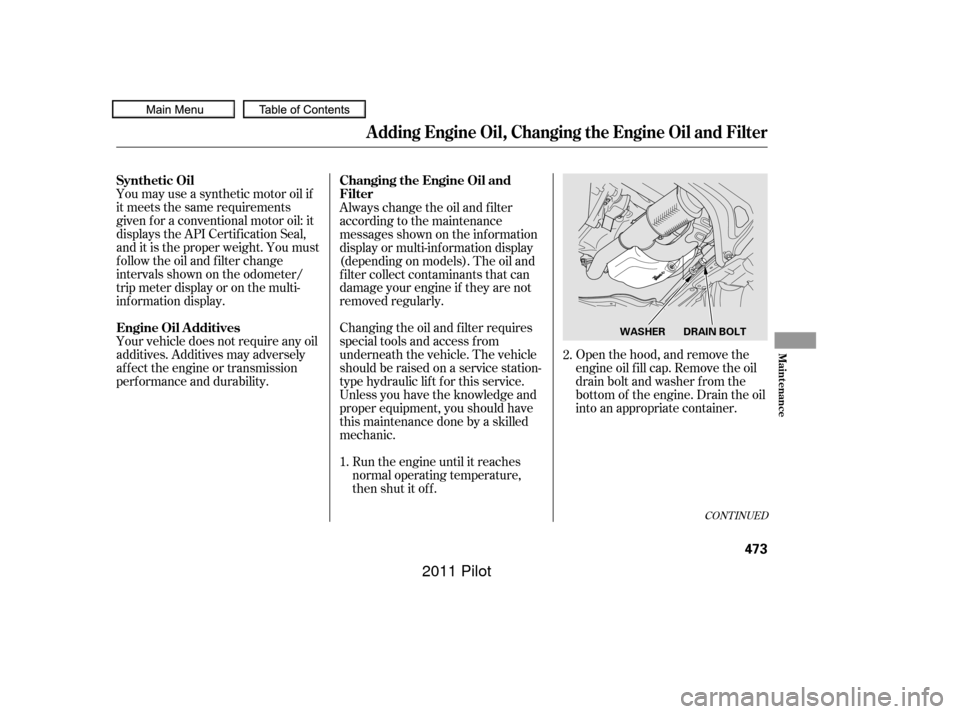
Open the hood, and remove the
engine oil f ill cap. Remove the oil
drain bolt and washer f rom the
bottom of the engine. Drain the oil
into an appropriate container.
You may use a synthetic motor oil if
it meets the same requirements
given f or a conventional motor oil: it
displays the API Certif ication Seal,
and it is the proper weight. You must
f ollow the oil and f ilter change
intervals shown on the odometer/
trip meter display or on the multi-
inf ormation display.
Your vehicle does not require any oil
additives. Additives may adversely
af f ect the engine or transmission
perf ormance and durability.
Always change the oil and f ilter
according to the maintenance
messages shown on the inf ormation
display or multi-inf ormation display
(depending on models). The oil and
f ilter collect contaminants that can
damage your engine if they are not
removed regularly.
Changing the oil and f ilter requires
special tools and access f rom
underneath the vehicle. The vehicle
should be raised on a service station-
type hydraulic lif t f or this service.
Unless you have the knowledge and
proper equipment, you should have
this maintenance done by a skilled
mechanic.
Run the engine until it reaches
normal operating temperature,
then shut it off.
1. 2.
CONT INUED
Synthetic Oil
Changing the Engine Oil and
Filter
Engine Oil A dditives
A dding Engine Oil, Changing the Engine Oil and Filter
Maint enance
473
WASHER DRAIN BOLT
10/01/26 19:45:19 31SZA620_478
2011 Pilot
Page 482 of 574
Remove the dipstick (yellow loop)
f rom the transmission, and wipe it
with a clean cloth.Insert the dipstick all the way into
the transmission securely as
shown in the illustration.
Remove the dipstick and check
the f luid level. It should be
between the upper and lower
marks.
Check the f luid level with the engine
at normal operating temperature.
Park the vehicle on level ground.
Start the engine, let it run until the
radiator f an comes on, then shut
of f the engine. For accurate
results, wait about 60 seconds (but
no longer than 90 seconds) bef ore
doing step 2.
The transmission should be drained
and ref illed with new f luid when this
service is shown on the inf ormation
display or multi-inf ormation display
(depending on models).
1.
2.3.
4.
Automatic Transmission Fluid
478
DIPSTICKDIPSTICK
UPPER MARK
LOWER MARK
10/01/26 19:46:11 31SZA620_483
2011 Pilot
Page 483 of 574
If the level is below the lower
mark, add f luid into the dipstick
hole to bring it to the level
between the upper and lower
marks.
Pour the f luid slowly and caref ully
so you do not spill any. Clean up
any spill immediately; it could
damage components in the engine
compartment.The transmission should be drained
and ref illed with new f luid when this
service is indicated by a maintenance
message on the multi-inf ormation
display.
If you are not sure how to add f luid,
contact your dealer.
Always use Honda Genuine
ATF-Z1 (automatic transmission
f luid).
Insert the dipstick all the way back
into the transmission securely as
shown in the illustration.
Make sure the rubber cap on the
dipstick f its in the dipstick guide
and that you push the dipstick in
all the way.
5.
6.
Automatic Transmission Fluid
Maint enance
479
Use only Honda Genuine ATF-Z1
(automatic transmission f luid). Do not
mix with other transmission f luids.
Using transmission f luid other than
Honda Genuine ATF-Z1 may cause
deterioration in transmission operation
and durability, and could result in
damage to the transmission.
Damage resulting f rom the use of
transmission f luid other than Honda
Genuine ATF-Z1 is not covered by the
Honda new vehicle warranty.
10/01/26 19:46:21 31SZA620_484
2011 Pilot