Page 449 of 574
�´
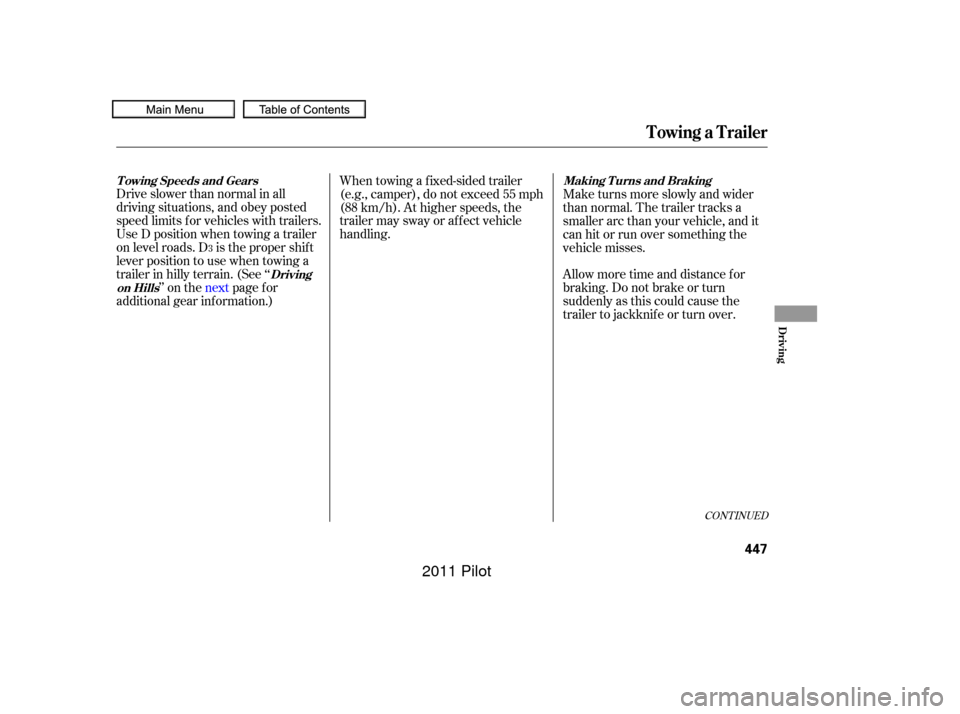
Ref er to the above illustrations f or
wiring information.The trailer jumper harness is used to
install the controller f or the electric
trailer brakes. For more inf ormation,
see
on page .
Insert the connector securely into
the socket.
Hook the retaining tab on the
inner side of the lid against the
retaining tab of the connector to
prevent disconnection during
operation.
Insert the trailer brake f use into the
secondary under-hood f use box (see
page ).
3.
441
529
On Touring models On Touring models
Towing a Trailer
T railer Jumper Harness
T railer Connect or Socket s
Trailer Brakes
T railer Brake Fuse
Driving
445
7-PIN TRAILER SOCKET SMALL
LIGHT
(GREEN)
LEFT
TURN/
STOP
(RED)
BACK LIGHT
(YELLOW) GROUND
(BLACK)
BRAKE
(20A)
(BLUE)
ELECTRIC BRAKE
(BROWN/WHITE)
BRAKE LIGHTS
(SKY BLUE)
B
CHARGE
(BLUE)
RIGHT
TURN/
STOP
(WHITE)
ELECTRIC
BRAKE
(BROWN/
WHITE)
GROUND
(BLACK)
10/01/26 19:40:35 31SZA620_450
2011 Pilot
Page 450 of 574

When preparing to tow, and bef ore
driving away, be sure to check the
f ollowing:The added weight, length, and
height of a trailer will af f ect your
vehicle’s handling and perf ormance,
so driving with a trailer requires
some special driving skills and
techniques.
The vehicle has been properly
serviced, and the suspension and
the cooling system are in good
operating condition. The lights and brakes on your
vehicle and the trailer are working
properly.
Your vehicle tires and spare are in
good condition and properly
inf lated.
The trailer has been properly
serviced and is in good condition.
All weights and loads are within
limits.
Thehitch,safetychains,andany
other attachments are secure.
Allitemsonandinthetrailerare
properly secured and cannot shif t
while you drive. Foryoursafetyandthesafetyof
others,taketimetopracticedriving
maneuvers bef ore heading f or the
open road, and f ollow the guidelines
in this section.
Towing perf ormance can be
af f ected by high altitude, high
temperature, or when climbing
steep grades. Theref ore, premium
f uel (premium unleaded gasoline
with pump octane number of 91 or
higher) is recommended when
towing more than 3,500 lbs (1,590
kg).
The trailer tires and spare are in
good condition and inf lated as
recommended by the trailer
maker.
Towing a Trailer
Pre-T ow Checklist
Driving Saf ely With a T railer
446
10/01/26 19:40:49 31SZA620_451
2011 Pilot
Page 451 of 574
CONT INUED
Drive slower than normal in all
driving situations, and obey posted
speed limits f or vehicles with trailers.
Use D position when towing a trailer
on level roads. D is the proper shif t
lever position to use when towing a
trailer in hilly terrain. (See ‘‘’’onthenext pagefor
additional gear information.) When towing a f ixed-sided trailer
(e.g., camper), do not exceed 55 mph
(88 km/h). At higher speeds, the
trailer may sway or affect vehicle
handling.
Maketurnsmoreslowlyandwider
than normal. The trailer tracks a
smaller arc than your vehicle, and it
canhitorrunoversomethingthe
vehicle misses.
Allow more time and distance f or
braking. Do not brake or turn
suddenly as this could cause the
trailer to jackknif e or turn over.
3
Towing a Trailer
T owing Speeds and Gears
Driving
on Hills Making T urns and Braking
Driving
447
10/01/26 19:40:58 31SZA620_452
2011 Pilot
Page 452 of 574
When climbing hills, closely watch
your temperature gauge. If it nears
the red (Hot) mark, turn the air
conditioning of f , reduce speed and, if
necessary, pull to the side of the
road to let the engine cool.Always drive slowly and have
someone guide you when backing up.
Grip the of the steering wheel,
then turn the wheel to the left to get
the trailer to move to the lef t. Turn
the wheel to the right to move the
trailer to the right.
Follow all normal precautions when
parking, including putting the
transmission in Park and f irmly
setting the parking brake. Also, place
wheel chocks at each of the trailer’s
tires. Crosswinds and air turbulence
caused by passing trucks can disrupt
your steering and cause the trailer to
sway. When being passed by a large
vehicle, keep a constant speed, and
steer straight ahead. Do not try to
make quick steering or braking
corrections.If the vehicle’s tires slip when
retrieving a boat f rom the water,
shif t to f irst gear, and turn on VTM-4
lock (see page ). Disengage
VTM-4 lock as soon as the boat is
out of the water to prevent damage
to the VTM-4 system.
Your vehicle is not designed to be
towed behind a motor home. If your
vehicle needs to be towed in an
emergency, see page .
If the automatic transmission shif ts
f requently while going up a hill, shif t
to D .
When driving down hills, reduce
your speed and shif t down to D . Do
not ‘‘ride’’ the brakes. If you must stop when f acing uphill,
use the f oot brake or parking brake.
Do not try to hold the vehicle in
placebypressingontheaccelerator,
as this can cause the automatic
transmission to overheat. 418
531
bottom
3
3
Driving on Hills Handling Crosswinds and Buf f et ing
Backing UpParking Ret rieving a Boat
Towing a Trailer
Towing Your Vehicle
Remember, it
takes longer to slow down and
stop when towing a trailer.
448
10/01/26 19:41:12 31SZA620_453
2011 Pilot
Page 456 of 574
Use a nylon strap to attach your
vehicle to the recovery vehicle, and
caref ully take out the slack in the
strap. Once the strap is tight, the
recovery vehicle should apply f orce.
Remember that the recovery vehicle
needs good traction to avoid
becoming stuck, too.
You should never use a jack to try to
get unstuck. Your vehicle could
easily slip of f the jack and hurt you
or someone else.You may be able to safely tow a
lightweight trailer (such as a
motorcycle or small tent trailer) of f -
road if you f ollow these guidelines.
Do not exceed 1,000 lbs (450 kg)
or a tongue weight of 100 lbs (45
kg).
Stay on smooth, level dirt roads,
and avoid driving in hilly terrain.
Allow extra room f or starting,
stopping, and turning.
Slow down if you encounter bumps
or other obstacles.
Of f -Highway Driving Guidelines
Towing a Trailer Off-Road
452
10/01/26 19:42:00 31SZA620_457
2011 Pilot
Page 473 of 574

�Î
�Î�Ì �Ì �Î
�Î
�µ�µ�Ì
�Î
�Î
Maintenance Inf ormation
469
Maintenance Main Items
Replace engine oil
Replace engine oil and oil filter
Inspect front and rear brakes
Check parking brake adjustment
Inspect these items: Tie rod ends, steering gear box, and boots
Suspension components
Driveshaft boots
Brake hoses and lines (including ABS/VSA)
All fluid levels and condition of fluids
Exhaust system
Fuel lines and connections Maintenance Sub Items
Rotate tires
Replace air cleaner element
Replace dust and pollen filter
Inspect drive belt
Replace transmission and transfer fluid
Replace spark plugs
Replace timing belt and inspect water pump
Inspect valve clearance
Replace engine coolant
Replace VTM-4 rear differential fluid
Symbol
Symbol
A B 1
2
3
4
5
61
1
22
See information on maintenance and emissions warranty on page . If the message, ‘‘SERVICE’’ does not appear more than 12 months after the
display is reset, change the engine oil every year.Independent of the maintenance messages in the information display,
replace the brake fluid every 3 years.
Inspect idle speed every 160,000 miles (256,000 km).
Adjust the valves during services A, B, 1, 2, or 3 if they are noisy.
:
NOTE : 467
1:
2 : 4WD models only
If you drive in dusty conditions, replace every 15,000
miles (24,000 km).
If you drive primarily in urban areas that have high
concentrations of soot in the air from industry and from
diesel-powered vehicles, replace every 15,000 miles
(24,000 km).
If you drive regularly in very high temperatures
(over 110°F, 43°C), in very low temperatures
(under 20°F, 29°C), or towing a trailer, replace every
60,000 miles (U.S.)/100,000 km (Canada).
Driving in mountainous areas at very low vehicle
speeds or trailer towing results in higher level of
mechanical (shear) stress to fluid. This requires
differential fluid changes more frequently than
recommended by the maintenance information. If you
regularly drive your vehicle under these conditions,
have the differential fluid changed at 7,500 miles
(12,000 km), then every 15,000 miles (24,000 km).
Maintenance Information
10/01/26 19:44:45 31SZA620_474
2011 Pilot
Page 486 of 574

�µ�µ
Check the level on the side of the
reservoir when the engine is cold.
The f luid should be between the
UPPER LEVEL and LOWER LEVEL.
If not add power steering f luid to the
UPPER LEVEL mark. Always use Honda Power Steering
Fluid. You may use another power
steering f luid as an emergency
replacement, but have the power
steering system f lushed and ref illed
with Honda PSF as soon as possible.
The timing belt should be replaced
at the intervals shown in the
maintenance inf ormation schedule.
A low power steering f luid level can
indicate a leak in the system. Check
the f luid level f requently, and have
the system inspected as soon as
possible.
If you are not sure how to add
f luid, contact your dealer.
Pour the f luid slowly and caref ully so
you do not spill any. Clean up any
spills immediately; it could damage
components in the engine
compartment. Replace the timing belt every 60,000
miles (U.S.) or every 100,000 km
(Canada) if you regularly drive your
vehicle in any of the f ollowing
conditions:
In very high temperatures
(over 110°F, 43°C).
In very low temperatures
(under 20°F, 29°C).
Frequently towing a trailer.
Timing Belt
Power Steering Fluid
Power Steering Fluid, Timing Belt
482
UPPER LEVEL
LOWER LEVEL
Turning the steering wheel to f ull lef t
or right lock and holding it there can
damage the power steering pump.
10/01/26 19:46:50 31SZA620_487
2011 Pilot
Page 511 of 574
This section covers the more
common problems that motorists
experience with their vehicles. It
gives you inf ormation about how to
safely evaluate the problem and what
to do to correct it. If the problem has
stranded you on the side of the road,
you may be able to get going again.
If not, you will also f ind instructions
on getting your vehicle towed.......................
Compact Spare Tire .508
....................
Changing a Flat Tire .509
.............
If the Engine Won’t Start . 516
................................
Jump Starting .517
..............
If the Engine Overheats . 519
.........
Low Oil Pressure Indicator . 521
..........
Charging System Indicator . 521
.......
Malf unction Indicator Lamp . 522
...............
Brake System Indicator . 523
..............................................
Fuses .524
..............................
Fuse Locations .528
......................
Emergency Towing .531
..........
If Your Vehicle Gets Stuck . 532
Taking Care of the Unexpected
T aking Care of t he Unexpect ed
507
10/01/26 19:50:56 31SZA620_512
2011 Pilot