2011 HONDA FIT tailgate
[x] Cancel search: tailgatePage 287 of 356
If you need to park your vehicle for
an extended period (more than 1
month), there are several things you
should do to prepare it for storage.
Proper preparation helps prevent
deterioration and makes it easier to
get your vehicle back on the road. If
possible, store your vehicle indoors. Fill the fuel tank.
Wash and dry the exteriorcompletely.
Clean the interior. Make sure the
carpeting, floor mats, etc., are
completely dry.
Leave the parking brake off. Put
the transmission in reverse
(manual) or Park (automatic).
Block the rear wheels.
If the vehicle is to be stored for a
longer period, it should be
supported on jackstands so the
tires are off the ground.
Leave one window open slightly (if
the vehicle is being storedindoors).
Disconnect the battery.
Support the front and rear wiper
blade arms with a folded towel or
rag so they do not touch thewindshield.
To minimize sticking, apply a
silicone spray lubricant to all door
and tailgate seals. Also, apply a
vehicle body wax to the painted
surfaces that mate with the door
and tailgate seals.
Cover the vehicle with a‘‘breathable ’’cover, one made from
a porous material such as cotton.
Non-porous materials, such as
plastic sheeting, trap moisture,
which can damage the paint.
If possible, periodically run the
engine until it reaches full
operating temperature (the cooling
fans cycle on and off twice).
Preferably, do this once a month.
Vehicle Storage
283
Maintenance
Main MenuTable of Contents
Page 291 of 356
Except all Canadian models withautomatic transmission
If you have a flat tire while driving,
stop in a safe place to change it.
Drive slowly along the shoulder until
you get to an exit or an area to stop
that is far away from the traffic lanes.The vehicle can easily roll off
the jack, seriously injuring
anyone underneath.
Follow the directions for
changing a tire exactly, and
never get under the vehicle
when it is supported only by thejack.
1. Park the vehicle on firm, level, and non-slippery ground. Put the
transmission in Park (automatic)
or reverse (manual). Apply the
parking brake.
2. Turn on the hazard warning lights, and turn the ignition switch to the
LOCK (0) position. Have all
passengers get out of the vehicle
while you change the tire.
3. Lift the rear center head restraint.
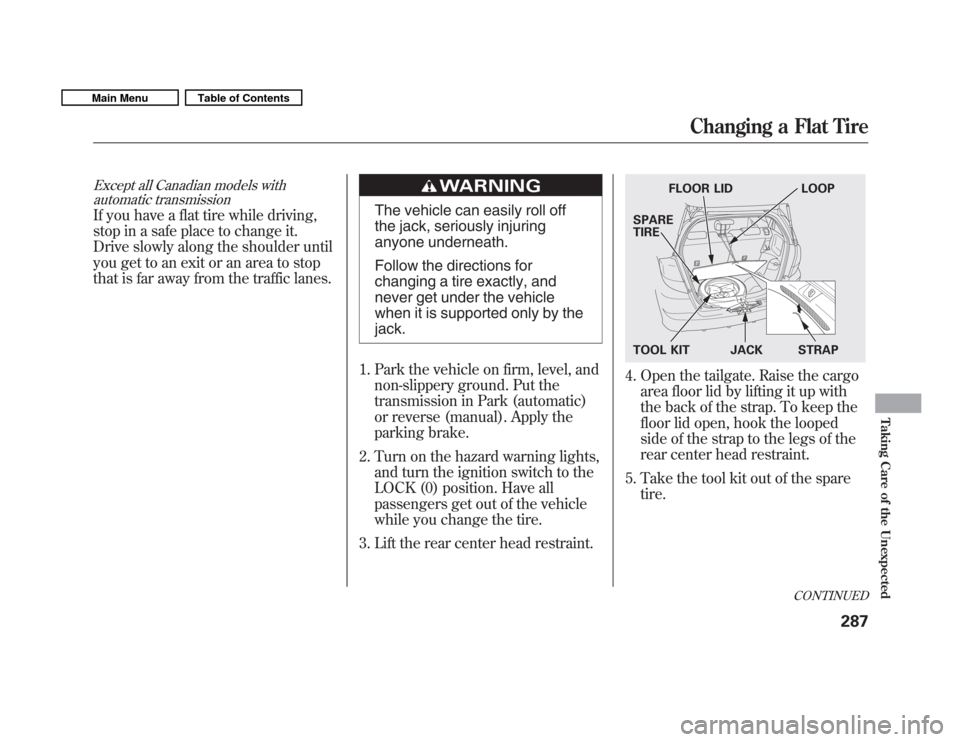
4. Open the tailgate. Raise the cargo area floor lid by lifting it up with
the back of the strap. To keep the
floor lid open, hook the looped
side of the strap to the legs of the
rear center head restraint.
5. Take the tool kit out of the spare tire.
FLOOR LID LOOP
SPARE TIRE
TOOL KIT JACK STRAP
CONTINUED
Changing a Flat Tire
287
Taking Care of the Unexpected
Main MenuTable of Contents
Page 295 of 356
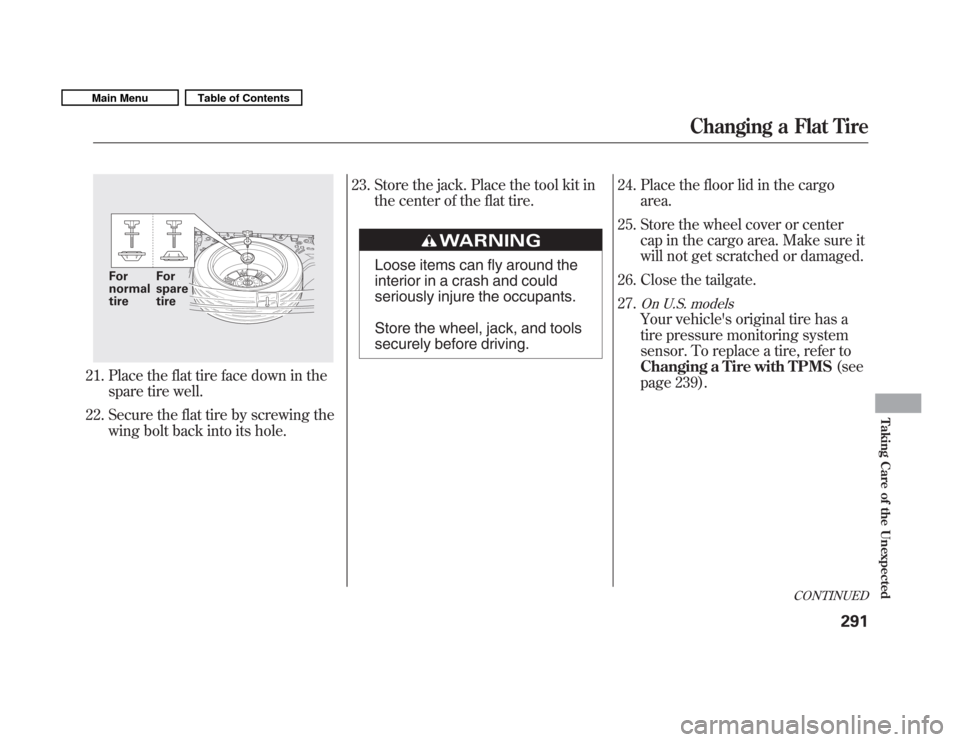
21. Place the flat tire face down in thespare tire well.
22. Secure the flat tire by screwing the wing bolt back into its hole. 23. Store the jack. Place the tool kit in
the center of the flat tire.
Loose items can fly around the
interior in a crash and could
seriously injure the occupants.
Store the wheel, jack, and tools
securely before driving. 24. Place the floor lid in the cargo
area.
25. Store the wheel cover or center cap in the cargo area. Make sure it
will not get scratched or damaged.
26. Close the tailgate. 27.
On U.S. models
Your vehicle's original tire has a
tire pressure monitoring system
sensor. To replace a tire, refer to
Changing a Tire with TPMS (see
page 239).
For normal tire For spare tire
CONTINUED
Changing a Flat Tire
291
Taking Care of the Unexpected
Main MenuTable of Contents
Page 298 of 356
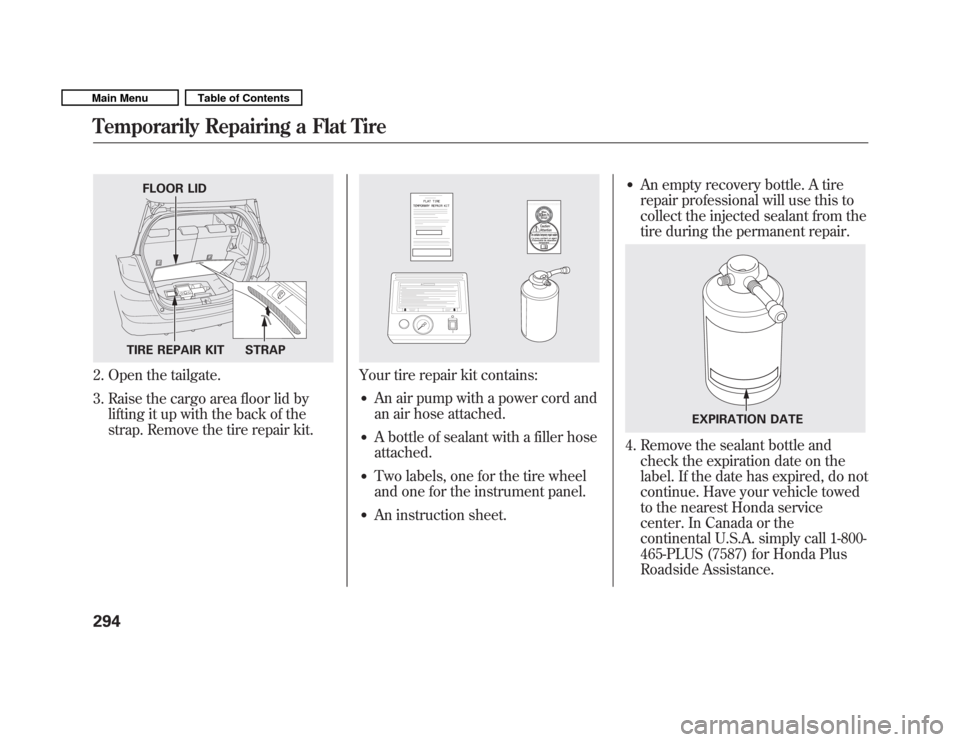
2. Open the tailgate.
3. Raise the cargo area floor lid bylifting it up with the back of the
strap. Remove the tire repair kit.Your tire repair kit contains:
An air pump with a power cord and
an air hose attached.
A bottle of sealant with a filler hose attached.
Two labels, one for the tire wheel
and one for the instrument panel.
An instruction sheet.
An empty recovery bottle. A tire
repair professional will use this to
collect the injected sealant from the
tire during the permanent repair.
4. Remove the sealant bottle and
check the expiration date on the
label. If the date has expired, do not
continue. Have your vehicle towed
to the nearest Honda service
center. In Canada or the
continental U.S.A. simply call 1-800-
465-PLUS (7587) for Honda Plus
Roadside Assistance.
FLOOR LID
TIRE REPAIR KIT STRAP
EXPIRATION DATE
Temporarily Repairing a Flat Tire
294
Main MenuTable of Contents
Page 347 of 356
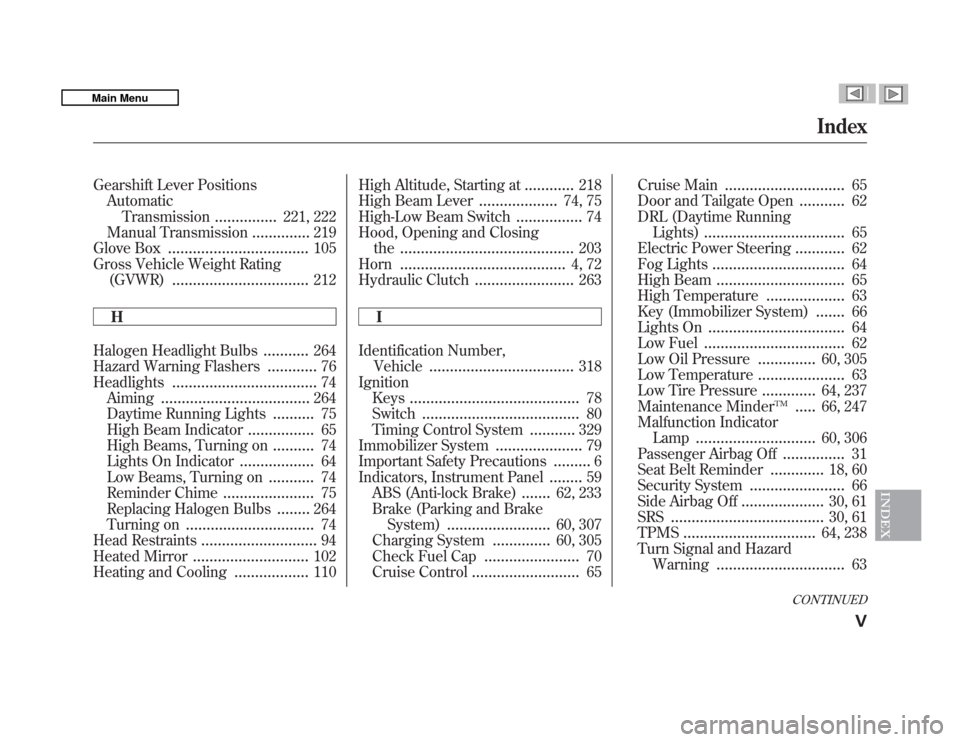
Gearshift Lever PositionsAutomatic
Transmission ...............221, 222
Manual Transmission ..............219
Glove Box .................................. 105
Gross Vehicle Weight Rating (GVWR) ................................. 212
H
Halogen Headlight Bulbs ...........264
Hazard Warning Flashers ............76
Headlights ................................... 74
Aiming .................................... 264
Daytime Running Lights ..........75
High Beam Indicator ................65
High Beams, Turning on ..........74
Lights On Indicator ..................64
Low Beams, Turning on ...........74
Reminder Chime ......................75
Replacing Halogen Bulbs ........264
Turning on ............................... 74
Head Restraints ............................ 94
Heated Mirror ............................ 102
Heating and Cooling ..................110High Altitude, Starting at
............
218
High Beam Lever ...................74, 75
High-Low Beam Switch ................74
Hood, Opening and Closing
the .......................................... 203
Horn ........................................ 4, 72
Hydraulic Clutch ........................263
IIdentification Number, Vehicle ................................... 318
Ignition Keys ......................................... 78
Switch ...................................... 80
Timing Control System ...........329
Immobilizer System .....................79
Important Safety Precautions .........6
Indicators, Instrument Panel ........59
ABS (Anti-lock Brake) .......62, 233
Brake (Parking and Brake System) ......................... 60, 307
Charging System ..............60, 305
Check Fuel Cap .......................70
Cruise Control .......................... 65Cruise Main
.............................
65
Door and Tailgate Open ...........62
DRL (Daytime Running Lights) .................................. 65
Electric Power Steering ............62
Fog Lights ................................ 64
High Beam ............................... 65
High Temperature ...................63
Key (Immobilizer System) .......66
Lights On ................................. 64
Low Fuel .................................. 62
Low Oil Pressure ..............60, 305
Low Temperature .....................63
Low Tire Pressure .............64, 237
Maintenance Minder
TM..... 66, 247
Malfunction Indicator
Lamp ............................. 60, 306
Passenger Airbag Off ...............31
Seat Belt Reminder .............18, 60
Security System .......................66
Side Airbag Off ....................30, 61
SRS ..................................... 30, 61
TPMS ................................ 64, 238
Turn Signal and Hazard Warning ............................... 63
CONTINUED
Index
V
INDEX
Main Menu
Page 351 of 356

Seat Under Box.......................... 106
Security System .........................194
Security System Indicator ............66
Sensors
Driver's Seat Position Sensor ...26
Front Passenger's Weight Sensors ................................ 26
Impact Sensors ........................22
Serial Number ............................ 318
Service Intervals .........................247
Service Manual (U.S. only) ........337
Service Station Procedures ........201
Setting the Clock ........................193
Shifting the Automatic Transmission .......................... 221
Shift Lever Position Indicators ...221
Shift Lock Release ......................225
Side Airbags ................................. 28
How the Side Airbag Off Indicator Works ...................30
How Your Side Airbags Work ..28
Side Curtain Airbags ....................29
How Your Side Curtain Airbags
Work .................................... 29
Side Marker Lights, Bulb Replacement in .......................265Signaling Turns
............................ 63
Snow Tires ................................. 280
Spare Tire .................................. 286
Inflating ........................... 275, 286
Specifications .......................... 322
Spark Plugs ................................ 320
Specifications ............................. 320
Speed Control ............................ 195
Speed Limiter ......................220, 224
Speedometer ................................ 68
SRS, Additional Information .........22
Additional Safety Precautions ...33
Airbag Service .......................... 32
Airbag System Components .....22
How the Side Airbag Off
Indicator Works ...................30
How the SRS Indicator Works ..30
How Your Front Airbags Work .................................... 24
How Your Side Airbags Work ..28
How Your Side Curtain Airbags Work .................................... 29
SRS Indicator ......................... 30, 61
START (Ignition Key Position) .....80 Starting the Engine
....................
218
In Cold Weather at High
Altitude ................................ 218
With a Dead Battery ................301
State Emissions Testing .............331
Steam Coming from Engine .......303
Steering Wheel Adjustments ............................. 77
Anti-theft Column Lock ............80
Buttons ........................... 190, 195
Storing Your Vehicle ..................283
Sun Visor ................................... 106
Supplemental Restraint
System .............................. 9, 22
Servicing .................................. 32
SRS Indicator ...................... 30, 61
System Components ................22
Synthetic Oil .............................. 256
T
Tachometer .................................. 68
Tailgate ........................................ 88
Open Indicator ......................... 62
Opening the ............................. 88
CONTINUED
Index
IX
INDEX
Main Menu