Page 204 of 333

203
Driving
When Driving Shifting
Shift Lever Operation
■ Shift Lever Operation
NOTICE
Before you move the shift lever from to and
vice versa, come to a complete stop and keep the brake pedal depressed.Operating the shift lever before the vehicle has come to a complete standstill can damage the transmission. Use the shift lever position indicator to check the lever position before pulling away. Whichever position the shift lever is in when driving, a blinking
indicator indicates a
transmission problem. Avoid sudden acceleration and have the transmission checked by a dealer as soon as possible. The fuel supply may be cut off if you drive at engine speeds in or over the tachometer red zone (engine speed limit). If this happens, you may experience a slight jolt. It may not be possible to operate the shift lever if the brake pedal is applied while the shift lever release button is held down.Depress the brake pedal irst.
Shift Lever Position Indicator
Tachometer's Red Zone
M (7-Speed Manual Shift Mode) Indicator/Shift Indicator
Depress the brake pedal and press the shift lever release button to shift.
Shift without pressing the shift lever release button.
Press the shift lever release button and shift. P
R
N D
Main MenuTable of Contents
Page 205 of 333

204
Driving
When Driving Shifting
7-Speed Manual Shift Mode
■
Use the paddle shifters to change between first and seventh speeds without removing your hands from the steering wheel. The transmission switches to the 7-speed manual shift mode when you pull a paddle shifter while driving. This mode is useful when engine braking is needed. You can cancel this mode by pressing any of the three driving mode buttons, or pulling the
paddle shifter for a few seconds.
When the Driving Mode is in ECON or NORMAL
■
The shift mode goes into the 7-speed manual shift mode temporarily, and the number is displayed in the shift indicator.The 7-speed manual shift mode is canceled automatically if you drive at constant speed or accelerate, and the number in the shift indicator goes off.The 7-speed manual shift mode is especially useful when reducing the vehicle speed temporarily before making a turn.
When the Driving Mode is in SPORT
■
The shift mode goes into the 7-speed manual shift mode. The
M indicator and the
speed number are displayed in the shift indicator. As the vehicle speed slows down, the transmission automatically shifts down accordingly. When the vehicle comes to a stop, it automatically shifts down into first. If the vehicle speed increases and the engine speed reaches near the tachometer’s red zone, the transmission automatically shifts up.
7-Speed Manual Shift Mode
To improve fuel economy, the transmission may shift up to a higher speed than the seventh under certain circumstances. In this case, the number in the shift indicator remains as "7." In the 7-speed manual shift mode, the transmission
shifts up or down by operating either paddle shifte r
under the following conditions:Shift Up: The engine speed reaches the lowest threshold of the higher speed position.Shift Down: The engine speed reaches the highest threshold of the lower speed position. When the engine speed reaches near the tachometer’s red zone, the transmission shifts up automatically.When the engine speed reaches the lowest threshold of the selected speed position, the transmission shifts down automatically. Operating the paddle shifters on slippery surfaces may cause the tires to lock up. In this case, the 7-speed manual shift mode is canceled and goes back to the normal D driving mode.
Main MenuTable of Contents
Page 207 of 333
206
Driving
When Driving Shifting
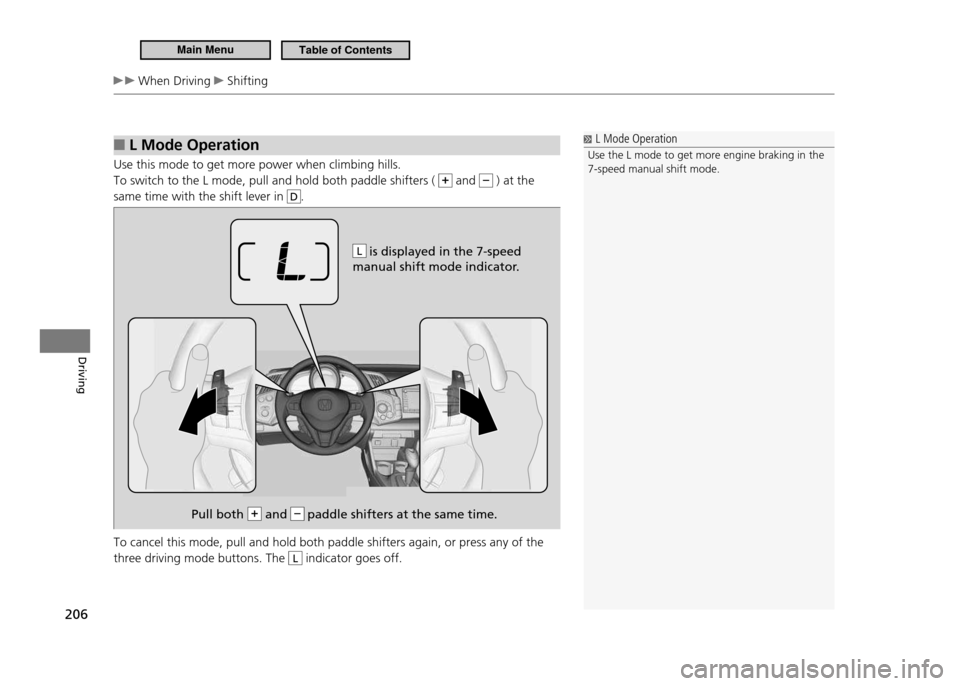
L Mode Operation
■
Use this mode to get more power when climbing hills. To switch to the L mode, pull and hold both paddle shifters (
and ) at the
same time with the shift lever in
D.
To cancel this mode, pull and hold both paddle shifters again, or press any of the three driving mode buttons. The
L indicator goes off.
L Mode Operation
Use the L mode to get more engine braking in the 7-speed manual shift mode.
is displayed in the 7-speed
manual shift mode indicator.
Pull both + and – paddle shifters at the same time.
L
Main MenuTable of Contents
Page 208 of 333

207
Driving
When Driving Shifting
Shifting
Manual transmission model
Shift Lever Operation
■
Fully depress the clutch pedal to operate the shift lever and change gears, then slowly release the pedal. Depress the clutch pedal, and pause for a few seconds before shifting into
R, or
shift into one of the forward gears for a moment. This stops the gears so they won’t “grind.”
When you are not shifting, do not rest your foot on the clutch pedal. This can cause your clutch to wear out faster.
Shifting
NOTICE
Do not shift to before the vehicle comes to a
complete stop. Shifting to
before stopping can damage the
transmission. Recommended Shift Points Driving in the highest gear that allows the engine to run and accelerate smoothly helps to optimize fuel economy and emissions control. The following shift points are recommended:
Shift Up Normal Acceleration
1st to 2nd 15 mph (24 km/h)
2nd to 3rd 25 mph (40 km/h) 3rd to 4th 40 mph (64 km/h)
4th to 5th 47 mph (76 km/h)
5th to 6th 52 mph (84 km/h)
If you exceed the maximum speed for the gear you are in, the engine speed will enter into the tachometer's red zone. When this happens, you may experience a slight jolt.
NOTICE Before downshifting, make sure the engine will not go into the tachometer's red zone.Should this occur, it can severely damage your engine. There is a metallic part on the shift lever. If you leave the vehicle parked outside for a long time on a hot day, be careful before moving the shift lever. Because of heat, the shift lever may be extremely hot. If the outside temperature is low, the shift lever feels cold.
Main MenuTable of Contents
Page 209 of 333
208
Driving
When Driving Shifting
Shift Up/Down Indicators
■
Come on to indicate when a gear change is appropriate to maintain the most fuel efficient driving style.
The shift up indicator: Comes on when shifting up is recommended.The shift down indicator: Comes on when shifting down is recommended.
The indicators do not come on in the SPORT
mode.
Shift Up/Down Indicators
This indicator will not prompt you to downshift to increase engine braking. It is up to you to downshift to increase engine braking when driving downhill. Always shift down at the appropriate vehicle speed.The shift down indicator does not come on when downshifting from
to .
Ambient meter color may change if you do not change gears when a shift indicator illuminates. This can result in a change in fuel economy. Road and trafic conditions may require you to shift at times other than those indicated.
Main MenuTable of Contents
Page 210 of 333
209
Driving
When Driving Shifting
Reverse Lockout
■
The manual transmission has a lockout mechanism that stops you from accidentally shifting into
R from a forward gear while the vehicle is moving at a certain speed.
If you cannot shift to
R when the vehicle is stopped, do the following: 1. Depress the clutch pedal, move the shift lever all the way to the left, and shift to
R.
If you still cannot shift into
2.
R, apply the
parking brake, and turn the ignition switch to ACCESSORY
I or LOCK 0.
Depress the clutch pedal and shift into
3.
R.
Keep depressing the clutch pedal and start
4.
the engine.
Have the vehicle checked by a dealer if you have to go through this procedure repeatedly.
Main MenuTable of Contents
Page 211 of 333
210
Driving
When Driving 3-Mode Drive System
3-Mode Drive System Driving mode is in NORMAL when you turn the ignition switch to ON
II.
To change driving modes, press the desired mode button. The corresponding mode indicator comes on in the instrument panel, and the mode icon appears briefly on the multi-information display. 3-Mode Drive System
To keep the system in the ECON mode the next
time the ignition switch is turned to ON
, change
the customized setting on the multi-information display.
Customized Features P. 9 0
The ECON mode helps you improve your fuel economy by changing the engine, transmission, climate control system, cruise control, and IMA system performances. While in the ECON mode, the climate control system has greater temperature luctuations.
�Ù Select a driving mode
and press the button.
�Ù The selected driving mode
indicator comes on.
SPORT Mode Button NORMAL Mode Button ECON Mode Button
Main MenuTable of Contents
Page 215 of 333

214
Driving
When Driving VSA®
(Vehicle Stability Assist), aka ESC (Electronic Stability Control), System
VSA ®
(Vehicle Stability Assist), aka ESC (Electronic
Stability Control), System VSA ®
helps to stabilize the vehicle during cornering if the vehicle turns more or less
than what was intended. It also assists in maintaining traction on slippery surfaces. It does so by regulating engine output and selectively applying the brakes.
VSA
■®
Operation
When VSA®
activates, you may notice that the
engine does not respond to the accelerator. You may also notice some noise from the hydraulic system. You will also see the indicator blink.
VSA ®
(Vehicle Stability Assist), aka ESC (Electronic
Stability Control), System
The VSA ®
may not function properly if tire type and
size are mixed. Make sure to use the same size and type of tire, and the air pressures as speciied. When the VSA ®
indicator comes on and stays on
while driving, there may be a problem with the system. While this may not interfere with normal driving, have your vehicle checked by a dealer immediately. VSA ®
cannot enhance stability in all driving
situations and does not control the entire braking system. You still need to drive and corner at speeds appropriate for the conditions and always leave a suficient margin of safety. The main function of the VSA ®
system is generally
known as Electronic Stability Control (ESC). The system also includes a traction control function.
VSA ®
System
Indicator
Main MenuTable of Contents