Page 115 of 445
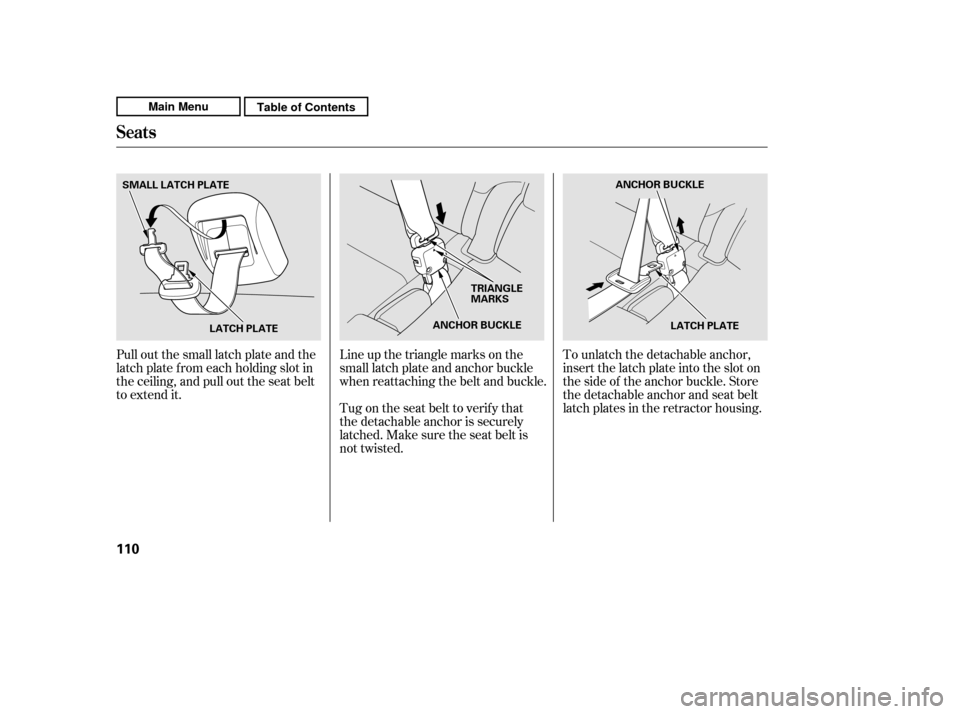
Pull out the small latch plate and the
latch plate f rom each holding slot in
the ceiling, and pull out the seat belt
to extend it.Line up the triangle marks on the
small latch plate and anchor buckle
when reattaching the belt and buckle.
Tug on the seat belt to verify that
the detachable anchor is securely
latched. Make sure the seat belt is
not twisted.To unlatch the detachable anchor,
insert the latch plate into the slot on
the side of the anchor buckle. Store
the detachable anchor and seat belt
latch plates in the retractor housing.
Seats
110
TRIANGLE
MARKS
ANCHOR BUCKLE
SMALL LATCH PLATE
LATCH PLATE LATCH PLATE
ANCHOR BUCKLE
Main MenuTable of Contents
Page 126 of 445
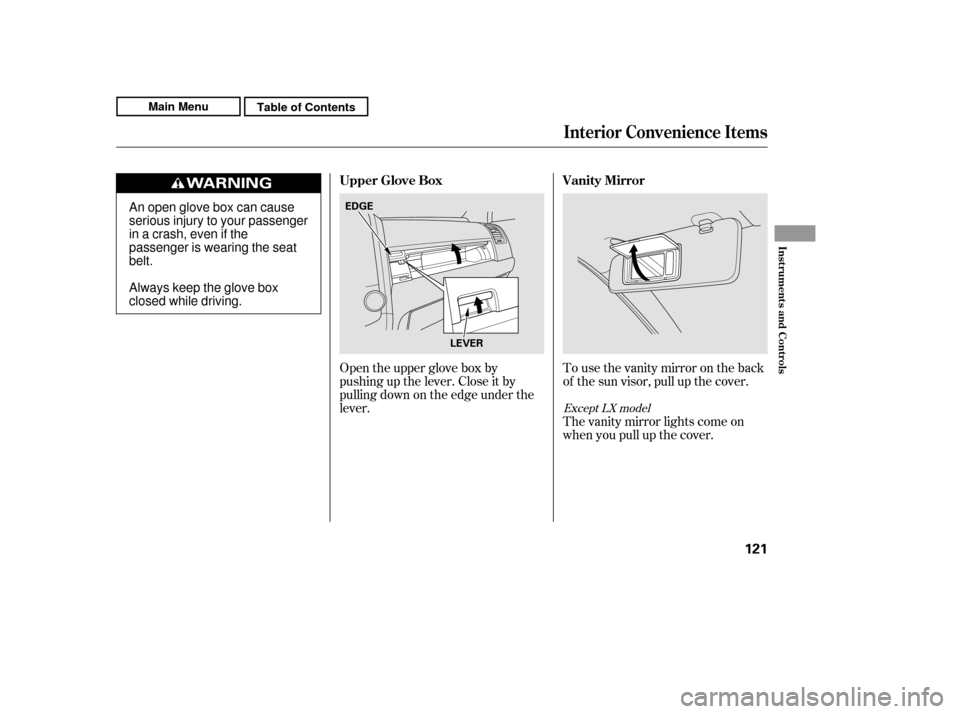
To use the vanity mirror on the back
of the sun visor, pull up the cover.
Open the upper glove box by
pushing up the lever. Close it by
pulling down on the edge under the
lever.
The vanity mirror lights come on
when you pull up the cover.
Except LX model
Vanity Mirror
Upper Glove Box
Interior Convenience Items
Inst rument s and Cont rols
121
EDGE
LEVERAn open glove box can cause
serious injury to your passenger
inacrash,evenifthe
passenger is wearing the seatbelt.
Always keep the glove box
closed while driving.
Main MenuTable of Contents
Page 318 of 445
Check the adjustment of the
inside and outside mirrors (see
page ).
Check the steering wheel
adjustment (see page ).
Fasten your seat belt. Check that
your passengers have f astened
their seat belts (see page ).
Make sure the doors and the
tailgate are securely closed and
locked.
Youshoulddothefollowingchecks
and adjustments bef ore you drive
your vehicle.
Make sure all windows, mirrors,
and outside lights are clean and
unobstructed. Remove f rost, snow,
or ice.
Check that the hood is f ully closed.
Visually check the tires. If a tire
looks low, use a gauge to check its
pressure.
Check that any items you may be
carrying are stored properly or
f astened down securely. When you start the engine, check
the gauges and indicators in the
instrument panel (see pages to
).
Check the seat adjustment (see
pages and ).
1. 2.
10.
3. 4. 5. 6. 7. 8. 9.
114
81
15
68 61
97 98
Preparing to Drive
Driving
313
Main MenuTable of Contents
Page 341 of 445

To avoid loss of control or rollover,
be sure to f ollow all precautions and
recommendations.
If you decide to drive on unpaved
roads, you will f ind that it requires
somewhat dif f erent driving skills.
Your vehicle will also handle
somewhat dif f erently than it does on
pavement. So be sure to read this
owner’s manual, pay special attention
to the precautions and tips in this
section, and get acquainted with
your vehicle before you leave the
pavement.
Your vehicle has been designed
primarily f or use on pavement. But
its higher ground clearance allows
you to occasionally travel on unpaved
roads, such as campgrounds, picnic
sites, and similar locations. It is not
designed f or trail-blazing, mountain
climbing, or other challenging of f -
road activities.
Be sure to store cargo properly
and do not exceed your cargo load
limits (see page and ).
Wherever you drive, make sure
you and your passengers always
wear seat belts.
Keep your speed low, and never
go faster than the conditions allow.
It’s up to you to continually assess
the situation and drive within the
limits.305 330
General Inf ormation
Important Saf ety Precautions
Of f -Highway Driving Guidelines
336
Follow all instructions and
guidelines in this owner’smanual.
Keep your speed low, and
don’t drive faster than
conditions permit.
Improperly operating this
vehicle on or off pavement can
cause a crash or rollover in
which you and your passengers
could be seriously injured orkilled.
Main MenuTable of Contents
Page 344 of 445

This section explains why it is
important to keep your vehicle well
maintained and how to f ollow basic
maintenance saf ety precautions.
This section also includes
instructions on how to read the
Maintenance Minder messages on
the information display, and
instructions f or simple maintenance
tasks you may want to take care of
yourself .
If you have the skills and tools to
perf orm more complex maintenance
tasks on your vehicle, you may want
to purchase the service manual. See
page f or inf ormation on how to
obtain a copy, or see your dealer.U.S. Vehicles:
......................
Maintenance Saf ety . 340
.................
Maintenance Minder . 341
..............................
Fluid Locations . 348
........................
Adding Engine Oil . 349
Changing the Engine Oil and
...........................................
Filter . 350
..............................
Engine Coolant . 352
....................
Windshield Washers . 354
....
Automatic Transmission Fluid . 355
.................
Rear Dif f erential Fluid . 357
....................................
Brake Fluid . 357
....................
Power Steering Fluid . 358
.............................................
Lights . 359
................
Cleaning the Seat Belts . 365
.....................................
Floor Mats . 366
..............................
Audio Antenna . 366
..................
Dust and Pollen Filter . 366
.................................
Wiper Blades . 367
...............................................
Tires . 370
...........................................
Wheels . 376
...................
Checking the Battery . 376
.............................
Vehicle Storage . 378
..................................
Interior Care . 379
425
Maintenance
Maintenance, replacement, or
repair of emissions control
devices and systems may be done
by any automotive repair
establishment or individual using
parts that are ‘‘certif ied’’ to EPA
standards.
Maint enance
339
TM
Main Menu
Page 352 of 445

�Î
�Î �Î
�Ì �Ì
�Î
�Ì �Î
Maintenance Minder
347
:
TM
See information on maintenance and emissions warranty on page .
Inspect idle speed every 160,000 miles (256,000 km).
Adjust the valves during services A, B, 1, 2, or 3 only if they are noisy.
If the message ‘‘SERVICE’’ does not appear more than 12 months after the
display is reset, change the engine oil every year.
Independent of the Maintenance Minder information, replace the brake
fluid every 3 years.
NOTE:
4WD
346
1:
2:
Maintenance Sub Items
Rotate tires
Replace air cleaner element
If you drive in dusty conditions, replace every
15,000 miles (24,000 km).
Replace dust and pollen filter If you drive primarily in urban areas that have high
concentrations of soot in the air from industry and
from diesel-powered vehicles, replace every 15,000
miles (24,000 km).
Inspect drive belt
Replace transmission fluid If you tow a CR-V behind a motorhome, the
transmission fluid must be changed every 2 years
or 30,000 miles (48,000 km), whichever comes first.
Replace spark plugs
Inspect valve clearance
Replace engine coolant
Replace rear differential fluid
Maintenance Main Items
Replace engine oil
Replace engine oil and oil filter
Inspect front and rear brakes
Check parking brake adjustment
Inspect these items: Tie rod ends, steering gear box, and boots
Suspension components
Driveshaft boots
Brake hoses and lines (including ABS/VSA)
All fluid levels and condition of fluids
Exhaust system
Fuel lines and connections
AB
Symbol
Symbol
12 3 4 5 6
2
1 1
Maintenance Minder
Main MenuTable of Contents
Page 370 of 445
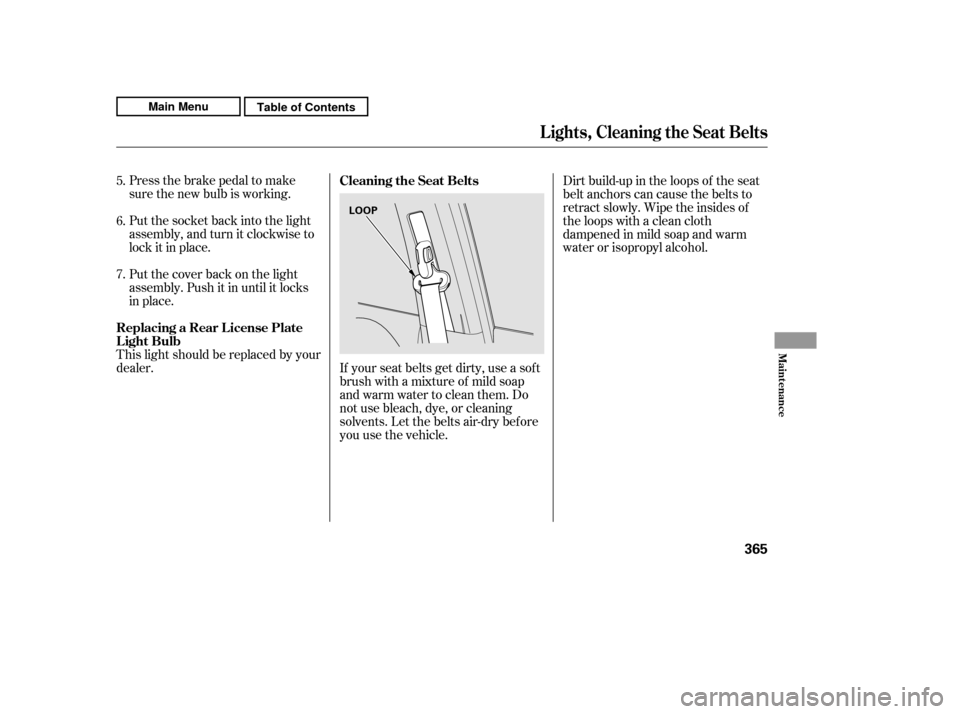
If your seat belts get dirty, use a sof t
brush with a mixture of mild soap
and warm water to clean them. Do
not use bleach, dye, or cleaning
solvents. Let the belts air-dry bef ore
you use the vehicle.
Press the brake pedal to make
sure the new bulb is working.
Put the socket back into the light
assembly, and turn it clockwise to
lock it in place.
Put the cover back on the light
assembly. Push it in until it locks
in place.
Dirt build-up in the loops of the seat
belt anchors can cause the belts to
retract slowly. Wipe the insides of
the loops with a clean cloth
dampened in mild soap and warm
water or isopropyl alcohol.
This light should be replaced by your
dealer.
5. 6. 7.
Cleaning the Seat Belts
Replacing a Rear License Plate
Light Bulb
Lights, Cleaning the Seat Belts
Maint enance
365
LOOP
Main MenuTable of Contents
Page 428 of 445

�µ�µ
�µ
�µ �µ
�µ
�µ
�µ
Your new vehicle is covered by these
warranties:
provides prorated
coverage f or a replacement battery
purchased f rom your dealer.
provides
coverageforaslongasthepur-
chaser of the muf f ler owns the
vehicle.
a seat
belt that f ails to f unction properly is
covered by a limited warranty.
Please read your warranty booklet
f or details.
covers all Honda
replacement parts against defects in
materials and workmanship.
Honda accessories are covered
under this warranty. Time and
mileage limits depend on the type of
accessory and other f actors. Please
read your warranty booklet f or
details. all exterior body panels are
covered f or rust-through f rom the
inside f or the specif ied time period
with no mileage limit.
covers your new vehicle, except f or
the emissions control systems and
accessories, against def ects in
materials and workmanship.
these two
warranties cover your vehicle’s
emissions control systems. Time,
mileage, and coverage are
conditional. Please read your
warranty booklet f or exact
inf ormation. Restrictions and exclusions apply to
all these warranties. Please read the
2011 Honda warranty inf ormation
booklet that came with your vehicle
f or precise inf ormation on warranty
coverages. Your vehicle’s original
tires are covered by their
manuf acturer. Tire warranty
inf ormation is in a separate booklet.
Please ref er to the 2011 warranty
manual that came with your vehicle.
U.S. Owners
Canadian Owners
Replacement Bat t ery L imit edWarranty
Replacement Muf f ler L if et imeLimited Warranty
Seat Belt Limited Warranty
Replacement Part s L imit edWarranty
Accessory Limited Warranty
Rust Perf orat ion L imit ed Warrant y
New Vehicle L imit ed Warrant y
Emissions Cont rol Syst ems Def ect sWarrant y and Emissions
Perf ormance Warranty
Warranty Coverages
Warrant y and Cust omer Relat ions
423
Main MenuTable of Contents