Page 66 of 445
�Î
�Î�Î
The U.S. instrument panel is shown. Dif f erences f or the Canadian models are noted in the tex
t.
:
Instrument Panel
Inst rument s and Cont rols
61
MAINTENANCE MINDER INDICATOR
CRUISE CONTROL INDICATOR
LIGHTS ON INDICATOR
(P.65) (P.63)(P.64)
(P.63)
TPMS INDICATOR
IMMOBILIZER SYSTEM INDICATOR
VSA OFF INDICATOR
DOOR AND TAILGATE
OPEN INDICATOR
(P.62, 396) LOW TIRE PRESSURE INDICATORCRUISE MAIN INDICATOR
DAYTIME RUNNING LIGHTS
INDICATOR
ANTI-LOCK BRAKE SYSTEM
INDICATOR
VEHICLE STABILITY ASSIST
(VSA) SYSTEM INDICATOR
(P.64)
(P.65)
MALFUNCTION INDICATOR LAMP
HIGH BEAM INDICATOR
LOW FUEL
INDICATOR
(P.65)
LOW OIL PRESSURE
INDICATOR
(P.62, 394)
CHARGING SYSTEM INDICATOR
PARKING BRAKE AND BRAKE SYSTEM
INDICATOR
SECURITY SYSTEM INDICATOR
(P.67, 264)
(P.67)
(P.66)
(P.62, 395)
(P.65)
(P.62, 394)
(P.64)(P.64)(P.66)
(P.66) (P.62)
SIDE AIRBAG OFF
INDICATOR
(P.63)
SEAT BELT
REMINDER
INDICATOR
SUPPLEMENTAL
RESTRAINT SYSTEM
INDICATOR
(P.63)
Main MenuTable of Contents
Page 67 of 445

The instrument panel has many
indicators that give you important
inf ormation about your vehicle.
See page .
If this indicator comes on when the
engine is running, the battery is not
being charged. For more inf ormation,
see page .
The engine can be severely damaged
if this indicator f lashes or stays on
when the engine is running. For
more inf ormation, see page . This indicator comes on when you
turn the ignition switch to the ON
(II) position. It reminds you and your
passengers to f asten your seat belts.
A beeper also sounds if you have not
f astened your seat belt.
If you turn the ignition switch to the
ON (II) position bef ore f astening
your seat belt, the beeper sounds,
and the indicator f lashes. If you do
notfastenyourseatbeltbeforethe
beeper stops, the indicator stops
f lashing but remains on.
If your f ront passenger does not
f asten their seat belt, the indicator
comes on about 6 seconds af ter the
ignition switch is turned to the ON
(II) position.
This indicator has two f unctions:
Itcomesonwhenyouturnthe
ignition switch to the ON (II)
position. It is a reminder to check
the parking brake. A beeper
sounds if you drive with the
parking brake not f ully released.
Driving with the parking brake not
fully released can damage the
brakes and tires.
If it stays on after you have fully
released the parking brake while
the engine is running, or if it
comes on while driving, there
could be a problem with the brake
system. For more inf ormation, see
page .
2.
1.
395
394
394 396
Malf unction Indicator
Lamp
L ow Oil Pressure
Indicator
Charging System
Indicator
Seat Belt Reminder
Indicator
Parking Brake and
Brake System
Indicator
Instrument Panel Indicators
62
U.S. Canada
Main MenuTable of Contents
Page 68 of 445

If either of you do not f asten your
seat belt while driving, the beeper
will sound and the indicator will f lash
again at regular intervals. For more
inf ormation, see page .This indicator normally comes on f or
a f ew seconds when you turn the
ignition switch to the ON (II)
position, and when the ignition
switch is turned to the START (III)
position. If it comes on at any other
time, there is a problem in the ABS.
If this happens, have your vehicle
checked by your dealer. With the
indicator on, your vehicle still has
normal braking ability but no anti-
lock. For more inf ormation, see page
.
This indicator comes on brief ly when
you turn the ignition switch to the
ON (II) position. If it comes on at
any other time, it indicates that the
passenger’s side airbag has
automatically shut off. For more
inf ormation, see page .
This indicator comes on brief ly when
you turn the ignition switch to the
ON (II) position. It will then go of f if
you have inserted a properly coded
ignition key. If it is not a properly
coded key, the indicator will blink,
and the engine’s f uel system will be
disabled (see page ).
This indicator comes on brief ly when
you turn the ignition switch to the
ON (II) position. If it comes on at
any other time, it indicates a
potential problem with your f ront
airbags. This indicator will also alert
you to a potential problem with your
airbag system components. For
more inf ormation, see page . 19
32
83 322
32
Instrument Panel Indicators
Supplemental Restraint
System Indicator Anti-lock Brake System
(A BS) Indicator
Immobilizer System
Indicator Side Airbag Of f
Indicator
Inst rument s and Cont rols
63
Canada
U.S.
Main MenuTable of Contents
Page 104 of 445
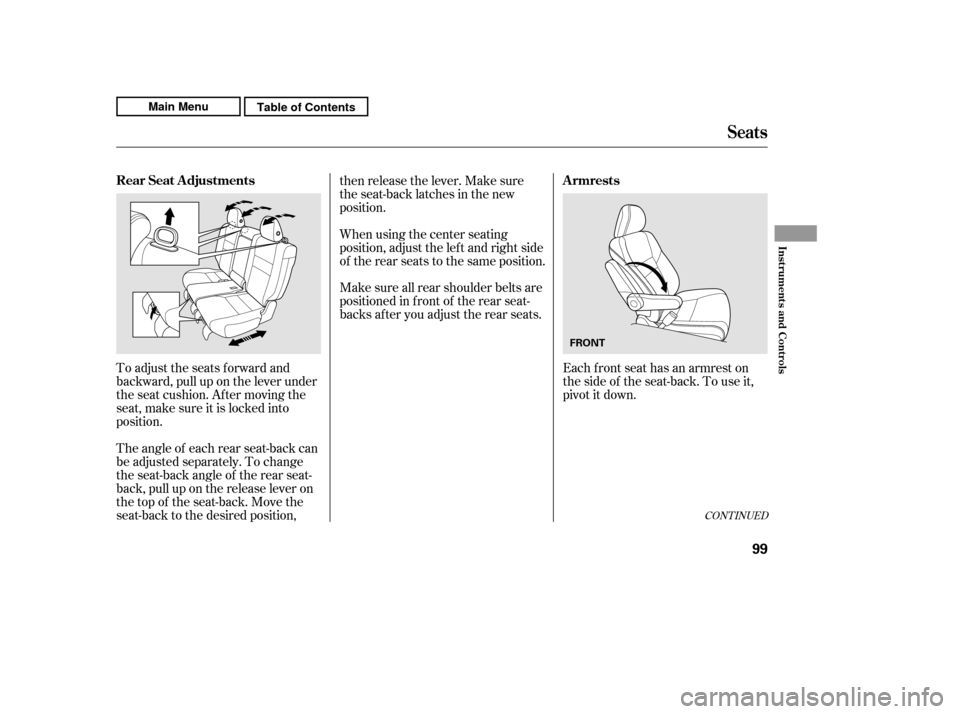
Each front seat has an armrest on
thesideof theseat-back.Touseit,
pivotitdown.
To adjust the seats forward and
backward, pull up on the lever under
the seat cushion. Af ter moving the
seat, make sure it is locked into
position.
The angle of each rear seat-back can
be adjusted separately. To change
the seat-back angle of the rear seat-
back, pull up on the release lever on
the top of the seat-back. Move the
seat-back to the desired position, then release the lever. Make sure
the seat-back latches in the new
position.
Make sure all rear shoulder belts are
positioned in f ront of the rear seat-
backs af ter you adjust the rear seats.
When using the center seating
position, adjust the lef t and right side
of the rear seats to the same position.
CONT INUED
Armrests
Rear Seat Adjustments
Seats
Inst rument s and Cont rols
99
FRONT
Main MenuTable of Contents
Page 108 of 445
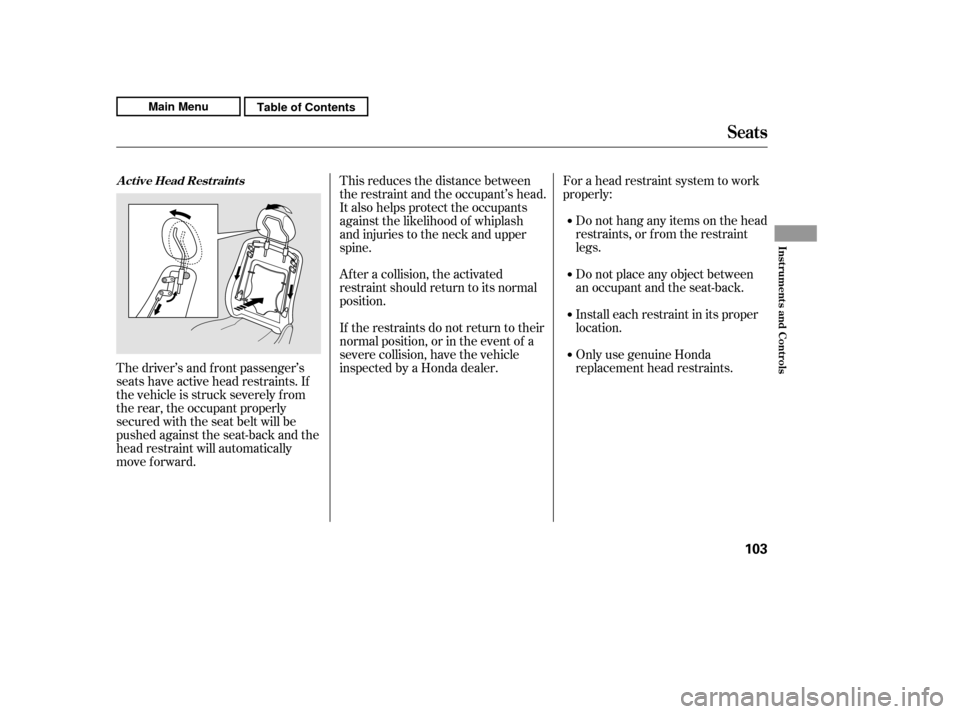
The driver’s and f ront passenger’s
seats have active head restraints. If
the vehicle is struck severely f rom
the rear, the occupant properly
secured with the seat belt will be
pushed against the seat-back and the
head restraint will automatically
move f orward.For a head restraint system to work
properly:
Do not hang any items on the head
restraints, or f rom the restraint
legs.
Do not place any object between
an occupant and the seat-back.
Install each restraint in its proper
location.
Only use genuine Honda
replacement head restraints.
If the restraints do not return to their
normal position, or in the event of a
severe collision, have the vehicle
inspected by a Honda dealer.
Af ter a collision, the activated
restraint should return to its normal
position.
This reduces the distance between
the restraint and the occupant’s head.
It also helps protect the occupants
against the likelihood of whiplash
and injuries to the neck and upper
spine.
A ct ive Head Rest raint s
Seats
Inst rument s and Cont rols
103
Main MenuTable of Contents
Page 110 of 445
Each rear seat-back can be folded
down separately to give more cargo
room. With either of the outer seat-
backs f olded-down, you can still
carry a passenger in the rear seat.
With the center seat-back folded-
down, either outer seating position
can be used.
You can also fold up the left or right
side of the rear seats separately to
create f urther cargo space (see page).
Remove any items from the seat
before folding down the seat-back. Push the seat belt buckles into the
seat cushion.
When you are f olding the rear center
seat-back, use the latch plate to
release the center seat belt from the
detachable anchor (see page ).
Allow the seat belt to retract into the
holder on the ceiling and store the
buckles in it.
Make sure the rear seat armrest is
stored.
1.
107
109
CONT INUED
Folding the Rear Seats Down
Seats
Inst rument s and Cont rols
105
LATCH PLATE
BUCKLE
Main MenuTable of Contents
Page 111 of 445

Reverse this procedure to return the
seat-back to the upright position.
Make sure the seat is secured and
the seat belt is in f ront of the seat-
back bef ore driving.
In the rear center seating position,
be sure the detachable anchor is
latched securely (see page ).Make sure that the f olded down rear
seat does not interf ere with the f ront
passenger’s seat-back. This will
cause the f ront passenger’s weight
sensors and the f ront passenger’s
seat belt reminder indicator to work
improperly (see page ). Also
check the passenger airbag of f
indicator to assure proper operation
of the passenger’s f ront airbag (see
page ).
Do not put any heavy items on the
seat-back when it is folded down. Fold the seat-back forward.
Pull up the release lever on the top
of the seat-back.
Lower the rear center head
restraint to its lowest position.
Push the button located next to
each rear outer head restraint to
pivot the head restraint down.
2. 3. 4. 109
19
33
Seats
106
RELEASE LEVER
Main MenuTable of Contents
Page 114 of 445

Make sure that the f olded up right
rear seat does not interf ere with the
f ront passenger’s seat-back. This will
cause the f ront passenger’s weight
sensors and the f ront passenger’s
seat belt reminder indicator to work
improperly (see page ). Also
check the passenger airbag of f
indicator to assure proper operation
of the passenger’s advanced f ront
airbag.
Reverse this procedure to return the
seat to the upright position.
Make sure the seat is securely
latched bef ore driving.
When you are not using the
fastening strap, store the strap into
the slit on the seat-back.Make sure both outer seat belts are
positioned in side of the rear seat-
backs.
Make sure all items in the cargo area
are secured. Loose items can f ly
f orward and cause injury if you have
to brake hard (See
on page ).
Do not use the dual deck cargo shelf
(if equipped) when the seats are
folded down or forward.
The seat belt in the rear center seat
is equipped with a detachable anchor.
This allows the center seat belt to be
unlatched when the rear center seat
back is f olded down or the right side
rear seat is f olded f orward.
In the center seating position of the
rear seat, be sure the detachable
anchor is latched securely bef ore
using the seat belt (see next column).
33
304
CONT INUED
Carrying CargoDetachable A nchor
Seats
Inst rument s and Cont rols
109
Using the seat belt with the
detachable anchor unlatched
increases the chance of serious
injury or death in a crash.
Before using the seat belt,
make sure the detachable
anchor is correctly latched.
Main MenuTable of Contents