Page 55 of 388

Your vehicle’s exhaust contains
carbon monoxide gas. Carbon
monoxide should not enter the
vehicle in normal driving if you
maintain your vehicle properly and
f ollow the inf ormation on this page.High levels of carbon monoxide can
collect rapidly in enclosed areas,
such as a garage. Do not run the
engine with the garage door closed.
Even with the door open, run the
engine only long enough to move the
vehicle out of the garage.If you must sit in your parked vehicle
with the engine running, even in an
unconf ined area, adjust the heating
and cooling system as f ollows:
Select the f resh air mode.
Select the mode.
Turn the f an on high speed.
Set the temperature control to a
comfortable setting.
With the trunk open, airf low can pull
exhaust gas into your vehicle’s
interior and create a hazardous
condition. If you must drive with the
trunk open, open all the windows,
and set the heating and cooling
system as shown below.
Have the exhaust system inspected
f or leaks whenever:
The vehicle is raised f or an oil
change.
You notice a change in the sound
of the exhaust.
The vehicle was in a collision that
may have damaged the underside. 1.2.3.4.
Carbon Monoxide Hazard
Driver and Passenger Saf ety
51
Carbon monoxide gas is toxic.
Breathing it can cause
unconsciousness and even killyou.
Avoid any enclosed areas or
activities that expose you to
carbon monoxide.
Main Menu
Page 59 of 388

This section gives inf ormation about
the controls and displays that
contribute to the daily operation of
your vehicle. All the essential
controls are within easy reach............................
Control Locations . 56
............................
Instrument Panel . 57
..........
Instrument Panel Indicators . 59
.............................................
Gauges . 66
..............
Display Change Button . 66
....................
Inf ormation Display . 67
..................................
Fuel Gauge . 70
...................
Temperature Gauge . 70
Controls Near the Steering ...........................................
Wheel . 71
.
Windshield Wipers and Washers . 72
.........
Turn Signals and Headlights . 73
............
Daytime Running Lights . 74
........................................
Fog Lights . 74
........
Instrument Panel Brightness . 75
.................
Hazard Warning Button . 76
.................
Rear Window Def ogger . 76
..........
Steering Wheel Adjustment . 77
...............................
Keys and Locks . 78
........................
Immobilizer System . 79
................................
Ignition Switch . 80
......................................
Door Locks . 81
......................
Power Door Locks . 82
..............
Childproof Door Locks . 82
.
Auto Door Locking/Unlocking . 83
.....................
Auto Door Locking . 83 .................
Auto Door Unlocking . 85
................................................
Trunk . 88
........
Emergency Trunk Opener . 89
.......................
Remote Transmitter . 90
.................................................
Seats . 93
..................................
Seat Heaters . 100
............................
Power Windows . 101
.......................................
Moonroof . 102
...........................................
Mirrors . 103
...............................
Parking Brake . 105
...............................
Interior Lights . 105
.........
Interior Convenience Items . 107
.....................
Beverage Holders . 108
.........
Accessory Power Socket . 108
..................................
Glove Box . 108
.............
Console Compartment . 108
Instruments and Controls
Inst rument s and Cont rols
55
Main Menu
Page 70 of 388
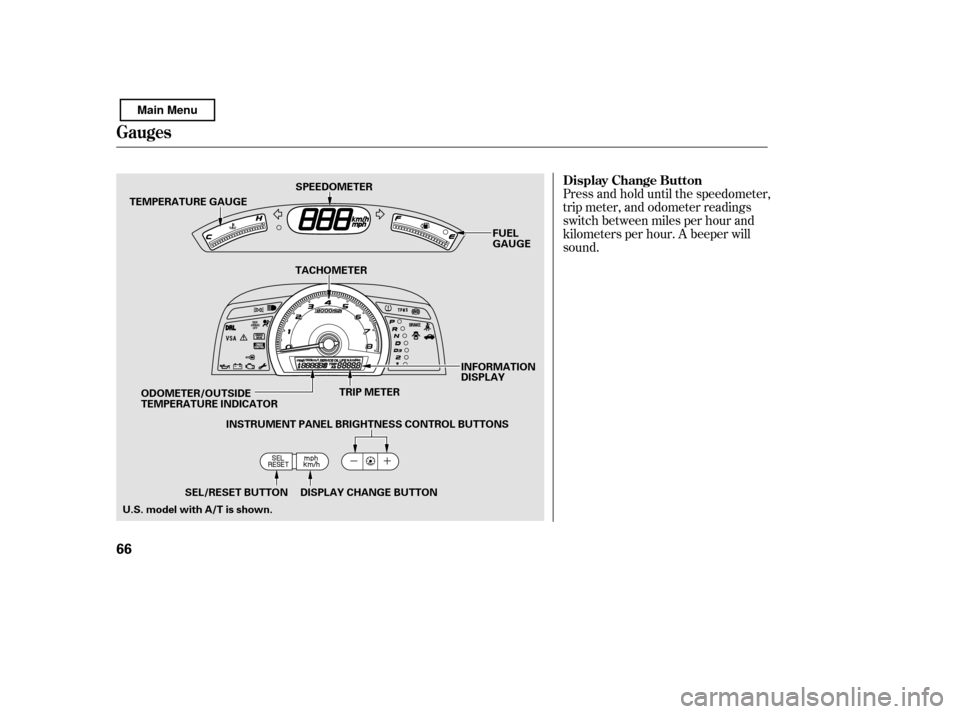
Press and hold until the speedometer,
trip meter, and odometer readings
switch between miles per hour and
kilometers per hour. A beeper willsound.
Gauges
Display Change Button
66
TEMPERATURE GAUGETRIP METER
SPEEDOMETER
FUEL
GAUGE
SEL/RESET BUTTON DISPLAY CHANGE BUTTON INFORMATION
DISPLAY
TACHOMETER
ODOMETER/OUTSIDE
TEMPERATURE INDICATOR INSTRUMENT PANEL BRIGHTNESS CONTROL BUTTONS
U.S. model with A/T is shown.
Main Menu
Page 71 of 388
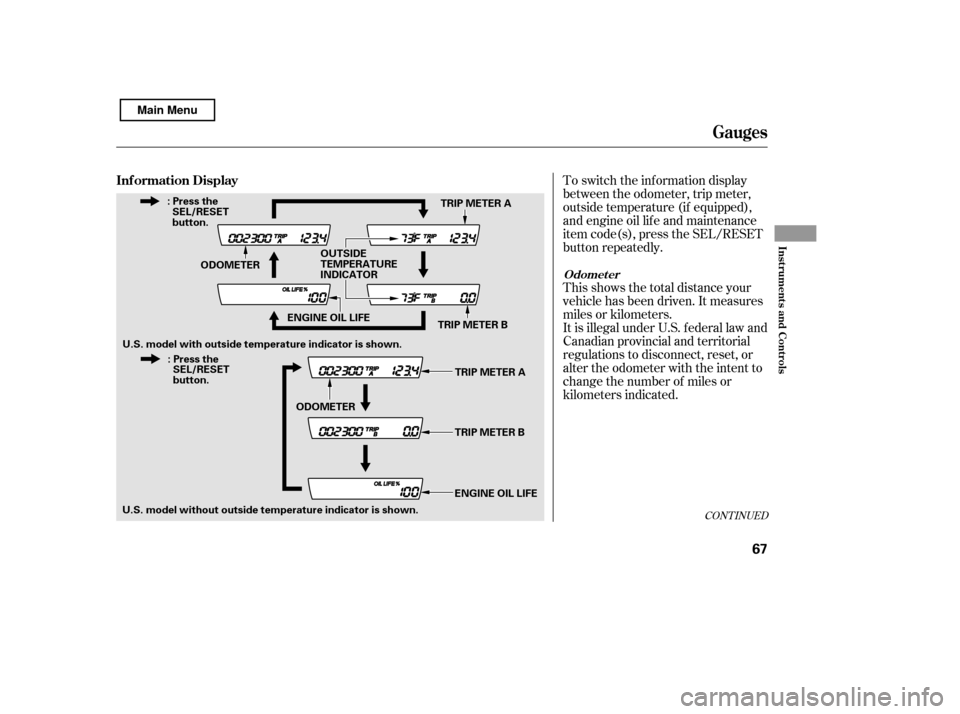
To switch the information display
between the odometer, trip meter,
outside temperature (if equipped),
and engine oil lif e and maintenance
item code(s), press the SEL/RESET
button repeatedly.
This shows the total distance your
vehicle has been driven. It measures
miles or kilometers.
It is illegal under U.S. f ederal law and
Canadian provincial and territorial
regulations to disconnect, reset, or
alter the odometer with the intent to
change the number of miles or
kilometers indicated.
CONT INUED
Gauges
Odomet er
Inf ormation Display
Inst rument s and Cont rols
67
U.S. model without outside temperature indicator is shown.ODOMETER
ODOMETER TRIP METER A
TRIP METER B
ENGINE OIL LIFE
TRIP METER A
U.S. model with outside temperature indicator is shown. ENGINE OIL LIFEOUTSIDE
TEMPERATURE
INDICATOR
TRIP METER B
: Press the
SEL/RESET
button.
: Press the SEL/RESET
button.
Main Menu
Page 72 of 388

�¶�¶�µ
�µ�µ�µ�µ �µ�µ�µ
Each trip meter works independently,
so you can keep track of two
dif f erent distances.
There are two trip meters: TRIP A
and TRIP B. Switch between these
displays by pressing the SEL/
RESET button repeatedly.
To reset a trip meter, display it, and
then press and hold the SEL/RESET
button until the number resets to‘‘0.0.’’
This meter shows the number of
miles or kilometers driven since you
last reset it.
This indicator displays the outside
temperature in Fahrenheit (U.S.
models) or Celsius (Canadian
models). To see the outside
temperature, press and release the
SEL/RESET button until the
temperature is shown on the
inf ormation display.If the outside temperature is
incorrectly displayed, you can adjust
it up to 5°F ( 3°C) warmer or
cooler.
The temperature must be
stabilized bef ore doing this
procedure.
Select the outside temperature
display, then press and hold the
SEL/RESET button f or 10 seconds.
The f ollowing sequence will appear
for1secondeach:0,1,2,3,4,5, 5, 4, 3, 2, 1, 0 (U.S.) or 0, 1, 2,
3, 3, 2, 1, 0 (Canada).
When it reaches the desired value,
release the SEL/RESET button. You
should see the new outside
temperature displayed.
In certain weather conditions,
temperature readings near f reezing
(32°F, 0°C) could mean that ice is
f orming on the road surf ace.
The temperature sensor is in the
f ront bumper. Theref ore, the
temperature reading can be af f ected
by heat ref lection f rom the road
surf ace, engine heat, and the
exhaust f rom surrounding traf f ic.
This can cause an incorrect
temperature reading when your
speed is under 19 mph (30 km/h).
The sensor delays the display update
until it reaches the correct outside
temperature. This may take several
minutes.
If equipped
Gauges
T rip Met er Out side T emperat ure Indicat or
68
NOTE:
Main Menu
Page 74 of 388
This shows how much f uel you have.
It may show slightly more or less
than the actual amount.This shows the temperature of the
engine’s coolant. During normal
operation, the reading should rise to
about the middle of the gauge. In
severe driving conditions, such as
very hot weather or a long period of
uphill driving, the reading may rise
intotheupperhalfofthegauge.Ifit
reaches the red (Hot) mark, pull
safely to the side of the road. See
page f or instructions and
precautions on checking the engine
cooling system.338
Gauges
Fuel Gauge T emperature Gauge
70
Avoid driving with an extremely low
f uel level. Running out of f uel could
cause the engine to misf ire, damaging
the catalytic converter.
Main Menu
Page 83 of 388

CONT INUED
If the system repeatedly does not
recognize the coding of your key,
contact your dealer.
Do not attempt to alter this system
or add other devices to it. Electrical
problems could result that may make
your vehicle inoperable.
If you have lost your key and cannot
start your engine, contact your
dealer.
These keys contain electronic
circuits that are activated by the
immobilizer system. They will not
work to start the engine if the
circuits are damaged.
Protect the keys f rom direct
sunlight, high temperature, and
high humidity.
Donotdropthekeysorsetheavy
objects on them.
Keep the keys away f rom liquids.
If they get wet, dry them
immediately with a sof t cloth. When you turn the ignition switch to
the ON (II) position, the immobilizer
system indicator should come on
brief ly, then go of f . If the indicator
starts to blink, it means the system
does not recognize the coding of the
key. Turn the ignition switch to the
LOCK (0) position, remove the key,
reinsert it, and turn the ignition
switch to the ON (II) position again.
The immobilizer system protects
your vehicle f rom thef t. If an
improperly coded key (or other
device) is used, the engine’s f uel
system is disabled.
The keys without a remote
transmitter do not contain batteries.
Do not try to take them apart. The system may not recognize your
key’s coding if another immobilizer
key or other metal object (i.e. key
chain) is near the ignition switch
when you insert the key.
Keys and Locks, Immobilizer System
Immobilizer System
Inst rument s and Cont rols
79
Always take the ignition key with you
whenever you leave the vehicle alone.
Main Menu
Page 95 of 388
Avoid dropping or throwing the
transmitter.
If you lose a transmitter, the
replacement needs to be
reprogrammed by your dealer.
Do not immerse the transmitter in
any liquid.
Protect the transmitter from
extreme temperature.
If it takes several pushes on the
button to lock or unlock the doors,
replace the battery as soon as
possible.
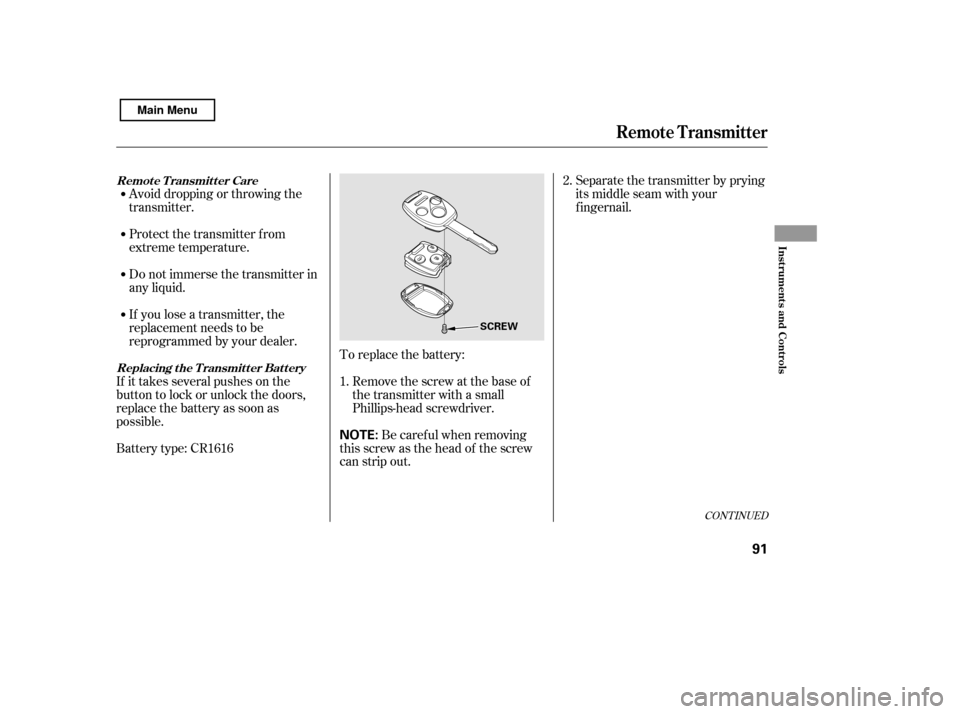
Battery type: CR1616 To replace the battery:
Remove the screw at the base of
the transmitter with a small
Phillips-head screwdriver. Be caref ul when removing
this screw as the head of the screw
can strip out. Separate the transmitter by prying
its middle seam with your
f ingernail.
1. 2.
CONT INUED
Remote Transmitter Care
Replacing the Transmitter Battery
Remote Transmitter
Inst rument s and Cont rols
91
NOTE:
SCREW
Main Menu